



SEQUENCES
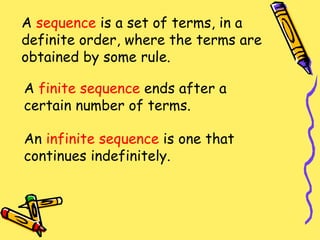
A  sequence  is a set of terms, in a definite order, where the terms are obtained by some rule. A  finite sequence  ends after a certain number of terms. An  infinite sequence  is one that continues indefinitely.
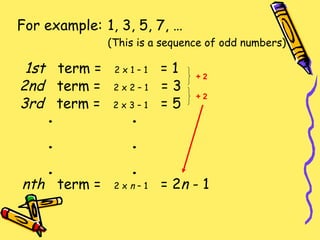
For example: 1, 3, 5, 7, … (This is a sequence of odd numbers) 1st   term =  2 x 1 – 1   = 1 2nd   term =  2 x 2 – 1   = 3 3rd   term =  2 x 3 – 1   = 5 nth   term =  2 x  n  – 1   = 2 n  - 1 . . . . . . + 2 + 2
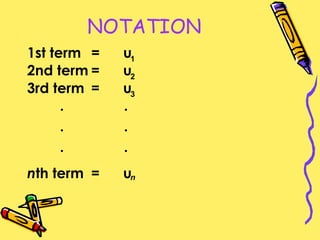
NOTATION 1st term = u 2nd term = u 3rd term = u n th term = u . . . . . . 1 2 3 n
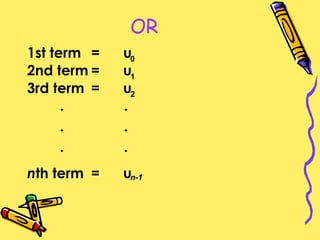
OR 1st term = u 2nd term = u 3rd term = u n th term = u . . . . . . 0 1 2 n-1
FINDING THE FORMULA FOR THE TERMS OF A SEQUENCE
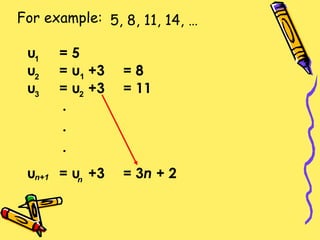
A  recurrence relation  defines the first term(s) in the sequence and the relation between successive terms.
u = 5 u = u  +3 = 8 u = u  +3 = 11 u = u  +3 = 3 n  + 2 . . . 1 2 3 n+1 For example: 5, 8, 11, 14, … 1 2 n
What to look for when looking for the rule defining a sequence
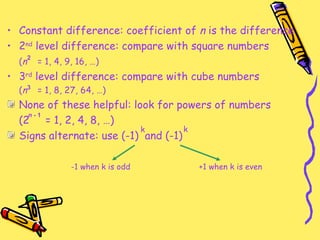
Constant difference: coefficient of  n  is the difference 2 nd  level difference: compare with square numbers ( n   = 1, 4, 9, 16, …) 3 rd  level difference: compare with cube numbers ( n   = 1, 8, 27, 64, …) None of these helpful: look for powers of numbers (2  = 1, 2, 4, 8, …) Signs alternate: use (-1)  and (-1) -1 when k is odd +1 when k is even k k 2 3 n  - 1
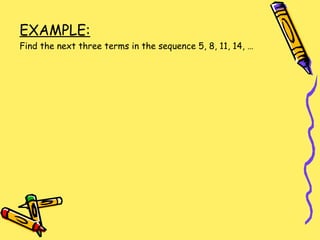
EXAMPLE:   Find the next three terms in the sequence 5, 8, 11, 14, …
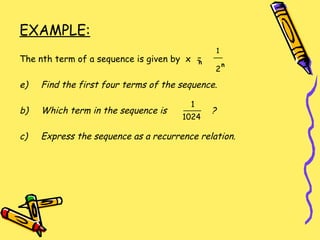
EXAMPLE:   The nth term of a sequence is given by  x  = Find the first four terms of the sequence. b) Which term in the sequence is ? c) Express the sequence as a recurrence relation.  1 __ 2 n n 1 1024 ____
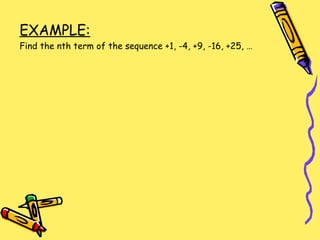
EXAMPLE:   Find the nth term of the sequence +1, -4, +9, -16, +25, …
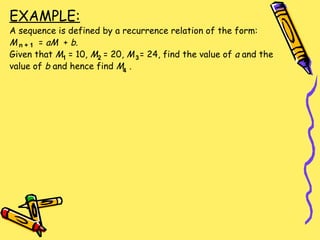
EXAMPLE:   A sequence is defined by a recurrence relation of the form: M   =  aM   +  b . Given that  M  = 10,  M   = 20,  M   = 24, find the value of  a  and the value of  b  and hence find  M   . n + 1 1 3 2 4

Sequences finding a rule

  • 1.
  • 2.
  • 3.
    A sequence is a set of terms, in a definite order, where the terms are obtained by some rule. A finite sequence ends after a certain number of terms. An infinite sequence is one that continues indefinitely.
  • 4.
    For example: 1,3, 5, 7, … (This is a sequence of odd numbers) 1st term = 2 x 1 – 1 = 1 2nd term = 2 x 2 – 1 = 3 3rd term = 2 x 3 – 1 = 5 nth term = 2 x n – 1 = 2 n - 1 . . . . . . + 2 + 2
  • 5.
    NOTATION 1st term= u 2nd term = u 3rd term = u n th term = u . . . . . . 1 2 3 n
  • 6.
    OR 1st term= u 2nd term = u 3rd term = u n th term = u . . . . . . 0 1 2 n-1
  • 7.
    FINDING THE FORMULAFOR THE TERMS OF A SEQUENCE
  • 8.
    A recurrencerelation defines the first term(s) in the sequence and the relation between successive terms.
  • 9.
    u = 5u = u +3 = 8 u = u +3 = 11 u = u +3 = 3 n + 2 . . . 1 2 3 n+1 For example: 5, 8, 11, 14, … 1 2 n
  • 10.
    What to lookfor when looking for the rule defining a sequence
  • 11.
    Constant difference: coefficientof n is the difference 2 nd level difference: compare with square numbers ( n = 1, 4, 9, 16, …) 3 rd level difference: compare with cube numbers ( n = 1, 8, 27, 64, …) None of these helpful: look for powers of numbers (2 = 1, 2, 4, 8, …) Signs alternate: use (-1) and (-1) -1 when k is odd +1 when k is even k k 2 3 n - 1
  • 12.
    EXAMPLE: Find the next three terms in the sequence 5, 8, 11, 14, …
  • 13.
    EXAMPLE: The nth term of a sequence is given by x = Find the first four terms of the sequence. b) Which term in the sequence is ? c) Express the sequence as a recurrence relation. 1 __ 2 n n 1 1024 ____
  • 14.
    EXAMPLE: Find the nth term of the sequence +1, -4, +9, -16, +25, …
  • 15.
    EXAMPLE: A sequence is defined by a recurrence relation of the form: M = aM + b . Given that M = 10, M = 20, M = 24, find the value of a and the value of b and hence find M . n + 1 1 3 2 4