A sequence is a
function whose domain
is the finite set {1,23,
…, n} or the infinite
set {1,2 ,3,…}.
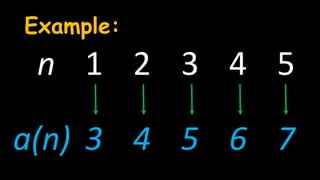
Example:
n 1 2 3 4 5
a(n) 3 4 5 6 7
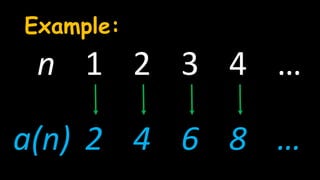
Example:
n 1 2 3 4 …
a(n) 2 4 6 8 …
Activity: Term
after TermFind the first five
terms of the sequence
given the nth term.
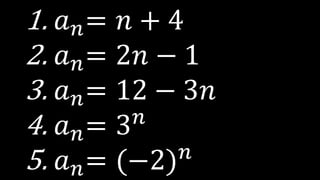
1. π‘Ž 𝑛= 𝑛 + 4
2. π‘Ž 𝑛= 2𝑛 βˆ’ 1
3. π‘Ž 𝑛= 12 βˆ’ 3𝑛
4. π‘Ž 𝑛= 3 𝑛
5. π‘Ž 𝑛= (βˆ’2) 𝑛
Activity: Getting to
Know You
What is the nth term
for each sequence
below?
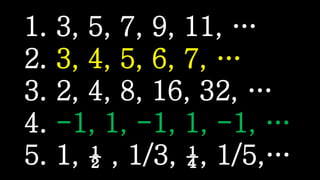
1. 3, 5, 7, 9, 11, …
2. 3, 4, 5, 6, 7, …
3. 2, 4, 8, 16, 32, …
4. -1, 1, -1, 1, -1, …
5. 1, Β½ , 1/3, ΒΌ, 1/5,…
ARITHMETIC
SEQUENCE
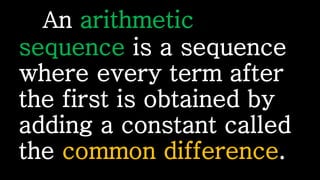
An arithmetic
sequence is a sequence
where every term after
the first is obtained by
adding a constant called
the common difference.
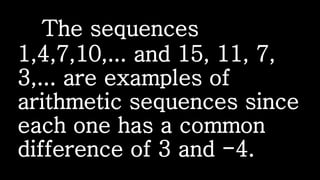
The sequences
1,4,7,10,... and 15, 11, 7,
3,... are examples of
arithmetic sequences since
each one has a common
difference of 3 and -4.
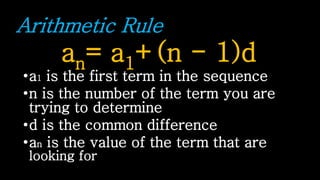
Arithmetic Rule
an= a1+(n - 1)d
β€’a1 is the first term in the sequence
β€’n is the number of the term you are
trying to determine
β€’d is the common difference
β€’an is the value of the term that are
looking for
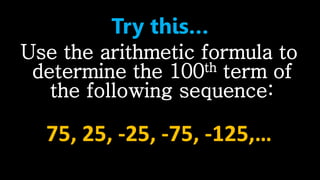
Try this…
Use the arithmetic formula to
determine the 100th term of
the following sequence:
75, 25, -25, -75, -125,…
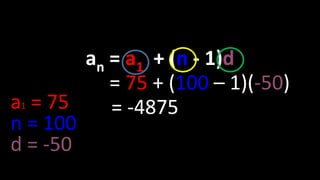
an = a1 + (n - 1)d
= 75 + (100 – 1)(-50)
= -4875a1 = 75
n = 100
d = -50
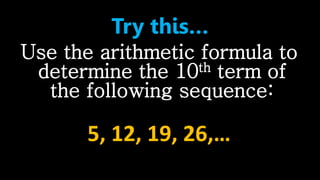
Try this…
Use the arithmetic formula to
determine the 10th term of
the following sequence:
5, 12, 19, 26,…
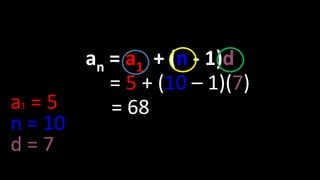
an = a1 + (n - 1)d
= 5 + (10 – 1)(7)
= 68a1 = 5
n = 10
d = 7
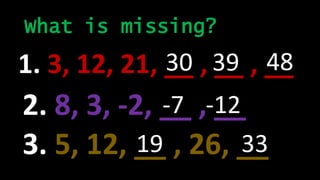
What is missing?
1. 3, 12, 21, __ , __ , __30 39 48
2. 8, 3, -2, __ , __-7 -12
3. 5, 12, __ , 26, __19 33
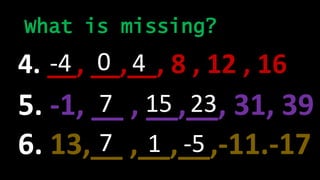
What is missing?
4. __, __,__, 8 , 12 , 16-4 0 4
5. -1, __ , __,__, 31, 397 15
6. 13,__ ,__,__,-11.-177 1
23
-5
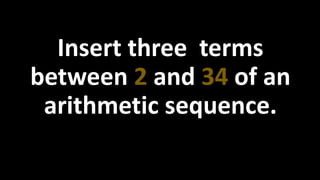
Insert three terms
between 2 and 34 of an
arithmetic sequence.
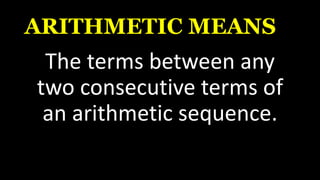
ARITHMETIC MEANS
The terms between any
two consecutive terms of
an arithmetic sequence.
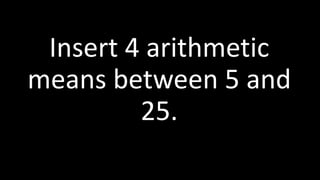
Insert 4 arithmetic
means between 5 and
25.
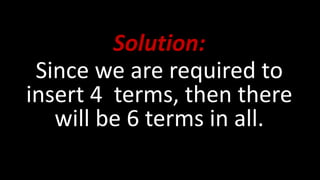
Solution:
Since we are required to
insert 4 terms, then there
will be 6 terms in all.
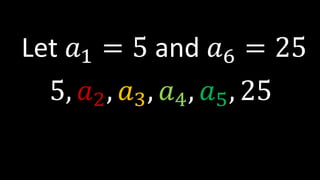
Let π‘Ž1 = 5 and π‘Ž6 = 25
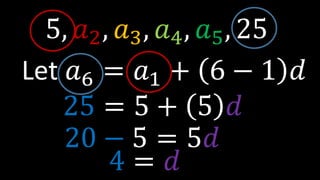
5, π‘Ž2, π‘Ž3, π‘Ž4, π‘Ž5, 25
Let π‘Ž6 = π‘Ž1 + 6 βˆ’ 1 𝑑
5, π‘Ž2, π‘Ž3, π‘Ž4, π‘Ž5, 25
25 = 5 + 5 𝑑
20 βˆ’ 5 = 5𝑑
4 = 𝑑
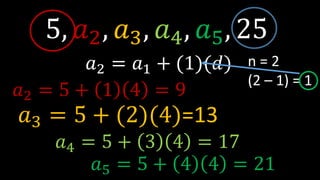
5, π‘Ž2, π‘Ž3, π‘Ž4, π‘Ž5, 25
π‘Ž2 = π‘Ž1 + (1)(𝑑) n = 2
(2 – 1) = 1
π‘Ž2 = 5 + 1 4 = 9
π‘Ž3 = 5 + (2)(4)=13
π‘Ž4 = 5 + 3 4 = 17
π‘Ž5 = 5 + 4 4 = 21
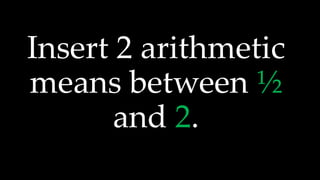
Insert 2 arithmetic
means between Β½
and 2.
ARITHMETIC SUM
Sum of the terms in an
arithmetic sequence.
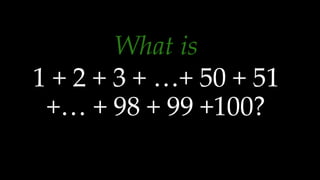
What is
1 + 2 + 3 + …+ 50 + 51
+… + 98 + 99 +100?
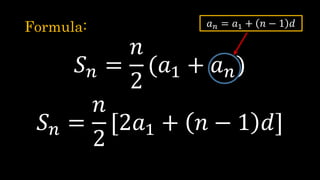
Formula:
𝑆 𝑛 =
𝑛
2
(π‘Ž1 + π‘Ž 𝑛)
𝑆 𝑛 =
𝑛
2
[2π‘Ž1 + 𝑛 βˆ’ 1 𝑑]
π‘Ž 𝑛 = π‘Ž1 + 𝑛 βˆ’ 1 𝑑
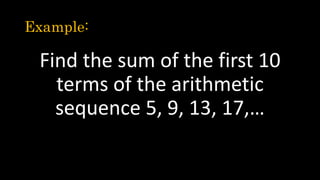
Example:
Find the sum of the first 10
terms of the arithmetic
sequence 5, 9, 13, 17,…
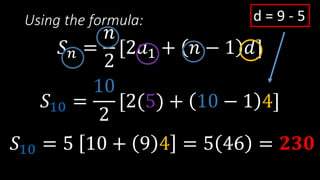
Using the formula:
𝑆 𝑛 =
𝑛
2
[2π‘Ž1 + 𝑛 βˆ’ 1 𝑑]
𝑆10 =
10
2
[2(5) + 10 βˆ’ 1 4]
d = 9 - 5
𝑆10 = 5 10 + 9 4 = 5 46 = πŸπŸ‘πŸŽ
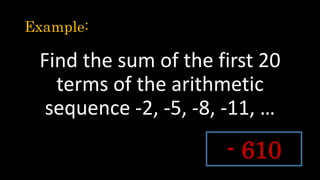
Example:
Find the sum of the first 20
terms of the arithmetic
sequence -2, -5, -8, -11, …
- 610
Activity:
How well do
you know me?
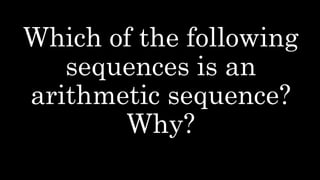
Which of the following
sequences is an
arithmetic sequence?
Why?
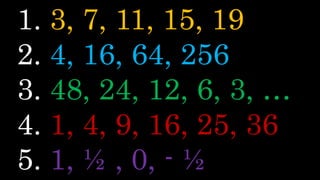
1. 3, 7, 11, 15, 19
2. 4, 16, 64, 256
3. 48, 24, 12, 6, 3, …
4. 1, 4, 9, 16, 25, 36
5. 1, Β½ , 0, - Β½
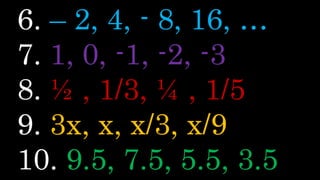
6. – 2, 4, - 8, 16, …
7. 1, 0, -1, -2, -3
8. Β½ , 1/3, ΒΌ , 1/5
9. 3x, x, x/3, x/9
10. 9.5, 7.5, 5.5, 3.5
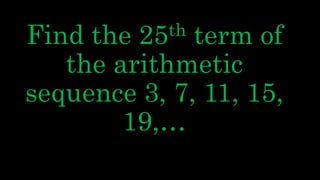
Find the 25th term of
the arithmetic
sequence 3, 7, 11, 15,
19,…
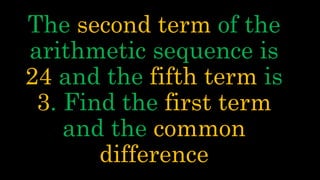
The second term of the
arithmetic sequence is
24 and the fifth term is
3. Find the first term
and the common
difference
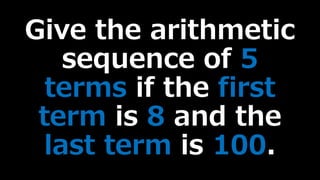
Give the arithmetic
sequence of 5
terms if the first
term is 8 and the
last term is 100.
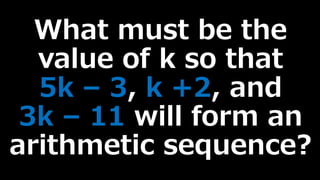
What must be the
value of k so that
5k – 3, k +2, and
3k – 11 will form an
arithmetic sequence?