Arithmetic Sequences
Section 1.3 Arithmetic Sequences

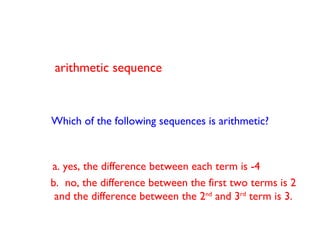
An arithmetic sequence is a sequence in which
 the difference between each term and the
      preceding term is always constant.
  Which of the following sequences is arithmetic?
               a. {14, 10, 6, 2, -2, -6, -10, . . . }
              b. {3, 5, 8, 12, 17, . . . }
  a. yes, the difference between each term is -4
  b. no, the difference between the first two terms is 2
   and the difference between the 2nd and 3rd term is 3.
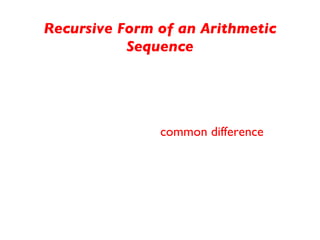
Recursive Form of an Arithmetic
                Sequence
                Un = Un-1 + d
        for some constant d and all n > 2

The number d is called the common difference of the
               arithmetic sequence.
Graph of an Arithmetic Sequence

•   If {Un} is an arithmetic sequence with U1 = 3
    and U2 = 4.5 as its first two terms,

    •    a. Find the common difference.

    •    b. Write the sequence as a recursive
            function.

    •    c. Give the first six terms of the sequence.

    •    d. Graph the sequence.
•
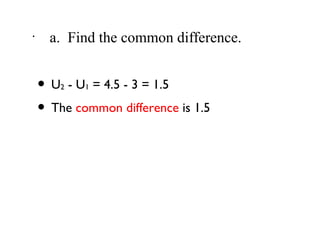
      a. Find the common difference.


    • U - U = 4.5 - 3 = 1.5
        2   1


    • The common difference is 1.5
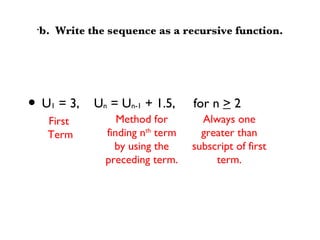
•   b. Write the sequence as a recursive function.


•U    1   = 3,   Un = Un-1 + 1.5,     for n > 2
     First            Method for        Always one
     Term          finding nth term     greater than
                     by using the     subscript of first
                   preceding term.         term.
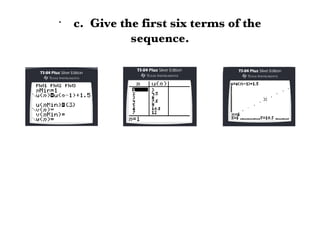
•   c. Give the first six terms of the
              sequence.
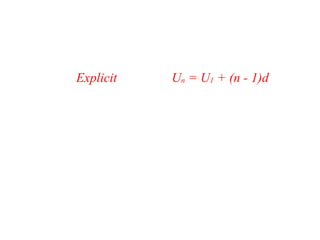
Explicit Form of an Arithmetic Sequence

 • In an arithmetic sequence {Un} with common
    difference d, Un = U1 + (n - 1)d for every n > 1

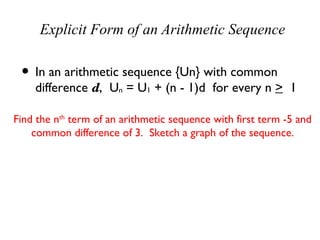
Find the nth term of an arithmetic sequence with first term -5 and
    common difference of 3. Sketch a graph of the sequence.

               Un = U1 + (n - 1)d
                   = -5 + (n - 1)3
                   = -5 + 3n - 3
                   = 3n - 8
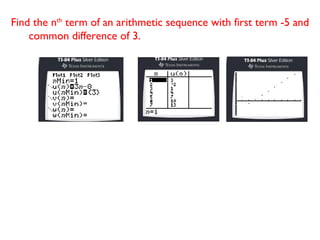
Find the nth term of an arithmetic sequence with first term -5 and
    common difference of 3. Sketch a graph of the sequence.
Finding a Term of an Arithmetic
                  Sequence
What is the 45th term of the arithmetic sequence whose first
                three terms are 5, 9, and 13?
     First find d; d = 9 - 5 = 4
     Second find explicit form: Un = 5 + (n - 1)4
                                Un = 4n + 1
     Then find 45th term: U45 = 4(45) + 1
                              U45 = 181
Finding Explicit and Recursive
                  Formulas
 If {Un} is an arithmetic sequence with U6 = 57 and
U10 = 93, find U1, a recursive formula, and an explicit
                    formula for Un.
To find d when given to non-consecutive terms use the formula:

                     d = Um --Un
                         m n

                     d = 93 -- 57
                         10 6
                                    =9
Finding U1
Select either of the given terms and substitute
   into Explicit formula. Un = U1 + (n - 1)d
  U6 = 57                   U10 = 93
57 = U1 + (6 - 1)9       93 = U1 + (10 - 1)9
   U1 = 12                  U1 = 12
FORMULAS
    Explicit Form        Recursive Form
  Un = U1 + (n - 1)d      Un = Un-1 + d

  Un = 12 + (n - 1)9     Un = Un-1 + 9, for n > 2

Un = 9n + 3, for n > 1

Arithmetic Sequences

  • 1.
  • 2.
    Section 1.3 ArithmeticSequences An arithmetic sequence is a sequence in which the difference between each term and the preceding term is always constant. Which of the following sequences is arithmetic? a. {14, 10, 6, 2, -2, -6, -10, . . . } b. {3, 5, 8, 12, 17, . . . } a. yes, the difference between each term is -4 b. no, the difference between the first two terms is 2 and the difference between the 2nd and 3rd term is 3.
  • 3.
    Recursive Form ofan Arithmetic Sequence Un = Un-1 + d for some constant d and all n > 2 The number d is called the common difference of the arithmetic sequence.
  • 4.
    Graph of anArithmetic Sequence • If {Un} is an arithmetic sequence with U1 = 3 and U2 = 4.5 as its first two terms, • a. Find the common difference. • b. Write the sequence as a recursive function. • c. Give the first six terms of the sequence. • d. Graph the sequence.
  • 5.
    a. Find the common difference. • U - U = 4.5 - 3 = 1.5 2 1 • The common difference is 1.5
  • 6.
    b. Write the sequence as a recursive function. •U 1 = 3, Un = Un-1 + 1.5, for n > 2 First Method for Always one Term finding nth term greater than by using the subscript of first preceding term. term.
  • 7.
    c. Give the first six terms of the sequence.
  • 8.
    Explicit Form ofan Arithmetic Sequence • In an arithmetic sequence {Un} with common difference d, Un = U1 + (n - 1)d for every n > 1 Find the nth term of an arithmetic sequence with first term -5 and common difference of 3. Sketch a graph of the sequence. Un = U1 + (n - 1)d = -5 + (n - 1)3 = -5 + 3n - 3 = 3n - 8
  • 9.
    Find the nthterm of an arithmetic sequence with first term -5 and common difference of 3. Sketch a graph of the sequence.
  • 10.
    Finding a Termof an Arithmetic Sequence What is the 45th term of the arithmetic sequence whose first three terms are 5, 9, and 13? First find d; d = 9 - 5 = 4 Second find explicit form: Un = 5 + (n - 1)4 Un = 4n + 1 Then find 45th term: U45 = 4(45) + 1 U45 = 181
  • 11.
    Finding Explicit andRecursive Formulas If {Un} is an arithmetic sequence with U6 = 57 and U10 = 93, find U1, a recursive formula, and an explicit formula for Un. To find d when given to non-consecutive terms use the formula: d = Um --Un m n d = 93 -- 57 10 6 =9
  • 12.
    Finding U1 Select eitherof the given terms and substitute into Explicit formula. Un = U1 + (n - 1)d U6 = 57 U10 = 93 57 = U1 + (6 - 1)9 93 = U1 + (10 - 1)9 U1 = 12 U1 = 12
  • 13.
    FORMULAS Explicit Form Recursive Form Un = U1 + (n - 1)d Un = Un-1 + d Un = 12 + (n - 1)9 Un = Un-1 + 9, for n > 2 Un = 9n + 3, for n > 1