SEQUENCE
and SERIES
What is a SEQUENCE?
 In mathematics, a sequence is an ordered list.
Like a set, it contains members (also
called elements, or terms). The number of
ordered elements (possibly infinite) is called
the length of the sequence. Unlike a set, order
matters, and exactly the same elements can
appear multiple times at different positions in
the sequence. Most precisely, a sequence
can be defined as a function whose domain
is a countable totally ordered set, such as
the natural numbers.
Source:
Wikipedia:http://en.wikipedia.org/wiki/Sequence
INFINITE SEQUENCE
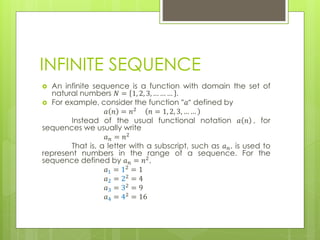
 An infinite sequence is a function with domain the set of
natural numbers 𝑁 = 1, 2, 3, … … … .
 For example, consider the function "𝑎“ defined by
𝑎 𝑛 = 𝑛2 𝑛 = 1, 2, 3, … …
Instead of the usual functional notation 𝑎 𝑛 , for
sequences we usually write
𝑎 𝑛 = 𝑛2
That is, a letter with a subscript, such as 𝑎 𝑛, is used to
represent numbers in the range of a sequence. For the
sequence defined by 𝑎 𝑛 = 𝑛2,
𝑎1 = 12
= 1
𝑎2 = 22
= 4
𝑎3 = 32
= 9
𝑎4 = 42
= 16
General or nth Term
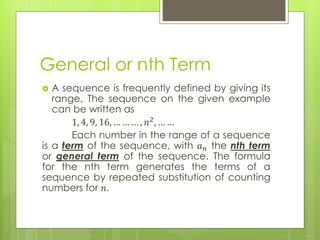
 A sequence is frequently defined by giving its
range. The sequence on the given example
can be written as
1, 4, 9, 16, … … … , 𝑛2
, … …
Each number in the range of a sequence
is a term of the sequence, with 𝑎 𝑛 the nth term
or general term of the sequence. The formula
for the nth term generates the terms of a
sequence by repeated substitution of counting
numbers for 𝑛.
FINITE SEQUENCE
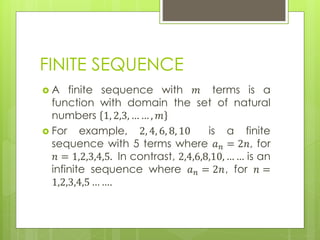
 A finite sequence with 𝑚 terms is a
function with domain the set of natural
numbers 1, 2,3, … … , 𝑚
 For example, 2, 4, 6, 8, 10 is a finite
sequence with 5 terms where 𝑎 𝑛 = 2𝑛, for
𝑛 = 1,2,3,4,5. In contrast, 2,4,6,8,10, … … is an
infinite sequence where 𝑎 𝑛 = 2𝑛, for 𝑛 =
1,2,3,4,5 … ….
Sample Problems
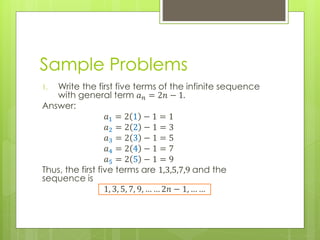
1. Write the first five terms of the infinite sequence
with general term 𝑎 𝑛 = 2𝑛 − 1.
Answer:
𝑎1 = 2 1 − 1 = 1
𝑎2 = 2 2 − 1 = 3
𝑎3 = 2 3 − 1 = 5
𝑎4 = 2 4 − 1 = 7
𝑎5 = 2 5 − 1 = 9
Thus, the first five terms are 1,3,5,7,9 and the
sequence is
1, 3, 5, 7, 9, … … 2𝑛 − 1, … …
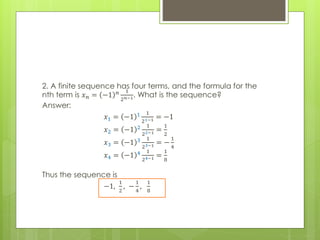
2. A finite sequence has four terms, and the formula for the
nth term is 𝑥 𝑛 = −1 𝑛 1
2 𝑛−1. What is the sequence?
Answer:
𝑥1 = −1 1 1
21−1 = −1
𝑥2 = −1 2 1
22−1 =
1
2
𝑥3 = −1 3 1
23−1 = −
1
4
𝑥4 = −1 4 1
24−1 =
1
8
Thus the sequence is
−1,
1
2
, −
1
4
,
1
8
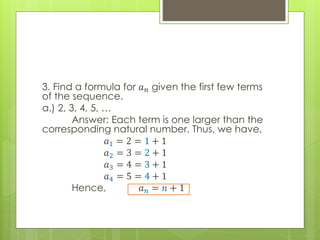
3. Find a formula for 𝑎 𝑛 given the first few terms
of the sequence.
a.) 2, 3, 4, 5, …
Answer: Each term is one larger than the
corresponding natural number. Thus, we have,
𝑎1 = 2 = 1 + 1
𝑎2 = 3 = 2 + 1
𝑎3 = 4 = 3 + 1
𝑎4 = 5 = 4 + 1
Hence, 𝑎 𝑛 = 𝑛 + 1
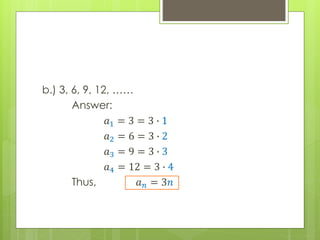
b.) 3, 6, 9, 12, ……
Answer:
𝑎1 = 3 = 3 ∙ 1
𝑎2 = 6 = 3 ∙ 2
𝑎3 = 9 = 3 ∙ 3
𝑎4 = 12 = 3 ∙ 4
Thus, 𝑎 𝑛 = 3𝑛
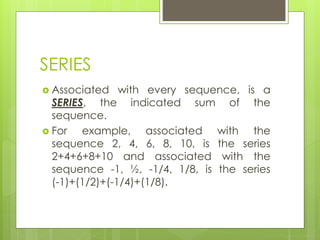
SERIES
 Associated with every sequence, is a
SERIES, the indicated sum of the
sequence.
 For example, associated with the
sequence 2, 4, 6, 8, 10, is the series
2+4+6+8+10 and associated with the
sequence -1, ½, -1/4, 1/8, is the series
(-1)+(1/2)+(-1/4)+(1/8).
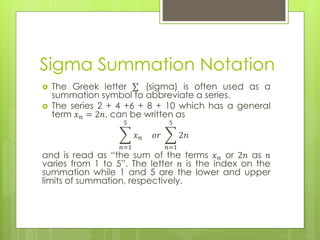
Sigma Summation Notation
 The Greek letter ∑ (sigma) is often used as a
summation symbol to abbreviate a series.
 The series 2 + 4 +6 + 8 + 10 which has a general
term 𝑥 𝑛 = 2𝑛, can be written as
𝑛=1
5
𝑥 𝑛 𝑜𝑟
𝑛=1
5
2𝑛
and is read as “the sum of the terms 𝑥 𝑛 or 2𝑛 as 𝑛
varies from 1 to 5”. The letter 𝑛 is the index on the
summation while 1 and 5 are the lower and upper
limits of summation, respectively.
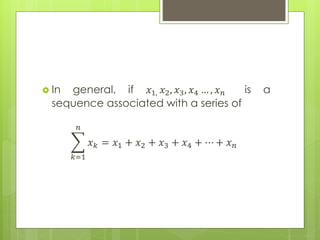
 In general, if 𝑥1, 𝑥2, 𝑥3, 𝑥4 … , 𝑥 𝑛 is a
sequence associated with a series of
𝑘=1
𝑛
𝑥 𝑘 = 𝑥1 + 𝑥2 + 𝑥3 + 𝑥4 + ⋯ + 𝑥 𝑛
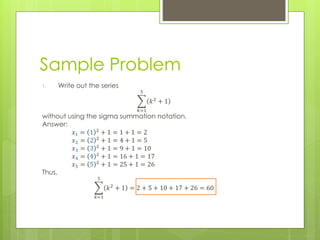
Sample Problem
1. Write out the series
𝑘=1
5
𝑘2
+ 1
without using the sigma summation notation.
Answer:
𝑥1 = 1 2
+ 1 = 1 + 1 = 2
𝑥2 = 2 2
+ 1 = 4 + 1 = 5
𝑥3 = 3 2
+ 1 = 9 + 1 = 10
𝑥4 = 4 2
+ 1 = 16 + 1 = 17
𝑥5 = 5 2
+ 1 = 25 + 1 = 26
Thus,
𝑘=1
5
𝑘2
+ 1 = 2 + 5 + 10 + 17 + 26 = 60
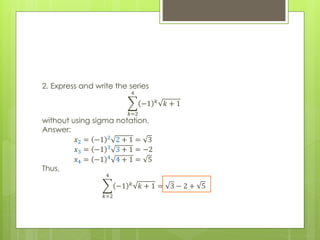
2. Express and write the series
𝑘=2
4
−1 𝑘
𝑘 + 1
without using sigma notation.
Answer:
𝑥2 = −1 2 2 + 1 = 3
𝑥3 = −1 3
3 + 1 = −2
𝑥4 = −1 4
4 + 1 = 5
Thus,
𝑘=2
4
−1 𝑘
𝑘 + 1 = 3 − 2 + 5
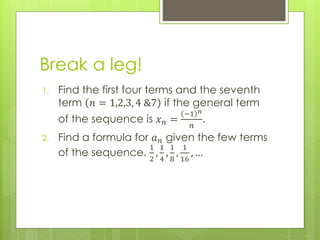
Break a leg!
1. Find the first four terms and the seventh
term 𝑛 = 1,2,3, 4 &7 if the general term
of the sequence is 𝑥 𝑛 =
−1 𝑛
𝑛
.
2. Find a formula for 𝑎 𝑛 given the few terms
of the sequence.
1
2
,
1
4
,
1
8
,
1
16
, …
THANK YOU VERY MUCH!!!
PROF. DENMAR ESTRADA MARASIGAN

Sequence and series

  • 1.
  • 2.
    What is aSEQUENCE?  In mathematics, a sequence is an ordered list. Like a set, it contains members (also called elements, or terms). The number of ordered elements (possibly infinite) is called the length of the sequence. Unlike a set, order matters, and exactly the same elements can appear multiple times at different positions in the sequence. Most precisely, a sequence can be defined as a function whose domain is a countable totally ordered set, such as the natural numbers. Source: Wikipedia:http://en.wikipedia.org/wiki/Sequence
  • 3.
    INFINITE SEQUENCE  Aninfinite sequence is a function with domain the set of natural numbers 𝑁 = 1, 2, 3, … … … .  For example, consider the function "𝑎“ defined by 𝑎 𝑛 = 𝑛2 𝑛 = 1, 2, 3, … … Instead of the usual functional notation 𝑎 𝑛 , for sequences we usually write 𝑎 𝑛 = 𝑛2 That is, a letter with a subscript, such as 𝑎 𝑛, is used to represent numbers in the range of a sequence. For the sequence defined by 𝑎 𝑛 = 𝑛2, 𝑎1 = 12 = 1 𝑎2 = 22 = 4 𝑎3 = 32 = 9 𝑎4 = 42 = 16
  • 4.
    General or nthTerm  A sequence is frequently defined by giving its range. The sequence on the given example can be written as 1, 4, 9, 16, … … … , 𝑛2 , … … Each number in the range of a sequence is a term of the sequence, with 𝑎 𝑛 the nth term or general term of the sequence. The formula for the nth term generates the terms of a sequence by repeated substitution of counting numbers for 𝑛.
  • 5.
    FINITE SEQUENCE  Afinite sequence with 𝑚 terms is a function with domain the set of natural numbers 1, 2,3, … … , 𝑚  For example, 2, 4, 6, 8, 10 is a finite sequence with 5 terms where 𝑎 𝑛 = 2𝑛, for 𝑛 = 1,2,3,4,5. In contrast, 2,4,6,8,10, … … is an infinite sequence where 𝑎 𝑛 = 2𝑛, for 𝑛 = 1,2,3,4,5 … ….
  • 6.
    Sample Problems 1. Writethe first five terms of the infinite sequence with general term 𝑎 𝑛 = 2𝑛 − 1. Answer: 𝑎1 = 2 1 − 1 = 1 𝑎2 = 2 2 − 1 = 3 𝑎3 = 2 3 − 1 = 5 𝑎4 = 2 4 − 1 = 7 𝑎5 = 2 5 − 1 = 9 Thus, the first five terms are 1,3,5,7,9 and the sequence is 1, 3, 5, 7, 9, … … 2𝑛 − 1, … …
  • 7.
    2. A finitesequence has four terms, and the formula for the nth term is 𝑥 𝑛 = −1 𝑛 1 2 𝑛−1. What is the sequence? Answer: 𝑥1 = −1 1 1 21−1 = −1 𝑥2 = −1 2 1 22−1 = 1 2 𝑥3 = −1 3 1 23−1 = − 1 4 𝑥4 = −1 4 1 24−1 = 1 8 Thus the sequence is −1, 1 2 , − 1 4 , 1 8
  • 8.
    3. Find aformula for 𝑎 𝑛 given the first few terms of the sequence. a.) 2, 3, 4, 5, … Answer: Each term is one larger than the corresponding natural number. Thus, we have, 𝑎1 = 2 = 1 + 1 𝑎2 = 3 = 2 + 1 𝑎3 = 4 = 3 + 1 𝑎4 = 5 = 4 + 1 Hence, 𝑎 𝑛 = 𝑛 + 1
  • 9.
    b.) 3, 6,9, 12, …… Answer: 𝑎1 = 3 = 3 ∙ 1 𝑎2 = 6 = 3 ∙ 2 𝑎3 = 9 = 3 ∙ 3 𝑎4 = 12 = 3 ∙ 4 Thus, 𝑎 𝑛 = 3𝑛
  • 10.
    SERIES  Associated withevery sequence, is a SERIES, the indicated sum of the sequence.  For example, associated with the sequence 2, 4, 6, 8, 10, is the series 2+4+6+8+10 and associated with the sequence -1, ½, -1/4, 1/8, is the series (-1)+(1/2)+(-1/4)+(1/8).
  • 11.
    Sigma Summation Notation The Greek letter ∑ (sigma) is often used as a summation symbol to abbreviate a series.  The series 2 + 4 +6 + 8 + 10 which has a general term 𝑥 𝑛 = 2𝑛, can be written as 𝑛=1 5 𝑥 𝑛 𝑜𝑟 𝑛=1 5 2𝑛 and is read as “the sum of the terms 𝑥 𝑛 or 2𝑛 as 𝑛 varies from 1 to 5”. The letter 𝑛 is the index on the summation while 1 and 5 are the lower and upper limits of summation, respectively.
  • 12.
     In general,if 𝑥1, 𝑥2, 𝑥3, 𝑥4 … , 𝑥 𝑛 is a sequence associated with a series of 𝑘=1 𝑛 𝑥 𝑘 = 𝑥1 + 𝑥2 + 𝑥3 + 𝑥4 + ⋯ + 𝑥 𝑛
  • 13.
    Sample Problem 1. Writeout the series 𝑘=1 5 𝑘2 + 1 without using the sigma summation notation. Answer: 𝑥1 = 1 2 + 1 = 1 + 1 = 2 𝑥2 = 2 2 + 1 = 4 + 1 = 5 𝑥3 = 3 2 + 1 = 9 + 1 = 10 𝑥4 = 4 2 + 1 = 16 + 1 = 17 𝑥5 = 5 2 + 1 = 25 + 1 = 26 Thus, 𝑘=1 5 𝑘2 + 1 = 2 + 5 + 10 + 17 + 26 = 60
  • 14.
    2. Express andwrite the series 𝑘=2 4 −1 𝑘 𝑘 + 1 without using sigma notation. Answer: 𝑥2 = −1 2 2 + 1 = 3 𝑥3 = −1 3 3 + 1 = −2 𝑥4 = −1 4 4 + 1 = 5 Thus, 𝑘=2 4 −1 𝑘 𝑘 + 1 = 3 − 2 + 5
  • 15.
    Break a leg! 1.Find the first four terms and the seventh term 𝑛 = 1,2,3, 4 &7 if the general term of the sequence is 𝑥 𝑛 = −1 𝑛 𝑛 . 2. Find a formula for 𝑎 𝑛 given the few terms of the sequence. 1 2 , 1 4 , 1 8 , 1 16 , …
  • 16.
    THANK YOU VERYMUCH!!! PROF. DENMAR ESTRADA MARASIGAN