Grade 10 – Mathematics
Quarter I
PATTERNS IN SEQUENCES
OBJECTIVES:
• define sequence, finite and infinite
sequence;
• list the next few terms given several
consecutive terms of a sequence; and
• derive a mathematical expression
(rule) for generating the sequence by
pattern searching.
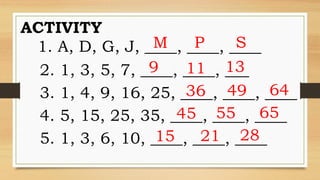
ACTIVITY
1. A, D, G, J, ____, ____, ____
2. 1, 3, 5, 7, ____, ____, ___
3. 1, 4, 9, 16, 25, ____, ____, ____
4. 5, 15, 25, 35, ____, ____, ____
5. 1, 3, 6, 10, ____, ____, ____
M P S
9 1311
36 49 64
45 55 65
15 21 28
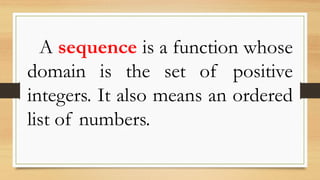
A sequence is a function whose
domain is the set of positive
integers. It also means an ordered
list of numbers.
A sequence is infinite if its domain is the
set of positive integers without a last term, {1,
2, 3, 4, 5, ...}. The three dots show that the
sequence goes on and on indefinitely.
A sequence is finite if its domain is the set
of positive integers {1, 2, 3, 4, 5, …, n} which
has a last term, n.
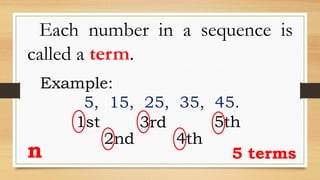
Each number in a sequence is
called a term.
Example:
5, 15, 25, 35, 45.
1st
2nd
3rd
4th
5th
5 termsn
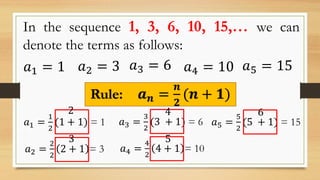
In the sequence 1, 3, 6, 10, 15,… we can
denote the terms as follows:
𝑎1 = 1 𝑎2 = 3 𝑎5 = 15𝑎4 = 10𝑎3 = 6
Rule: 𝒂 𝒏 =
𝒏
𝟐
(𝒏 + 𝟏)
𝑎1 =
1
2
(1 + 1) = 1
𝑎2 =
2
2
2 + 1 = 3
𝑎3 =
3
2
(3 + 1) = 6
𝑎4 =
4
2
4 + 1 = 10
𝑎5 =
5
2
(5 + 1) = 15
2 4
53
6
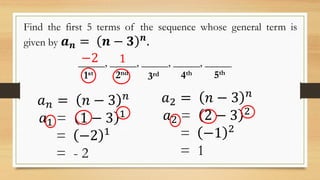
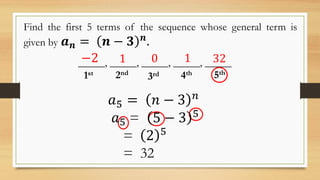
Find the first 5 terms of the sequence whose general term is
given by 𝒂 𝒏 = 𝒏 − 𝟑 𝒏
.
_____, _____, _____, _____, _____
1st 2nd
3rd 4th 5th
𝑎 𝑛 = 𝑛 − 3 𝑛
𝑎1 = 1 − 3 1
= −2 1
= - 2
𝑎2 = 𝑛 − 3 𝑛
𝑎2 = 2 − 3 2
= −1 2
= 1
−2 1
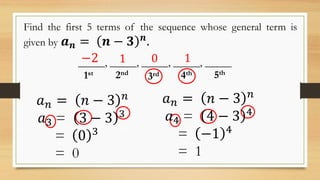
Find the first 5 terms of the sequence whose general term is
given by 𝒂 𝒏 = 𝒏 − 𝟑 𝒏
.
_____, _____, _____, _____, _____
1st 2nd
3rd 4th 5th
−2 1
𝑎 𝑛 = 𝑛 − 3 𝑛
𝑎3 = 3 − 3 3
= 0 3
= 0
𝑎 𝑛 = 𝑛 − 3 𝑛
𝑎4 = 4 − 3 4
= −1 4
= 1
0 1
Find the first 5 terms of the sequence whose general term is
given by 𝒂 𝒏 = 𝒏 − 𝟑 𝒏
.
_____, _____, _____, _____, _____
1st 2nd
3rd 4th 5th
−2 1 0 1
𝑎5 = 𝑛 − 3 𝑛
𝑎5 = 5 − 3 5
= 2 5
= 32
32
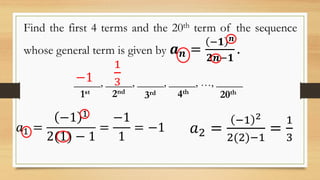
Find the first 4 terms and the 20th term of the sequence
whose general term is given by 𝒂 𝒏 =
−𝟏 𝒏
𝟐𝒏−𝟏
.
𝑎2 =
−1 2
2(2)−1
=
1
3
_____, _____, _____, _____, …, _____
1st 2nd
3rd 4th
20th
𝑎1 =
−1 1
2(1) − 1
=
−1
1
= −1
−1
1
3
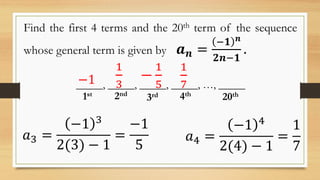
Find the first 4 terms and the 20th term of the sequence
whose general term is given by 𝒂 𝒏 =
−𝟏 𝒏
𝟐𝒏−𝟏
.
𝑎4 =
−1 4
2(4) − 1
=
1
7
𝑎3 =
−1 3
2(3) − 1
=
−1
5
_____, _____, _____, _____, …, _____
1st 2nd
3rd 4th
20th
−1
1
3
−
1
5
1
7
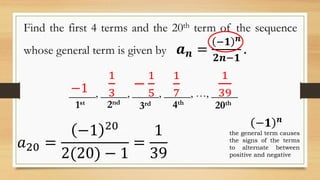
Find the first 4 terms and the 20th term of the sequence
whose general term is given by 𝒂 𝒏 =
−𝟏 𝒏
𝟐𝒏−𝟏
.
_____, _____, _____, _____, …, _____
1st 2nd
3rd 4th
20th
−1
1
3
−
1
5
1
7
1
39
𝑎20 =
−1 20
2(20) − 1
=
1
39
−𝟏 𝒏
the general term causes
the signs of the terms
to alternate between
positive and negative
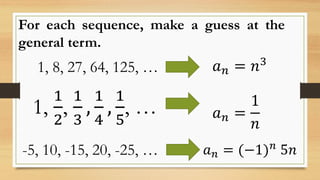
For each sequence, make a guess at the
general term.
1, 8, 27, 64, 125, … 𝑎 𝑛 = 𝑛3
1,
1
2
,
1
3
,
1
4
,
1
5
, … 𝑎 𝑛 =
1
𝑛
-5, 10, -15, 20, -25, … 𝑎 𝑛 = (−1) 𝑛
5𝑛
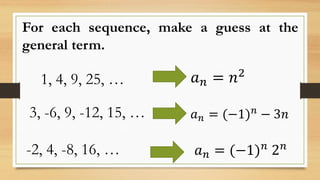
For each sequence, make a guess at the
general term.
1, 4, 9, 25, … 𝑎 𝑛 = 𝑛2
3, -6, 9, -12, 15, … 𝑎 𝑛 = (−1) 𝑛 − 3𝑛
-2, 4, -8, 16, … 𝑎 𝑛 = (−1) 𝑛
2 𝑛

Patterns in Sequences

  • 1.
    Grade 10 –Mathematics Quarter I PATTERNS IN SEQUENCES
  • 2.
    OBJECTIVES: • define sequence,finite and infinite sequence; • list the next few terms given several consecutive terms of a sequence; and • derive a mathematical expression (rule) for generating the sequence by pattern searching.
  • 3.
    ACTIVITY 1. A, D,G, J, ____, ____, ____ 2. 1, 3, 5, 7, ____, ____, ___ 3. 1, 4, 9, 16, 25, ____, ____, ____ 4. 5, 15, 25, 35, ____, ____, ____ 5. 1, 3, 6, 10, ____, ____, ____ M P S 9 1311 36 49 64 45 55 65 15 21 28
  • 4.
    A sequence isa function whose domain is the set of positive integers. It also means an ordered list of numbers.
  • 5.
    A sequence isinfinite if its domain is the set of positive integers without a last term, {1, 2, 3, 4, 5, ...}. The three dots show that the sequence goes on and on indefinitely. A sequence is finite if its domain is the set of positive integers {1, 2, 3, 4, 5, …, n} which has a last term, n.
  • 6.
    Each number ina sequence is called a term. Example: 5, 15, 25, 35, 45. 1st 2nd 3rd 4th 5th 5 termsn
  • 7.
    In the sequence1, 3, 6, 10, 15,… we can denote the terms as follows: 𝑎1 = 1 𝑎2 = 3 𝑎5 = 15𝑎4 = 10𝑎3 = 6 Rule: 𝒂 𝒏 = 𝒏 𝟐 (𝒏 + 𝟏) 𝑎1 = 1 2 (1 + 1) = 1 𝑎2 = 2 2 2 + 1 = 3 𝑎3 = 3 2 (3 + 1) = 6 𝑎4 = 4 2 4 + 1 = 10 𝑎5 = 5 2 (5 + 1) = 15 2 4 53 6
  • 8.
    Find the first5 terms of the sequence whose general term is given by 𝒂 𝒏 = 𝒏 − 𝟑 𝒏 . _____, _____, _____, _____, _____ 1st 2nd 3rd 4th 5th 𝑎 𝑛 = 𝑛 − 3 𝑛 𝑎1 = 1 − 3 1 = −2 1 = - 2 𝑎2 = 𝑛 − 3 𝑛 𝑎2 = 2 − 3 2 = −1 2 = 1 −2 1
  • 9.
    Find the first5 terms of the sequence whose general term is given by 𝒂 𝒏 = 𝒏 − 𝟑 𝒏 . _____, _____, _____, _____, _____ 1st 2nd 3rd 4th 5th −2 1 𝑎 𝑛 = 𝑛 − 3 𝑛 𝑎3 = 3 − 3 3 = 0 3 = 0 𝑎 𝑛 = 𝑛 − 3 𝑛 𝑎4 = 4 − 3 4 = −1 4 = 1 0 1
  • 10.
    Find the first5 terms of the sequence whose general term is given by 𝒂 𝒏 = 𝒏 − 𝟑 𝒏 . _____, _____, _____, _____, _____ 1st 2nd 3rd 4th 5th −2 1 0 1 𝑎5 = 𝑛 − 3 𝑛 𝑎5 = 5 − 3 5 = 2 5 = 32 32
  • 11.
    Find the first4 terms and the 20th term of the sequence whose general term is given by 𝒂 𝒏 = −𝟏 𝒏 𝟐𝒏−𝟏 . 𝑎2 = −1 2 2(2)−1 = 1 3 _____, _____, _____, _____, …, _____ 1st 2nd 3rd 4th 20th 𝑎1 = −1 1 2(1) − 1 = −1 1 = −1 −1 1 3
  • 12.
    Find the first4 terms and the 20th term of the sequence whose general term is given by 𝒂 𝒏 = −𝟏 𝒏 𝟐𝒏−𝟏 . 𝑎4 = −1 4 2(4) − 1 = 1 7 𝑎3 = −1 3 2(3) − 1 = −1 5 _____, _____, _____, _____, …, _____ 1st 2nd 3rd 4th 20th −1 1 3 − 1 5 1 7
  • 13.
    Find the first4 terms and the 20th term of the sequence whose general term is given by 𝒂 𝒏 = −𝟏 𝒏 𝟐𝒏−𝟏 . _____, _____, _____, _____, …, _____ 1st 2nd 3rd 4th 20th −1 1 3 − 1 5 1 7 1 39 𝑎20 = −1 20 2(20) − 1 = 1 39 −𝟏 𝒏 the general term causes the signs of the terms to alternate between positive and negative
  • 14.
    For each sequence,make a guess at the general term. 1, 8, 27, 64, 125, … 𝑎 𝑛 = 𝑛3 1, 1 2 , 1 3 , 1 4 , 1 5 , … 𝑎 𝑛 = 1 𝑛 -5, 10, -15, 20, -25, … 𝑎 𝑛 = (−1) 𝑛 5𝑛
  • 15.
    For each sequence,make a guess at the general term. 1, 4, 9, 25, … 𝑎 𝑛 = 𝑛2 3, -6, 9, -12, 15, … 𝑎 𝑛 = (−1) 𝑛 − 3𝑛 -2, 4, -8, 16, … 𝑎 𝑛 = (−1) 𝑛 2 𝑛