Separation of boundary layer
• As the flow proceed over a soil surface , the
boundary layer thickness increases .
• The velocity profile change from parabolic to
logarithmic .
• The fluid layer adjacent to the solid surface has to
do work against surface friction by consuming some
kinetic energy. This loss of kinetic energy recovered
from adjacent fluid layer through momentum
exchange process.
• Thus the velocity of the layer goes on decreasing.
• Along the length of solid body, at a certain point a
stage may come when the boundary layer may not
be able to keep sticking to the solid body .
• In other words , the boundary layer will be
separated from the surface . This phenomenon is
called the boundary layer separation.
• The point on the body at which the boundary layer
is on the verge of separation from the surface is
called point of separation.
Disadvantage of boundary layer separation
• Separation of boundary layer greatly affect the flow
as a whole.
• In particular the formation of a weak zone of
disturbed fluid on the downstream, in which the
pressure is approximately constant and much less
than that on the upstream, gives rise to boundary
forces.
• Thus, the separation of boundary layer gives to
additional resistance to flow.
• Separation of boundary layer from the surface of a
body is a accompained by reversed flow in the
vicinity of the body.
• Reversal of flow and consequent eddy formation
are generally undesirable because considerable
amount of energy is lost in the process of eddying.
• It is therefore necessary to control the separation of
boundary layer as far as possible.
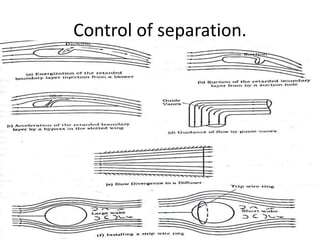
Control of separation.
Method of controlling separation of
boundary layer
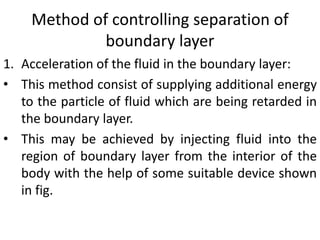
1. Acceleration of the fluid in the boundary layer:
• This method consist of supplying additional energy
to the particle of fluid which are being retarded in
the boundary layer.
• This may be achieved by injecting fluid into the
region of boundary layer from the interior of the
body with the help of some suitable device shown
in fig.
2. Suction of the fluid from the boundary layer :
• In this method the slow moving fluid in the
boundary layer is removed by suctions through
slots, so that on the downstream of the point of
suction a new boundary layer starts developing
which is able to withstand an adverse pressure
gradient and hence separation is prevented.
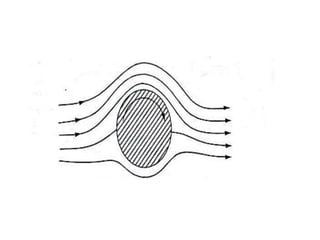
3.Motion of solid boundary :
• The formation of the boundary layer is due to the
difference between the velocity of the flowing fluid
and that of the solid boundary.
• As such it is possible to eliminate the formation of
boundary layer by causing the solid boundary to
move with the flowing fluid.
4. When the flow take place round a bend, a pressure
gradient is generated and there is a tendency of
separation at the inner radius of the bend.

Separation of boundary layer

  • 1.
    Separation of boundarylayer • As the flow proceed over a soil surface , the boundary layer thickness increases . • The velocity profile change from parabolic to logarithmic . • The fluid layer adjacent to the solid surface has to do work against surface friction by consuming some kinetic energy. This loss of kinetic energy recovered from adjacent fluid layer through momentum exchange process.
  • 2.
    • Thus thevelocity of the layer goes on decreasing. • Along the length of solid body, at a certain point a stage may come when the boundary layer may not be able to keep sticking to the solid body . • In other words , the boundary layer will be separated from the surface . This phenomenon is called the boundary layer separation. • The point on the body at which the boundary layer is on the verge of separation from the surface is called point of separation.
  • 3.
    Disadvantage of boundarylayer separation • Separation of boundary layer greatly affect the flow as a whole. • In particular the formation of a weak zone of disturbed fluid on the downstream, in which the pressure is approximately constant and much less than that on the upstream, gives rise to boundary forces. • Thus, the separation of boundary layer gives to additional resistance to flow.
  • 4.
    • Separation ofboundary layer from the surface of a body is a accompained by reversed flow in the vicinity of the body. • Reversal of flow and consequent eddy formation are generally undesirable because considerable amount of energy is lost in the process of eddying. • It is therefore necessary to control the separation of boundary layer as far as possible.
  • 5.
  • 6.
    Method of controllingseparation of boundary layer 1. Acceleration of the fluid in the boundary layer: • This method consist of supplying additional energy to the particle of fluid which are being retarded in the boundary layer. • This may be achieved by injecting fluid into the region of boundary layer from the interior of the body with the help of some suitable device shown in fig.
  • 8.
    2. Suction ofthe fluid from the boundary layer : • In this method the slow moving fluid in the boundary layer is removed by suctions through slots, so that on the downstream of the point of suction a new boundary layer starts developing which is able to withstand an adverse pressure gradient and hence separation is prevented. 3.Motion of solid boundary : • The formation of the boundary layer is due to the difference between the velocity of the flowing fluid and that of the solid boundary.
  • 9.
    • As suchit is possible to eliminate the formation of boundary layer by causing the solid boundary to move with the flowing fluid. 4. When the flow take place round a bend, a pressure gradient is generated and there is a tendency of separation at the inner radius of the bend.