BOUNDARY LAYER..
CONCEPT
PROF P C SWAIN
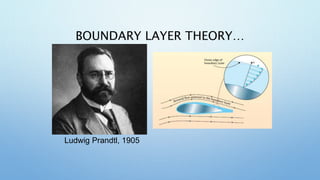
BOUNDARY LAYER THEORY…
Ludwig Prandtl, 1905
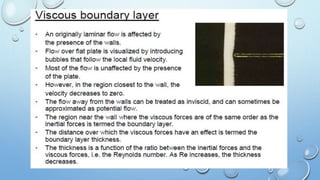
 Whenever there is relative movement between a fluid and a solid
surface, whether externally round a body, or internally in an
enclosed passage, a boundary layer exists with viscous
forces present in the layer of fluid close to the surface.
 Boundary layers can be either laminar or turbulent.
 A reasonable assessment of whether the boundary layer will be
laminar or turbulent can be made by calculating the Reynolds
number of the local flow conditions.
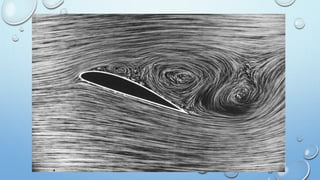
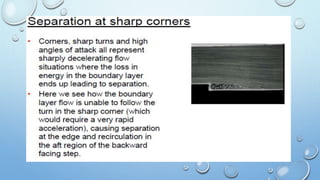
 Flow separation or boundary layer separation is the
detachment of a boundary layer from a surface into a wake.
 Separation occurs in flow that is slowing down, with pressure
increasing, after passing the thickest part of a streamline body or
passing through a widening passage
 Flowing against an increasing pressure is known as flowing in an adverse
pressure gradient.
 The boundary layer separates when it has travelled far enough in
an adverse pressure gradient that the speed of the boundary layer relative
to the surface has stopped and reversed direction.
 The flow becomes detached from the surface, and instead takes the forms
of eddies and vortices.
 The fluid exerts a constant pressure on the surface once it has separated
instead of a continually increasing pressure if still attached
 In aerodynamics, flow separation results in reduced lift and
increased pressure drag, caused by the pressure differential between the
front and rear surfaces of the object.
 It causes buffeting of aircraft structures and control surfaces.
 In internal passages separation causes stalling and vibrations in
machinery blading and increased losses(lower efficiency) in inlets and
compressors.
 Much effort and research has gone into the design of aerodynamic
and hydrodynamic surface contours and added features which delay flow
separation and keep the flow attached for as long as possible.
 Examples include the fur on a tennis ball, dimples on a golf
ball, turbulators on a glider, which induce an early transition to turbulent
flow; vortex generators on aircraft.
Drag
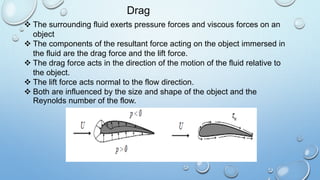
 The surrounding fluid exerts pressure forces and viscous forces on an
object
 The components of the resultant force acting on the object immersed in
the fluid are the drag force and the lift force.
 The drag force acts in the direction of the motion of the fluid relative to
the object.
 The lift force acts normal to the flow direction.
 Both are influenced by the size and shape of the object and the
Reynolds number of the flow.
 When a high Reynolds number fluid passes around a streamlined
obstacle, such as a slender plate that is aligned with the flow, a
relatively thin boundary layer form on the obstacle's surface.
 Here, by relatively thin, we mean that the typical transverse (to the flow)
thickness of the layer is 𝛿~
𝐿
𝑅𝑒1/2, where L is the length of the obstacle
(in the direction of the flow), and Re is the Reynolds number of the
external flow.
 Suppose, however, that the obstacle is not streamlined: that is, the
surface of the obstacle is not closely aligned with the streamlines of the
unperturbed flow pattern.
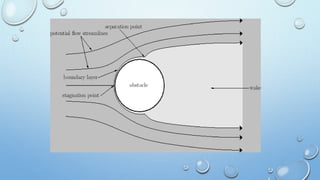
 In this case, the typically observed behavior is illustrated in Figure ,
which shows the flow pattern of a high Reynolds number irrotational
fluid around a cylindrical obstacle (whose axis is normal to the direction
of the unperturbed flow).
 It can be seen that a stagnation point, at which the flow velocity is
locally zero, forms in front of the obstacle.
 Moreover, a thin boundary layer covers the front side of the obstacle.
 The thickness of this layer is smallest at the stagnation point, and
increases towards the back side of the obstacle.
 However, at some point on the back side, the boundary layer
separates from the obstacle's surface to form a vortex-filled wake
whose transverse dimensions are similar to those of the obstacle
itself.
 This phenomenon is known as boundary layer separation.
Flow separation
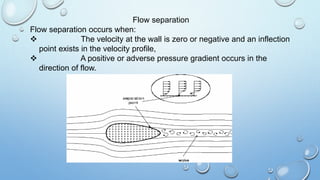
Flow separation occurs when:
 The velocity at the wall is zero or negative and an inflection
point exists in the velocity profile,
 A positive or adverse pressure gradient occurs in the
direction of flow.
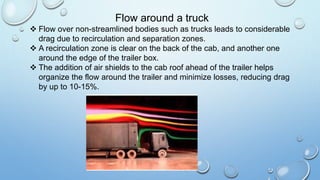
Flow around a truck
 Flow over non-streamlined bodies such as trucks leads to considerable
drag due to recirculation and separation zones.
 A recirculation zone is clear on the back of the cab, and another one
around the edge of the trailer box.
 The addition of air shields to the cab roof ahead of the trailer helps
organize the flow around the trailer and minimize losses, reducing drag
by up to 10-15%.
TWO DIMENSIONAL WAKE AND VORTEX FORMATION
 A cylinder having mild variations in diameter along its span is
subjected to controlled excitation at frequencies above and below the
inherent shedding frequency from the corresponding two dimensional
cylinder
 The response of the near wake is characterized in terms of timeline
visualization and velocity traces, spectra, and phase plane
representations
 It is possible to generate several types of vortex formation, depending
upon the excitation frequency
 Globally locked in, three dimensional vortex formation can occur along
the entire span of the flow
 Regions of locally locked in and period doubled vortex formation can
exist along different portions of the span provided the excitation
frequency is properly tuned
 Unlike the classical subharmonic instability in free shear flows, the
occurrence of period doubled vortex formation does not involve vortex
coalescence instead, the flow structure alternates between two
different states
 An experimental study of the flow around a cylinder with a single
straight perturbation was conducted in a wind tunnel
 With this bluff body, positioned in a uniform crossflow the vortex
shedding frequency and other flow characteristics could be
manipulated
 The Strouhal number has been shown to be a function of the
perturbation angular position, theta, as well as the perturbation size
and Reynolds number
 The perturbation size compared to the boundary layer thickness, delta,
was varied from approximately 1 delta to about 20 delta
 The Reynolds number was varied from 10 000 to 40 000
 A detailed investigation of the characteristic Strouhal number variation
has shown that varying theta had a significant influence on the
boundary layer separation and transition to turbulence
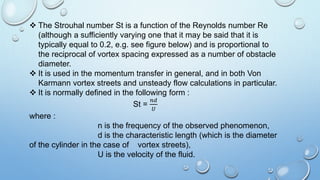
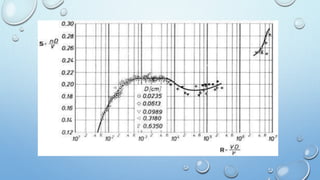
 The Strouhal number St is a function of the Reynolds number Re
(although a sufficiently varying one that it may be said that it is
typically equal to 0.2, e.g. see figure below) and is proportional to
the reciprocal of vortex spacing expressed as a number of obstacle
diameter.
 It is used in the momentum transfer in general, and in both Von
Karmann vortex streets and unsteady flow calculations in particular.
 It is normally defined in the following form :
St =
𝑛𝑑
𝑈
where :
n is the frequency of the observed phenomenon,
d is the characteristic length (which is the diameter
of the cylinder in the case of vortex streets),
U is the velocity of the fluid.
THANK YOU

Boundary layer PCS1.pptx Fluid Mechanics and Fluid Dynamics

  • 1.
  • 2.
  • 3.
     Whenever thereis relative movement between a fluid and a solid surface, whether externally round a body, or internally in an enclosed passage, a boundary layer exists with viscous forces present in the layer of fluid close to the surface.  Boundary layers can be either laminar or turbulent.  A reasonable assessment of whether the boundary layer will be laminar or turbulent can be made by calculating the Reynolds number of the local flow conditions.  Flow separation or boundary layer separation is the detachment of a boundary layer from a surface into a wake.  Separation occurs in flow that is slowing down, with pressure increasing, after passing the thickest part of a streamline body or passing through a widening passage
  • 5.
     Flowing againstan increasing pressure is known as flowing in an adverse pressure gradient.  The boundary layer separates when it has travelled far enough in an adverse pressure gradient that the speed of the boundary layer relative to the surface has stopped and reversed direction.  The flow becomes detached from the surface, and instead takes the forms of eddies and vortices.  The fluid exerts a constant pressure on the surface once it has separated instead of a continually increasing pressure if still attached  In aerodynamics, flow separation results in reduced lift and increased pressure drag, caused by the pressure differential between the front and rear surfaces of the object.
  • 6.
     It causesbuffeting of aircraft structures and control surfaces.  In internal passages separation causes stalling and vibrations in machinery blading and increased losses(lower efficiency) in inlets and compressors.  Much effort and research has gone into the design of aerodynamic and hydrodynamic surface contours and added features which delay flow separation and keep the flow attached for as long as possible.  Examples include the fur on a tennis ball, dimples on a golf ball, turbulators on a glider, which induce an early transition to turbulent flow; vortex generators on aircraft.
  • 7.
    Drag  The surroundingfluid exerts pressure forces and viscous forces on an object  The components of the resultant force acting on the object immersed in the fluid are the drag force and the lift force.  The drag force acts in the direction of the motion of the fluid relative to the object.  The lift force acts normal to the flow direction.  Both are influenced by the size and shape of the object and the Reynolds number of the flow.
  • 10.
     When ahigh Reynolds number fluid passes around a streamlined obstacle, such as a slender plate that is aligned with the flow, a relatively thin boundary layer form on the obstacle's surface.  Here, by relatively thin, we mean that the typical transverse (to the flow) thickness of the layer is 𝛿~ 𝐿 𝑅𝑒1/2, where L is the length of the obstacle (in the direction of the flow), and Re is the Reynolds number of the external flow.  Suppose, however, that the obstacle is not streamlined: that is, the surface of the obstacle is not closely aligned with the streamlines of the unperturbed flow pattern.  In this case, the typically observed behavior is illustrated in Figure , which shows the flow pattern of a high Reynolds number irrotational fluid around a cylindrical obstacle (whose axis is normal to the direction of the unperturbed flow).
  • 11.
     It canbe seen that a stagnation point, at which the flow velocity is locally zero, forms in front of the obstacle.  Moreover, a thin boundary layer covers the front side of the obstacle.  The thickness of this layer is smallest at the stagnation point, and increases towards the back side of the obstacle.  However, at some point on the back side, the boundary layer separates from the obstacle's surface to form a vortex-filled wake whose transverse dimensions are similar to those of the obstacle itself.  This phenomenon is known as boundary layer separation.
  • 12.
    Flow separation Flow separationoccurs when:  The velocity at the wall is zero or negative and an inflection point exists in the velocity profile,  A positive or adverse pressure gradient occurs in the direction of flow.
  • 13.
    Flow around atruck  Flow over non-streamlined bodies such as trucks leads to considerable drag due to recirculation and separation zones.  A recirculation zone is clear on the back of the cab, and another one around the edge of the trailer box.  The addition of air shields to the cab roof ahead of the trailer helps organize the flow around the trailer and minimize losses, reducing drag by up to 10-15%.
  • 15.
    TWO DIMENSIONAL WAKEAND VORTEX FORMATION  A cylinder having mild variations in diameter along its span is subjected to controlled excitation at frequencies above and below the inherent shedding frequency from the corresponding two dimensional cylinder  The response of the near wake is characterized in terms of timeline visualization and velocity traces, spectra, and phase plane representations  It is possible to generate several types of vortex formation, depending upon the excitation frequency  Globally locked in, three dimensional vortex formation can occur along the entire span of the flow  Regions of locally locked in and period doubled vortex formation can exist along different portions of the span provided the excitation frequency is properly tuned
  • 16.
     Unlike theclassical subharmonic instability in free shear flows, the occurrence of period doubled vortex formation does not involve vortex coalescence instead, the flow structure alternates between two different states  An experimental study of the flow around a cylinder with a single straight perturbation was conducted in a wind tunnel  With this bluff body, positioned in a uniform crossflow the vortex shedding frequency and other flow characteristics could be manipulated  The Strouhal number has been shown to be a function of the perturbation angular position, theta, as well as the perturbation size and Reynolds number
  • 17.
     The perturbationsize compared to the boundary layer thickness, delta, was varied from approximately 1 delta to about 20 delta  The Reynolds number was varied from 10 000 to 40 000  A detailed investigation of the characteristic Strouhal number variation has shown that varying theta had a significant influence on the boundary layer separation and transition to turbulence
  • 18.
     The Strouhalnumber St is a function of the Reynolds number Re (although a sufficiently varying one that it may be said that it is typically equal to 0.2, e.g. see figure below) and is proportional to the reciprocal of vortex spacing expressed as a number of obstacle diameter.  It is used in the momentum transfer in general, and in both Von Karmann vortex streets and unsteady flow calculations in particular.  It is normally defined in the following form : St = 𝑛𝑑 𝑈 where : n is the frequency of the observed phenomenon, d is the characteristic length (which is the diameter of the cylinder in the case of vortex streets), U is the velocity of the fluid.
  • 20.