Boundary layer flow
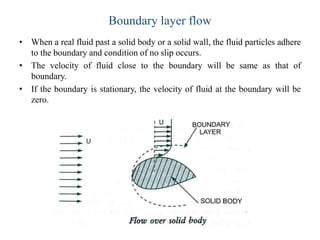
• When a real fluid past a solid body or a solid wall, the fluid particles adhere
to the boundary and condition of no slip occurs.
• The velocity of fluid close to the boundary will be same as that of
boundary.
• If the boundary is stationary, the velocity of fluid at the boundary will be
zero.
Boundary layer flow
• The velocity of fluid starts increasing when it is away from the boundary,
the velocity gradient will exist.
• The velocity of fluid increases from zero velocity on the stationary
boundary to free-stream velocity (U) of the fluid in the direction normal to
the boundary.
Boundary layer flow
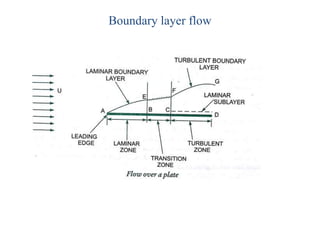
• The variation of velocity from zero to free-stream velocity in the direction
normal to the boundary takes place in a narrow region in the vicinity of
solid boundary. This narrow region of the fluid is called boundary layer.
• According to boundary layer theory, the flow of fluid in the neighbourhood
of the solid boundary may be divided into two regions:
– Inside boundary layer (Shear stress occurs due to velocity gradient)
– Outside boundary layer (Shear stress is zero, due to constant velocity)
Boundary layer flow
Boundary layer flow
Boundary layer flow
• Boundary layer thickness (δ)
– It is defined as the distance from the boundary of the solid body
measured in the y-direction to the point where the velocity of fluid is
approximately equal to 0.99 times the free stream velocity (U) of the
fluid.
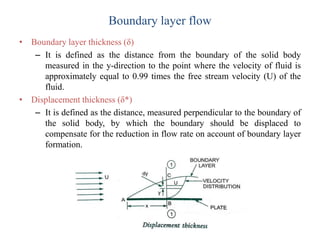
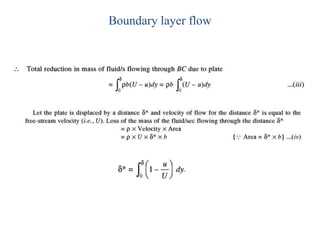
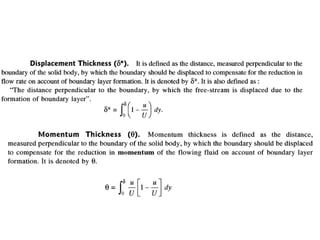
• Displacement thickness (δ*)
– It is defined as the distance, measured perpendicular to the boundary of
the solid body, by which the boundary should be displaced to
compensate for the reduction in flow rate on account of boundary layer
formation.
Boundary layer flow
Boundary layer flow
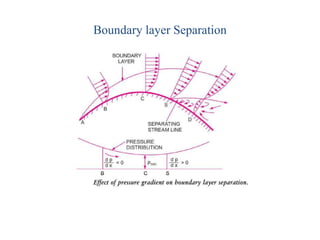
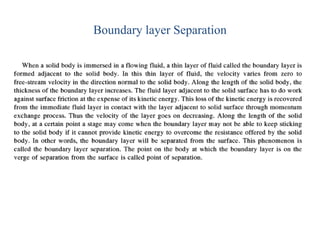
Boundary layer Separation
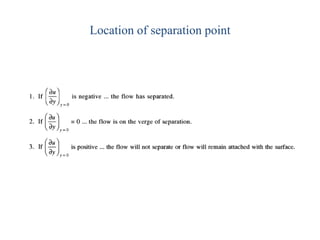
Location of separation point
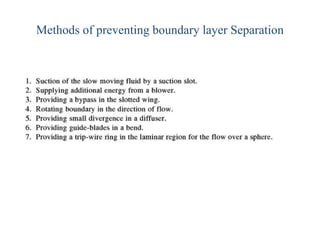
Methods of preventing boundary layer Separation

Boundary Layer.pptx

  • 1.
    Boundary layer flow •When a real fluid past a solid body or a solid wall, the fluid particles adhere to the boundary and condition of no slip occurs. • The velocity of fluid close to the boundary will be same as that of boundary. • If the boundary is stationary, the velocity of fluid at the boundary will be zero.
  • 2.
    Boundary layer flow •The velocity of fluid starts increasing when it is away from the boundary, the velocity gradient will exist. • The velocity of fluid increases from zero velocity on the stationary boundary to free-stream velocity (U) of the fluid in the direction normal to the boundary.
  • 3.
    Boundary layer flow •The variation of velocity from zero to free-stream velocity in the direction normal to the boundary takes place in a narrow region in the vicinity of solid boundary. This narrow region of the fluid is called boundary layer. • According to boundary layer theory, the flow of fluid in the neighbourhood of the solid boundary may be divided into two regions: – Inside boundary layer (Shear stress occurs due to velocity gradient) – Outside boundary layer (Shear stress is zero, due to constant velocity)
  • 4.
  • 5.
  • 6.
    Boundary layer flow •Boundary layer thickness (δ) – It is defined as the distance from the boundary of the solid body measured in the y-direction to the point where the velocity of fluid is approximately equal to 0.99 times the free stream velocity (U) of the fluid. • Displacement thickness (δ*) – It is defined as the distance, measured perpendicular to the boundary of the solid body, by which the boundary should be displaced to compensate for the reduction in flow rate on account of boundary layer formation.
  • 7.
  • 8.
  • 11.
  • 12.
  • 13.
  • 14.
    Methods of preventingboundary layer Separation