Subject Code : 130101
Topic:
Viscous Flow
3rd
semester
B.E. Mechanical
CCET, WADHWAN
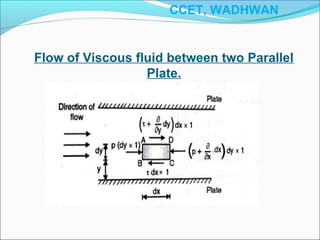
Flow of Viscous fluid between two Parallel
Plate.
CCET, WADHWAN
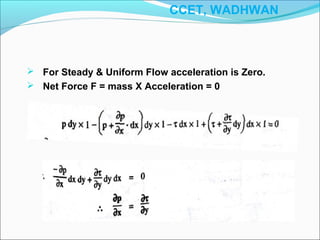
 For Steady & Uniform Flow acceleration is Zero.
 Net Force F = mass X Acceleration = 0
CCET, WADHWAN
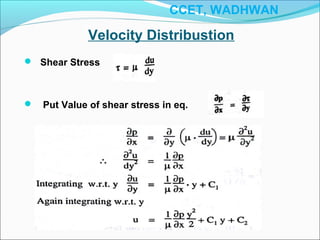
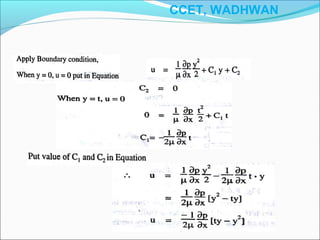
Velocity Distribustion
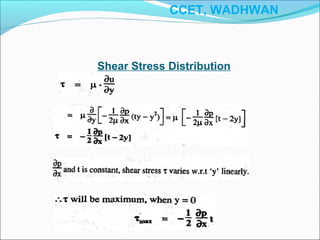
 Shear Stress
 Put Value of shear stress in eq.
CCET, WADHWAN
CCET, WADHWAN
CCET, WADHWAN
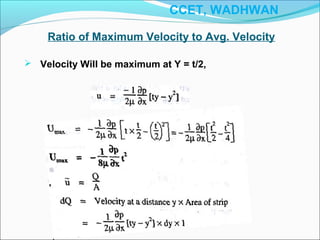
Ratio of Maximum Velocity to Avg. Velocity
 Velocity Will be maximum at Y = t/2,
CCET, WADHWAN
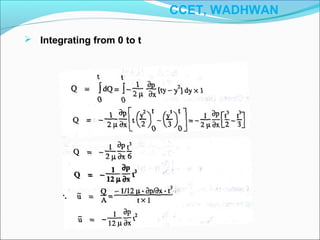
 Integrating from 0 to t
CCET, WADHWAN
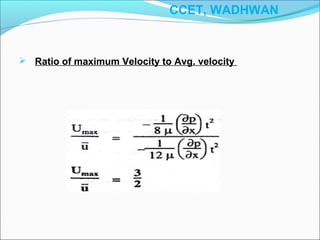
 Ratio of maximum Velocity to Avg. velocity
CCET, WADHWAN
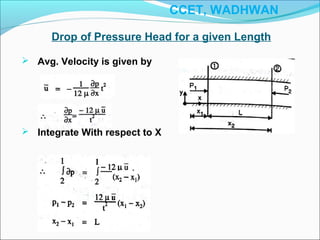
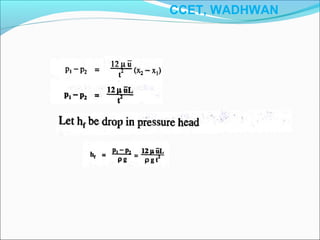
Drop of Pressure Head for a given Length
 Avg. Velocity is given by
 Integrate With respect to X
CCET, WADHWAN
CCET, WADHWAN
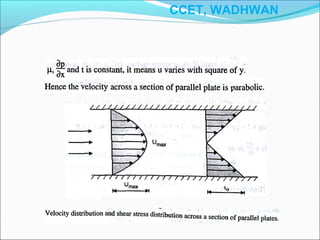
Shear Stress Distribution
CCET, WADHWAN
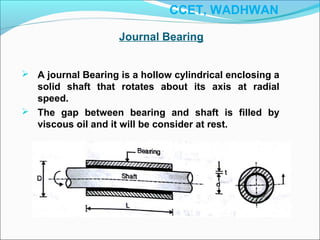
Journal Bearing
 A journal Bearing is a hollow cylindrical enclosing a
solid shaft that rotates about its axis at radial
speed.
 The gap between bearing and shaft is filled by
viscous oil and it will be consider at rest.
CCET, WADHWAN
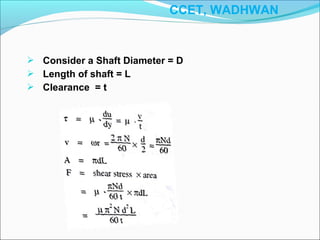
 Consider a Shaft Diameter = D
 Length of shaft = L
 Clearance = t
CCET, WADHWAN
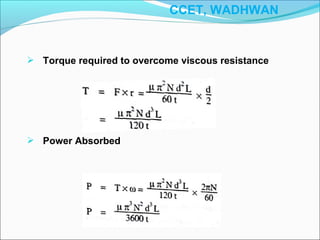
 Torque required to overcome viscous resistance
 Power Absorbed
CCET, WADHWAN
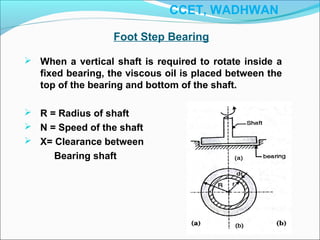
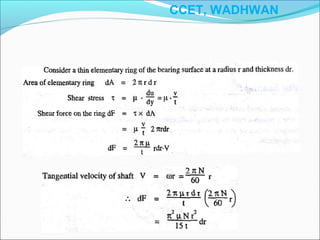
Foot Step Bearing
 When a vertical shaft is required to rotate inside a
fixed bearing, the viscous oil is placed between the
top of the bearing and bottom of the shaft.
 R = Radius of shaft
 N = Speed of the shaft
 X= Clearance between
Bearing shaft
CCET, WADHWAN
CCET, WADHWAN
CCET, WADHWAN
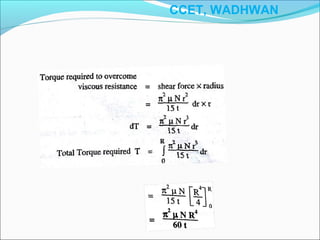
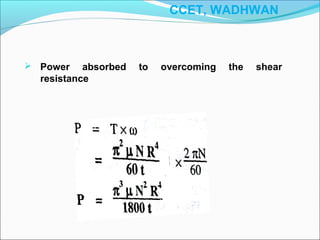
 Power absorbed to overcoming the shear
resistance
CCET, WADHWAN
Movement of Piston in Dashpot
 Dashpot is a device used for damping vibration of
machine by using high viscous fluid.
 It consist of a piston which moves in a cylinder.
 Diameter of cylinder is slightly greater the piston.
 Piston is connected to the machine element whose
movement is to be restrained.
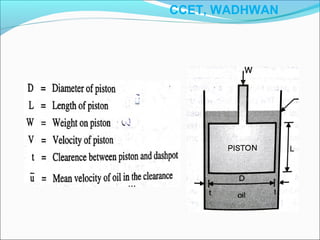
 Consider a piston moving in a vertical dashpot
containing oil as shown in fig.
CCET, WADHWAN
CCET, WADHWAN
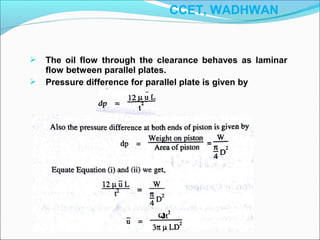
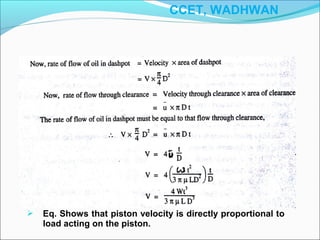
 The oil flow through the clearance behaves as laminar
flow between parallel plates.
 Pressure difference for parallel plate is given by
CCET, WADHWAN
 Eq. Shows that piston velocity is directly proportional to
load acting on the piston.
CCET, WADHWAN
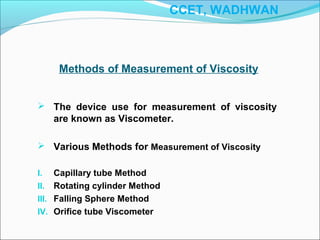
Methods of Measurement of Viscosity
 The device use for measurement of viscosity
are known as Viscometer.
 Various Methods for Measurement of Viscosity
I. Capillary tube Method
II. Rotating cylinder Method
III. Falling Sphere Method
IV. Orifice tube Viscometer
CCET, WADHWAN
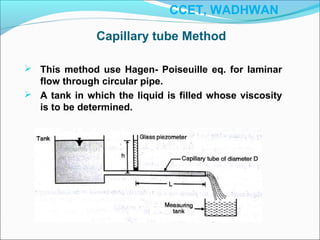
Capillary tube Method
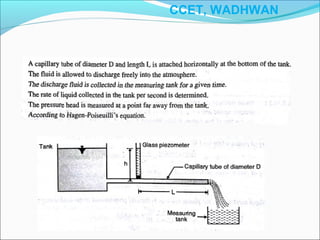
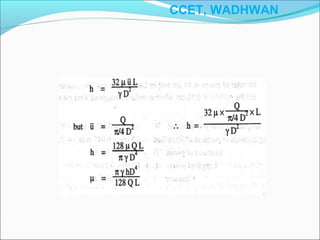
 This method use Hagen- Poiseuille eq. for laminar
flow through circular pipe.
 A tank in which the liquid is filled whose viscosity
is to be determined.
CCET, WADHWAN
CCET, WADHWAN
CCET, WADHWAN
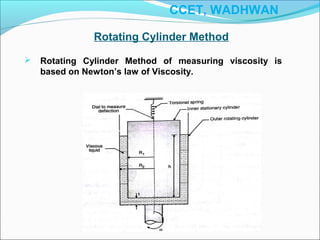
Rotating Cylinder Method
 Rotating Cylinder Method of measuring viscosity is
based on Newton’s law of Viscosity.
CCET, WADHWAN
CCET, WADHWAN
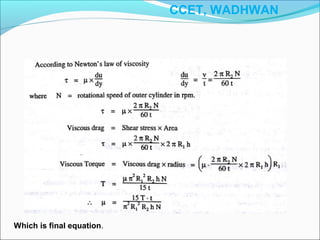
Which is final equation.
Thank you….

PPT on fully Mathematical Derivation of Viscous Flow as part of FLUID MECHANICS by M.M.RAFIK.

  • 1.
  • 2.
  • 3.
    Flow of Viscousfluid between two Parallel Plate. CCET, WADHWAN
  • 4.
     For Steady& Uniform Flow acceleration is Zero.  Net Force F = mass X Acceleration = 0 CCET, WADHWAN
  • 5.
    Velocity Distribustion  ShearStress  Put Value of shear stress in eq. CCET, WADHWAN
  • 6.
  • 7.
  • 8.
    Ratio of MaximumVelocity to Avg. Velocity  Velocity Will be maximum at Y = t/2, CCET, WADHWAN
  • 9.
     Integrating from0 to t CCET, WADHWAN
  • 10.
     Ratio ofmaximum Velocity to Avg. velocity CCET, WADHWAN
  • 11.
    Drop of PressureHead for a given Length  Avg. Velocity is given by  Integrate With respect to X CCET, WADHWAN
  • 12.
  • 13.
  • 14.
    Journal Bearing  Ajournal Bearing is a hollow cylindrical enclosing a solid shaft that rotates about its axis at radial speed.  The gap between bearing and shaft is filled by viscous oil and it will be consider at rest. CCET, WADHWAN
  • 15.
     Consider aShaft Diameter = D  Length of shaft = L  Clearance = t CCET, WADHWAN
  • 16.
     Torque requiredto overcome viscous resistance  Power Absorbed CCET, WADHWAN
  • 17.
    Foot Step Bearing When a vertical shaft is required to rotate inside a fixed bearing, the viscous oil is placed between the top of the bearing and bottom of the shaft.  R = Radius of shaft  N = Speed of the shaft  X= Clearance between Bearing shaft CCET, WADHWAN
  • 18.
  • 19.
  • 20.
     Power absorbedto overcoming the shear resistance CCET, WADHWAN
  • 21.
    Movement of Pistonin Dashpot  Dashpot is a device used for damping vibration of machine by using high viscous fluid.  It consist of a piston which moves in a cylinder.  Diameter of cylinder is slightly greater the piston.  Piston is connected to the machine element whose movement is to be restrained.  Consider a piston moving in a vertical dashpot containing oil as shown in fig. CCET, WADHWAN
  • 22.
  • 23.
     The oilflow through the clearance behaves as laminar flow between parallel plates.  Pressure difference for parallel plate is given by CCET, WADHWAN
  • 24.
     Eq. Showsthat piston velocity is directly proportional to load acting on the piston. CCET, WADHWAN
  • 25.
    Methods of Measurementof Viscosity  The device use for measurement of viscosity are known as Viscometer.  Various Methods for Measurement of Viscosity I. Capillary tube Method II. Rotating cylinder Method III. Falling Sphere Method IV. Orifice tube Viscometer CCET, WADHWAN
  • 26.
    Capillary tube Method This method use Hagen- Poiseuille eq. for laminar flow through circular pipe.  A tank in which the liquid is filled whose viscosity is to be determined. CCET, WADHWAN
  • 27.
  • 28.
  • 29.
    Rotating Cylinder Method Rotating Cylinder Method of measuring viscosity is based on Newton’s law of Viscosity. CCET, WADHWAN
  • 30.
    CCET, WADHWAN Which isfinal equation.
  • 31.

Editor's Notes

  • #22 Restrained- Under Control