Chapter 8
Momentum Analysis of Flow
Prepared By:
Binu Karki
Momentum equation
•It is based on law of conservation of
momentum or on momentum principle which
states
“The net force acting on the fluid mass is equal
to the change in momentum of flow per unit time
in that direction”.
The force acting on a fluid mass ‘m’ is given by
the Newton's second law of motion.
F=ma
Where, a-acceleration acting in the same
direction as force F.
Momentum equation
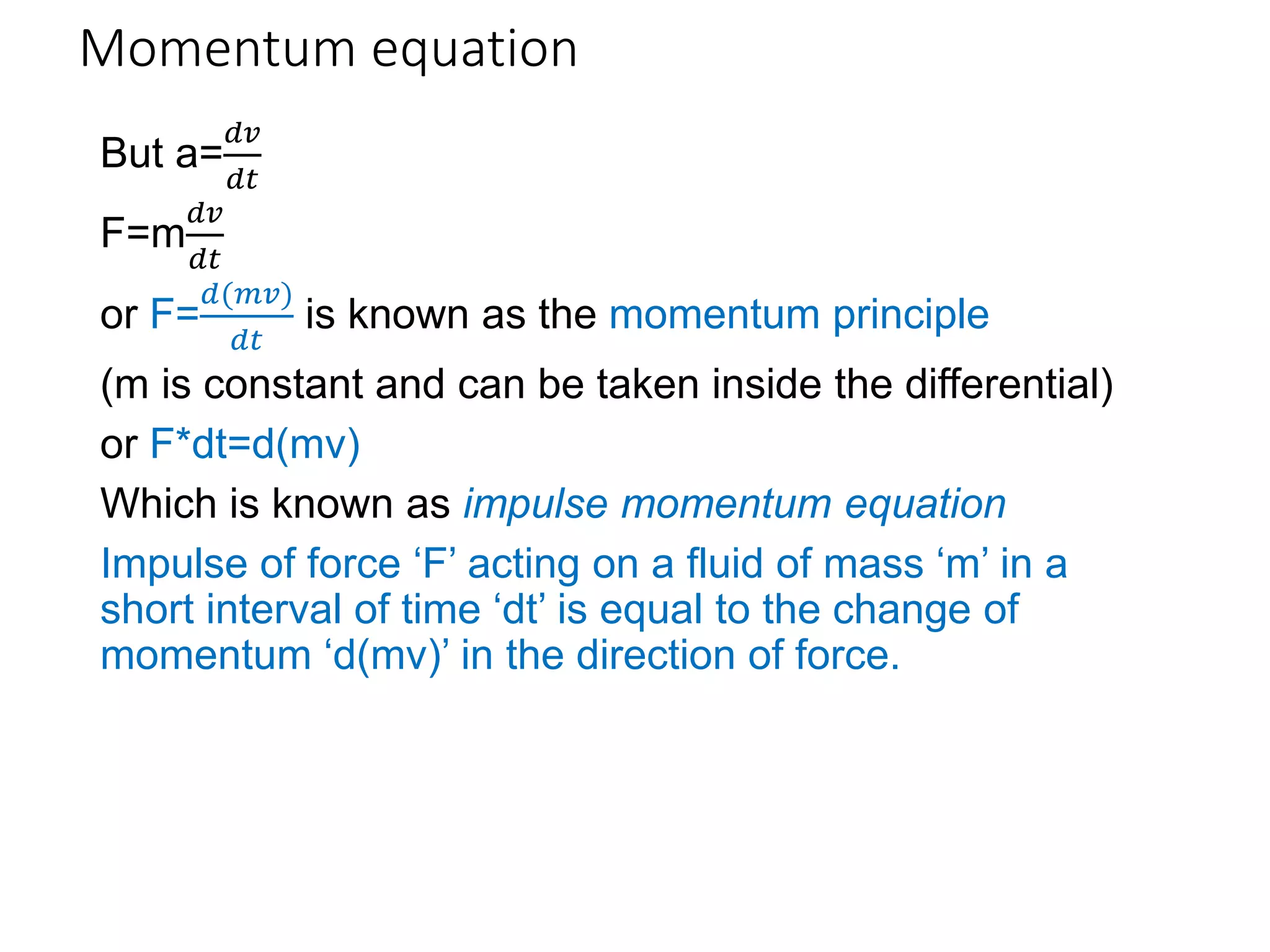
But a=
𝑑𝑣
𝑑𝑡
F=m
𝑑𝑣
𝑑𝑡
or F=
𝑑(𝑚𝑣)
𝑑𝑡
is known as the momentum principle
(m is constant and can be taken inside the differential)
or F*dt=d(mv)
Which is known as impulse momentum equation
Impulse of force ‘F’ acting on a fluid of mass ‘m’ in a
short interval of time ‘dt’ is equal to the change of
momentum ‘d(mv)’ in the direction of force.
Force exerted by a flowing fluid on a pipe
bend
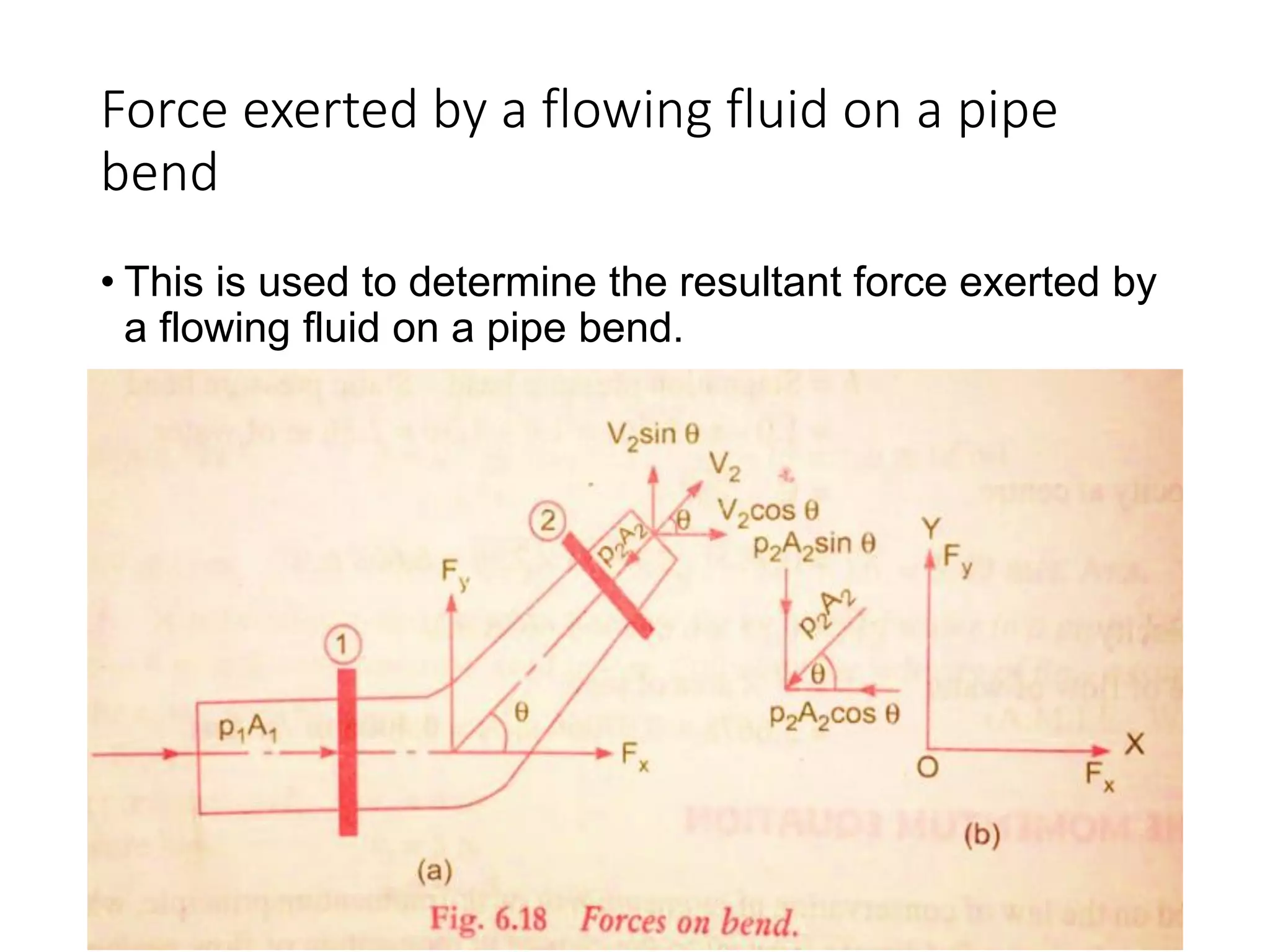
• This is used to determine the resultant force exerted by
a flowing fluid on a pipe bend.
Force exerted by a flowing fluid on a pipe
bend
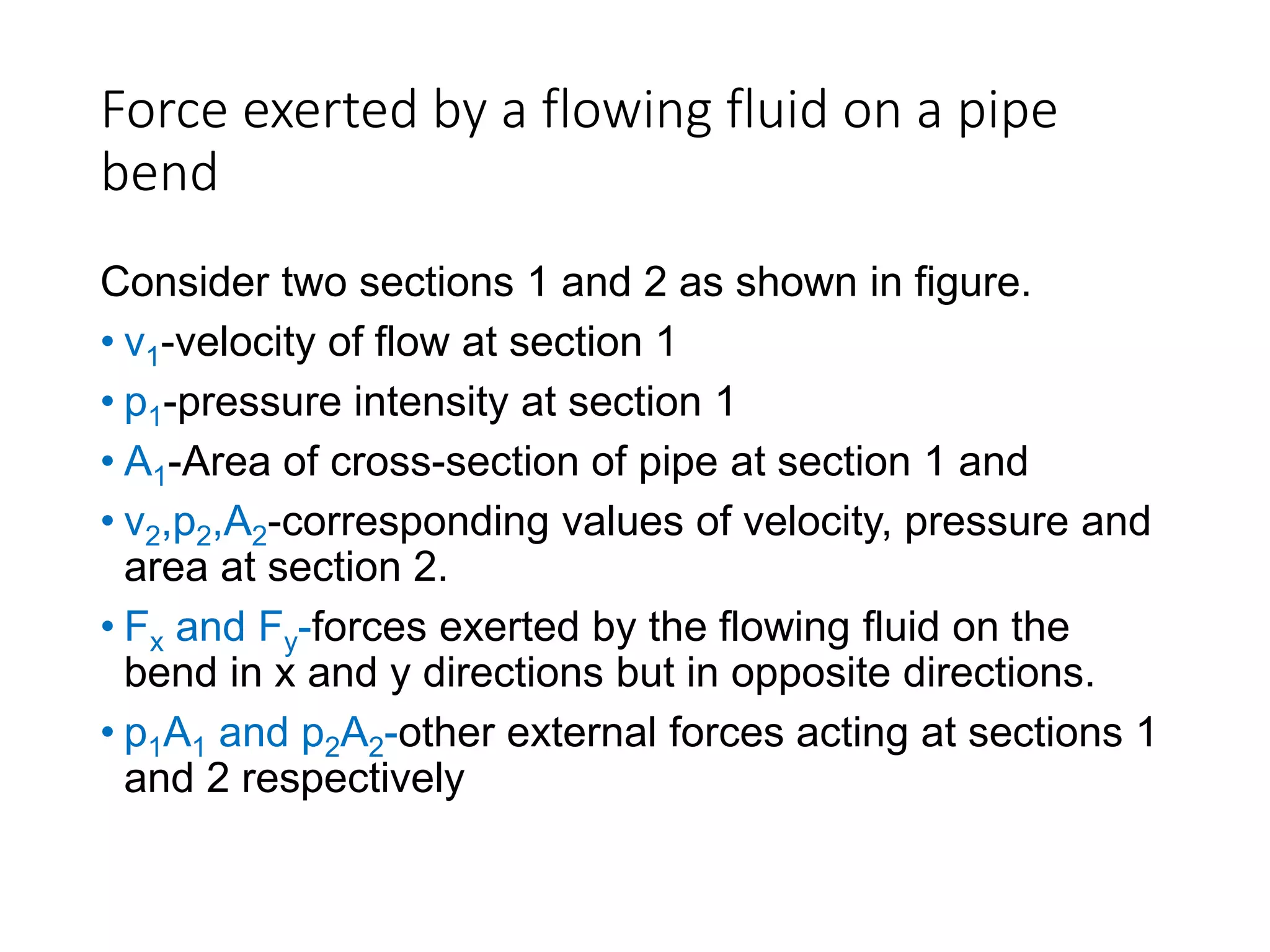
Consider two sections 1 and 2 as shown in figure.
• v1-velocity of flow at section 1
• p1-pressure intensity at section 1
• A1-Area of cross-section of pipe at section 1 and
• v2,p2,A2-corresponding values of velocity, pressure and
area at section 2.
• Fx and Fy-forces exerted by the flowing fluid on the
bend in x and y directions but in opposite directions.
• p1A1 and p2A2-other external forces acting at sections 1
and 2 respectively
Force exerted by a flowing fluid on a pipe
bend
Then, momentum equation in x-direction is given by:
Force exerted by a flowing fluid on a pipe
bend
Impact of Jets
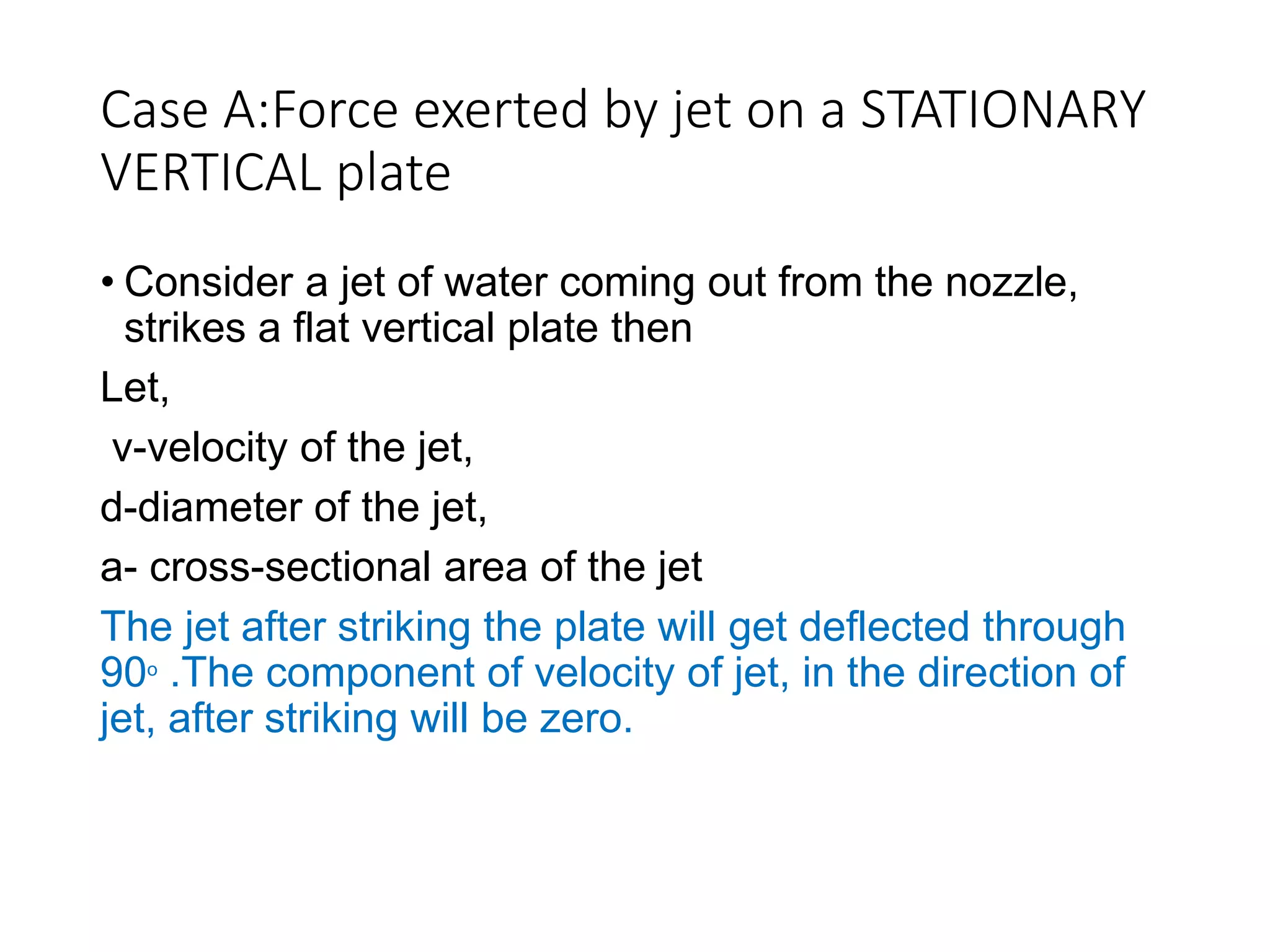
• The liquid comes out in the form of jet from the outlet of the nozzle,
which is fitted to a pipe through which the liquid is flowing under
pressure.
• If some plate(fixed or moving) is placed in the path of the jet, force is
exerted by the jet on the plate.
• This force is obtained from Newtons second law of motion OR from
impulse momentum equation.
Force exerted by jet on the stationary
plate
Cases:
• Plate is vertical to the jet
• Plate is inclined to the jet
• Plate is curved
Case A:Force exerted by jet on a STATIONARY
VERTICAL plate
Case A:Force exerted by jet on a STATIONARY
VERTICAL plate
• Consider a jet of water coming out from the nozzle,
strikes a flat vertical plate then
Let,
v-velocity of the jet,
d-diameter of the jet,
a- cross-sectional area of the jet
The jet after striking the plate will get deflected through
90ₒ .The component of velocity of jet, in the direction of
jet, after striking will be zero.
Case A:Force exerted by jet on a STATIONARY
VERTICAL plate
The force exerted by the jet on the plate in the direction of the jet,
Case A:Force exerted by jet on a STATIONARY
VERTICAL plate
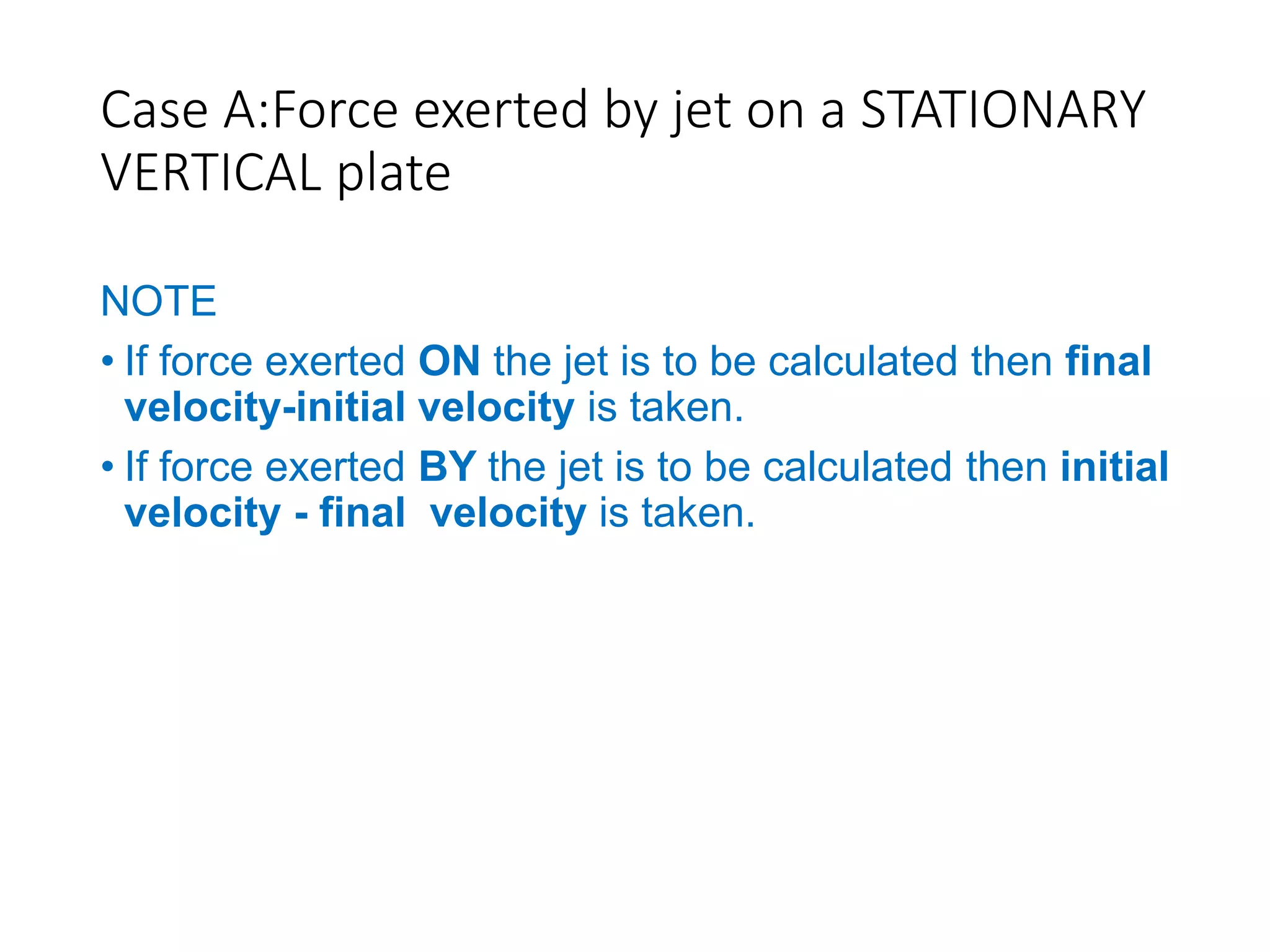
NOTE
• If force exerted ON the jet is to be calculated then final
velocity-initial velocity is taken.
• If force exerted BY the jet is to be calculated then initial
velocity - final velocity is taken.
Case A:Force exerted by jet on a STATIONARY
INCLINED FLAT plate
Case A:Force exerted by jet on a STATIONARY
INCLINED FLAT plate
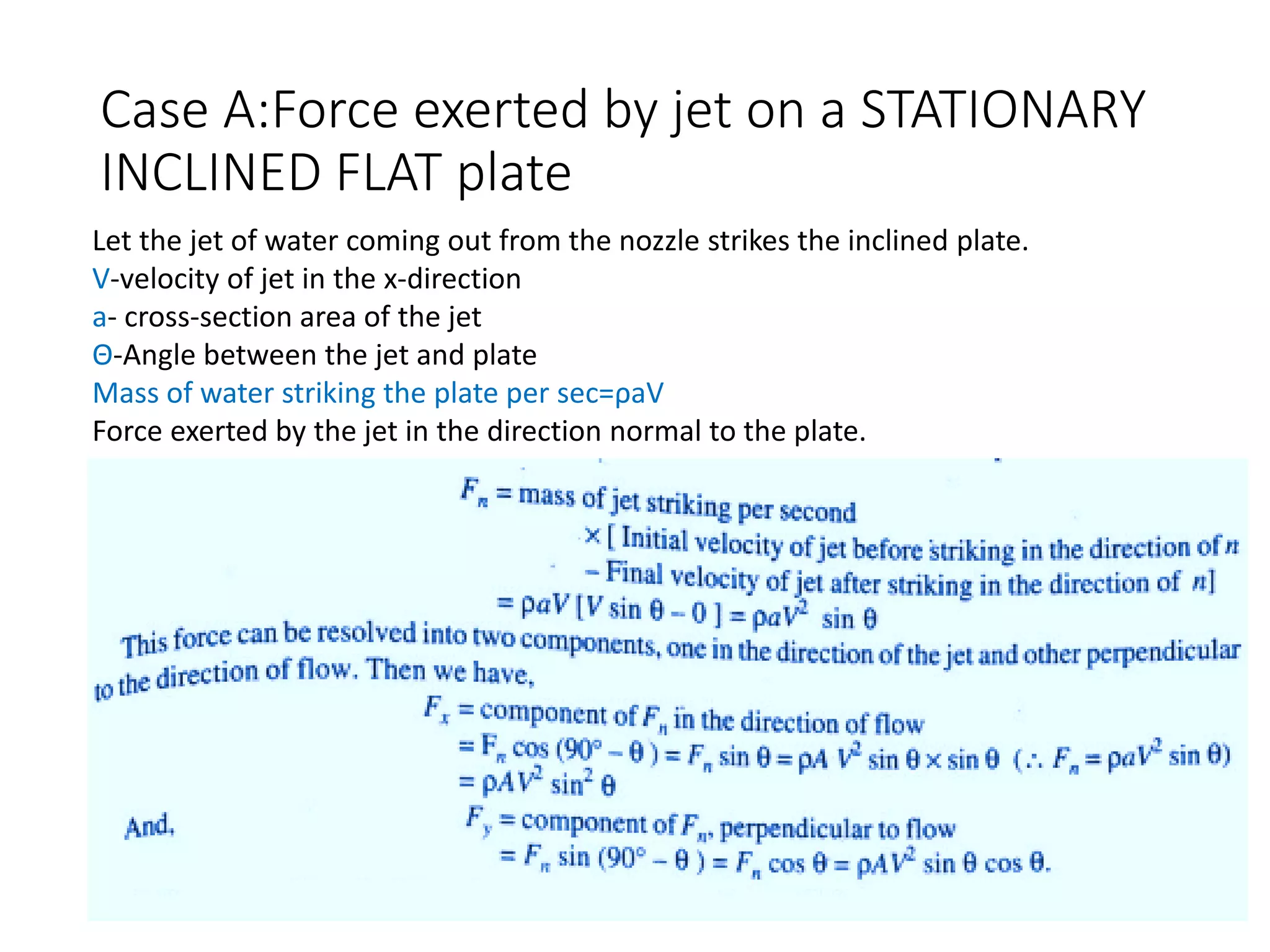
Let the jet of water coming out from the nozzle strikes the inclined plate.
V-velocity of jet in the x-direction
a- cross-section area of the jet
Θ-Angle between the jet and plate
Mass of water striking the plate per sec=ρaV
Force exerted by the jet in the direction normal to the plate.
Case A:Force exerted by jet on a STATIONARY
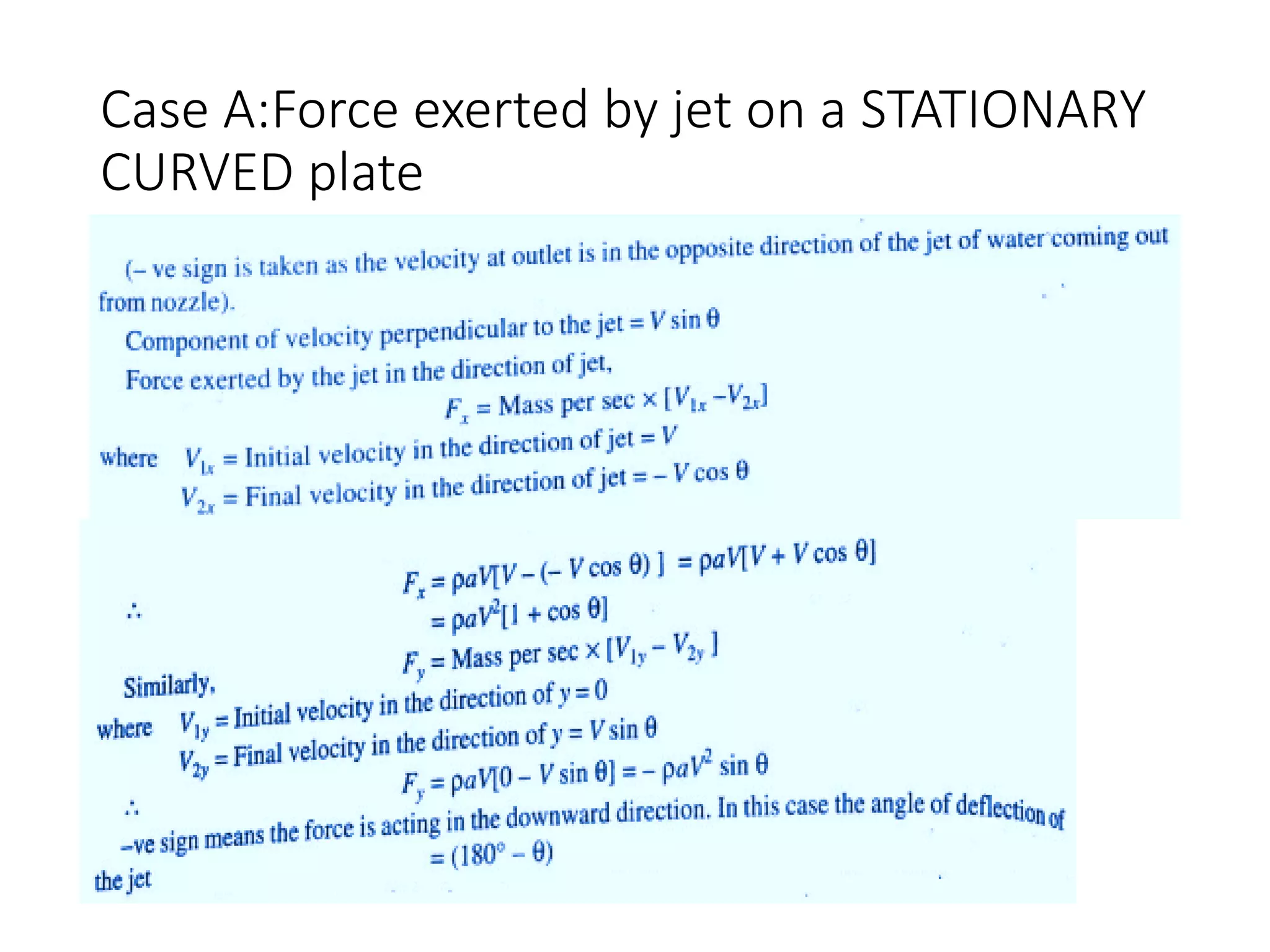
CURVED plate
Case A:Force exerted by jet on a STATIONARY
CURVED plate
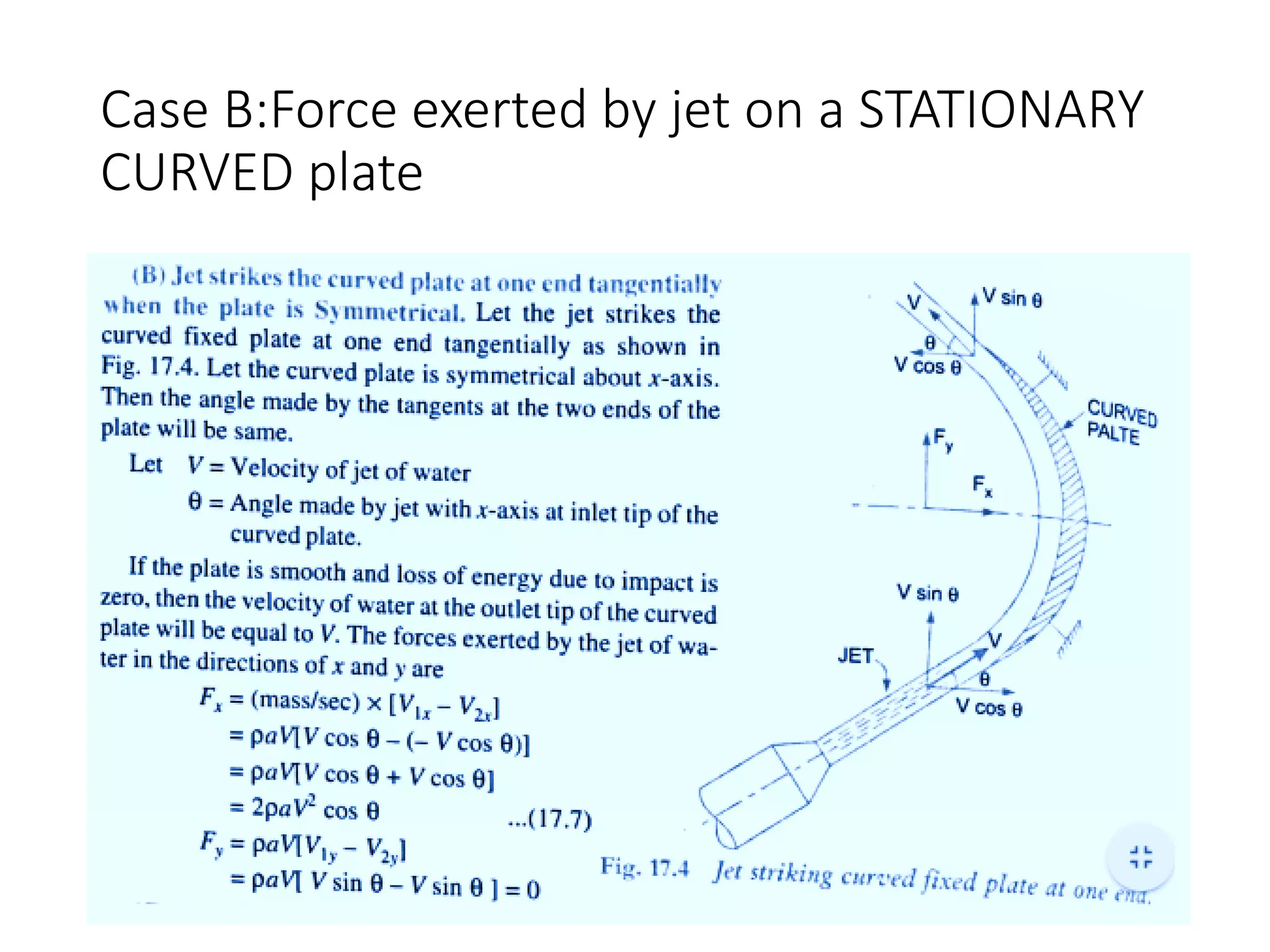
Case B:Force exerted by jet on a STATIONARY
CURVED plate
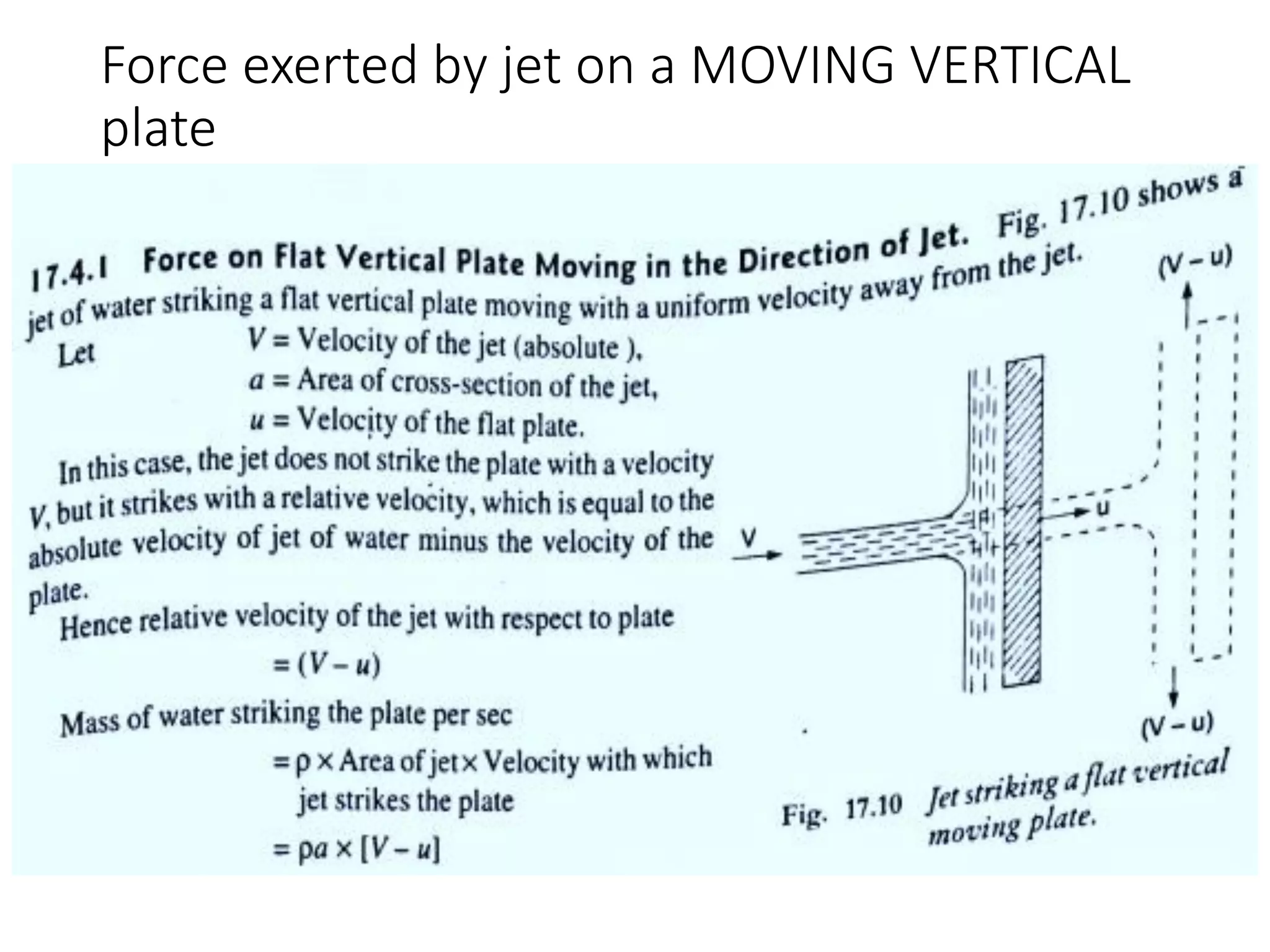
Force exerted by jet on a MOVING VERTICAL
plate
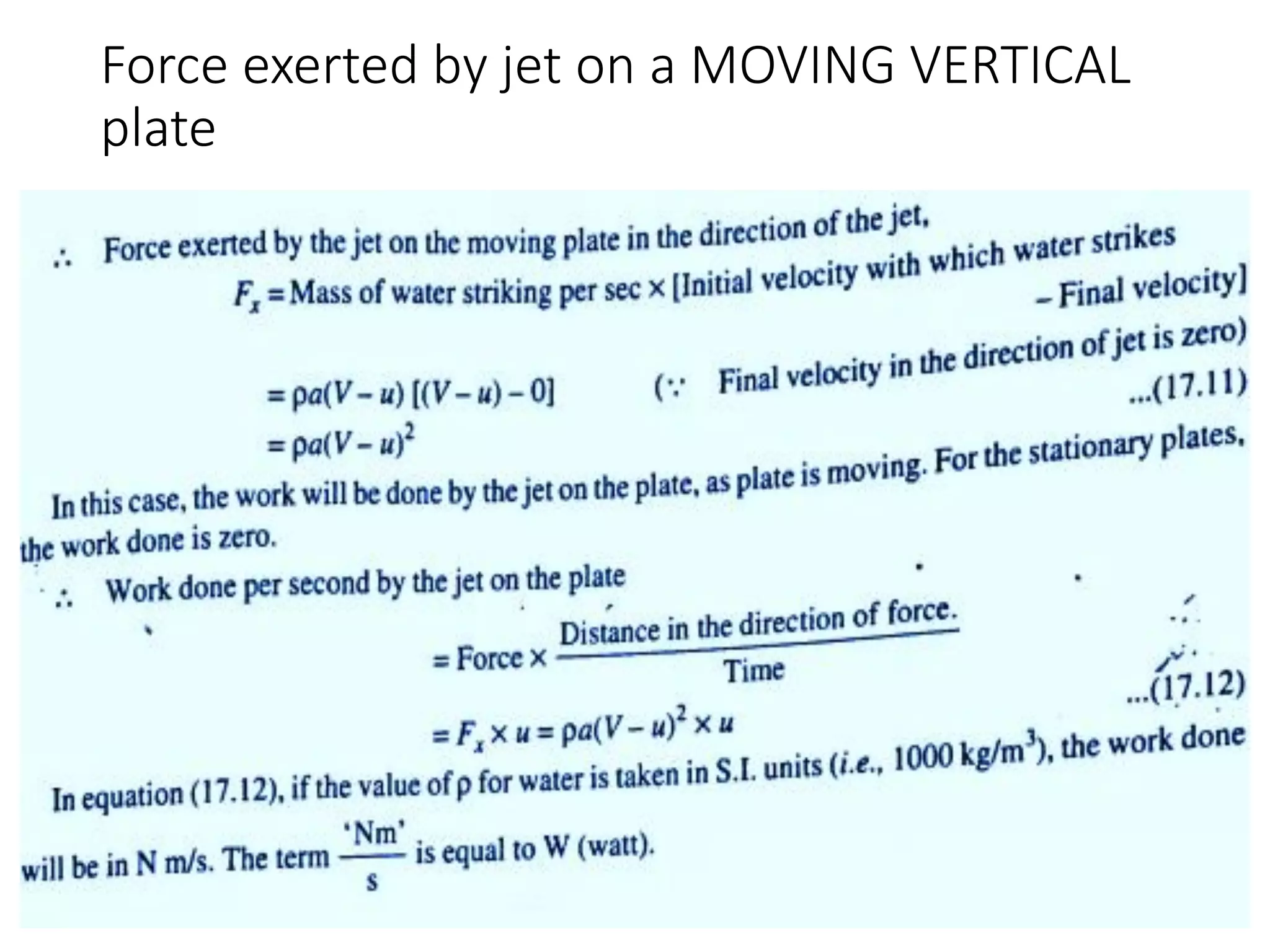
Force exerted by jet on a MOVING VERTICAL
plate
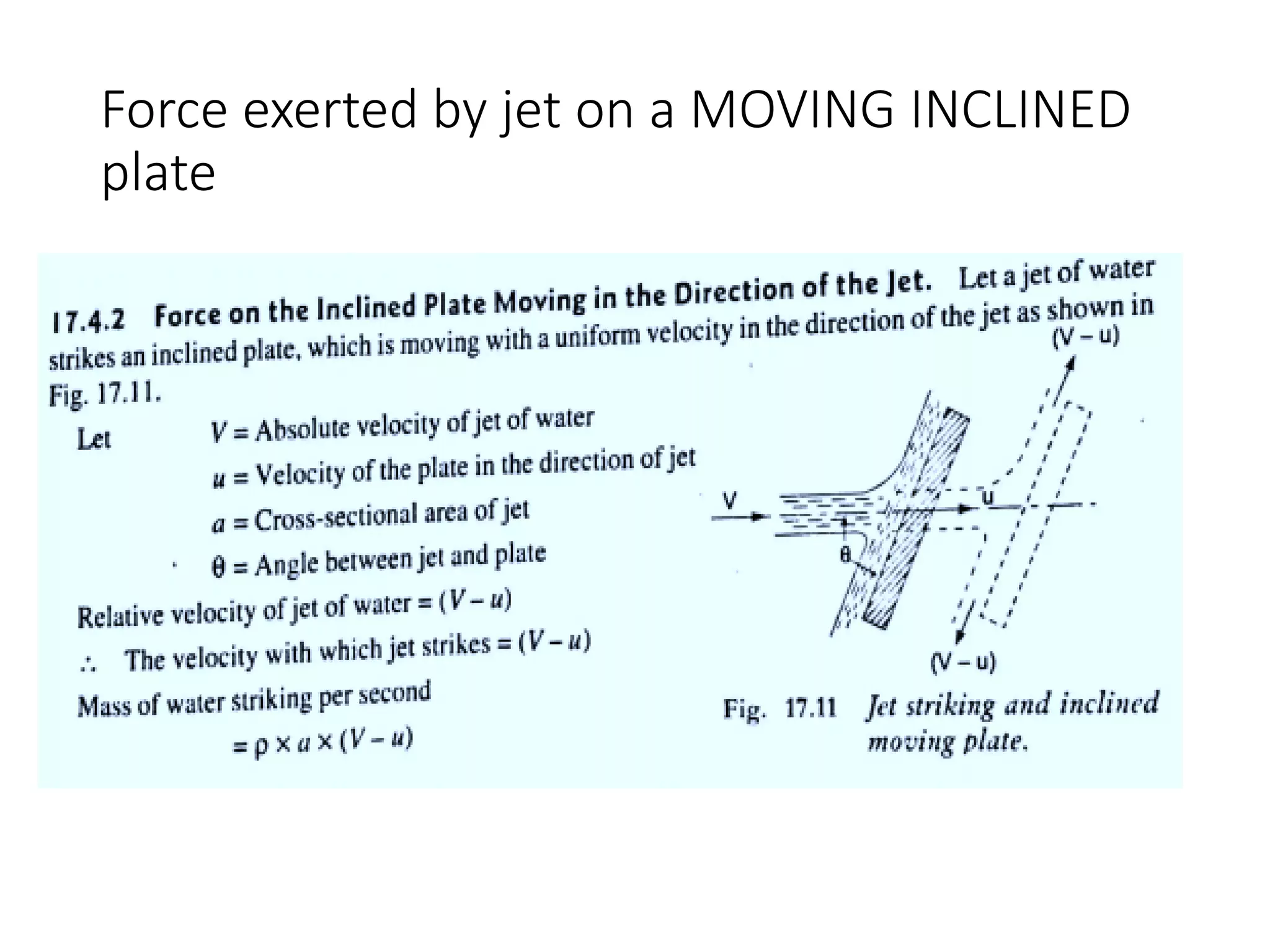
Force exerted by jet on a MOVING INCLINED
plate
Force exerted by jet on a MOVING INCLINED
plate
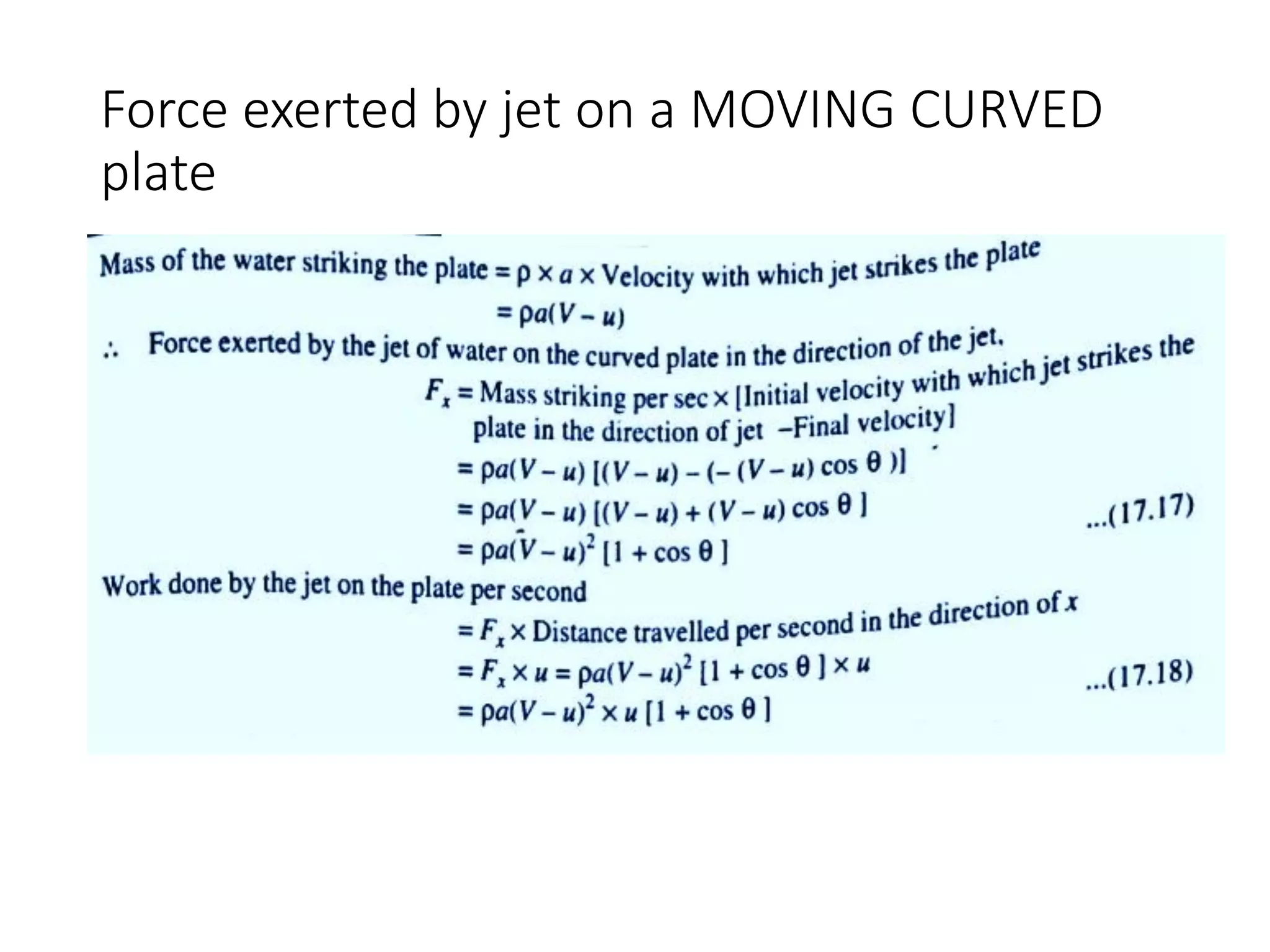
Force exerted by jet on a MOVING CURVED
plate
Force exerted by jet on a MOVING CURVED
plate
Concept of Angular momentum/Moment of
Momentum Equation

120218 chapter 8 momentum analysis of flow

  • 1.
    Chapter 8 Momentum Analysisof Flow Prepared By: Binu Karki
  • 2.
    Momentum equation •It isbased on law of conservation of momentum or on momentum principle which states “The net force acting on the fluid mass is equal to the change in momentum of flow per unit time in that direction”. The force acting on a fluid mass ‘m’ is given by the Newton's second law of motion. F=ma Where, a-acceleration acting in the same direction as force F.
  • 3.
    Momentum equation But a= 𝑑𝑣 𝑑𝑡 F=m 𝑑𝑣 𝑑𝑡 orF= 𝑑(𝑚𝑣) 𝑑𝑡 is known as the momentum principle (m is constant and can be taken inside the differential) or F*dt=d(mv) Which is known as impulse momentum equation Impulse of force ‘F’ acting on a fluid of mass ‘m’ in a short interval of time ‘dt’ is equal to the change of momentum ‘d(mv)’ in the direction of force.
  • 4.
    Force exerted bya flowing fluid on a pipe bend • This is used to determine the resultant force exerted by a flowing fluid on a pipe bend.
  • 5.
    Force exerted bya flowing fluid on a pipe bend Consider two sections 1 and 2 as shown in figure. • v1-velocity of flow at section 1 • p1-pressure intensity at section 1 • A1-Area of cross-section of pipe at section 1 and • v2,p2,A2-corresponding values of velocity, pressure and area at section 2. • Fx and Fy-forces exerted by the flowing fluid on the bend in x and y directions but in opposite directions. • p1A1 and p2A2-other external forces acting at sections 1 and 2 respectively
  • 6.
    Force exerted bya flowing fluid on a pipe bend Then, momentum equation in x-direction is given by:
  • 7.
    Force exerted bya flowing fluid on a pipe bend
  • 8.
    Impact of Jets •The liquid comes out in the form of jet from the outlet of the nozzle, which is fitted to a pipe through which the liquid is flowing under pressure. • If some plate(fixed or moving) is placed in the path of the jet, force is exerted by the jet on the plate. • This force is obtained from Newtons second law of motion OR from impulse momentum equation.
  • 9.
    Force exerted byjet on the stationary plate Cases: • Plate is vertical to the jet • Plate is inclined to the jet • Plate is curved
  • 10.
    Case A:Force exertedby jet on a STATIONARY VERTICAL plate
  • 11.
    Case A:Force exertedby jet on a STATIONARY VERTICAL plate • Consider a jet of water coming out from the nozzle, strikes a flat vertical plate then Let, v-velocity of the jet, d-diameter of the jet, a- cross-sectional area of the jet The jet after striking the plate will get deflected through 90ₒ .The component of velocity of jet, in the direction of jet, after striking will be zero.
  • 12.
    Case A:Force exertedby jet on a STATIONARY VERTICAL plate The force exerted by the jet on the plate in the direction of the jet,
  • 13.
    Case A:Force exertedby jet on a STATIONARY VERTICAL plate NOTE • If force exerted ON the jet is to be calculated then final velocity-initial velocity is taken. • If force exerted BY the jet is to be calculated then initial velocity - final velocity is taken.
  • 14.
    Case A:Force exertedby jet on a STATIONARY INCLINED FLAT plate
  • 15.
    Case A:Force exertedby jet on a STATIONARY INCLINED FLAT plate Let the jet of water coming out from the nozzle strikes the inclined plate. V-velocity of jet in the x-direction a- cross-section area of the jet Θ-Angle between the jet and plate Mass of water striking the plate per sec=ρaV Force exerted by the jet in the direction normal to the plate.
  • 16.
    Case A:Force exertedby jet on a STATIONARY CURVED plate
  • 17.
    Case A:Force exertedby jet on a STATIONARY CURVED plate
  • 18.
    Case B:Force exertedby jet on a STATIONARY CURVED plate
  • 19.
    Force exerted byjet on a MOVING VERTICAL plate
  • 20.
    Force exerted byjet on a MOVING VERTICAL plate
  • 21.
    Force exerted byjet on a MOVING INCLINED plate
  • 22.
    Force exerted byjet on a MOVING INCLINED plate
  • 23.
    Force exerted byjet on a MOVING CURVED plate
  • 24.
    Force exerted byjet on a MOVING CURVED plate
  • 25.
    Concept of Angularmomentum/Moment of Momentum Equation