Name Enrollment No.
Desai Keval J. 131100106005
Desai Divy J. 131100106008
Naik Kunj N. 131100106016
Patel Kinjal M. 131100106032
Patel Yash 131100106042
Guided by – Prof. Manali Shah
1
 Cross regulators
 Head regulators
 Canal escapes
 Silt control devices
 Canal outlet works & flow meter
2
3
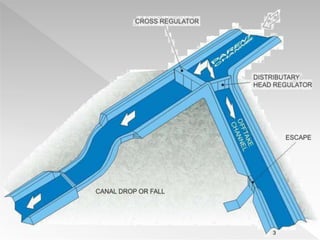
 A cross regulator is provided on the parent channel at the
downstream of the off taking canal to head up the water level
and to enable the off taking channel to draw the required
supply.
OR
 To head up water in the parent channel to divert some of it
through an off take channel, like a distributary.
4
1. Usually a bridges on the cross regulator, which provides a
means of Communication.
2. During the periods of low Discharge, the cross regulator
raises water level on the u/s so that the offtaking channel
can takes its full supply.
3. Helps in closing the supply to the d/s of the parent channel,
for the purpose of repairs.
4. Used to control the drawdown when the subsoil water levels
are high to ensure safety of canal lining.
5
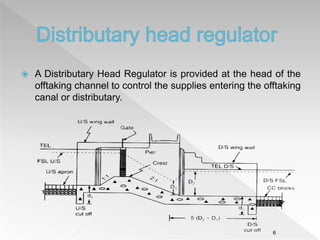
 A Distributary Head Regulator is provided at the head of the
offtaking channel to control the supplies entering the offtaking
canal or distributary.
6
1. They regulate or control the supply of water to the offtaking
channel from the parent channel
2. They control the entry of silt in the offtaking channel.
3. They serve as meter for measuring the discharge entering
into the offtaking canal
4. They help in shutting off the supplies when not needed in the
offtaking channel is required to be closed for repairs
7
 A canal escapes is a structure constructed on an irrigation
canal for the disposal of surplus water from the canal.
 Structures meant to release excess water from a canal,
which could be main canal, branch canal, distributary, minors
etc.
 It is a short of safety value.
8
a) Classification based on the purpose
1. Surplus water escape
2. Canal scouring escape
3. Tail escape
b) Classification based on the structural
1. Regulator type escape or sluice type escapes
2. Weir type escapes
9
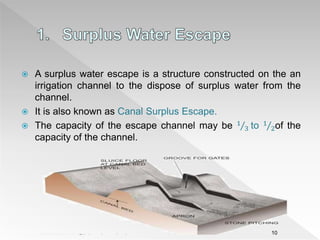
 A surplus water escape is a structure constructed on the an
irrigation channel to the dispose of surplus water from the
channel.
 It is also known as Canal Surplus Escape.
 The capacity of the escape channel may be 1
3 to 1
2of the
capacity of the channel.
10
 The canal scouring escape is constructed in the bank of the
canal for the purpose of scouring off excess silt from time to
time.
 The discharge capacity of the canal scouring escape should
be about 1
2 to 2
3 of the capacity of the main canal at the
head.
11
 An irrigation canal generally ends in a natural drain or river.
 An escape is provided across the channel at its tail end to
maintain the required F.S.L at the tail end.
 Such an escape is called tail escape.
12
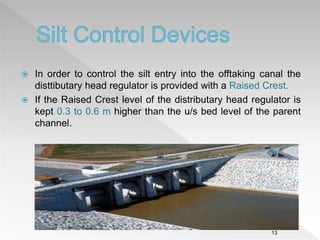
 In order to control the silt entry into the offtaking canal the
disttibutary head regulator is provided with a Raised Crest.
 If the Raised Crest level of the distributary head regulator is
kept 0.3 to 0.6 m higher than the u/s bed level of the parent
channel.
13
 Following devices are used to reduce the silt entry into
the offtaking channel :
1. King’s vanes
2. Gibb’s groyne wall
3. Cantilever skimming platform
4. Curved wings
5. Curved wings with sediment vanes
6. Desilting basins
7. Vortex tube
14
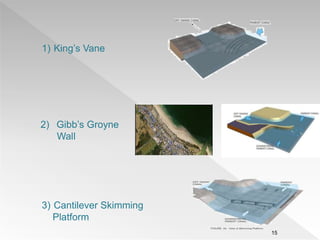
1) King’s Vane
2) Gibb’s Groyne
Wall
3) Cantilever Skimming
Platform
15
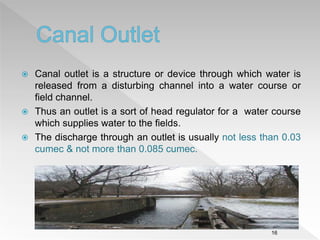
 Canal outlet is a structure or device through which water is
released from a disturbing channel into a water course or
field channel.
 Thus an outlet is a sort of head regulator for a water course
which supplies water to the fields.
 The discharge through an outlet is usually not less than 0.03
cumec & not more than 0.085 cumec.
16
 It should be simple in design ,construction and maintenance.
 It should be quite strong and durable.
 It should not be easily tampered with by the cultivators, but if
tampered with it should be easily detected
 It should be worked efficiently with a small working load.
 It should not be expensive.
 It design should be such that it can be easily constructed by the
local workers.
17
 Outlets may be classified as ,
1. Non-modular outlet
2. Semi-modular outlet (Flexible modules)
3. Modular outlets (Rigid modules)
18
 A non–modular outlet is the outlet whose discharge depend
upon the difference in ware levels of both the distributing
channel and the water course.
 The discharge through through a non – modular outlet ,
therefore, varies with the variation of water levels in both the
distributary and the water course.
For example:
Submerged pipe outlet
Masonry sluice and orifice
Wooden shoots
19
 A semi modular outlet is the outlet whose discharge depends
only upon the water level in the distributary and is
independent of the water level in the water course.
For example :
Pipe outlet
Kennedy’s gauge outlet
crump’s open flume outlet
Pipe cum open flume outlet
20
 A modular outlet is the outlet whose discharge is
independent of the water levels of both the distributary and
the water course.
 Thus, a modular outlet maintains a constant discharge
irrespective of variation of water levels in the disrtributary and
the water course
For example :
Gibb’s rigid module
21
 Flow meter or parshall flume is a device for measuring water
flowing in irrigation channels or canals by measuring the loss
of head of a stream passing through the flume.
 It can be used to measure water flow in streams of varying
sizes from of very small one to a very large one.
 Different sizes of parshall flumes are used for the purpose.
 Smaller ones are used in irrigation channels and large ones
in canals.
22
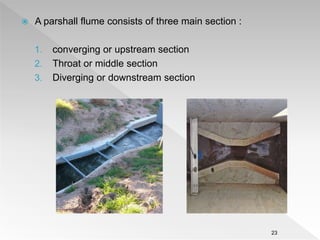
 A parshall flume consists of three main section :
1. converging or upstream section
2. Throat or middle section
3. Diverging or downstream section
23
 http://www.slideshare.net/bibhabasumohanty/canal-
regulation-works-m4pptx
 https://www.google.com/search?q=distributary+head+regulat
or&espv=2&biw=1366&bih=662&source=lnms&tbm=isch&sa
=X&ved=0ahUKEwj0ppy6n63PAhUFqo8KHaalAvUQ_AUIBy
gC#imgrc=C1-2v_bfIKJqnM%3A
 https://www.google.co.in/
 Atul Prakashan by Dr. R.P. rethaliya & Dr. S.K. dave
24
25

Canal Regulation Work

  • 1.
    Name Enrollment No. DesaiKeval J. 131100106005 Desai Divy J. 131100106008 Naik Kunj N. 131100106016 Patel Kinjal M. 131100106032 Patel Yash 131100106042 Guided by – Prof. Manali Shah 1
  • 2.
     Cross regulators Head regulators  Canal escapes  Silt control devices  Canal outlet works & flow meter 2
  • 3.
  • 4.
     A crossregulator is provided on the parent channel at the downstream of the off taking canal to head up the water level and to enable the off taking channel to draw the required supply. OR  To head up water in the parent channel to divert some of it through an off take channel, like a distributary. 4
  • 5.
    1. Usually abridges on the cross regulator, which provides a means of Communication. 2. During the periods of low Discharge, the cross regulator raises water level on the u/s so that the offtaking channel can takes its full supply. 3. Helps in closing the supply to the d/s of the parent channel, for the purpose of repairs. 4. Used to control the drawdown when the subsoil water levels are high to ensure safety of canal lining. 5
  • 6.
     A DistributaryHead Regulator is provided at the head of the offtaking channel to control the supplies entering the offtaking canal or distributary. 6
  • 7.
    1. They regulateor control the supply of water to the offtaking channel from the parent channel 2. They control the entry of silt in the offtaking channel. 3. They serve as meter for measuring the discharge entering into the offtaking canal 4. They help in shutting off the supplies when not needed in the offtaking channel is required to be closed for repairs 7
  • 8.
     A canalescapes is a structure constructed on an irrigation canal for the disposal of surplus water from the canal.  Structures meant to release excess water from a canal, which could be main canal, branch canal, distributary, minors etc.  It is a short of safety value. 8
  • 9.
    a) Classification basedon the purpose 1. Surplus water escape 2. Canal scouring escape 3. Tail escape b) Classification based on the structural 1. Regulator type escape or sluice type escapes 2. Weir type escapes 9
  • 10.
     A surpluswater escape is a structure constructed on the an irrigation channel to the dispose of surplus water from the channel.  It is also known as Canal Surplus Escape.  The capacity of the escape channel may be 1 3 to 1 2of the capacity of the channel. 10
  • 11.
     The canalscouring escape is constructed in the bank of the canal for the purpose of scouring off excess silt from time to time.  The discharge capacity of the canal scouring escape should be about 1 2 to 2 3 of the capacity of the main canal at the head. 11
  • 12.
     An irrigationcanal generally ends in a natural drain or river.  An escape is provided across the channel at its tail end to maintain the required F.S.L at the tail end.  Such an escape is called tail escape. 12
  • 13.
     In orderto control the silt entry into the offtaking canal the disttibutary head regulator is provided with a Raised Crest.  If the Raised Crest level of the distributary head regulator is kept 0.3 to 0.6 m higher than the u/s bed level of the parent channel. 13
  • 14.
     Following devicesare used to reduce the silt entry into the offtaking channel : 1. King’s vanes 2. Gibb’s groyne wall 3. Cantilever skimming platform 4. Curved wings 5. Curved wings with sediment vanes 6. Desilting basins 7. Vortex tube 14
  • 15.
    1) King’s Vane 2)Gibb’s Groyne Wall 3) Cantilever Skimming Platform 15
  • 16.
     Canal outletis a structure or device through which water is released from a disturbing channel into a water course or field channel.  Thus an outlet is a sort of head regulator for a water course which supplies water to the fields.  The discharge through an outlet is usually not less than 0.03 cumec & not more than 0.085 cumec. 16
  • 17.
     It shouldbe simple in design ,construction and maintenance.  It should be quite strong and durable.  It should not be easily tampered with by the cultivators, but if tampered with it should be easily detected  It should be worked efficiently with a small working load.  It should not be expensive.  It design should be such that it can be easily constructed by the local workers. 17
  • 18.
     Outlets maybe classified as , 1. Non-modular outlet 2. Semi-modular outlet (Flexible modules) 3. Modular outlets (Rigid modules) 18
  • 19.
     A non–modularoutlet is the outlet whose discharge depend upon the difference in ware levels of both the distributing channel and the water course.  The discharge through through a non – modular outlet , therefore, varies with the variation of water levels in both the distributary and the water course. For example: Submerged pipe outlet Masonry sluice and orifice Wooden shoots 19
  • 20.
     A semimodular outlet is the outlet whose discharge depends only upon the water level in the distributary and is independent of the water level in the water course. For example : Pipe outlet Kennedy’s gauge outlet crump’s open flume outlet Pipe cum open flume outlet 20
  • 21.
     A modularoutlet is the outlet whose discharge is independent of the water levels of both the distributary and the water course.  Thus, a modular outlet maintains a constant discharge irrespective of variation of water levels in the disrtributary and the water course For example : Gibb’s rigid module 21
  • 22.
     Flow meteror parshall flume is a device for measuring water flowing in irrigation channels or canals by measuring the loss of head of a stream passing through the flume.  It can be used to measure water flow in streams of varying sizes from of very small one to a very large one.  Different sizes of parshall flumes are used for the purpose.  Smaller ones are used in irrigation channels and large ones in canals. 22
  • 23.
     A parshallflume consists of three main section : 1. converging or upstream section 2. Throat or middle section 3. Diverging or downstream section 23
  • 24.
  • 25.