LOSSES OF PIPE FLOW
 WHEN A FLUID IS FLOWING A
PIPE,THE FLUID EXPERIENCE
SOME RESISTANCE DUE TO
WHICH SOME OF THE ENERGY OF
FLUID IS LOST.
1
THE LOSSES OF ENERGY IS
CLASSIFIED AS
 MAJOR ENERGY LOSSES
 MINOR ENERGY LOSSES
2
MAJOR ENERGY LOSSES
 The fluid flowing in the pipe is always subjected to resistance due to
shear forces between fluid particles and the boundary wall of the pipe
and between the fluid particles themselves resulting from the viscosity
of the fluid. This resistance to the flow is called frictional resistance
and loss of head due to that is called frictional losses.
 This frictional losses depends upon the type of flow (laminar or
turbulent ). There are different laws of fluid friction for laminar flow and
turbulent flow.
3
LAWS OF FLUID FRICTION
 (A) LAWS OF FLUID FRICTIONAL FOR LAMINAR FLOW.
The frictional resistance in the laminar flow is –
* proportional to the velocity of flow .
* independent of the pressure .
* proportional to the surface area in contact.
* independent of the nature of surface is contact.
4
.
 (B) LAWS OF FLUID FRICTIONAL FOR TURBULENT FLOW.
The frictional resistance in the case of turbulent flow is -
* proportional to (velocity).
* independent of pressure .
* proportional to the density of the flowing fluid.
* proportional to the surface area in contact.
5
Laminar flow transition flow turbulent flow
Rn.no=<2000 Rn.no=2000 to 4000 Rn.no=>4000
Rn.no = renold number
6
MINOR LOSSES
 The minor losses of energy are those which are caused on account of
the change in the velocity of flowing fluid. The change may be there in
either magnitude or direction. Minor losses are caused by certain local
features or disturbance, which may cause eddy formation.
 In case of long pipes these losses are usually quite small as compared
with the loss of energy due to friction and hence are called as ‘minor
losses’.
 It can be neglected without serious error. But in short pipes these
losses may overweigh the friction loss.
7
The minor loss of energy includes following cases :
 Loss of head due to sudden enlargement.
 Loss of head due to sudden contraction.
 Loss of head at the entrance of pipe.
 Loss of head at the exit of pipe.
 Loss of head due to an obstruction.
 Loss of head due to bend in the pipe.
 Loss of head in various pipe fittings.
8
Sudden enlargement 9
Energy lost is because of
turbulence.
Amount of turbulence
depends on the differences
in pipe diameters
ℎ𝑙 = K(𝑣1
2
/2g)
 ℎ𝑙 = head loss of flow
 K = Resistance coefficient
 V = velocity of flow
 g = gravitational force
K = [1-(𝐴1/𝐴2)]2
=[1-(𝐷1/𝐷2)2
]2
A= area of pipe
D = diameter of pipe
10
Sudden Contraction
 Decrease in pipe diameter
 loss is related to the velocity in the
smaller pipe.
 The loss is associated with the
contraction of flow and turbulence.
 The section at which the flow is the
narrowest – Vena Contracta.
 At vena contracta the velocity is
maximum.
11
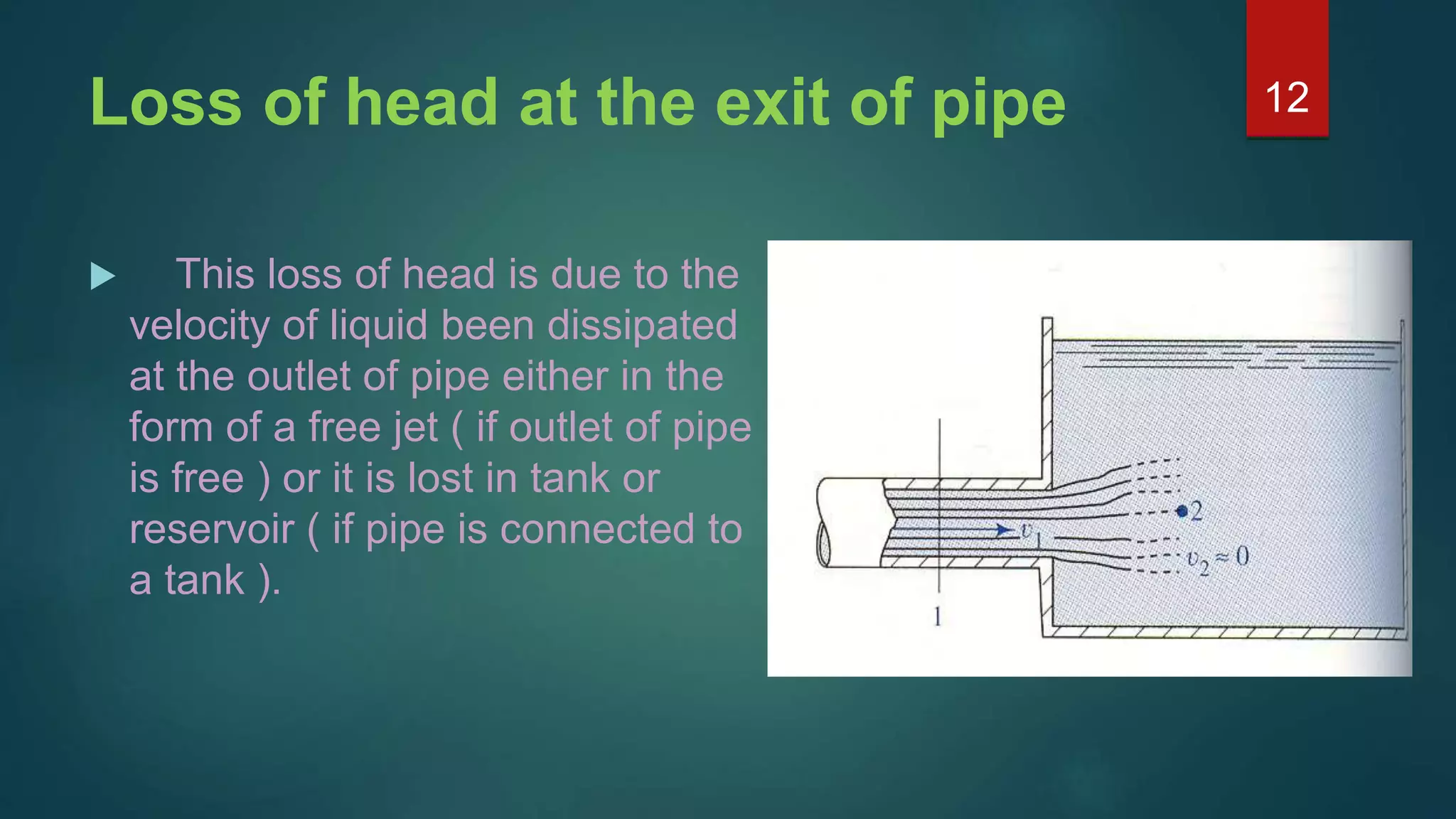
Loss of head at the exit of pipe
 This loss of head is due to the
velocity of liquid been dissipated
at the outlet of pipe either in the
form of a free jet ( if outlet of pipe
is free ) or it is lost in tank or
reservoir ( if pipe is connected to
a tank ).
12
.
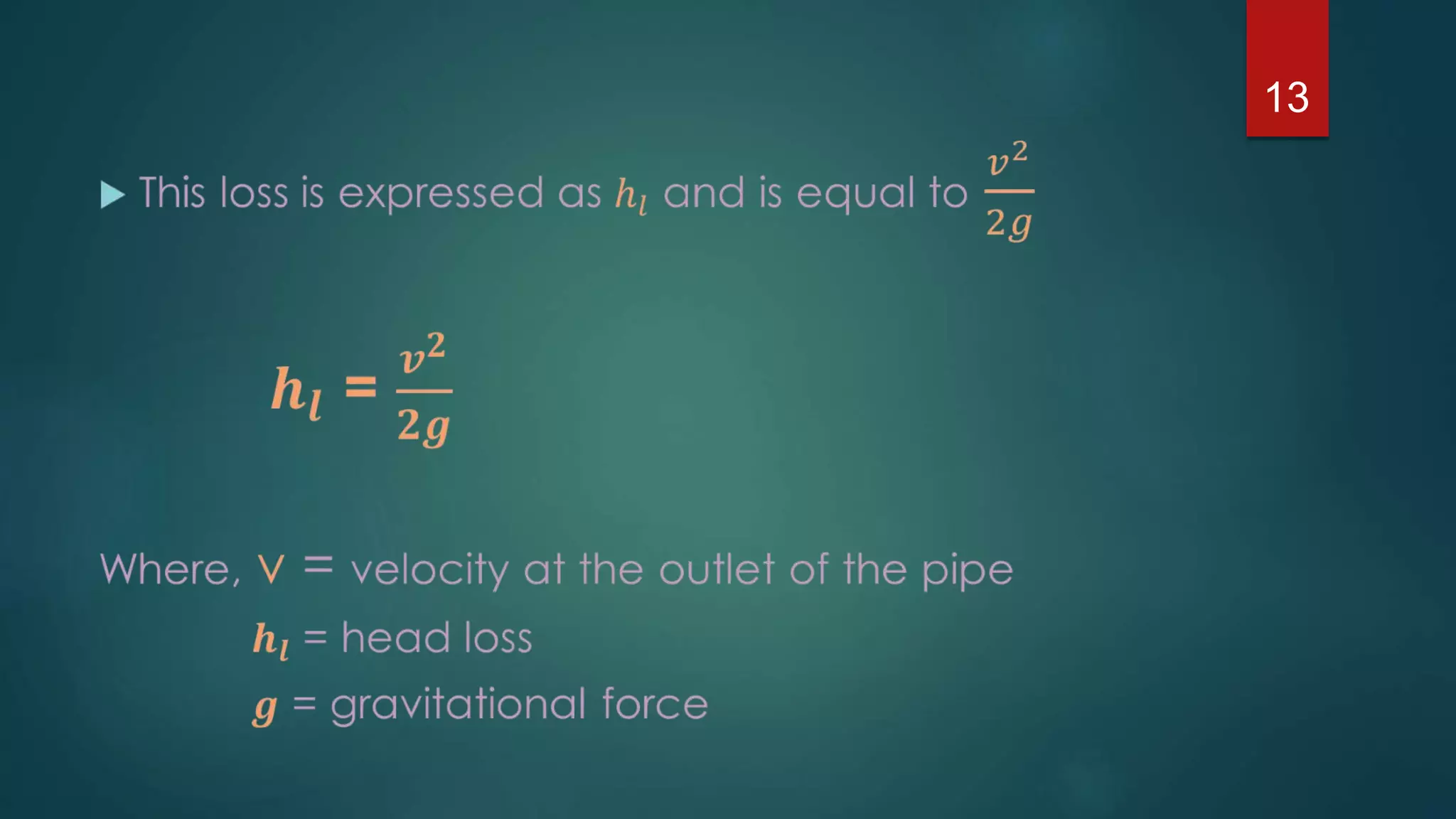
13
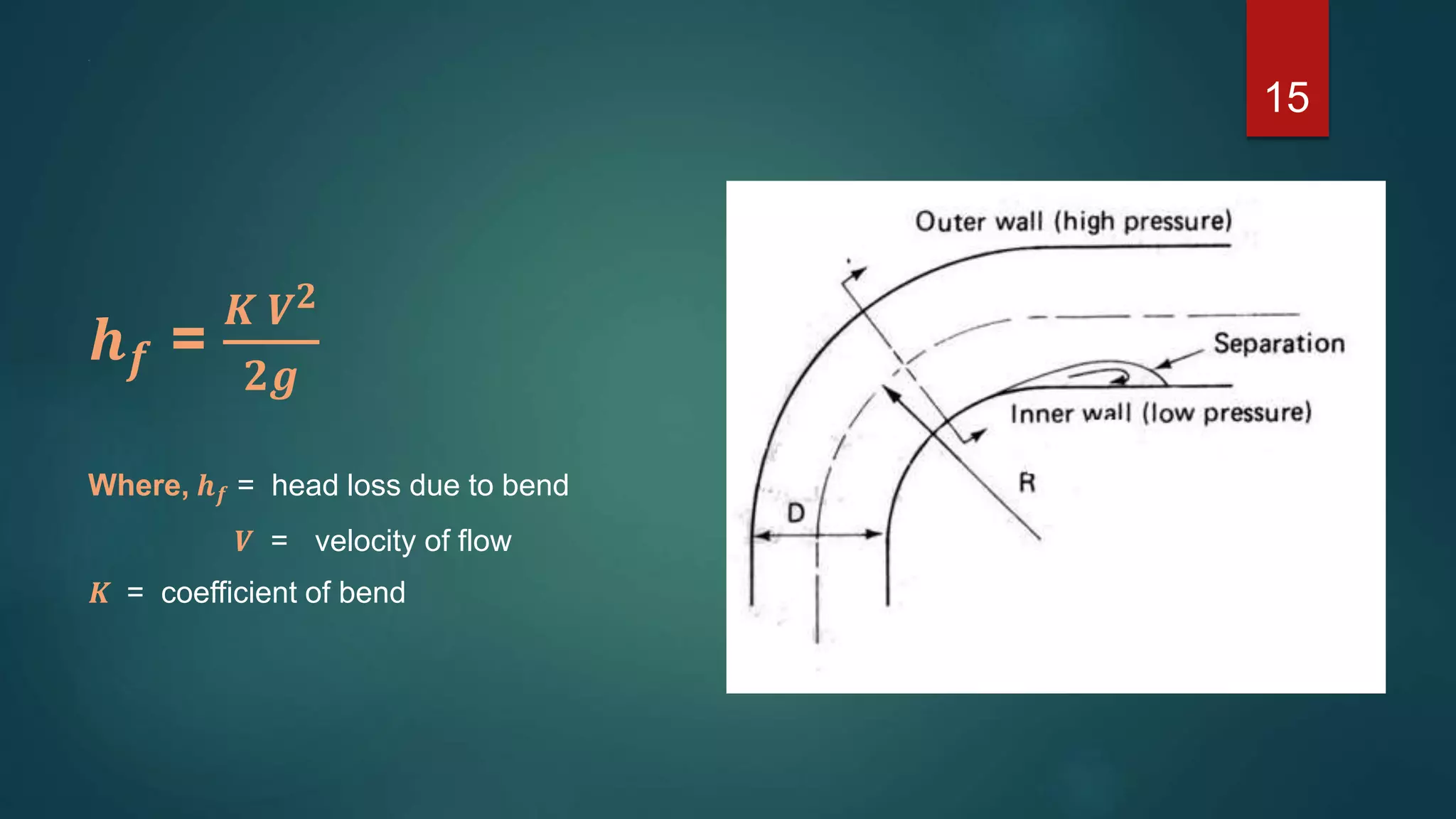
Loss of head due to bend in the pipe
 When there is any bend in a pipe, the velocity of flow
changes due to which the separation of the flow from the
boundary takes place, there is also formation of eddies. Which
results in a loss of energy or head. This loss of head or energy
as expressed as
14
<<,
15
𝒉 𝒇 =
𝑲 𝑽 𝟐
𝟐𝒈
Where, 𝒉 𝒇 = head loss due to bend
𝑽 = velocity of flow
𝑲 = coefficient of bend
Loss of head in various pipe fittings
 The loss of head in the various pipe fitting like valves,coupling,elbow, etc.
can be expressed as
=
𝒌 𝑽 𝟐
𝟐𝒈
𝒌= co-efficient of pipe fitting
16
.
17

losses in pipe flow

  • 1.
    LOSSES OF PIPEFLOW  WHEN A FLUID IS FLOWING A PIPE,THE FLUID EXPERIENCE SOME RESISTANCE DUE TO WHICH SOME OF THE ENERGY OF FLUID IS LOST. 1
  • 2.
    THE LOSSES OFENERGY IS CLASSIFIED AS  MAJOR ENERGY LOSSES  MINOR ENERGY LOSSES 2
  • 3.
    MAJOR ENERGY LOSSES The fluid flowing in the pipe is always subjected to resistance due to shear forces between fluid particles and the boundary wall of the pipe and between the fluid particles themselves resulting from the viscosity of the fluid. This resistance to the flow is called frictional resistance and loss of head due to that is called frictional losses.  This frictional losses depends upon the type of flow (laminar or turbulent ). There are different laws of fluid friction for laminar flow and turbulent flow. 3
  • 4.
    LAWS OF FLUIDFRICTION  (A) LAWS OF FLUID FRICTIONAL FOR LAMINAR FLOW. The frictional resistance in the laminar flow is – * proportional to the velocity of flow . * independent of the pressure . * proportional to the surface area in contact. * independent of the nature of surface is contact. 4
  • 5.
    .  (B) LAWSOF FLUID FRICTIONAL FOR TURBULENT FLOW. The frictional resistance in the case of turbulent flow is - * proportional to (velocity). * independent of pressure . * proportional to the density of the flowing fluid. * proportional to the surface area in contact. 5
  • 6.
    Laminar flow transitionflow turbulent flow Rn.no=<2000 Rn.no=2000 to 4000 Rn.no=>4000 Rn.no = renold number 6
  • 7.
    MINOR LOSSES  Theminor losses of energy are those which are caused on account of the change in the velocity of flowing fluid. The change may be there in either magnitude or direction. Minor losses are caused by certain local features or disturbance, which may cause eddy formation.  In case of long pipes these losses are usually quite small as compared with the loss of energy due to friction and hence are called as ‘minor losses’.  It can be neglected without serious error. But in short pipes these losses may overweigh the friction loss. 7
  • 8.
    The minor lossof energy includes following cases :  Loss of head due to sudden enlargement.  Loss of head due to sudden contraction.  Loss of head at the entrance of pipe.  Loss of head at the exit of pipe.  Loss of head due to an obstruction.  Loss of head due to bend in the pipe.  Loss of head in various pipe fittings. 8
  • 9.
    Sudden enlargement 9 Energylost is because of turbulence. Amount of turbulence depends on the differences in pipe diameters
  • 10.
    ℎ𝑙 = K(𝑣1 2 /2g) ℎ𝑙 = head loss of flow  K = Resistance coefficient  V = velocity of flow  g = gravitational force K = [1-(𝐴1/𝐴2)]2 =[1-(𝐷1/𝐷2)2 ]2 A= area of pipe D = diameter of pipe 10
  • 11.
    Sudden Contraction  Decreasein pipe diameter  loss is related to the velocity in the smaller pipe.  The loss is associated with the contraction of flow and turbulence.  The section at which the flow is the narrowest – Vena Contracta.  At vena contracta the velocity is maximum. 11
  • 12.
    Loss of headat the exit of pipe  This loss of head is due to the velocity of liquid been dissipated at the outlet of pipe either in the form of a free jet ( if outlet of pipe is free ) or it is lost in tank or reservoir ( if pipe is connected to a tank ). 12
  • 13.
  • 14.
    Loss of headdue to bend in the pipe  When there is any bend in a pipe, the velocity of flow changes due to which the separation of the flow from the boundary takes place, there is also formation of eddies. Which results in a loss of energy or head. This loss of head or energy as expressed as 14
  • 15.
    <<, 15 𝒉 𝒇 = 𝑲𝑽 𝟐 𝟐𝒈 Where, 𝒉 𝒇 = head loss due to bend 𝑽 = velocity of flow 𝑲 = coefficient of bend
  • 16.
    Loss of headin various pipe fittings  The loss of head in the various pipe fitting like valves,coupling,elbow, etc. can be expressed as = 𝒌 𝑽 𝟐 𝟐𝒈 𝒌= co-efficient of pipe fitting 16
  • 17.