GL

BAL

Institute of Information Technology
Group members:
Deshraj Singh
Rajmurat Yadav
Contents
 A Short
 Its

Introduction

uses
 Some examples
 Nature of Sensors
 Resolution of Sensors
 Types of sensors
 Bio-sensors
 Properties
INTRODUCTION


A sensor is a device that measures a
physical quantity and converts it into a
signal which can be read by an observer or
by an instrument



Example: You can say that our
skin, ears, eyes and nose are also a
sensor because the can sense touch
,heat,cold, light, noise and smell.



For accuracy, most of the sensors are
calibrated against some known standards..
What is a sensor??


A sensor is a device that receives and
responds to a signal. A sensors sensitivity
indicates how much the sensors output
changes when the measured quantity
changes.



Sensors are a new solution for measuring
currents and voltages in medium voltage
power systems.



A Typical example is a mercury used in a
glass thermometer that measures the
temperature and converts it into the
expansion of a liquid.
USES


Sensors are used in every day objects
such as touch-sensitive elevator buttons
and lamps which dim or brighten by
touching the base.



There are innumerable applications of this
technology of which most of people are not
aware .



Its
applications
include
Cars, Machines, Aerospace, Medicines, M
anufacturing and Robotics... And many
more.
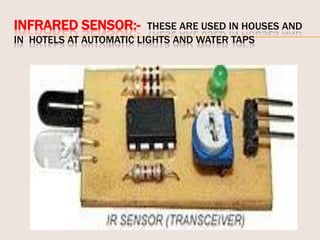
INFRARED SENSOR:-

THESE ARE USED IN HOUSES AND
IN HOTELS AT AUTOMATIC LIGHTS AND WATER TAPS
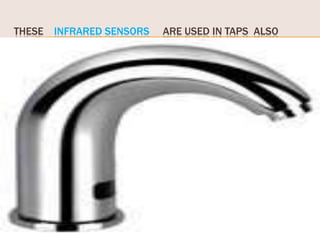
THESE INFRARED SENSORS

ARE USED IN TAPS ALSO
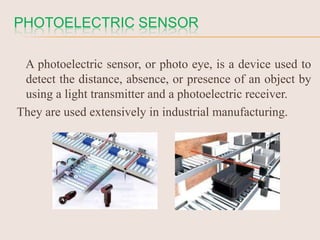
PHOTOELECTRIC SENSOR
A photoelectric sensor, or photo eye, is a device used to
detect the distance, absence, or presence of an object by
using a light transmitter and a photoelectric receiver.
They are used extensively in industrial manufacturing.
STREET LIGHTS
The street lights automatically turns on and
off as the sun rises and sun sets.
 This is implemented by using photo electric
effect.
 The street lights automatically turns on and
off on the basis of darkness measured by a
sensor.

AUTOMATIC STAIRS


It starts running and stops automatically as it
senses the presence or absence of a person.
SENSOR’S NATURE
A good sensor obeys the following rules:
• It is sensitive to the measured property
•Itis insensitive to any other property
• It does not influence the measured
property


A Bad sensor has following Characteristics



If the sensor is not ideal, several types of
deviations can be observed:



The sensitivity may differ from the value specified.
This is called a sensitivity error, but the sensor is
still linear.
Rules for good sensor


It is sensitive to the measured property
only.



It is insensitive to any other property
likely to be encountered in its
applications..



It does not influence the measured
property



Ideal sensors are designed to be linear.
Some other attributes


The output signal of a good sensor is
linearly proportional to the value of the
measured property



The sensitivity is then defined as the
ratio between output signal and
measured property..



Ex: If a sensor measures temperature
and has a voltage output, the sensitivity
is a constant.



Sensor is linear because the ratio is
constant at all points of measurement..
Resolution


The resolution of a sensor is the
smallest change that it can detect in the
quantity that it is measuring..



In a digital display, the least significant
digit will fluctuate, indicating the
changes of its magnitude.



And Resolution is related to precision.



Ex: A scanning tunnelling probe
resolves into atoms and molecules.
Types of sensors


Optical sensor



Microwave sensor



Bio sensor



Non-biological sensor
Optical Sensor


Optical sensors observe visible lights
and infrared rays.



There are two kinds of observation
methods using optical sensors:



Visible/near infrared remote sensing



Thermal infrared remote sensing.
Microwave Sensor


Microwave sensors receive microwaves, which
is longer wavelength than visible light and
infrared rays, and observation is not affected by
day, night or weather.



There are two types of observation methods
using microwave sensor: active and passive.

o

Active type

o

Passive type
Bio-sensor


In bio medicine, and bio technology, sensors
which can detect analyses thanks to a
biological component, such as
cells, proteins, nucleic acid or biometric
polymers, are called bio sensors.
Non-biological sensors


A non biological for both sensor, even
organic=carbon
chemistry,
for
biological analyses is referred to as
sensor or nano sensor.



This terminology applies for both in
vitro and in vivo applications.



The encapsulation of the biological
component in bio sensors, presents
with a slightly different problem that
ordinary sensors.


This can be done by means of a semi
permeable barrier, such as a dialysis
membrane or a hydrogen, a 3d polymer
matrix
which
either
physically
constrains the sensing macro molecule
or chemically.
Properties


The natural properties of the soft iron
core, as maximal flux density and lack
of linearity in the excitation curve, have
sets limits for the possibilities to reduce
the transformer size and to use the
transformer in a wider range of
applications



These principles are far from new, they
are generally as old as the principles of
conventional
inductive
instrument
transformers.
Sensor technology
Sensor technology

Sensor technology

  • 1.
  • 2.
  • 3.
    Contents  A Short Its Introduction uses  Some examples  Nature of Sensors  Resolution of Sensors  Types of sensors  Bio-sensors  Properties
  • 4.
    INTRODUCTION  A sensor isa device that measures a physical quantity and converts it into a signal which can be read by an observer or by an instrument  Example: You can say that our skin, ears, eyes and nose are also a sensor because the can sense touch ,heat,cold, light, noise and smell.  For accuracy, most of the sensors are calibrated against some known standards..
  • 5.
    What is asensor??  A sensor is a device that receives and responds to a signal. A sensors sensitivity indicates how much the sensors output changes when the measured quantity changes.  Sensors are a new solution for measuring currents and voltages in medium voltage power systems.  A Typical example is a mercury used in a glass thermometer that measures the temperature and converts it into the expansion of a liquid.
  • 6.
    USES  Sensors are usedin every day objects such as touch-sensitive elevator buttons and lamps which dim or brighten by touching the base.  There are innumerable applications of this technology of which most of people are not aware .  Its applications include Cars, Machines, Aerospace, Medicines, M anufacturing and Robotics... And many more.
  • 7.
    INFRARED SENSOR:- THESE AREUSED IN HOUSES AND IN HOTELS AT AUTOMATIC LIGHTS AND WATER TAPS
  • 8.
    THESE INFRARED SENSORS AREUSED IN TAPS ALSO
  • 9.
    PHOTOELECTRIC SENSOR A photoelectricsensor, or photo eye, is a device used to detect the distance, absence, or presence of an object by using a light transmitter and a photoelectric receiver. They are used extensively in industrial manufacturing.
  • 10.
    STREET LIGHTS The streetlights automatically turns on and off as the sun rises and sun sets.  This is implemented by using photo electric effect.  The street lights automatically turns on and off on the basis of darkness measured by a sensor. 
  • 11.
    AUTOMATIC STAIRS  It startsrunning and stops automatically as it senses the presence or absence of a person.
  • 12.
    SENSOR’S NATURE A goodsensor obeys the following rules: • It is sensitive to the measured property •Itis insensitive to any other property • It does not influence the measured property  A Bad sensor has following Characteristics  If the sensor is not ideal, several types of deviations can be observed:  The sensitivity may differ from the value specified. This is called a sensitivity error, but the sensor is still linear.
  • 13.
    Rules for goodsensor  It is sensitive to the measured property only.  It is insensitive to any other property likely to be encountered in its applications..  It does not influence the measured property  Ideal sensors are designed to be linear.
  • 14.
    Some other attributes  Theoutput signal of a good sensor is linearly proportional to the value of the measured property  The sensitivity is then defined as the ratio between output signal and measured property..  Ex: If a sensor measures temperature and has a voltage output, the sensitivity is a constant.  Sensor is linear because the ratio is constant at all points of measurement..
  • 15.
    Resolution  The resolution ofa sensor is the smallest change that it can detect in the quantity that it is measuring..  In a digital display, the least significant digit will fluctuate, indicating the changes of its magnitude.  And Resolution is related to precision.  Ex: A scanning tunnelling probe resolves into atoms and molecules.
  • 16.
    Types of sensors  Opticalsensor  Microwave sensor  Bio sensor  Non-biological sensor
  • 17.
    Optical Sensor  Optical sensorsobserve visible lights and infrared rays.  There are two kinds of observation methods using optical sensors:  Visible/near infrared remote sensing  Thermal infrared remote sensing.
  • 18.
    Microwave Sensor  Microwave sensorsreceive microwaves, which is longer wavelength than visible light and infrared rays, and observation is not affected by day, night or weather.  There are two types of observation methods using microwave sensor: active and passive. o Active type o Passive type
  • 19.
    Bio-sensor  In bio medicine,and bio technology, sensors which can detect analyses thanks to a biological component, such as cells, proteins, nucleic acid or biometric polymers, are called bio sensors.
  • 20.
    Non-biological sensors  A nonbiological for both sensor, even organic=carbon chemistry, for biological analyses is referred to as sensor or nano sensor.  This terminology applies for both in vitro and in vivo applications.  The encapsulation of the biological component in bio sensors, presents with a slightly different problem that ordinary sensors.
  • 21.
     This can bedone by means of a semi permeable barrier, such as a dialysis membrane or a hydrogen, a 3d polymer matrix which either physically constrains the sensing macro molecule or chemically.
  • 22.
    Properties  The natural propertiesof the soft iron core, as maximal flux density and lack of linearity in the excitation curve, have sets limits for the possibilities to reduce the transformer size and to use the transformer in a wider range of applications  These principles are far from new, they are generally as old as the principles of conventional inductive instrument transformers.