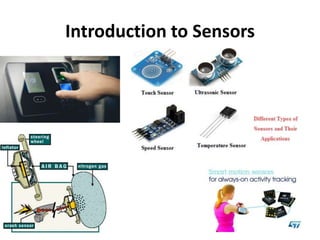
Introduction to Sensors
Overview
 What are Sensors?
 Detectable Phenomenon
 Physical Principles – How Do Sensors Work?
 Need for Sensors
 Choosing a Sensor
 Sensor Descriptions
 Temperature Sensor
 Accelerometer
 Light Sensor
 Magnetic Field Sensor
 Ultrasonic Sensor
 Photogate
 CO2 Gas Sensor
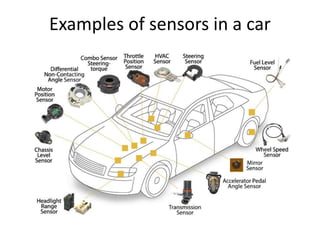
Examples of sensors in a car
Some general statements
• Sensors/actuators are common
• Usually integrated in a system (never alone)
• A system of any complexity cannot be
designed without them
• Very difficult to classify
• Difficult to get good data on them
• Definitions and terms are confusing
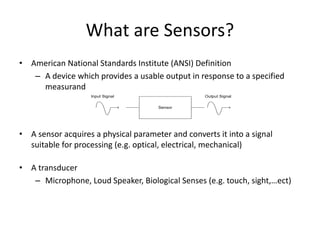
What are Sensors?
• American National Standards Institute (ANSI) Definition
– A device which provides a usable output in response to a specified
measurand
• A sensor acquires a physical parameter and converts it into a signal
suitable for processing (e.g. optical, electrical, mechanical)
• A transducer
– Microphone, Loud Speaker, Biological Senses (e.g. touch, sight,…ect)
Sensor
Input Signal Output Signal
Definitions - Sensors
• Also called: transducer, probe, gauge,
detector, pick-up etc.
• Start with the dictionary:
• A device that responds to a physical stimulus and transmits a resulting impulse.
(New Collegiate Dictionary)
• A device, such as a photoelectric cell, that receives and responds to a signal or
stimulus. (American Heritage Dictionary, 3rd ed., 1996)
• A device that responds to a physical stimulus (as heat, light, sound, pressure,
magnetism, or a particular motion) and transmits a resulting impulse (as for
measurement or operating a control) . (Webster, 3rd ed., 1999)
Definitions - Transducer
• A device that is actuated by power from one system and supplies power
usually in another form to a second system. (New Collegiate Dictionary)
• A substance or device, such as a piezoelectric crystal, that converts input
energy of one form into output energy of another. (from: Trans-ducere –
to transfer, to lead) (American Heritage Dictionary, 3rd ed., 1996)
• A device that is actuated by power from one system and supplies power
usually in another form to a second system (a loudspeaker is a transducer
that transforms electrical signals to sound energy) . (Webster, 3rd ed.,
1999)
Definitions - Actuator
• A mechanism for moving or controlling something indirectly
instead of by hand. (New Collegiate Dictionary)
• One that activates, especially a device responsible for
actuating a mechanical device such as one connected to a
computer by a sensor link (American Heritage Dictionary, 3rd
ed., 1996)
• One that actuates; a mechanical device for moving or
controlling something. (Webster, 3rd ed., 1999)
More confusion
• Transducer can mean:
sensor
actuator
transducer can be part of a sensor
sensor can be part of a transducer
• Many sensors can work as actuators (duality)
• Many actuators can work as sensors
• What is it then? - All of the above!
Our definitions:
Stimulus
• The quantity that is sensed.
• Sometimes called the measurand.
Our definitions:
Sensor
• A device that responds to a physical stimulus.
Transducer
• A device that converts energy of one form into energy of
another form.
Actuator
• A device or mechanism capable of performing a physical
action
1. Active and passive sensors
Active sensor: a sensor that requires external power to
operate. Examples: the carbon microphone, thermistors,
strain gauges, capacitive and inductive sensors, etc.
Other name: parametric sensors (output is a function of a
parameter - like resistance)
Passive sensor: generates its own electric signal and does
not require a power source. Examples: thermocouples,
magnetic microphones, piezoelectric sensors.
Other name: self-generating sensors
Note: some define these exactly the other way around
2. Contact and noncontact sensors
Contact sensor: a sensor that requires physical contact with
the stimulus. Examples: strain gauges, most temperature
sensors
Non-contact sensor: requires no physical contact. Examples:
most optical and magnetic sensors, infrared
thermometers, etc.
3. Absolute and relative sensors
Absolute sensor: a sensor that reacts to a stimulus on an
absolute scale: Thermistors, strain gauges, etc.,
(thermistor will always read the absolute temperature)
Relative scale: The stimulus is sensed relative to a fixed or
variable reference. Thermocouple measures the
temperature difference, pressure is often measured
relative to atmospheric pressure.
4. Other schemes
Classification by broad area of detection
• Electric sensors
• Magnetic
• Electromagnetic
• Acoustic
• Chemical
• Optical
• Heat, Temperature
• Mechanical
• Radiation
• Biological
• Etc.
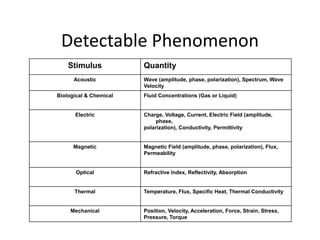
Detectable Phenomenon
Stimulus Quantity
Acoustic Wave (amplitude, phase, polarization), Spectrum, Wave
Velocity
Biological & Chemical Fluid Concentrations (Gas or Liquid)
Electric Charge, Voltage, Current, Electric Field (amplitude,
phase,
polarization), Conductivity, Permittivity
Magnetic Magnetic Field (amplitude, phase, polarization), Flux,
Permeability
Optical Refractive Index, Reflectivity, Absorption
Thermal Temperature, Flux, Specific Heat, Thermal Conductivity
Mechanical Position, Velocity, Acceleration, Force, Strain, Stress,
Pressure, Torque
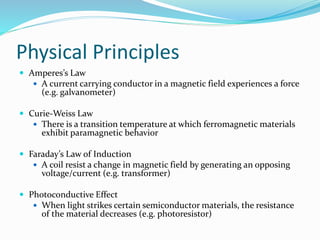
Physical Principles
 Amperes’s Law
 A current carrying conductor in a magnetic field experiences a force
(e.g. galvanometer)
 Curie-Weiss Law
 There is a transition temperature at which ferromagnetic materials
exhibit paramagnetic behavior
 Faraday’s Law of Induction
 A coil resist a change in magnetic field by generating an opposing
voltage/current (e.g. transformer)
 Photoconductive Effect
 When light strikes certain semiconductor materials, the resistance
of the material decreases (e.g. photoresistor)
Need for Sensors
 Sensors are omnipresent. They embedded in our
bodies, automobiles, airplanes, cellular telephones,
radios, chemical plants, industrial plants and
countless other applications.
 Without the use of sensors, there would be no
automation !!
 Imagine having to manually fill mineral water bottles
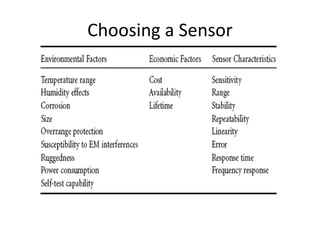
Choosing a Sensor
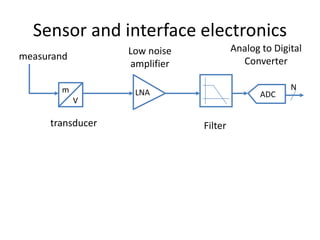
Sensor and interface electronics
m
V
measurand
transducer
LNA
N
ADC
Low noise
amplifier
Filter
Analog to Digital
Converter
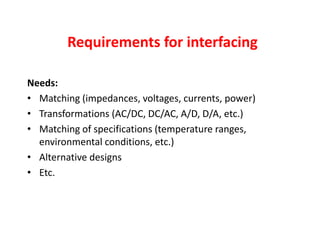
Requirements for interfacing
Needs:
• Matching (impedances, voltages, currents, power)
• Transformations (AC/DC, DC/AC, A/D, D/A, etc.)
• Matching of specifications (temperature ranges,
environmental conditions, etc.)
• Alternative designs
• Etc.
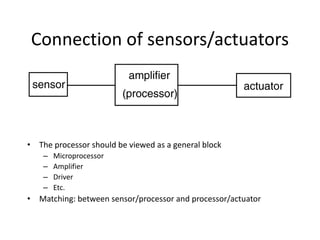
Connection of sensors/actuators
• The processor should be viewed as a general block
– Microprocessor
– Amplifier
– Driver
– Etc.
• Matching: between sensor/processor and processor/actuator
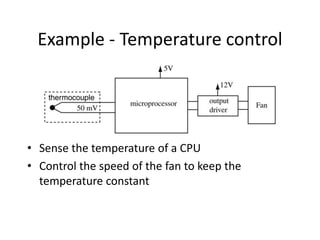
Example - Temperature control
• Sense the temperature of a CPU
• Control the speed of the fan to keep the
temperature constant
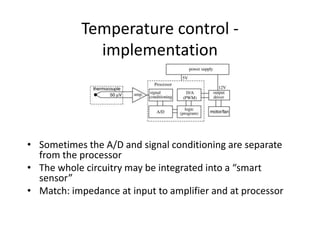
Temperature control -
implementation
• Sometimes the A/D and signal conditioning are separate
from the processor
• The whole circuitry may be integrated into a “smart
sensor”
• Match: impedance at input to amplifier and at processor
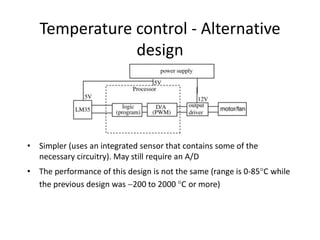
Temperature control - Alternative
design
• Simpler (uses an integrated sensor that contains some of the
necessary circuitry). May still require an A/D
• The performance of this design is not the same (range is 0-85C while
the previous design was -200 to 2000 C or more)
Temperature Sensor
 Temperature sensors appear in building, chemical
process plants, engines, appliances, computers,
and many other devices that require temperature
monitoring
 Many physical phenomena depend on
temperature, so we can often measure temperature
indirectly by measuring pressure, volume,
electrical resistance, and strain
Temperature Sensor
 Bimetallic Strip
 Application
 Thermostat (makes or
breaks electrical
connection with
deflection)
Metal A
Metal B
δ
)]T-(T1[ 00  LL
Temperature Sensor
• Resistance temperature
device.






-


0
11
0
00 )]T-(T1[
TT
eRR
RR


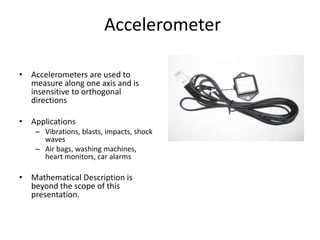
Accelerometer
• Accelerometers are used to
measure along one axis and is
insensitive to orthogonal
directions
• Applications
– Vibrations, blasts, impacts, shock
waves
– Air bags, washing machines,
heart monitors, car alarms
• Mathematical Description is
beyond the scope of this
presentation.
Vibrating Base
m
k b
Position Sensor
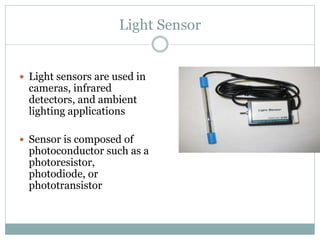
Light Sensor
 Light sensors are used in
cameras, infrared
detectors, and ambient
lighting applications
 Sensor is composed of
photoconductor such as a
photoresistor,
photodiode, or
phototransistor
p n
I
+ V -
Magnetic Field Sensor
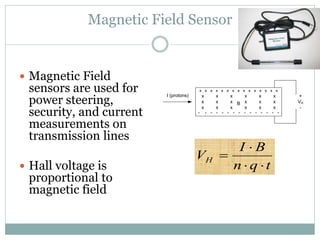
 Magnetic Field
sensors are used for
power steering,
security, and current
measurements on
transmission lines
 Hall voltage is
proportional to
magnetic field
x x x x x x
x x x x x x
x x x x x x
+ + + + + + + + + + + + + + +
- - - - - - - - - - - - - - -
I (protons) +
VH
-
B
tqn
BI
VH



Ultrasonic Sensor
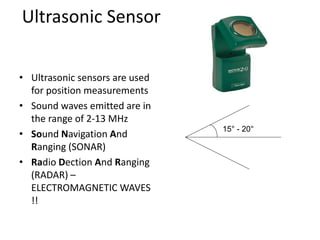
• Ultrasonic sensors are used
for position measurements
• Sound waves emitted are in
the range of 2-13 MHz
• Sound Navigation And
Ranging (SONAR)
• Radio Dection And Ranging
(RADAR) –
ELECTROMAGNETIC WAVES
!!
15° - 20°
Photogate
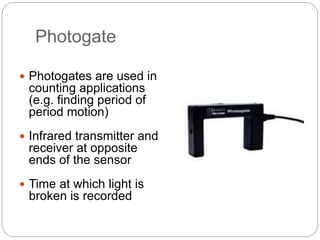
 Photogates are used in
counting applications
(e.g. finding period of
period motion)
 Infrared transmitter and
receiver at opposite
ends of the sensor
 Time at which light is
broken is recorded
CO2 Gas Sensor
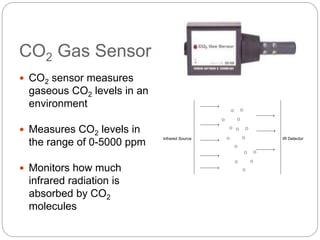
 CO2 sensor measures
gaseous CO2 levels in an
environment
 Measures CO2 levels in
the range of 0-5000 ppm
 Monitors how much
infrared radiation is
absorbed by CO2
molecules
Infrared Source IR Detector
Sensors
 Resistive, Capacitive
 Strain gauges, piezoresistivity
 Simple XL, pressure sensor
 ADXL50
 Noise
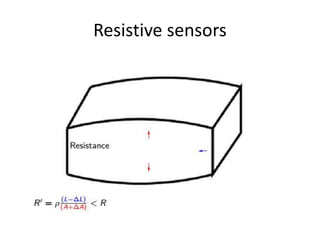
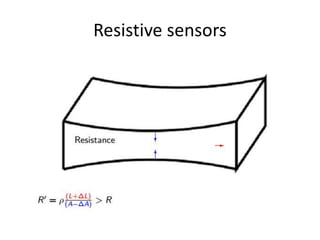
Resistive Sensor
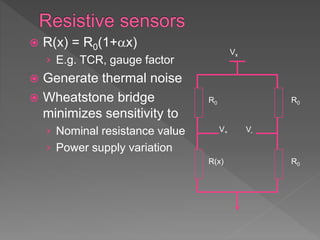
 R(x) = R0(1+x)
› E.g. TCR, gauge factor
 Generate thermal noise
 Wheatstone bridge
minimizes sensitivity to
› Nominal resistance value
› Power supply variation
R0R(x)
R0R0
Vx
V+ V-
Resistive sensors
Resistive sensors
Resistive sensors
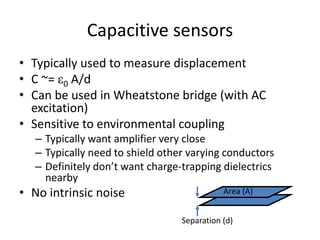
Capacitive sensors
• Typically used to measure displacement
• C ~= e0 A/d
• Can be used in Wheatstone bridge (with AC
excitation)
• Sensitive to environmental coupling
– Typically want amplifier very close
– Typically need to shield other varying conductors
– Definitely don’t want charge-trapping dielectrics
nearby
• No intrinsic noise
Separation (d)
Area (A)
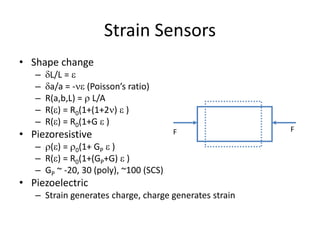
Strain Sensors
• Shape change
– dL/L = e
– da/a = -ne (Poisson’s ratio)
– R(a,b,L) = r L/A
– R(e) = R0(1+(1+2n) e )
– R(e) = R0(1+G e )
• Piezoresistive
– r(e) = r0(1+ GP e )
– R(e) = R0(1+(GP+G) e )
– GP ~ -20, 30 (poly), ~100 (SCS)
• Piezoelectric
– Strain generates charge, charge generates strain
F F
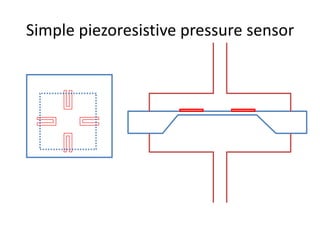
Simple piezoresistive pressure sensor
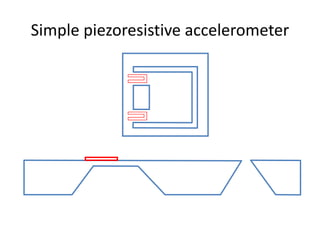
Simple piezoresistive accelerometer
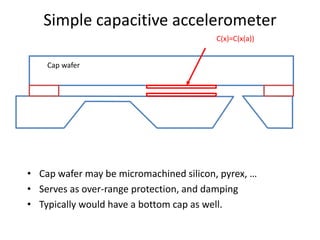
Simple capacitive accelerometer
• Cap wafer may be micromachined silicon, pyrex, …
• Serves as over-range protection, and damping
• Typically would have a bottom cap as well.
C(x)=C(x(a))
Cap wafer
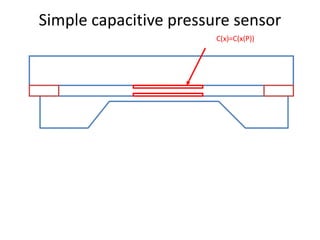
Simple capacitive pressure sensor
C(x)=C(x(P))
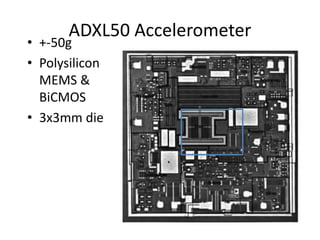
ADXL50 Accelerometer
• +-50g
• Polysilicon
MEMS &
BiCMOS
• 3x3mm die
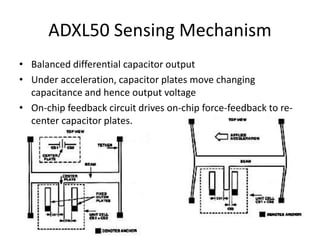
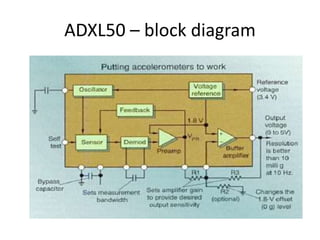
ADXL50 Sensing Mechanism
• Balanced differential capacitor output
• Under acceleration, capacitor plates move changing
capacitance and hence output voltage
• On-chip feedback circuit drives on-chip force-feedback to re-
center capacitor plates.
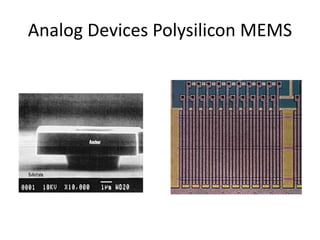
Analog Devices Polysilicon MEMS
ADXL50 – block diagram
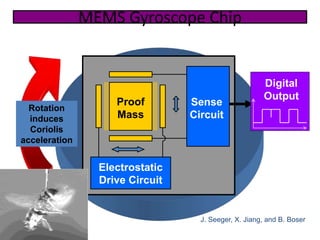
Sense
Circuit
Electrostatic
Drive Circuit
Proof
Mass
Digital
Output
MEMS Gyroscope Chip
Rotation
induces
Coriolis
acceleration
J. Seeger, X. Jiang, and B. Boser
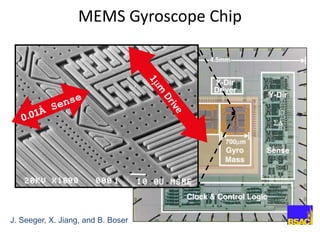
MEMS Gyroscope Chip
J. Seeger, X. Jiang, and B. Boser
Thermal Noise
 Fundamental limitation to sensor performance due to
thermal noise
 “White” noise, Johnson noise, Brownian motion all the
same
 Not the same as flicker, popcorn, 1/f noise
 Equipartition theorem (energy perspective)
 every energy storage mode will have ½ kBT of energy
 Nyquist (power perspective):
 Every dissipator will contribute PN = 4 kBT B
 B = bandwidth of interest in Hz
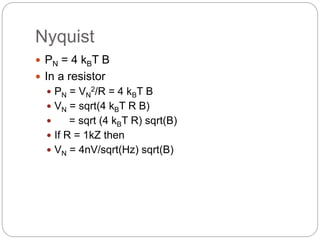
Nyquist
 PN = 4 kBT B
 In a resistor
 PN = VN
2/R = 4 kBT B
 VN = sqrt(4 kBT R B)
 = sqrt (4 kBT R) sqrt(B)
 If R = 1kZ then
 VN = 4nV/sqrt(Hz) sqrt(B)
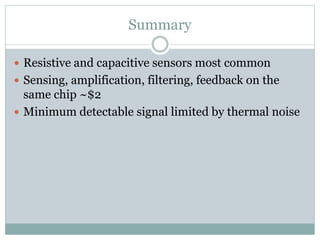
Summary
 Resistive and capacitive sensors most common
 Sensing, amplification, filtering, feedback on the
same chip ~$2
 Minimum detectable signal limited by thermal noise
Introduction to Sensor

Introduction to Sensor

  • 1.
  • 2.
    Overview  What areSensors?  Detectable Phenomenon  Physical Principles – How Do Sensors Work?  Need for Sensors  Choosing a Sensor  Sensor Descriptions  Temperature Sensor  Accelerometer  Light Sensor  Magnetic Field Sensor  Ultrasonic Sensor  Photogate  CO2 Gas Sensor
  • 3.
  • 4.
    Some general statements •Sensors/actuators are common • Usually integrated in a system (never alone) • A system of any complexity cannot be designed without them • Very difficult to classify • Difficult to get good data on them • Definitions and terms are confusing
  • 5.
    What are Sensors? •American National Standards Institute (ANSI) Definition – A device which provides a usable output in response to a specified measurand • A sensor acquires a physical parameter and converts it into a signal suitable for processing (e.g. optical, electrical, mechanical) • A transducer – Microphone, Loud Speaker, Biological Senses (e.g. touch, sight,…ect) Sensor Input Signal Output Signal
  • 6.
    Definitions - Sensors •Also called: transducer, probe, gauge, detector, pick-up etc. • Start with the dictionary: • A device that responds to a physical stimulus and transmits a resulting impulse. (New Collegiate Dictionary) • A device, such as a photoelectric cell, that receives and responds to a signal or stimulus. (American Heritage Dictionary, 3rd ed., 1996) • A device that responds to a physical stimulus (as heat, light, sound, pressure, magnetism, or a particular motion) and transmits a resulting impulse (as for measurement or operating a control) . (Webster, 3rd ed., 1999)
  • 7.
    Definitions - Transducer •A device that is actuated by power from one system and supplies power usually in another form to a second system. (New Collegiate Dictionary) • A substance or device, such as a piezoelectric crystal, that converts input energy of one form into output energy of another. (from: Trans-ducere – to transfer, to lead) (American Heritage Dictionary, 3rd ed., 1996) • A device that is actuated by power from one system and supplies power usually in another form to a second system (a loudspeaker is a transducer that transforms electrical signals to sound energy) . (Webster, 3rd ed., 1999)
  • 8.
    Definitions - Actuator •A mechanism for moving or controlling something indirectly instead of by hand. (New Collegiate Dictionary) • One that activates, especially a device responsible for actuating a mechanical device such as one connected to a computer by a sensor link (American Heritage Dictionary, 3rd ed., 1996) • One that actuates; a mechanical device for moving or controlling something. (Webster, 3rd ed., 1999)
  • 9.
    More confusion • Transducercan mean: sensor actuator transducer can be part of a sensor sensor can be part of a transducer • Many sensors can work as actuators (duality) • Many actuators can work as sensors • What is it then? - All of the above!
  • 10.
    Our definitions: Stimulus • Thequantity that is sensed. • Sometimes called the measurand.
  • 11.
    Our definitions: Sensor • Adevice that responds to a physical stimulus. Transducer • A device that converts energy of one form into energy of another form. Actuator • A device or mechanism capable of performing a physical action
  • 12.
    1. Active andpassive sensors Active sensor: a sensor that requires external power to operate. Examples: the carbon microphone, thermistors, strain gauges, capacitive and inductive sensors, etc. Other name: parametric sensors (output is a function of a parameter - like resistance) Passive sensor: generates its own electric signal and does not require a power source. Examples: thermocouples, magnetic microphones, piezoelectric sensors. Other name: self-generating sensors Note: some define these exactly the other way around
  • 13.
    2. Contact andnoncontact sensors Contact sensor: a sensor that requires physical contact with the stimulus. Examples: strain gauges, most temperature sensors Non-contact sensor: requires no physical contact. Examples: most optical and magnetic sensors, infrared thermometers, etc.
  • 14.
    3. Absolute andrelative sensors Absolute sensor: a sensor that reacts to a stimulus on an absolute scale: Thermistors, strain gauges, etc., (thermistor will always read the absolute temperature) Relative scale: The stimulus is sensed relative to a fixed or variable reference. Thermocouple measures the temperature difference, pressure is often measured relative to atmospheric pressure.
  • 15.
    4. Other schemes Classificationby broad area of detection • Electric sensors • Magnetic • Electromagnetic • Acoustic • Chemical • Optical • Heat, Temperature • Mechanical • Radiation • Biological • Etc.
  • 16.
    Detectable Phenomenon Stimulus Quantity AcousticWave (amplitude, phase, polarization), Spectrum, Wave Velocity Biological & Chemical Fluid Concentrations (Gas or Liquid) Electric Charge, Voltage, Current, Electric Field (amplitude, phase, polarization), Conductivity, Permittivity Magnetic Magnetic Field (amplitude, phase, polarization), Flux, Permeability Optical Refractive Index, Reflectivity, Absorption Thermal Temperature, Flux, Specific Heat, Thermal Conductivity Mechanical Position, Velocity, Acceleration, Force, Strain, Stress, Pressure, Torque
  • 17.
    Physical Principles  Amperes’sLaw  A current carrying conductor in a magnetic field experiences a force (e.g. galvanometer)  Curie-Weiss Law  There is a transition temperature at which ferromagnetic materials exhibit paramagnetic behavior  Faraday’s Law of Induction  A coil resist a change in magnetic field by generating an opposing voltage/current (e.g. transformer)  Photoconductive Effect  When light strikes certain semiconductor materials, the resistance of the material decreases (e.g. photoresistor)
  • 18.
    Need for Sensors Sensors are omnipresent. They embedded in our bodies, automobiles, airplanes, cellular telephones, radios, chemical plants, industrial plants and countless other applications.  Without the use of sensors, there would be no automation !!  Imagine having to manually fill mineral water bottles
  • 19.
  • 20.
    Sensor and interfaceelectronics m V measurand transducer LNA N ADC Low noise amplifier Filter Analog to Digital Converter
  • 21.
    Requirements for interfacing Needs: •Matching (impedances, voltages, currents, power) • Transformations (AC/DC, DC/AC, A/D, D/A, etc.) • Matching of specifications (temperature ranges, environmental conditions, etc.) • Alternative designs • Etc.
  • 22.
    Connection of sensors/actuators •The processor should be viewed as a general block – Microprocessor – Amplifier – Driver – Etc. • Matching: between sensor/processor and processor/actuator
  • 23.
    Example - Temperaturecontrol • Sense the temperature of a CPU • Control the speed of the fan to keep the temperature constant
  • 24.
    Temperature control - implementation •Sometimes the A/D and signal conditioning are separate from the processor • The whole circuitry may be integrated into a “smart sensor” • Match: impedance at input to amplifier and at processor
  • 25.
    Temperature control -Alternative design • Simpler (uses an integrated sensor that contains some of the necessary circuitry). May still require an A/D • The performance of this design is not the same (range is 0-85C while the previous design was -200 to 2000 C or more)
  • 26.
    Temperature Sensor  Temperaturesensors appear in building, chemical process plants, engines, appliances, computers, and many other devices that require temperature monitoring  Many physical phenomena depend on temperature, so we can often measure temperature indirectly by measuring pressure, volume, electrical resistance, and strain
  • 27.
    Temperature Sensor  BimetallicStrip  Application  Thermostat (makes or breaks electrical connection with deflection) Metal A Metal B δ )]T-(T1[ 00  LL
  • 28.
    Temperature Sensor • Resistancetemperature device.       -   0 11 0 00 )]T-(T1[ TT eRR RR  
  • 29.
    Accelerometer • Accelerometers areused to measure along one axis and is insensitive to orthogonal directions • Applications – Vibrations, blasts, impacts, shock waves – Air bags, washing machines, heart monitors, car alarms • Mathematical Description is beyond the scope of this presentation. Vibrating Base m k b Position Sensor
  • 30.
    Light Sensor  Lightsensors are used in cameras, infrared detectors, and ambient lighting applications  Sensor is composed of photoconductor such as a photoresistor, photodiode, or phototransistor p n I + V -
  • 31.
    Magnetic Field Sensor Magnetic Field sensors are used for power steering, security, and current measurements on transmission lines  Hall voltage is proportional to magnetic field x x x x x x x x x x x x x x x x x x + + + + + + + + + + + + + + + - - - - - - - - - - - - - - - I (protons) + VH - B tqn BI VH   
  • 32.
    Ultrasonic Sensor • Ultrasonicsensors are used for position measurements • Sound waves emitted are in the range of 2-13 MHz • Sound Navigation And Ranging (SONAR) • Radio Dection And Ranging (RADAR) – ELECTROMAGNETIC WAVES !! 15° - 20°
  • 33.
    Photogate  Photogates areused in counting applications (e.g. finding period of period motion)  Infrared transmitter and receiver at opposite ends of the sensor  Time at which light is broken is recorded
  • 34.
    CO2 Gas Sensor CO2 sensor measures gaseous CO2 levels in an environment  Measures CO2 levels in the range of 0-5000 ppm  Monitors how much infrared radiation is absorbed by CO2 molecules Infrared Source IR Detector
  • 35.
    Sensors  Resistive, Capacitive Strain gauges, piezoresistivity  Simple XL, pressure sensor  ADXL50  Noise
  • 36.
  • 37.
     R(x) =R0(1+x) › E.g. TCR, gauge factor  Generate thermal noise  Wheatstone bridge minimizes sensitivity to › Nominal resistance value › Power supply variation R0R(x) R0R0 Vx V+ V-
  • 38.
  • 39.
  • 40.
  • 41.
    Capacitive sensors • Typicallyused to measure displacement • C ~= e0 A/d • Can be used in Wheatstone bridge (with AC excitation) • Sensitive to environmental coupling – Typically want amplifier very close – Typically need to shield other varying conductors – Definitely don’t want charge-trapping dielectrics nearby • No intrinsic noise Separation (d) Area (A)
  • 43.
    Strain Sensors • Shapechange – dL/L = e – da/a = -ne (Poisson’s ratio) – R(a,b,L) = r L/A – R(e) = R0(1+(1+2n) e ) – R(e) = R0(1+G e ) • Piezoresistive – r(e) = r0(1+ GP e ) – R(e) = R0(1+(GP+G) e ) – GP ~ -20, 30 (poly), ~100 (SCS) • Piezoelectric – Strain generates charge, charge generates strain F F
  • 44.
  • 45.
  • 46.
    Simple capacitive accelerometer •Cap wafer may be micromachined silicon, pyrex, … • Serves as over-range protection, and damping • Typically would have a bottom cap as well. C(x)=C(x(a)) Cap wafer
  • 47.
    Simple capacitive pressuresensor C(x)=C(x(P))
  • 48.
    ADXL50 Accelerometer • +-50g •Polysilicon MEMS & BiCMOS • 3x3mm die
  • 49.
    ADXL50 Sensing Mechanism •Balanced differential capacitor output • Under acceleration, capacitor plates move changing capacitance and hence output voltage • On-chip feedback circuit drives on-chip force-feedback to re- center capacitor plates.
  • 50.
  • 51.
  • 52.
    Sense Circuit Electrostatic Drive Circuit Proof Mass Digital Output MEMS GyroscopeChip Rotation induces Coriolis acceleration J. Seeger, X. Jiang, and B. Boser
  • 53.
    MEMS Gyroscope Chip J.Seeger, X. Jiang, and B. Boser
  • 54.
    Thermal Noise  Fundamentallimitation to sensor performance due to thermal noise  “White” noise, Johnson noise, Brownian motion all the same  Not the same as flicker, popcorn, 1/f noise  Equipartition theorem (energy perspective)  every energy storage mode will have ½ kBT of energy  Nyquist (power perspective):  Every dissipator will contribute PN = 4 kBT B  B = bandwidth of interest in Hz
  • 55.
    Nyquist  PN =4 kBT B  In a resistor  PN = VN 2/R = 4 kBT B  VN = sqrt(4 kBT R B)  = sqrt (4 kBT R) sqrt(B)  If R = 1kZ then  VN = 4nV/sqrt(Hz) sqrt(B)
  • 56.
    Summary  Resistive andcapacitive sensors most common  Sensing, amplification, filtering, feedback on the same chip ~$2  Minimum detectable signal limited by thermal noise