Presented by
GIDLA VINAY
17ME320
1st yr M.Tech(PDM)
PEC.
Subject staff
Dr.T.Senthilvelan
Professor
PEC
PONDICHERRY ENGINEERING COLLEGE
Topics: Sensors-types, Position sensors, Velocity sensors
INTRODUCTION
• A robot without sensors is like a human being without eyes, ears,
sense of touch, etc.
-Sensor-less robots require costly/time consuming
programming.
-Can perform only in “playback” mode.
-No change in their environment, tooling and work piece can
be accounted for.
• Sensors constitute the perceptual system of a robot, designed:
-To make inferences about the physical environment,
-To navigate and localise itself,
-To respond more “flexibly” to the events occurring in its
environment, and
-To enable learning, thereby endowing robots with
“intelligence”.
• Sensors enable robots to perform complex and increased variety of
tasks reliably thereby reducing cost.
SENSORS IN ROBOTS
Sensor is an instrument that responds to a specific physical stimulus
and produces a measurable corresponding electrical signal.
Desirable features in sensors are
• High accuracy.
• High precision.
• Linear response.
• Large operating range.
• Low response time.
• Easy to calibrate.
• Reliable and rugged.
• Low cost
• Ease of operation
• Broad classification of sensors
in robots
• Internal state sensors.
• External state sensors.
SENSORS IN ROBOTS – INTERNAL
Internal sensors measure variables for control
Joint position.
Joint velocity.
Joint torque/force.
1) Joint position sensors (angular or linear)
Incremental & absolute encoders — Optical, magnetic or
capacitive.
Potentiometers.
Linear analog resistive or digital encoders.
2) Joint velocity sensors
DC tacho-generator & resolvers
Optical encoders.
3) Force/torque sensors.
At joint actuators for control.
At wrist to measure components of force/moment being
applied on environment.
At end-effector to measure applied force on gripped object.
SENSORS IN ROBOTS – EXTERNAL
Detection of environment variables for robot guidance, object
identification and material handling.
Two main types – Contacting and non-contacting sensors.
Contacting sensors: Respond to a physical contact
Touch: switches, Photo-diode/LED combination.
Slip:
Tactile: resistive/capacitive arrays.
Non-contacting sensors: Detect variations in optical, acoustic or
electromagnetic radiations or change in position/orientation.
Proximity: Inductive, Capacitive, Optical and Ultrasonic
Range: Capacitive and Magnetic, Camera, Sonar, Laser
range finder, Structured light.
Colour sensors:
Speed/Motion: Doppler radar/sound, Camera, Accelerometer,
Gyroscope.
Identification: Camera, RFID, Laser ranging, Ultrasound.
Localisation: Compass, Odometer, GPS.
Sensor Characteristics
These characteristics determine the performance, economy, ease of
application, and applicability of the sensor.
1.Cost:
2.Size:
3.Weight:
4.Type of output (digital or analog):
5. Interfacing:
6.Resolution:
7.Sensitivity:
8.Linearity.
9. Range:
10. Response rime:
11.Frequency response:
12.Reliability:
13.Accuracy:
15.Repeatability:
POSITION SENSORS
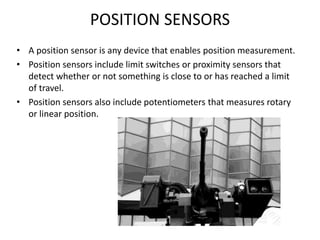
• A position sensor is any device that enables position measurement.
• Position sensors include limit switches or proximity sensors that
detect whether or not something is close to or has reached a limit
of travel.
• Position sensors also include potentiometers that measures rotary
or linear position.
Position Measurement Basics
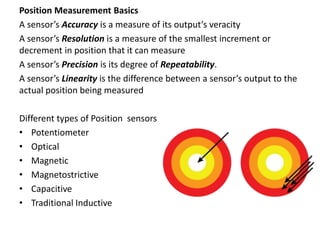
A sensor’s Accuracy is a measure of its output‘s veracity
A sensor’s Resolution is a measure of the smallest increment or
decrement in position that it can measure
A sensor’s Precision is its degree of Repeatability.
A sensor’s Linearity is the difference between a sensor’s output to the
actual position being measured
Different types of Position sensors
• Potentiometer
• Optical
• Magnetic
• Magnetostrictive
• Capacitive
• Traditional Inductive
Potentiometers
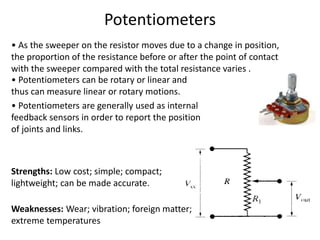
• As the sweeper on the resistor moves due to a change in position,
the proportion of the resistance before or after the point of contact
with the sweeper compared with the total resistance varies .
• Potentiometers can be rotary or linear and
thus can measure linear or rotary motions.
• Potentiometers are generally used as internal
feedback sensors in order to report the position
of joints and links.
Strengths: Low cost; simple; compact;
lightweight; can be made accurate.
Weaknesses: Wear; vibration; foreign matter;
extreme temperatures
Optical
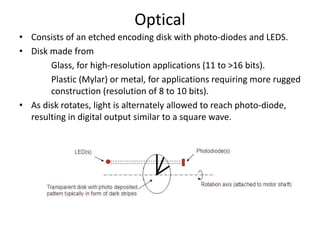
• Consists of an etched encoding disk with photo-diodes and LEDS.
• Disk made from
Glass, for high-resolution applications (11 to >16 bits).
Plastic (Mylar) or metal, for applications requiring more rugged
construction (resolution of 8 to 10 bits).
• As disk rotates, light is alternately allowed to reach photo-diode,
resulting in digital output similar to a square wave.
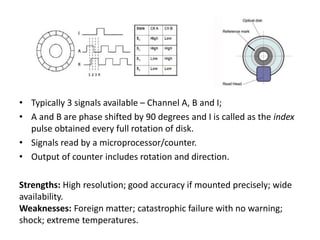
• Typically 3 signals available – Channel A, B and I;
• A and B are phase shifted by 90 degrees and I is called as the index
pulse obtained every full rotation of disk.
• Signals read by a microprocessor/counter.
• Output of counter includes rotation and direction.
Strengths: High resolution; good accuracy if mounted precisely; wide
availability.
Weaknesses: Foreign matter; catastrophic failure with no warning;
shock; extreme temperatures.
LVDT
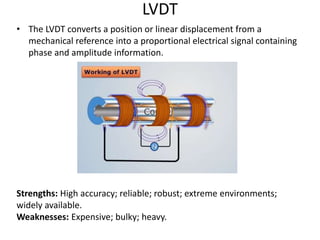
• The LVDT converts a position or linear displacement from a
mechanical reference into a proportional electrical signal containing
phase and amplitude information.
Strengths: High accuracy; reliable; robust; extreme environments;
widely available.
Weaknesses: Expensive; bulky; heavy.
Magnetic
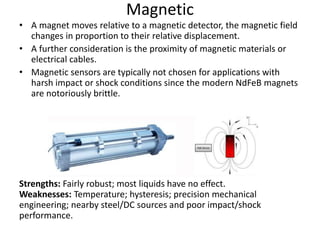
• A magnet moves relative to a magnetic detector, the magnetic field
changes in proportion to their relative displacement.
• A further consideration is the proximity of magnetic materials or
electrical cables.
• Magnetic sensors are typically not chosen for applications with
harsh impact or shock conditions since the modern NdFeB magnets
are notoriously brittle.
Strengths: Fairly robust; most liquids have no effect.
Weaknesses: Temperature; hysteresis; precision mechanical
engineering; nearby steel/DC sources and poor impact/shock
performance.
Magnetostrictive
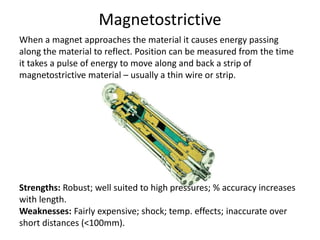
When a magnet approaches the material it causes energy passing
along the material to reflect. Position can be measured from the time
it takes a pulse of energy to move along and back a strip of
magnetostrictive material – usually a thin wire or strip.
Strengths: Robust; well suited to high pressures; % accuracy increases
with length.
Weaknesses: Fairly expensive; shock; temp. effects; inaccurate over
short distances (<100mm).
Velocity Sensors
A velocity receiver (velocity sensor) is a sensor that responds to velocity
rather than absolute position.
Speed measurement can be obtained by taking consecutive position
measurements at known time intervals and computing the derivative of the
position values.
A tachometer is an example of a velocity sensor that does this for a rotating
shaft.
Some types
Encoders
Tachometers
Differentiation of position signal
ENCODERS
•If an encoder is used for displacement measurement, there is no
need to use a velocity sensor.
•Since encoders send a known number of signals for any given angular
displacement, by counting the number of signals received in a given
length of time (dt),we can calculate velocity.
•A smaller length of time (dt) yields a more accurate calculated
velocity, once that is closer to the true instantaneous velocity.
•This velocity calculation is accomplished by programming the
controller to convert number of signals in a given length of time into
velocity information.
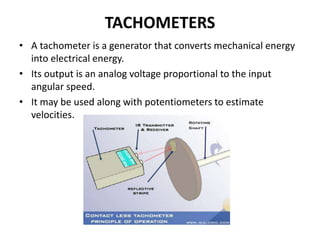
TACHOMETERS
• A tachometer is a generator that converts mechanical energy
into electrical energy.
• Its output is an analog voltage proportional to the input
angular speed.
• It may be used along with potentiometers to estimate
velocities.
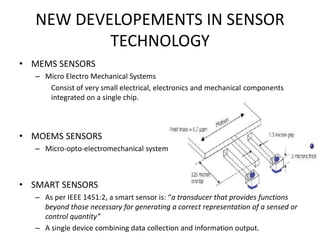
NEW DEVELOPEMENTS IN SENSOR
TECHNOLOGY
• MEMS SENSORS
– Micro Electro Mechanical Systems
Consist of very small electrical, electronics and mechanical components
integrated on a single chip.
• MOEMS SENSORS
– Micro-opto-electromechanical system
• SMART SENSORS
– As per IEEE 1451:2, a smart sensor is: “a transducer that provides functions
beyond those necessary for generating a correct representation of a sensed or
control quantity”
– A single device combining data collection and information output.
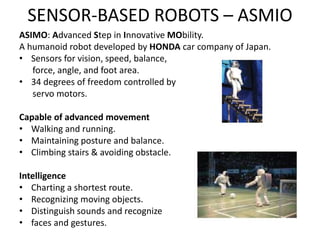
ASIMO: Advanced Step in Innovative MObility.
A humanoid robot developed by HONDA car company of Japan.
• Sensors for vision, speed, balance,
force, angle, and foot area.
• 34 degrees of freedom controlled by
servo motors.
Capable of advanced movement
• Walking and running.
• Maintaining posture and balance.
• Climbing stairs & avoiding obstacle.
Intelligence
• Charting a shortest route.
• Recognizing moving objects.
• Distinguish sounds and recognize
• faces and gestures.
SENSOR-BASED ROBOTS – ASMIO
?
THANK
YOU

sensors

  • 1.
    Presented by GIDLA VINAY 17ME320 1styr M.Tech(PDM) PEC. Subject staff Dr.T.Senthilvelan Professor PEC PONDICHERRY ENGINEERING COLLEGE Topics: Sensors-types, Position sensors, Velocity sensors
  • 2.
    INTRODUCTION • A robotwithout sensors is like a human being without eyes, ears, sense of touch, etc. -Sensor-less robots require costly/time consuming programming. -Can perform only in “playback” mode. -No change in their environment, tooling and work piece can be accounted for. • Sensors constitute the perceptual system of a robot, designed: -To make inferences about the physical environment, -To navigate and localise itself, -To respond more “flexibly” to the events occurring in its environment, and -To enable learning, thereby endowing robots with “intelligence”. • Sensors enable robots to perform complex and increased variety of tasks reliably thereby reducing cost.
  • 3.
    SENSORS IN ROBOTS Sensoris an instrument that responds to a specific physical stimulus and produces a measurable corresponding electrical signal. Desirable features in sensors are • High accuracy. • High precision. • Linear response. • Large operating range. • Low response time. • Easy to calibrate. • Reliable and rugged. • Low cost • Ease of operation • Broad classification of sensors in robots • Internal state sensors. • External state sensors.
  • 4.
    SENSORS IN ROBOTS– INTERNAL Internal sensors measure variables for control Joint position. Joint velocity. Joint torque/force. 1) Joint position sensors (angular or linear) Incremental & absolute encoders — Optical, magnetic or capacitive. Potentiometers. Linear analog resistive or digital encoders. 2) Joint velocity sensors DC tacho-generator & resolvers Optical encoders. 3) Force/torque sensors. At joint actuators for control. At wrist to measure components of force/moment being applied on environment. At end-effector to measure applied force on gripped object.
  • 5.
    SENSORS IN ROBOTS– EXTERNAL Detection of environment variables for robot guidance, object identification and material handling. Two main types – Contacting and non-contacting sensors. Contacting sensors: Respond to a physical contact Touch: switches, Photo-diode/LED combination. Slip: Tactile: resistive/capacitive arrays. Non-contacting sensors: Detect variations in optical, acoustic or electromagnetic radiations or change in position/orientation. Proximity: Inductive, Capacitive, Optical and Ultrasonic Range: Capacitive and Magnetic, Camera, Sonar, Laser range finder, Structured light. Colour sensors: Speed/Motion: Doppler radar/sound, Camera, Accelerometer, Gyroscope. Identification: Camera, RFID, Laser ranging, Ultrasound. Localisation: Compass, Odometer, GPS.
  • 6.
    Sensor Characteristics These characteristicsdetermine the performance, economy, ease of application, and applicability of the sensor. 1.Cost: 2.Size: 3.Weight: 4.Type of output (digital or analog): 5. Interfacing: 6.Resolution: 7.Sensitivity: 8.Linearity. 9. Range: 10. Response rime: 11.Frequency response: 12.Reliability: 13.Accuracy: 15.Repeatability:
  • 7.
    POSITION SENSORS • Aposition sensor is any device that enables position measurement. • Position sensors include limit switches or proximity sensors that detect whether or not something is close to or has reached a limit of travel. • Position sensors also include potentiometers that measures rotary or linear position.
  • 8.
    Position Measurement Basics Asensor’s Accuracy is a measure of its output‘s veracity A sensor’s Resolution is a measure of the smallest increment or decrement in position that it can measure A sensor’s Precision is its degree of Repeatability. A sensor’s Linearity is the difference between a sensor’s output to the actual position being measured Different types of Position sensors • Potentiometer • Optical • Magnetic • Magnetostrictive • Capacitive • Traditional Inductive
  • 9.
    Potentiometers • As thesweeper on the resistor moves due to a change in position, the proportion of the resistance before or after the point of contact with the sweeper compared with the total resistance varies . • Potentiometers can be rotary or linear and thus can measure linear or rotary motions. • Potentiometers are generally used as internal feedback sensors in order to report the position of joints and links. Strengths: Low cost; simple; compact; lightweight; can be made accurate. Weaknesses: Wear; vibration; foreign matter; extreme temperatures
  • 10.
    Optical • Consists ofan etched encoding disk with photo-diodes and LEDS. • Disk made from Glass, for high-resolution applications (11 to >16 bits). Plastic (Mylar) or metal, for applications requiring more rugged construction (resolution of 8 to 10 bits). • As disk rotates, light is alternately allowed to reach photo-diode, resulting in digital output similar to a square wave.
  • 11.
    • Typically 3signals available – Channel A, B and I; • A and B are phase shifted by 90 degrees and I is called as the index pulse obtained every full rotation of disk. • Signals read by a microprocessor/counter. • Output of counter includes rotation and direction. Strengths: High resolution; good accuracy if mounted precisely; wide availability. Weaknesses: Foreign matter; catastrophic failure with no warning; shock; extreme temperatures.
  • 12.
    LVDT • The LVDTconverts a position or linear displacement from a mechanical reference into a proportional electrical signal containing phase and amplitude information. Strengths: High accuracy; reliable; robust; extreme environments; widely available. Weaknesses: Expensive; bulky; heavy.
  • 13.
    Magnetic • A magnetmoves relative to a magnetic detector, the magnetic field changes in proportion to their relative displacement. • A further consideration is the proximity of magnetic materials or electrical cables. • Magnetic sensors are typically not chosen for applications with harsh impact or shock conditions since the modern NdFeB magnets are notoriously brittle. Strengths: Fairly robust; most liquids have no effect. Weaknesses: Temperature; hysteresis; precision mechanical engineering; nearby steel/DC sources and poor impact/shock performance.
  • 14.
    Magnetostrictive When a magnetapproaches the material it causes energy passing along the material to reflect. Position can be measured from the time it takes a pulse of energy to move along and back a strip of magnetostrictive material – usually a thin wire or strip. Strengths: Robust; well suited to high pressures; % accuracy increases with length. Weaknesses: Fairly expensive; shock; temp. effects; inaccurate over short distances (<100mm).
  • 15.
    Velocity Sensors A velocityreceiver (velocity sensor) is a sensor that responds to velocity rather than absolute position. Speed measurement can be obtained by taking consecutive position measurements at known time intervals and computing the derivative of the position values. A tachometer is an example of a velocity sensor that does this for a rotating shaft. Some types Encoders Tachometers Differentiation of position signal
  • 16.
    ENCODERS •If an encoderis used for displacement measurement, there is no need to use a velocity sensor. •Since encoders send a known number of signals for any given angular displacement, by counting the number of signals received in a given length of time (dt),we can calculate velocity. •A smaller length of time (dt) yields a more accurate calculated velocity, once that is closer to the true instantaneous velocity. •This velocity calculation is accomplished by programming the controller to convert number of signals in a given length of time into velocity information.
  • 17.
    TACHOMETERS • A tachometeris a generator that converts mechanical energy into electrical energy. • Its output is an analog voltage proportional to the input angular speed. • It may be used along with potentiometers to estimate velocities.
  • 18.
    NEW DEVELOPEMENTS INSENSOR TECHNOLOGY • MEMS SENSORS – Micro Electro Mechanical Systems Consist of very small electrical, electronics and mechanical components integrated on a single chip. • MOEMS SENSORS – Micro-opto-electromechanical system • SMART SENSORS – As per IEEE 1451:2, a smart sensor is: “a transducer that provides functions beyond those necessary for generating a correct representation of a sensed or control quantity” – A single device combining data collection and information output.
  • 19.
    ASIMO: Advanced Stepin Innovative MObility. A humanoid robot developed by HONDA car company of Japan. • Sensors for vision, speed, balance, force, angle, and foot area. • 34 degrees of freedom controlled by servo motors. Capable of advanced movement • Walking and running. • Maintaining posture and balance. • Climbing stairs & avoiding obstacle. Intelligence • Charting a shortest route. • Recognizing moving objects. • Distinguish sounds and recognize • faces and gestures. SENSOR-BASED ROBOTS – ASMIO
  • 20.
  • 22.

Editor's Notes

  • #7 To choose an appropriate sensor for a particular need, we have to consider a number of different characteristics. In certain situations, different types of sensors may be available for the same purpose.
  • #10 • A potentiometer converts position information into a variable voltage through a resistor.
  • #11 One of the most important and widely used internal sensor.
  • #12 Can be used for estimating velocity. Output can be absolute or relative joint rotation.
  • #14 Magnetic sensors overcome many of the drawbacks associated with optical devices, as they are more tolerant to foreign matter.
  • #17 However, if the rate of rotation of the encoder is low, the velocity measurement may become inaccurate.
  • #19 High resolution seismic sensing. Medical equipments. Hard disk drives. Computer peripherals. Wireless devices.