
Sensors
The New Generation Technology
Group Members
Rashil Mehta
Yash Bhan
Harshit Mathur
Ankit Yadav
Anoop Kumar
Transducers
• Transducer

– a device that converts a primary form of energy
into a corresponding signal with a different energy
form.
• Primary Energy Forms: mechanical, thermal, electromagnetic, optical, chemical,
etc.

– take form of a sensor or an actuator
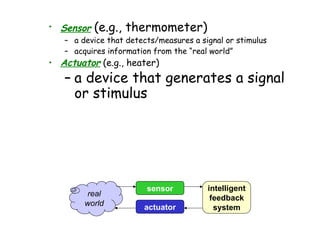
• Sensor

(e.g., thermometer)

– a device that detects/measures a signal or stimulus
– acquires information from the “real world”

• Actuator (e.g., heater)

– a device that generates a signal
or stimulus

real
world

sensor
actuator

intelligent
feedback
system
Need of Sensors
• To be useful, systems must interact with their
environment. To do this they use sensors and
actuators.
• Without the use of sensors, there would be no
automation.
• They are embedded in our bodies, automobiles,
airplanes, cellular telephones, radios, chemical
plants, industrial plants and countless other
applications.
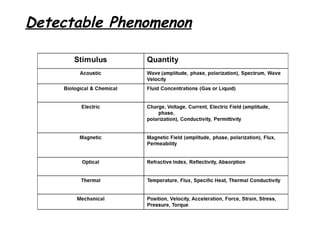
Detectable Phenomenon
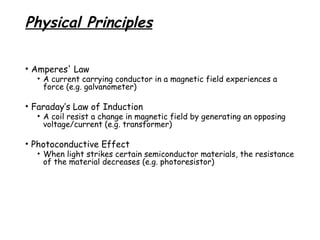
Physical Principles
• Amperes' Law

• A current carrying conductor in a magnetic field experiences a
force (e.g. galvanometer)

• Faraday’s Law of Induction

• A coil resist a change in magnetic field by generating an opposing
voltage/current (e.g. transformer)

• Photoconductive Effect

• When light strikes certain semiconductor materials, the resistance
of the material decreases (e.g. photoresistor)
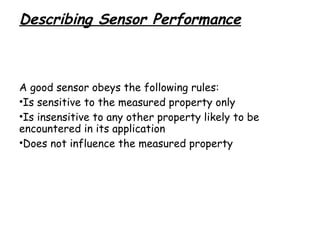
Describing Sensor Performance

A good sensor obeys the following rules:
•Is sensitive to the measured property only
•Is insensitive to any other property likely to be
encountered in its application
•Does not influence the measured property
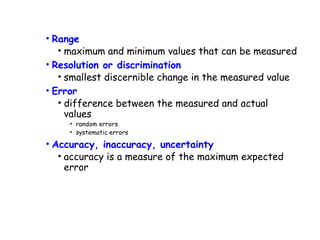
• Range
• maximum and minimum values that can be measured
• Resolution or discrimination
• smallest discernible change in the measured value
• Error
• difference between the measured and actual
values
• random errors
• systematic errors

• Accuracy, inaccuracy, uncertainty
• accuracy is a measure of the maximum expected
error
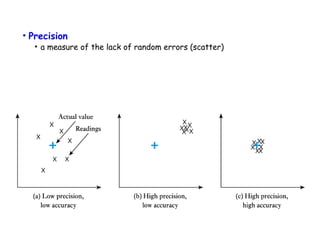
• Precision

• a measure of the lack of random errors (scatter)
• Linearity
• maximum deviation from a ‘straight-line’ response
• normally expressed as a percentage of the full-scale value

• Sensitivity
• a measure of the change produced at the output for a given change in
the quantity being measured
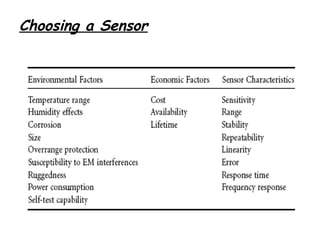
Choosing a Sensor
Types of Sensors
•
•
•
•
•
•
•
•
•
•
•
•
•

Sensors in nature
Acoustic, sound, vibration
Chemical
Electric current, electric potential, magnetic, radio
Environment, weather, moisture, humidity
Flow, fluid velocity
Navigation instruments
Position, angle, displacement, distance, speed, acceleration
Optical, light, imaging, photon
Pressure
Force, density, level
Thermal, heat, temperature
Proximity, presence
Sensors in nature
All living organisms contain biological sensors with
functions similar to those of the mechanical devices
described. Most of these are specialized cells that are
sensitive to:
•Light, motion, temperature, magnetic
fields, gravity, humidity, moisture, vibration,
pressure, electrical fields, sound, and other physical
aspects of the external environment
•Physical aspects of the internal environment, such
as stretch, motion of the organism, and position of
appendages
•Environmental molecules, including toxins, nutrients,
and pheromones
• Estimation of biomolecules interaction and
some kinetics parameters
• Internal metabolic milieu, such
as glucose level, oxygen level, or osmolality
• Internal signal molecules, such
as hormones, neurotransmitters, and cytokines
• Differences between proteins of the organism
itself and of the environment or alien
creatures.
Acoustic, sound, vibration
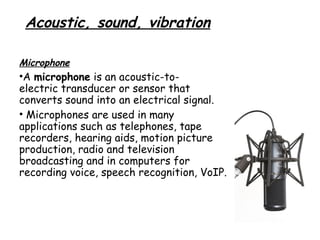
Microphone

•A microphone is an acoustic-toelectric transducer or sensor that
converts sound into an electrical signal.
• Microphones are used in many
applications such as telephones, tape
recorders, hearing aids, motion picture
production, radio and television
broadcasting and in computers for
recording voice, speech recognition, VoIP.
Force Sensors
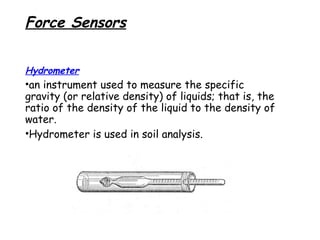
Hydrometer

•an instrument used to measure the specific
gravity (or relative density) of liquids; that is, the
ratio of the density of the liquid to the density of
water.
•Hydrometer is used in soil analysis.
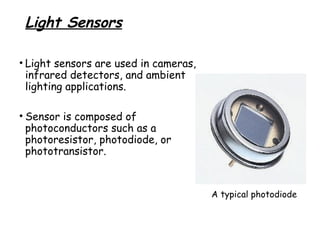
Light Sensors
• Light sensors are used in cameras,
infrared detectors, and ambient
lighting applications.
• Sensor is composed of
photoconductors such as a
photoresistor, photodiode, or
phototransistor.

A typical photodiode
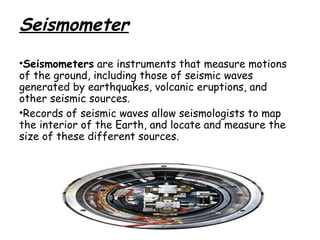
Seismometer
•Seismometers are instruments that measure motions
of the ground, including those of seismic waves
generated by earthquakes, volcanic eruptions, and
other seismic sources.
•Records of seismic waves allow seismologists to map
the interior of the Earth, and locate and measure the
size of these different sources. 
Temperature Sensor
• Temperature sensors appear in building, chemical process
plants, engines, appliances, computers, and many other
devices that require temperature monitoring.
Thermometer:
• measures temperature or temperature gradient using a
variety of different principles.
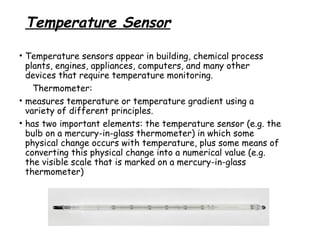
• has two important elements: the temperature sensor (e.g. the
bulb on a mercury-in-glass thermometer) in which some
physical change occurs with temperature, plus some means of
converting this physical change into a numerical value (e.g.
the visible scale that is marked on a mercury-in-glass
thermometer)
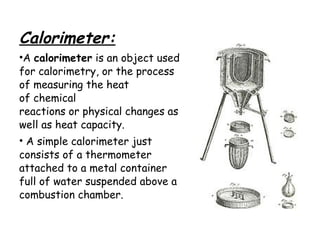
Calorimeter:
•A calorimeter is an object used
for calorimetry, or the process
of measuring the heat
of chemical
reactions or physical changes as
well as heat capacity.
• A simple calorimeter just
consists of a thermometer
attached to a metal container
full of water suspended above a
combustion chamber.
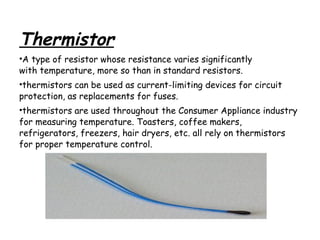
Thermistor
•A type of resistor whose resistance varies significantly
with temperature, more so than in standard resistors.
•thermistors can be used as current-limiting devices for circuit
protection, as replacements for fuses.
•thermistors are used throughout the Consumer Appliance industry
for measuring temperature. Toasters, coffee makers,
refrigerators, freezers, hair dryers, etc. all rely on thermistors
for proper temperature control.
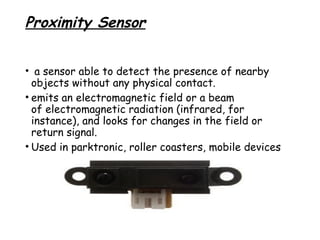
Proximity Sensor
•  a sensor able to detect the presence of nearby
objects without any physical contact.
• emits an electromagnetic field or a beam
of electromagnetic radiation (infrared, for
instance), and looks for changes in the field or
return signal.
• Used in parktronic, roller coasters, mobile devices
Pressure Sensor
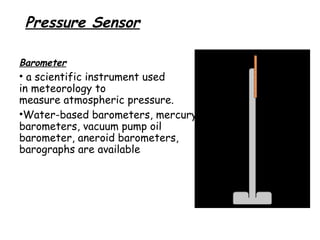
Barometer

• a scientific instrument used
in meteorology to
measure atmospheric pressure.
•Water-based barometers, mercury
barometers, vacuum pump oil
barometer, aneroid barometers,
barographs are available
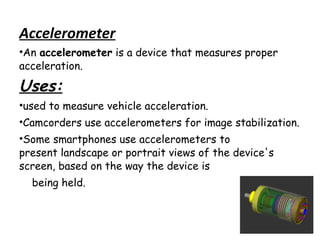
Accelerometer
•An accelerometer is a device that measures proper
acceleration.

Uses:
•used to measure vehicle acceleration.
•Camcorders use accelerometers for image stabilization.
•Some smartphones use accelerometers to
present landscape or portrait views of the device's
screen, based on the way the device is
being held.
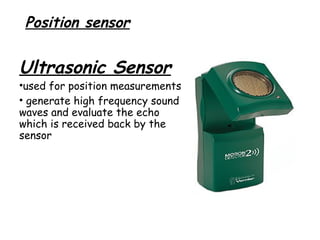
Position sensor

Ultrasonic Sensor

•used for position measurements
• generate high frequency sound
waves and evaluate the echo
which is received back by the
sensor
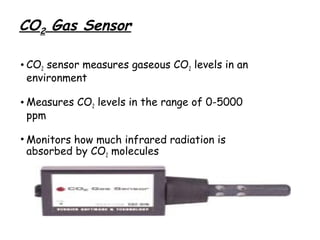
CO2 Gas Sensor
• CO2 sensor measures gaseous CO2 levels in an
environment
• Measures CO2 levels in the range of 0-5000
ppm
• Monitors how much infrared radiation is
absorbed by CO2 molecules

480 sensors

  • 1.
  • 2.
    Group Members Rashil Mehta YashBhan Harshit Mathur Ankit Yadav Anoop Kumar
  • 3.
    Transducers • Transducer – adevice that converts a primary form of energy into a corresponding signal with a different energy form. • Primary Energy Forms: mechanical, thermal, electromagnetic, optical, chemical, etc. – take form of a sensor or an actuator
  • 4.
    • Sensor (e.g., thermometer) –a device that detects/measures a signal or stimulus – acquires information from the “real world” • Actuator (e.g., heater) – a device that generates a signal or stimulus real world sensor actuator intelligent feedback system
  • 5.
    Need of Sensors •To be useful, systems must interact with their environment. To do this they use sensors and actuators. • Without the use of sensors, there would be no automation. • They are embedded in our bodies, automobiles, airplanes, cellular telephones, radios, chemical plants, industrial plants and countless other applications.
  • 6.
  • 7.
    Physical Principles • Amperes'Law • A current carrying conductor in a magnetic field experiences a force (e.g. galvanometer) • Faraday’s Law of Induction • A coil resist a change in magnetic field by generating an opposing voltage/current (e.g. transformer) • Photoconductive Effect • When light strikes certain semiconductor materials, the resistance of the material decreases (e.g. photoresistor)
  • 8.
    Describing Sensor Performance Agood sensor obeys the following rules: •Is sensitive to the measured property only •Is insensitive to any other property likely to be encountered in its application •Does not influence the measured property
  • 9.
    • Range • maximumand minimum values that can be measured • Resolution or discrimination • smallest discernible change in the measured value • Error • difference between the measured and actual values • random errors • systematic errors • Accuracy, inaccuracy, uncertainty • accuracy is a measure of the maximum expected error
  • 10.
    • Precision • ameasure of the lack of random errors (scatter)
  • 11.
    • Linearity • maximumdeviation from a ‘straight-line’ response • normally expressed as a percentage of the full-scale value • Sensitivity • a measure of the change produced at the output for a given change in the quantity being measured
  • 12.
  • 13.
    Types of Sensors • • • • • • • • • • • • • Sensorsin nature Acoustic, sound, vibration Chemical Electric current, electric potential, magnetic, radio Environment, weather, moisture, humidity Flow, fluid velocity Navigation instruments Position, angle, displacement, distance, speed, acceleration Optical, light, imaging, photon Pressure Force, density, level Thermal, heat, temperature Proximity, presence
  • 14.
    Sensors in nature Allliving organisms contain biological sensors with functions similar to those of the mechanical devices described. Most of these are specialized cells that are sensitive to: •Light, motion, temperature, magnetic fields, gravity, humidity, moisture, vibration, pressure, electrical fields, sound, and other physical aspects of the external environment •Physical aspects of the internal environment, such as stretch, motion of the organism, and position of appendages •Environmental molecules, including toxins, nutrients, and pheromones
  • 15.
    • Estimation ofbiomolecules interaction and some kinetics parameters • Internal metabolic milieu, such as glucose level, oxygen level, or osmolality • Internal signal molecules, such as hormones, neurotransmitters, and cytokines • Differences between proteins of the organism itself and of the environment or alien creatures.
  • 16.
    Acoustic, sound, vibration Microphone •A microphone isan acoustic-toelectric transducer or sensor that converts sound into an electrical signal. • Microphones are used in many applications such as telephones, tape recorders, hearing aids, motion picture production, radio and television broadcasting and in computers for recording voice, speech recognition, VoIP.
  • 17.
    Force Sensors Hydrometer •an instrumentused to measure the specific gravity (or relative density) of liquids; that is, the ratio of the density of the liquid to the density of water. •Hydrometer is used in soil analysis.
  • 18.
    Light Sensors • Lightsensors are used in cameras, infrared detectors, and ambient lighting applications. • Sensor is composed of photoconductors such as a photoresistor, photodiode, or phototransistor. A typical photodiode
  • 19.
    Seismometer •Seismometers are instruments thatmeasure motions of the ground, including those of seismic waves generated by earthquakes, volcanic eruptions, and other seismic sources. •Records of seismic waves allow seismologists to map the interior of the Earth, and locate and measure the size of these different sources. 
  • 20.
    Temperature Sensor • Temperaturesensors appear in building, chemical process plants, engines, appliances, computers, and many other devices that require temperature monitoring. Thermometer: • measures temperature or temperature gradient using a variety of different principles. • has two important elements: the temperature sensor (e.g. the bulb on a mercury-in-glass thermometer) in which some physical change occurs with temperature, plus some means of converting this physical change into a numerical value (e.g. the visible scale that is marked on a mercury-in-glass thermometer)
  • 21.
    Calorimeter: •A calorimeter is anobject used for calorimetry, or the process of measuring the heat of chemical reactions or physical changes as well as heat capacity. • A simple calorimeter just consists of a thermometer attached to a metal container full of water suspended above a combustion chamber.
  • 22.
    Thermistor •A type of resistor whose resistance variessignificantly with temperature, more so than in standard resistors. •thermistors can be used as current-limiting devices for circuit protection, as replacements for fuses. •thermistors are used throughout the Consumer Appliance industry for measuring temperature. Toasters, coffee makers, refrigerators, freezers, hair dryers, etc. all rely on thermistors for proper temperature control.
  • 23.
    Proximity Sensor •  a sensor ableto detect the presence of nearby objects without any physical contact. • emits an electromagnetic field or a beam of electromagnetic radiation (infrared, for instance), and looks for changes in the field or return signal. • Used in parktronic, roller coasters, mobile devices
  • 24.
    Pressure Sensor Barometer • a scientificinstrument used in meteorology to measure atmospheric pressure. •Water-based barometers, mercury barometers, vacuum pump oil barometer, aneroid barometers, barographs are available
  • 25.
    Accelerometer •An accelerometer is a devicethat measures proper acceleration. Uses: •used to measure vehicle acceleration. •Camcorders use accelerometers for image stabilization. •Some smartphones use accelerometers to present landscape or portrait views of the device's screen, based on the way the device is being held.
  • 26.
    Position sensor Ultrasonic Sensor •usedfor position measurements • generate high frequency sound waves and evaluate the echo which is received back by the sensor
  • 27.
    CO2 Gas Sensor •CO2 sensor measures gaseous CO2 levels in an environment • Measures CO2 levels in the range of 0-5000 ppm • Monitors how much infrared radiation is absorbed by CO2 molecules