Sensors

   Capacitive and Resistive sensors.

   Piezoelectric Transducers.

   Magnetic sensors.

   Hall Effect Sensors.

   Strain Guages Sensors.
Group Members:


• Adil Hussain               10-ECT-29

• Muhammad Saad Afzal        10-ECT-38

• Azeem Ali Shahbaz          10-ECT-02
Resistive Sensors:
• A resistive sensor is a transducer or
 electromechanical device that converts a mechanical
 change such as displacement into an electrical signal
 that can be monitored . Resistive sensors are among
 the most common in instrumentation.
Major types of Resistive transducers

• . Potentiometers


• Strain Gauges


• Resistance temperature detector (RTD)


• Thermistors


• Light Dependent Resistor (LDR)
Resistivity & Resistance.

        Resistance = (Resistivity * Length)/Area


       The resistance of a material depends on four factors:
          1.   Composition
          2.   Temperature
          3.   Length
          4.   Cross Sectional Area


     Changes in composition and temperature do not change
    the resistivity of a material in such a simple way.
RESISTIVITE POTENTIOMETERS


    A resistance element provided with a movable contact.


    The contact motion can be,
    Translation.
    Rotation.
    Combination of the two such as helical.
Capacitive Sensors
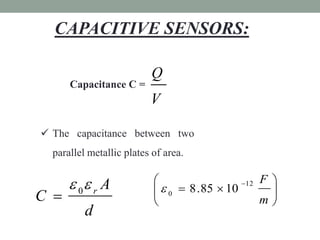
CAPACITIVE SENSORS:

                          Q
      Capacitance C =
                          V

 The capacitance between two
  parallel metallic plates of area.


       0 r A                                 12 F 
                             0  8 . 85  10        
C                                                 m
          d
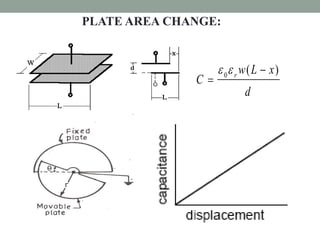
PLATE AREA CHANGE:


                    0 r w ( L  x )
              C
                           d
Piezoelectric Transducers

Example
The Piezoelectric Effect:
• How the Piezoelectric Effect Works.


• Uses.


• Applications.


• What are Typical Piezo Transducer Materials?
The Piezoelectric Effect
          Crystal material at rest: No forces applied,
          so net current flow is 0


              Crystal


                                  +-+-+-

                                                         Current Meter
                                                           =0


Charges cancel                     +-+-+-
each other, so
no current flow
The electromechanical effect


      Now, replace the current meter with a power source capable
      of supplying the same current indicated by the meter….
   Crystal

                                   switch
                      +-+-+-


charges cancel                                     power source


                      +-+-+-


…. With the switch open, the crystal material is now at rest again:
the positive charges cancel the negative charges.
What is Magnetic Sensor?

 The Sensors, transducers which uses the changes in magnetic
 field for their operations.

 Used to measure the currents, speed, position and Displacement.


 As the conventional sensors, Magnetic sensor does not give
 output parameters directly.

 Signal processing is required for desired output.
Difference between Conventional
and Magnetic Sensors:
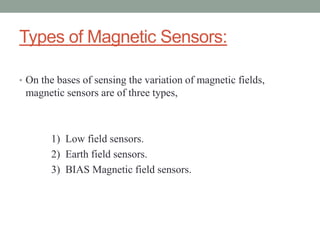
Types of Magnetic Sensors:

• On the bases of sensing the variation of magnetic fields,
 magnetic sensors are of three types,


       1) Low field sensors.
       2) Earth field sensors.
       3) BIAS Magnetic field sensors.
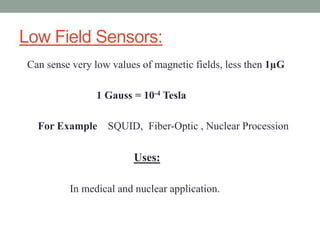
Low Field Sensors:
Can sense very low values of magnetic fields, less then 1µG

               1 Gauss = 10-4 Tesla

  For Example SQUID, Fiber-Optic , Nuclear Procession

                        Uses:

         In medical and nuclear application.
Earth Field Sensor:

 The magnetic range for the medium field sensors lends
 1µGauss to 10 Gauss


 Uses the Earth’s magnetic field in many of applications
 for Example,

             Navigation and Vehicle Detection
BIAS MAGNET FIELD SENSORS:
 Can Sense the large magnetic fields more then 10
 Gauss.

 Most industrial sensors use permanent magnets as a
 source of the detected magnetic field.

 These permanent magnets magnetize, or bias,
 ferromagnetic objects close to the sensor.

 Sensors in this category include reed switches, Hall
 devices, and GMR sensors….
Variable Reluctance Sensors:
 These sensors often measure Rotation.

 They create their own A/C voltage.

 Senses speed and position of rotating objects.


   Have many applications as:

        i) Magnetic Pulse Generators.
        ii) Pickup Coils.
       iii) Reluctor Sensors.
Working:
• Consist of a permanent Magnet and a Fixed coil on it.


• As the ferromagnetic wheel having tooth rotates, It changes the
 flux in the coil and in result the AC voltage is induced

• The frequency of this voltage depends on the speed of wheel


• The Output of the sensor is measured digitally using Signal
 processing techniques
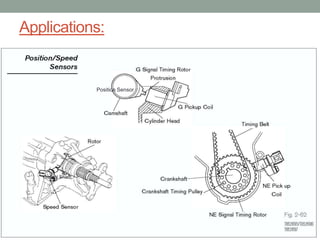
Applications:


                  Position Sensor


   Output Shaft
Inductive Sensors:

 Translate movement into a change in the inductance between
 magnetically coupled parts.

 The inductance principle is also used in differential
 transformers to measure translational and rotational
 displacements.

   For Example,
              inductive displacement transducer ,LVDT.
Working:

 The single winding on the central limb of a ‘E’-shaped
 ferromagnetic body is excited with an alternating voltage.

 The displacement to be measured is applied to a ferromagnetic
 plate in close proximity to the ‘E’ piece as

                       I = V/ωL.

 For the fixed values of V and ω the relationship I and L can
 be used to find the displacement.
Inductive Displacement Sensor:
Eddy Current Sensor:
Consist a probe containing coil excited at high frequency
 (1Mhz).

Because of the high frequency of excitation, eddy
 currents are induced only in the surface of the target and
 the current magnitude reduces to almost zero a short
 distance inside the target.

Eddy currents alter the inductance of the probe, this
 change can be translated into a d.c. voltage output that is
 proportional to the distance between the probe and the
 target.
Eddy Current Sensor
Hall Effect.
 The production of a potential difference across a conductor carrying an
 electric current when a magnetic field is applied in the direction
 perpendicular to the that of current flowing.


 It was discovered by Edwin Hall in 1879.
Hall Effect Sensor.
 Hall Effect Sensors are devices which are activated by an external
 magnetic field

 The output voltage, called the Hall voltage, (VH) of the basic Hall
 Element is directly proportional to the strength of the magnetic field
 passing through the semiconductor material (output ∝ H).

 Output voltage can be quite small, only a few microvolts even when
 subjected to strong magnetic fields.

 Most commercially available
 Hall effect devices are manufactured
 with built-in DC amplifiers.
Types:
• Linear or Analogue Hall Effect Sensor : These sensors give a
 continuous voltage output that increases with a strong magnetic field and
 decreases with a weak magnetic field.


• Digital Hall Effect Sensor: These sensors gives the output in the form
 of “ON” and “OFF”.
Applications:
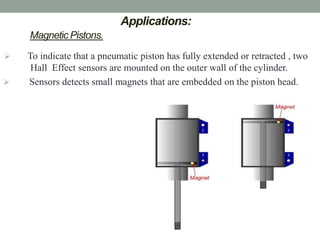
    Magnetic Pistons.
   To indicate that a pneumatic piston has fully extended or retracted , two
     Hall Effect sensors are mounted on the outer wall of the cylinder.
   Sensors detects small magnets that are embedded on the piston head.
Applications:

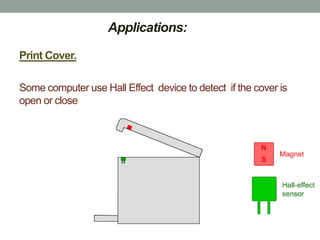
Print Cover.

Some computer use Hall Effect device to detect if the cover is
open or close.
Strain Gauge
Strain: A strain is a normalized measure of deformation representing the
displacement between particles in the body relative to a reference length.


A strain gauge is a device used to measure the strain of an object.


                           Working:

 It consist of a length of metal resistance wire formed in zigzag pattern. As
 the object is deformed, the foil is deformed, causing its electrical
 resistance to change.
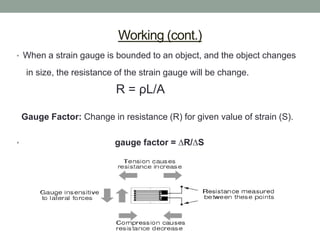
Working (cont.)
• When a strain gauge is bounded to an object, and the object changes

     in size, the resistance of the strain gauge will be change.

                            R = ρL/A

    Gauge Factor: Change in resistance (R) for given value of strain (S).

•                           gauge factor = ∆R/∆S
Application:
      Axial Strain                  Pipe pressure


 Measure the change in      • Measure the
the length of the object.    deformation in the
                             pipe.


   Important Factor:
     i) Direction.
     ii) Shape.
Magnetic sensors

Magnetic sensors

  • 2.
    Sensors  Capacitive and Resistive sensors.  Piezoelectric Transducers.  Magnetic sensors.  Hall Effect Sensors.  Strain Guages Sensors.
  • 3.
    Group Members: • AdilHussain 10-ECT-29 • Muhammad Saad Afzal 10-ECT-38 • Azeem Ali Shahbaz 10-ECT-02
  • 4.
    Resistive Sensors: • Aresistive sensor is a transducer or electromechanical device that converts a mechanical change such as displacement into an electrical signal that can be monitored . Resistive sensors are among the most common in instrumentation.
  • 5.
    Major types ofResistive transducers • . Potentiometers • Strain Gauges • Resistance temperature detector (RTD) • Thermistors • Light Dependent Resistor (LDR)
  • 6.
    Resistivity & Resistance.  Resistance = (Resistivity * Length)/Area  The resistance of a material depends on four factors: 1. Composition 2. Temperature 3. Length 4. Cross Sectional Area  Changes in composition and temperature do not change the resistivity of a material in such a simple way.
  • 7.
    RESISTIVITE POTENTIOMETERS A resistance element provided with a movable contact. The contact motion can be,  Translation.  Rotation.  Combination of the two such as helical.
  • 8.
  • 9.
    CAPACITIVE SENSORS: Q Capacitance C = V  The capacitance between two parallel metallic plates of area.  0 r A   12 F    0  8 . 85  10  C   m d
  • 10.
    PLATE AREA CHANGE:  0 r w ( L  x ) C d
  • 11.
  • 12.
    The Piezoelectric Effect: •How the Piezoelectric Effect Works. • Uses. • Applications. • What are Typical Piezo Transducer Materials?
  • 13.
    The Piezoelectric Effect Crystal material at rest: No forces applied, so net current flow is 0 Crystal +-+-+- Current Meter =0 Charges cancel +-+-+- each other, so no current flow
  • 14.
    The electromechanical effect Now, replace the current meter with a power source capable of supplying the same current indicated by the meter…. Crystal switch +-+-+- charges cancel power source +-+-+- …. With the switch open, the crystal material is now at rest again: the positive charges cancel the negative charges.
  • 16.
    What is MagneticSensor?  The Sensors, transducers which uses the changes in magnetic field for their operations.  Used to measure the currents, speed, position and Displacement.  As the conventional sensors, Magnetic sensor does not give output parameters directly.  Signal processing is required for desired output.
  • 17.
  • 18.
    Types of MagneticSensors: • On the bases of sensing the variation of magnetic fields, magnetic sensors are of three types, 1) Low field sensors. 2) Earth field sensors. 3) BIAS Magnetic field sensors.
  • 19.
    Low Field Sensors: Cansense very low values of magnetic fields, less then 1µG 1 Gauss = 10-4 Tesla For Example SQUID, Fiber-Optic , Nuclear Procession Uses: In medical and nuclear application.
  • 20.
    Earth Field Sensor: The magnetic range for the medium field sensors lends 1µGauss to 10 Gauss  Uses the Earth’s magnetic field in many of applications for Example, Navigation and Vehicle Detection
  • 21.
    BIAS MAGNET FIELDSENSORS:  Can Sense the large magnetic fields more then 10 Gauss.  Most industrial sensors use permanent magnets as a source of the detected magnetic field.  These permanent magnets magnetize, or bias, ferromagnetic objects close to the sensor.  Sensors in this category include reed switches, Hall devices, and GMR sensors….
  • 23.
    Variable Reluctance Sensors: These sensors often measure Rotation.  They create their own A/C voltage.  Senses speed and position of rotating objects.  Have many applications as: i) Magnetic Pulse Generators. ii) Pickup Coils. iii) Reluctor Sensors.
  • 24.
    Working: • Consist ofa permanent Magnet and a Fixed coil on it. • As the ferromagnetic wheel having tooth rotates, It changes the flux in the coil and in result the AC voltage is induced • The frequency of this voltage depends on the speed of wheel • The Output of the sensor is measured digitally using Signal processing techniques
  • 27.
    Applications: Position Sensor Output Shaft
  • 28.
    Inductive Sensors:  Translatemovement into a change in the inductance between magnetically coupled parts.  The inductance principle is also used in differential transformers to measure translational and rotational displacements. For Example, inductive displacement transducer ,LVDT.
  • 29.
    Working:  The singlewinding on the central limb of a ‘E’-shaped ferromagnetic body is excited with an alternating voltage.  The displacement to be measured is applied to a ferromagnetic plate in close proximity to the ‘E’ piece as I = V/ωL.  For the fixed values of V and ω the relationship I and L can be used to find the displacement.
  • 30.
  • 31.
    Eddy Current Sensor: Consista probe containing coil excited at high frequency (1Mhz). Because of the high frequency of excitation, eddy currents are induced only in the surface of the target and the current magnitude reduces to almost zero a short distance inside the target. Eddy currents alter the inductance of the probe, this change can be translated into a d.c. voltage output that is proportional to the distance between the probe and the target.
  • 32.
  • 33.
    Hall Effect.  Theproduction of a potential difference across a conductor carrying an electric current when a magnetic field is applied in the direction perpendicular to the that of current flowing.  It was discovered by Edwin Hall in 1879.
  • 34.
    Hall Effect Sensor. Hall Effect Sensors are devices which are activated by an external magnetic field  The output voltage, called the Hall voltage, (VH) of the basic Hall Element is directly proportional to the strength of the magnetic field passing through the semiconductor material (output ∝ H).  Output voltage can be quite small, only a few microvolts even when subjected to strong magnetic fields.  Most commercially available Hall effect devices are manufactured with built-in DC amplifiers.
  • 35.
    Types: • Linear orAnalogue Hall Effect Sensor : These sensors give a continuous voltage output that increases with a strong magnetic field and decreases with a weak magnetic field. • Digital Hall Effect Sensor: These sensors gives the output in the form of “ON” and “OFF”.
  • 36.
    Applications: Magnetic Pistons.  To indicate that a pneumatic piston has fully extended or retracted , two Hall Effect sensors are mounted on the outer wall of the cylinder.  Sensors detects small magnets that are embedded on the piston head.
  • 37.
    Applications: Print Cover. Some computeruse Hall Effect device to detect if the cover is open or close.
  • 38.
    Strain Gauge Strain: Astrain is a normalized measure of deformation representing the displacement between particles in the body relative to a reference length. A strain gauge is a device used to measure the strain of an object. Working: It consist of a length of metal resistance wire formed in zigzag pattern. As the object is deformed, the foil is deformed, causing its electrical resistance to change.
  • 39.
    Working (cont.) • Whena strain gauge is bounded to an object, and the object changes in size, the resistance of the strain gauge will be change. R = ρL/A Gauge Factor: Change in resistance (R) for given value of strain (S). • gauge factor = ∆R/∆S
  • 40.
    Application: Axial Strain Pipe pressure Measure the change in • Measure the the length of the object. deformation in the pipe. Important Factor: i) Direction. ii) Shape.