SEMINAR
ON
IMAGE SENSOR
CONTENTS
o What is a Sensor?
o Types of Sensors
o What is an Image Sensor?
o Types of Image Sensors
o What is CCD?
o What is CMOS?
o CCD vs CMOS
o Applications of Image Sensors
o Conclusion
WHAT IS A SENSOR?
 A sensor is a device that measures a
physical quantity and converts it into a
signal which can be read by an observer or by
an instrument.
 For example, a thermocouple converts
temperature to an output voltage which can
be read by a voltmeter.
 For accuracy, all sensors need to be
calibrated against known standards.
TYPES OF SENSORS
 Thermal Energy Sensors
 Electromagnetic Sensors
 Mechanical Sensors
 Chemical Sensors
 Optical and Radiation Sensors
 Acoustic Sensors
 Biological Sensors
WHAT IS AN IMAGE SENSOR?
 Unlike traditional camera, An Image Sensor is a photosensitive
device that converts light signals into digital signals (colours/RGB
data). It uses film to capture and store an image.
 Image sensors contain millions of photosensitive diodes known as
photosites.
 When you take a picture, the camera's shutter opens briefly and
each photo site on the image sensor records the brightness of the
light that falls on it by accumulating photons. The more light that
hits a photo site, the more photons it records.
 The brightness recorded by each photosite is then stored  as a set
of numbers (digital numbers) that can then be used to set the
color and brightness of a single pixel on the screen or ink on the
printed page to reconstruct the image.
IMAGE SENSOR HISTORY
 Before 1960 mainly film photography was
done and vacuum tubes were being used.
 From 1960-1975 early research and
development was done in the fields of CCD
and CMOS.
 From 1975-1990 commercialization of CCD
took place.
 After 1990 re-emergence of CMOS took place
and amorphous Si also came into the picture.
TYPES OF IMAGE SENSORS
An image sensor is typically of two types:
1. Charged Coupled Device (CCD)
2. Complementary Metal Oxide
Semiconductor (CMOS)
WHAT IS CCD?
 Charge-coupled devices (CCDs) are silicon-based
integrated circuits consisting of a dense matrix of
photodiodes that operate by converting light
energy in the form of photons into an electronic
charge.
 Electrons generated by the interaction of photons
with silicon atoms are stored in a potential well
and can subsequently be transferred across the
chip through registers and output to an
amplifier.
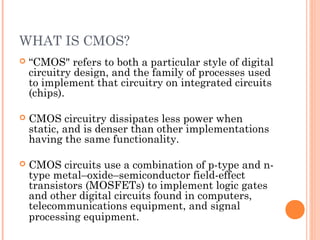
CHARGED COUPLED DEVICE (CCD)
WHAT IS CMOS?
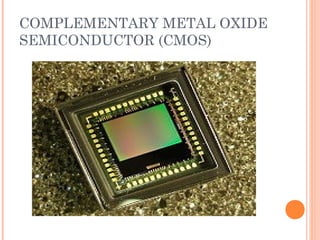
 “CMOS" refers to both a particular style of digital
circuitry design, and the family of processes used
to implement that circuitry on integrated circuits
(chips).
 CMOS circuitry dissipates less power when
static, and is denser than other implementations
having the same functionality.
 CMOS circuits use a combination of p-type and n-
type metal–oxide–semiconductor field-effect
transistors (MOSFETs) to implement logic gates
and other digital circuits found in computers,
telecommunications equipment, and signal
processing equipment.
COMPLEMENTARY METAL OXIDE
SEMICONDUCTOR (CMOS)
CCD VS CMOS
 CMOS image sensors can incorporate other circuits on the same
chip, eliminating the many separate chips required for a CCD.
 This also allows additional on-chip features to be added at little
extra cost. These features include image stabilization and image
compression.
 Not only does this make the camera smaller, lighter, and cheaper;
it also requires less power so batteries last longer.
 CMOS image sensors can switch modes on the fly between still
photography and video.
 CMOS sensors excel in the capture of outdoor pictures on sunny
days, they suffer in low light conditions.
 Their sensitivity to light is decreased because part of each
photosite is covered with circuitry that filters out noise and
performs other functions.
 The percentage of a pixel devoted to collecting light is called the
pixel’s fill factor. CCDs have a 100% fill factor but CMOS cameras
have much less.
APPLICATION
OF
IMAGE SENSORS
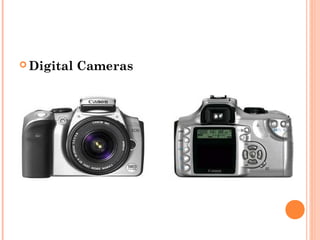
 Digital Cameras
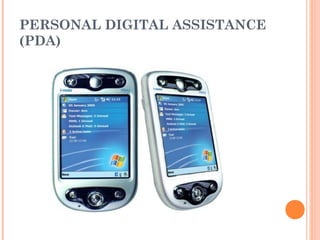
PERSONAL DIGITAL ASSISTANCE
(PDA)
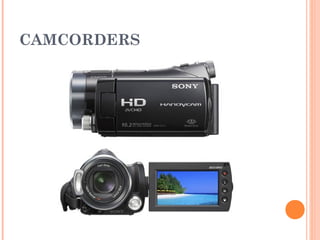
CAMCORDERS
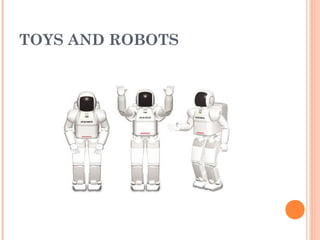
TOYS AND ROBOTS
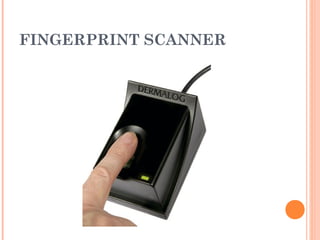
FINGERPRINT SCANNER
SOME OTHER
APPLICATIONS
Biometrics.
Optical Mouse.
Video Conferencing.
CONCLUSION
 Image sensors are an emergent solution for
practically every automation-focused machine-
vision application.
 New electronic fabrication processes, software
implementations, and new application fields will
dictate the growth of image-sensor technology in
the future.
Image sensor

Image sensor

  • 1.
  • 2.
    CONTENTS o What isa Sensor? o Types of Sensors o What is an Image Sensor? o Types of Image Sensors o What is CCD? o What is CMOS? o CCD vs CMOS o Applications of Image Sensors o Conclusion
  • 3.
    WHAT IS ASENSOR?  A sensor is a device that measures a physical quantity and converts it into a signal which can be read by an observer or by an instrument.  For example, a thermocouple converts temperature to an output voltage which can be read by a voltmeter.  For accuracy, all sensors need to be calibrated against known standards.
  • 4.
    TYPES OF SENSORS Thermal Energy Sensors  Electromagnetic Sensors  Mechanical Sensors  Chemical Sensors  Optical and Radiation Sensors  Acoustic Sensors  Biological Sensors
  • 5.
    WHAT IS ANIMAGE SENSOR?  Unlike traditional camera, An Image Sensor is a photosensitive device that converts light signals into digital signals (colours/RGB data). It uses film to capture and store an image.  Image sensors contain millions of photosensitive diodes known as photosites.  When you take a picture, the camera's shutter opens briefly and each photo site on the image sensor records the brightness of the light that falls on it by accumulating photons. The more light that hits a photo site, the more photons it records.  The brightness recorded by each photosite is then stored  as a set of numbers (digital numbers) that can then be used to set the color and brightness of a single pixel on the screen or ink on the printed page to reconstruct the image.
  • 7.
    IMAGE SENSOR HISTORY Before 1960 mainly film photography was done and vacuum tubes were being used.  From 1960-1975 early research and development was done in the fields of CCD and CMOS.  From 1975-1990 commercialization of CCD took place.  After 1990 re-emergence of CMOS took place and amorphous Si also came into the picture.
  • 8.
    TYPES OF IMAGESENSORS An image sensor is typically of two types: 1. Charged Coupled Device (CCD) 2. Complementary Metal Oxide Semiconductor (CMOS)
  • 9.
    WHAT IS CCD? Charge-coupled devices (CCDs) are silicon-based integrated circuits consisting of a dense matrix of photodiodes that operate by converting light energy in the form of photons into an electronic charge.  Electrons generated by the interaction of photons with silicon atoms are stored in a potential well and can subsequently be transferred across the chip through registers and output to an amplifier.
  • 10.
  • 11.
    WHAT IS CMOS? “CMOS" refers to both a particular style of digital circuitry design, and the family of processes used to implement that circuitry on integrated circuits (chips).  CMOS circuitry dissipates less power when static, and is denser than other implementations having the same functionality.  CMOS circuits use a combination of p-type and n- type metal–oxide–semiconductor field-effect transistors (MOSFETs) to implement logic gates and other digital circuits found in computers, telecommunications equipment, and signal processing equipment.
  • 12.
  • 13.
    CCD VS CMOS CMOS image sensors can incorporate other circuits on the same chip, eliminating the many separate chips required for a CCD.  This also allows additional on-chip features to be added at little extra cost. These features include image stabilization and image compression.  Not only does this make the camera smaller, lighter, and cheaper; it also requires less power so batteries last longer.  CMOS image sensors can switch modes on the fly between still photography and video.  CMOS sensors excel in the capture of outdoor pictures on sunny days, they suffer in low light conditions.  Their sensitivity to light is decreased because part of each photosite is covered with circuitry that filters out noise and performs other functions.  The percentage of a pixel devoted to collecting light is called the pixel’s fill factor. CCDs have a 100% fill factor but CMOS cameras have much less.
  • 14.
  • 15.
  • 16.
  • 17.
  • 18.
  • 19.
  • 20.
  • 21.
    CONCLUSION  Image sensorsare an emergent solution for practically every automation-focused machine- vision application.  New electronic fabrication processes, software implementations, and new application fields will dictate the growth of image-sensor technology in the future.

Editor's Notes

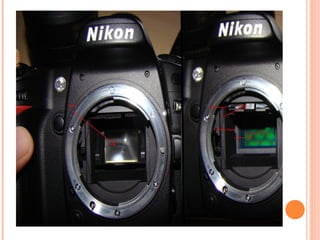
  • #7 Mirror Covering sensor, Mirror xposed sensor opened