
PREPARED BY
SANTHOSH KUMAR V
A sensor is a device that detects and responds to some
type of input from the physical environment. The
specific input could be light, heat, motion, moisture,
pressure, or any one of a great number of other
environmental phenomena. The output is generally a
signal that is converted to human-readable display at the
sensor location or transmitted electronically over a
network for reading or further processing.
The following is a list of different types of sensors that are commonly used
in various applications. All these sensors are used for measuring one of
the physical properties like Temperature, Resistance, Capacitance,
Conduction, Heat Transfer etc.
• Temperature Sensor
• Proximity Sensor
• Accelerometer
• IR Sensor (Infrared Sensor)
• Pressure Sensor
• Light Sensor
• Ultrasonic Sensor
• Smoke, Gas and Alcohol Sensor
• Touch Sensor
• Color Sensor
• Humidity Sensor
• Tilt Sensor
• Flow and Level Sensor
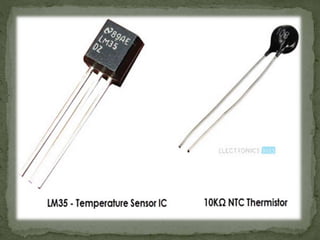
 One of the most common and most popular sensor is the
Temperature Sensor. A Temperature Sensor, as the name
suggests, senses the temperature i.e. it measures the
changes in the temperature.
 In a Temperature Sensor, the changes in the Temperature
correspond to change in its physical property like
resistance or voltage.
 There are different types of Temperature Sensors like
Temperature Sensor ICs (like LM35), Thermistors,
Thermocouples, RTD (Resistive Temperature Devices), etc.
 Temperature Sensors are used everywhere like computers,
mobile phones, automobiles, air conditioning systems,
industries etc.
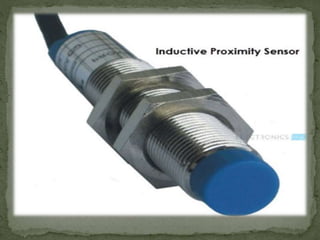
 A Proximity Sensor is a non-contact type sensor that
detects the presence of an object. Proximity Sensors
can be implemented using different techniques like
Optical (like Infrared or Laser), Ultrasonic, Hall Effect,
Capacitive, etc.
 Some of the applications of Proximity Sensors are
Mobile Phones, Cars (Parking Sensors), industries
(object alignment), Ground Proximity in Aircrafts, etc.
 IR Sensors or Infrared Sensor are light based sensor that are used
in various applications like Proximity and Object Detection. IR
Sensors are used as proximity sensors in almost all mobile
phones.
 There are two types of Infrared or IR Sensors: Transmissive Type
and Reflective Type. In Transmissive Type IR Sensor, the IR
Transmitter (usually an IR LED) and the IR Detector (usually a
Photo Diode) are positioned facing each other so that when an
object passes between them, the sensor detects the object.
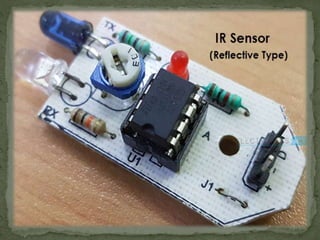
 The other type of IR Sensor is a Reflective Type IR Sensor. In this,
the transmitter and the detector are positioned adjacent to each
other facing the object. When an object comes in front of the
sensor, the sensor detects the object.
 Different applications where IR Sensor is implemented are
Mobile Phones, Robots, Industrial assembly, automobiles etc.
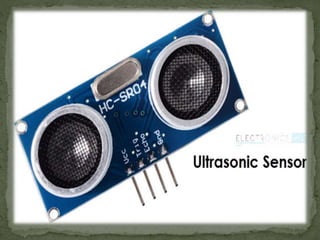
 An Ultrasonic Sensor is a non-contact type device that
can be used to measure distance as well as velocity of
an object. An Ultrasonic Sensor works based on the
properties of the sound waves with frequency greater
than that of the human audible range.
 Using the time of flight of the sound wave, an
Ultrasonic Sensor can measure the distance of the
object (similar to SONAR). The Doppler Shift property
of the sound wave is used to measure the velocity of an
object.
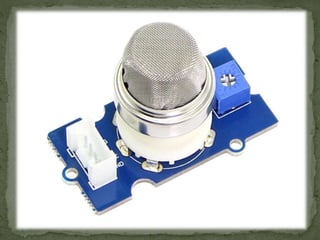
 The Grove - Gas Sensor(MQ2) module is useful for gas
leakage detection (home and industry). It is suitable
for detecting H2, LPG, CH4, CO, Alcohol, Smoke or
Propane. Due to its high sensitivity and fast response
time, measurement can be taken as soon as possible.
The sensitivity of the sensor can be adjusted by
potentiometer.
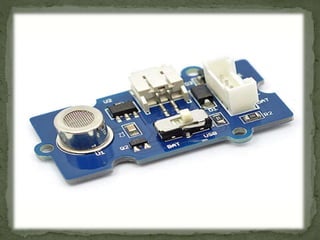
 This alcohol sensor is suitable for detecting alcohol
concentration on your breath, just like your common
breathalyzer. It has a high sensitivity and fast response
time. Sensor provides an analog resistive output based
on alcohol concentration. The drive circuit is very
simple, all it needs is one resistor. A simple interface
could be a 0-3.3V ADC.
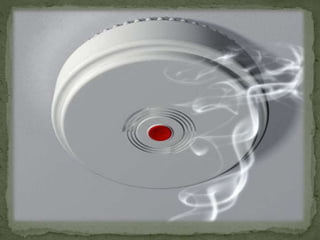
 A smoke detector is a sensor that detects smoke as a
primary indication of fire.
 It provides a signal to a fire alarm system in a large
building, or produces an audible and visual signal
locally in a room or a home.
 Smoke detectors are usually housed in a small, round
shaped plastic case, and placed at the roof where there
are risks of fire or fire hazards..
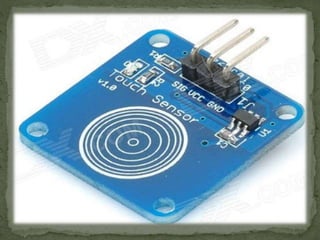
 A touch sensor is a type of equipment that captures
and records physical touch or embrace on a device
and/or object. It enables a device or object to detech
touch, typically by a human user or operator.
 A touch sensor may also be called a touch detector.
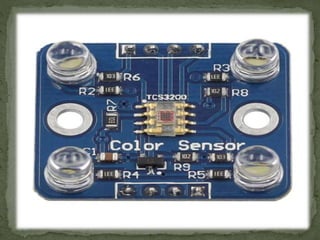
 The color sensor detects the color of the surface,
usually in the RGB scale. Color is the result of
interaction between a light source, an object and an
observer.
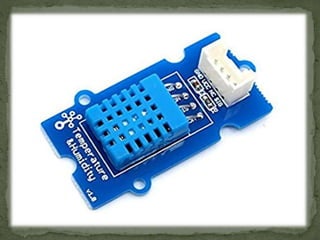
 A humidity sensor (or hygrometer) senses, measures and reports the
relative humidity in the air. It therefore measures both moisture and air
temperature.
 Relative humidity is the ratio of actual moisture in the air to the
highest amount of moisture that can be held at that air temperature.
 The warmer the air temperature is, the more moisture it can hold.
Humidity / dew sensors use capacitive measurement, which relies on
electrical capacitance.
 Electrical capacity is the ability of two nearby electrical conductors to
create an electrical field between them. The sensor is composed of two
metal plates and contains a non-conductive polymer film between
them.
 This film collects moisture from the air, which causes the voltage
between the two plates to change. These voltage changes are converted
into digital readings showing the level of moisture in the air.
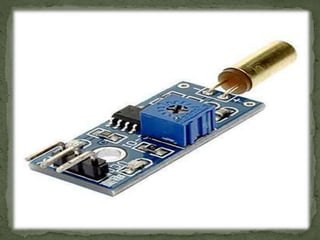
 A clinometer or inclinometer is an instrument for measuring angles of slope (or
tilt), elevation or depression of an object with respect to gravity. It is also
known as a tilt indicator, tilt sensor, tilt meter, slope alert, slope gauge, gradient
meter, gradiometer, level gauge, level meter, declinometer, and pitch & roll
indicator. Clinometers measure both inclines (positive slopes, as seen by an
observer looking upwards) and declines (negative slopes, as seen by an
observer looking downward) using three different units of measure: degrees,
percent, and topo (see Grade (slope) for details). Astrolabes are inclinometers
that were used for navigation and locating astronomical objects from ancient
times to the Renaissance.
 A tilt sensor can measure the tilting in often two axes of a reference plane in
two axes. In contrast, a full motion would use at least three axes and often
additional sensors. One way to measure tilt angle with reference to the earth's
ground plane, is to use an accelerometer. Typical applications can be found in
the industry and in game controllers. In aircraft, the "ball" in turn coordinators
or turn and bank indicators is sometimes referred to as an inclinomete
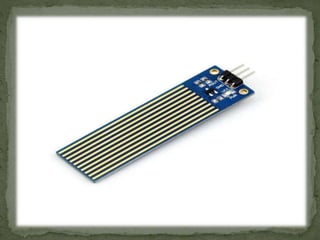
 Level sensors detect the level of liquids and other fluids
and fluidized solids, including slurries, granular materials,
and powders that exhibit an upper free surface. Substances
that flow become essentially horizontal in their containers
(or other physical boundaries) because of gravity whereas
most bulk solids pile at an angle of repose to a peak. The
substance to be measured can be inside a container or can
be in its natural form (e.g., a river or a lake).
 The level measurement can be either continuous or point
values. Continuous level sensors measure level within a
specified range and determine the exact amount of
substance in a certain place, while point-level sensors only
indicate whether the substance is above or below the
sensing point. Generally the latter detect levels that are
excessively high or low.
THANK YOU

Sensors

  • 1.
  • 2.
    A sensor isa device that detects and responds to some type of input from the physical environment. The specific input could be light, heat, motion, moisture, pressure, or any one of a great number of other environmental phenomena. The output is generally a signal that is converted to human-readable display at the sensor location or transmitted electronically over a network for reading or further processing.
  • 3.
    The following isa list of different types of sensors that are commonly used in various applications. All these sensors are used for measuring one of the physical properties like Temperature, Resistance, Capacitance, Conduction, Heat Transfer etc. • Temperature Sensor • Proximity Sensor • Accelerometer • IR Sensor (Infrared Sensor) • Pressure Sensor • Light Sensor • Ultrasonic Sensor • Smoke, Gas and Alcohol Sensor • Touch Sensor • Color Sensor • Humidity Sensor • Tilt Sensor • Flow and Level Sensor
  • 4.
     One ofthe most common and most popular sensor is the Temperature Sensor. A Temperature Sensor, as the name suggests, senses the temperature i.e. it measures the changes in the temperature.  In a Temperature Sensor, the changes in the Temperature correspond to change in its physical property like resistance or voltage.  There are different types of Temperature Sensors like Temperature Sensor ICs (like LM35), Thermistors, Thermocouples, RTD (Resistive Temperature Devices), etc.  Temperature Sensors are used everywhere like computers, mobile phones, automobiles, air conditioning systems, industries etc.
  • 6.
     A ProximitySensor is a non-contact type sensor that detects the presence of an object. Proximity Sensors can be implemented using different techniques like Optical (like Infrared or Laser), Ultrasonic, Hall Effect, Capacitive, etc.  Some of the applications of Proximity Sensors are Mobile Phones, Cars (Parking Sensors), industries (object alignment), Ground Proximity in Aircrafts, etc.
  • 8.
     IR Sensorsor Infrared Sensor are light based sensor that are used in various applications like Proximity and Object Detection. IR Sensors are used as proximity sensors in almost all mobile phones.  There are two types of Infrared or IR Sensors: Transmissive Type and Reflective Type. In Transmissive Type IR Sensor, the IR Transmitter (usually an IR LED) and the IR Detector (usually a Photo Diode) are positioned facing each other so that when an object passes between them, the sensor detects the object.  The other type of IR Sensor is a Reflective Type IR Sensor. In this, the transmitter and the detector are positioned adjacent to each other facing the object. When an object comes in front of the sensor, the sensor detects the object.  Different applications where IR Sensor is implemented are Mobile Phones, Robots, Industrial assembly, automobiles etc.
  • 10.
     An UltrasonicSensor is a non-contact type device that can be used to measure distance as well as velocity of an object. An Ultrasonic Sensor works based on the properties of the sound waves with frequency greater than that of the human audible range.  Using the time of flight of the sound wave, an Ultrasonic Sensor can measure the distance of the object (similar to SONAR). The Doppler Shift property of the sound wave is used to measure the velocity of an object.
  • 12.
     The Grove- Gas Sensor(MQ2) module is useful for gas leakage detection (home and industry). It is suitable for detecting H2, LPG, CH4, CO, Alcohol, Smoke or Propane. Due to its high sensitivity and fast response time, measurement can be taken as soon as possible. The sensitivity of the sensor can be adjusted by potentiometer.
  • 14.
     This alcoholsensor is suitable for detecting alcohol concentration on your breath, just like your common breathalyzer. It has a high sensitivity and fast response time. Sensor provides an analog resistive output based on alcohol concentration. The drive circuit is very simple, all it needs is one resistor. A simple interface could be a 0-3.3V ADC.
  • 16.
     A smokedetector is a sensor that detects smoke as a primary indication of fire.  It provides a signal to a fire alarm system in a large building, or produces an audible and visual signal locally in a room or a home.  Smoke detectors are usually housed in a small, round shaped plastic case, and placed at the roof where there are risks of fire or fire hazards..
  • 18.
     A touchsensor is a type of equipment that captures and records physical touch or embrace on a device and/or object. It enables a device or object to detech touch, typically by a human user or operator.  A touch sensor may also be called a touch detector.
  • 20.
     The colorsensor detects the color of the surface, usually in the RGB scale. Color is the result of interaction between a light source, an object and an observer.
  • 22.
     A humiditysensor (or hygrometer) senses, measures and reports the relative humidity in the air. It therefore measures both moisture and air temperature.  Relative humidity is the ratio of actual moisture in the air to the highest amount of moisture that can be held at that air temperature.  The warmer the air temperature is, the more moisture it can hold. Humidity / dew sensors use capacitive measurement, which relies on electrical capacitance.  Electrical capacity is the ability of two nearby electrical conductors to create an electrical field between them. The sensor is composed of two metal plates and contains a non-conductive polymer film between them.  This film collects moisture from the air, which causes the voltage between the two plates to change. These voltage changes are converted into digital readings showing the level of moisture in the air.
  • 24.
     A clinometeror inclinometer is an instrument for measuring angles of slope (or tilt), elevation or depression of an object with respect to gravity. It is also known as a tilt indicator, tilt sensor, tilt meter, slope alert, slope gauge, gradient meter, gradiometer, level gauge, level meter, declinometer, and pitch & roll indicator. Clinometers measure both inclines (positive slopes, as seen by an observer looking upwards) and declines (negative slopes, as seen by an observer looking downward) using three different units of measure: degrees, percent, and topo (see Grade (slope) for details). Astrolabes are inclinometers that were used for navigation and locating astronomical objects from ancient times to the Renaissance.  A tilt sensor can measure the tilting in often two axes of a reference plane in two axes. In contrast, a full motion would use at least three axes and often additional sensors. One way to measure tilt angle with reference to the earth's ground plane, is to use an accelerometer. Typical applications can be found in the industry and in game controllers. In aircraft, the "ball" in turn coordinators or turn and bank indicators is sometimes referred to as an inclinomete
  • 26.
     Level sensorsdetect the level of liquids and other fluids and fluidized solids, including slurries, granular materials, and powders that exhibit an upper free surface. Substances that flow become essentially horizontal in their containers (or other physical boundaries) because of gravity whereas most bulk solids pile at an angle of repose to a peak. The substance to be measured can be inside a container or can be in its natural form (e.g., a river or a lake).  The level measurement can be either continuous or point values. Continuous level sensors measure level within a specified range and determine the exact amount of substance in a certain place, while point-level sensors only indicate whether the substance is above or below the sensing point. Generally the latter detect levels that are excessively high or low.
  • 28.