ARTIFICIAL INTELLIGENCE
PRESENTED BY

Intekhab Alam
Khan
Shrijana Tiwari
TOPICS
Introduction
History of Artificial Intelligence
Historic Attempts
Why is AI
Limitations of Human Mind
Robotics
Robots as part of Human Society
Applications
Advantages
Disadvantages
Conclusion
ARTIFICIAL INTELLIGENCE
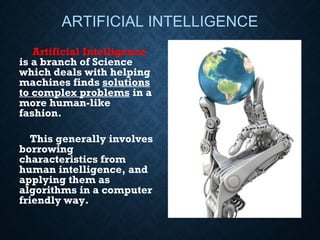
Artificial Intelligence
is a branch of Science
which deals with helping
machines finds solutions
to complex problems in a
more human-like
fashion.
This generally involves
borrowing
characteristics from
human intelligence, and
applying them as
algorithms in a computer
friendly way.
BRIEF HISTORY OF
ARTIFICIAL INTELLIGENCE
5th century BC
Aristotle invents syllogistic logic, the first formal deductive
reasoning system.
17thth century AD
16 century
Descartes proposes animals are machines and founds a
scientific paradigm that will dominatethe Golem, an artificial man
Rabbi Loew supposedly invents for 250 years.
Pascal creates
made out of clay the first mechanical calculator in 1642
18th century
Wolfgang von Kempelen “invents” fake chess-playing machine,
The Turk
19th century
George Boole creates a binary algebra to represent “laws of thought”

Charles Babbage and Lady Lovelace develop sophisticated
programmable mechanical computers, precursor to modern electronic
computers.
20th century
Karel Kapek writes “Rossum’s Universal Robots”, coining the
English word “robot”
Warren McCulloch and Walter Pitts lay partial groundwork for
neural networks
Turing writes “Computing Machinery and Intelligence” – proposal
of Turing test
HISTORIC ATTEMPTS
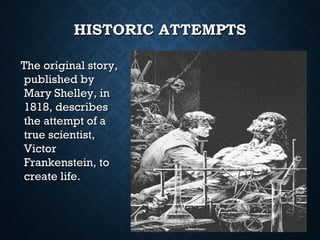
The original story,
published by
Mary Shelley, in
1818, describes
the attempt of a
true scientist,
Victor
Frankenstein, to
create life.
WHY IS AI
• Computers are
fundamentally well suited to
performing mechanical
computations, using fixed
programmed rules. This
allows artificial machines to
perform simple monotonous
tasks efficiently and
reliably, which humans are
ill-suited to. `
LIMITATIONS OF HUMAN MIND
• Object recognition. People cannot properly
explain how they recognize objects.
Face recognition. Cannot be passed on to
another person by explanation.
• Naming of colours. Based on learning, not on
absolute standards.
ROBOTICS
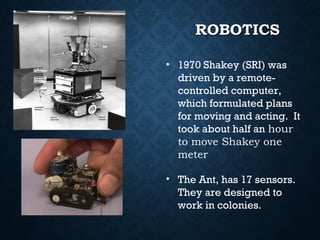
• 1970 Shakey (SRI) was
driven by a remotecontrolled computer,
which formulated plans
for moving and acting. It
took about half an hour
to move Shakey one
meter
• The Ant, has 17 sensors.
They are designed to
work in colonies.
ROBOTS AS PART OF THE HUMAN
SOCIETY :

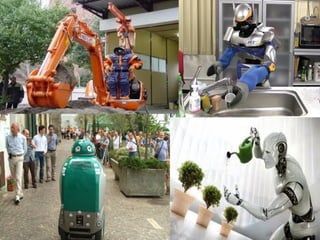
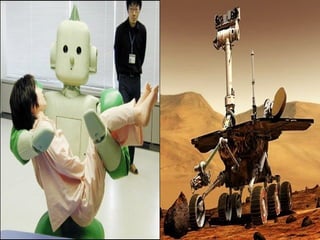
• As robots are getting the appearance and functionalities of
humans and animals there is a growing need to make them
interact and communicate as a sociable partner rather than a
tool.
• This trend is requiring that robots would be able to
communicate, cooperate, and learn from people in familiar
human-oriented terms.
APPLICATIONS…
• They stretch from the military for autonomous control and
target identification, to the entertainment industry for computer
games and robotic pets.
• Lets also not forget big establishments dealing with huge
amounts of information such as hospitals, banks and insurances,
who can use AI to predict customer behavior and detect
trends.
ADVANTAGES
 They will probably be increasingly used in the field of medicine.
 A knowledge based expert system, which can cross-reference
symptoms and diseases will greatly improve the accuracy of
diagnostics.
 Object recognition will also be a great aid to doctors.
 Along with images from cats cans or X-ray machines, they will be
able to get preliminary analysis of those images.
 This of course will be possible only if people solve legal
questions that arise by giving power to a machine to control or
influence the health of a human
DISADVANTAGES:

• Self-modifying, when combined
with self-replicating, can lead to
dangerous, unexpected results,
such as a new and frequently
mutating computer virus.
CONCLUSION
 Idea of Artificial
Intelligence is being
replaced by Artificial life,
or anything with a form or
body.
 The consensus among
scientists is that a
requirement for life is that
it has an embodiment in
some physical form, but
this will change. Programs
may not fit this
requirement for life yet.
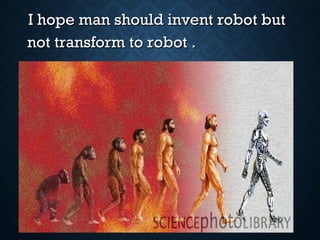
I hope man should invent robot but
not transform to robot .
Artificial intelligenc

Artificial intelligenc

  • 1.
  • 2.
    TOPICS Introduction History of ArtificialIntelligence Historic Attempts Why is AI Limitations of Human Mind Robotics Robots as part of Human Society Applications Advantages Disadvantages Conclusion
  • 3.
    ARTIFICIAL INTELLIGENCE Artificial Intelligence isa branch of Science which deals with helping machines finds solutions to complex problems in a more human-like fashion. This generally involves borrowing characteristics from human intelligence, and applying them as algorithms in a computer friendly way.
  • 4.
    BRIEF HISTORY OF ARTIFICIALINTELLIGENCE 5th century BC Aristotle invents syllogistic logic, the first formal deductive reasoning system. 17thth century AD 16 century Descartes proposes animals are machines and founds a scientific paradigm that will dominatethe Golem, an artificial man Rabbi Loew supposedly invents for 250 years. Pascal creates made out of clay the first mechanical calculator in 1642 18th century Wolfgang von Kempelen “invents” fake chess-playing machine, The Turk
  • 5.
    19th century George Boolecreates a binary algebra to represent “laws of thought” Charles Babbage and Lady Lovelace develop sophisticated programmable mechanical computers, precursor to modern electronic computers. 20th century Karel Kapek writes “Rossum’s Universal Robots”, coining the English word “robot” Warren McCulloch and Walter Pitts lay partial groundwork for neural networks Turing writes “Computing Machinery and Intelligence” – proposal of Turing test
  • 6.
    HISTORIC ATTEMPTS The originalstory, published by Mary Shelley, in 1818, describes the attempt of a true scientist, Victor Frankenstein, to create life.
  • 7.
    WHY IS AI •Computers are fundamentally well suited to performing mechanical computations, using fixed programmed rules. This allows artificial machines to perform simple monotonous tasks efficiently and reliably, which humans are ill-suited to. `
  • 8.
    LIMITATIONS OF HUMANMIND • Object recognition. People cannot properly explain how they recognize objects. Face recognition. Cannot be passed on to another person by explanation. • Naming of colours. Based on learning, not on absolute standards.
  • 9.
    ROBOTICS • 1970 Shakey(SRI) was driven by a remotecontrolled computer, which formulated plans for moving and acting. It took about half an hour to move Shakey one meter • The Ant, has 17 sensors. They are designed to work in colonies.
  • 10.
    ROBOTS AS PARTOF THE HUMAN SOCIETY : • As robots are getting the appearance and functionalities of humans and animals there is a growing need to make them interact and communicate as a sociable partner rather than a tool. • This trend is requiring that robots would be able to communicate, cooperate, and learn from people in familiar human-oriented terms.
  • 12.
    APPLICATIONS… • They stretchfrom the military for autonomous control and target identification, to the entertainment industry for computer games and robotic pets. • Lets also not forget big establishments dealing with huge amounts of information such as hospitals, banks and insurances, who can use AI to predict customer behavior and detect trends.
  • 14.
    ADVANTAGES  They willprobably be increasingly used in the field of medicine.  A knowledge based expert system, which can cross-reference symptoms and diseases will greatly improve the accuracy of diagnostics.  Object recognition will also be a great aid to doctors.  Along with images from cats cans or X-ray machines, they will be able to get preliminary analysis of those images.  This of course will be possible only if people solve legal questions that arise by giving power to a machine to control or influence the health of a human
  • 15.
    DISADVANTAGES: • Self-modifying, whencombined with self-replicating, can lead to dangerous, unexpected results, such as a new and frequently mutating computer virus.
  • 17.
    CONCLUSION  Idea ofArtificial Intelligence is being replaced by Artificial life, or anything with a form or body.  The consensus among scientists is that a requirement for life is that it has an embodiment in some physical form, but this will change. Programs may not fit this requirement for life yet.
  • 18.
    I hope manshould invent robot but not transform to robot .