Quantum Phenomena Electron-volt  Photons Energy levels Monday 26 September 2011
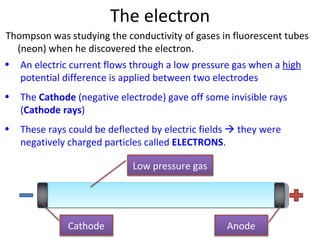
The electron Thompson was studying the conductivity of gases in fluorescent tubes (neon) when he discovered the electron. An electric current flows through a low pressure gas when a  high  potential difference is applied between two electrodes The  Cathode  (negative electrode) gave off some invisible rays ( Cathode rays ) These rays could be deflected by electric fields    they were negatively charged particles called  ELECTRONS . Anode Cathode Low pressure gas
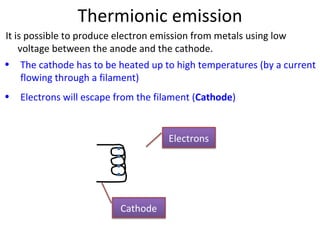
Thermionic emission It is possible to produce electron emission from metals using low voltage between the anode and the cathode.  The cathode has to be heated up to high temperatures (by a current flowing through a filament) Electrons will escape from the filament ( Cathode ) Cathode Electrons
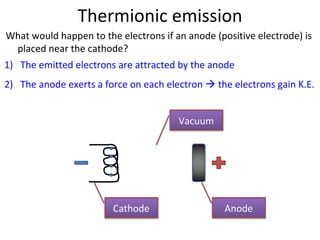
Thermionic emission What would happen to the electrons if an anode (positive electrode) is placed near the cathode? The emitted electrons are attracted by the anode The anode exerts a force on each electron    the electrons gain K.E. Cathode Anode Vacuum
Electron deflection So, how did Thompson realised that the “cathode rays” are streams of negative particles? The cathode rays could be deflected by electric, or magnetic fields. Draw the path of the electrons that go through the hole in the anode and between the positive and negative electrodes. Cathode Anode Electrodes
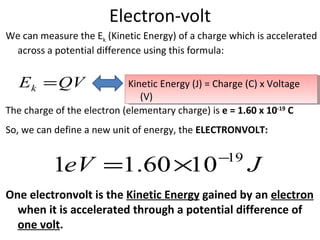
Electron-volt We can measure the E k  (Kinetic Energy) of a charge which is accelerated across a potential difference using this formula: Kinetic Energy (J) = Charge (C) x Voltage (V) The charge of the electron (elementary charge) is  e = 1.60 x 10 -19  C So, we can define a new unit of energy, the  ELECTRONVOLT: One electronvolt is the  Kinetic Energy  gained by an  electron  when it is accelerated through a potential difference of  one volt .
Neon Lamps But, why do fluorescent tubes emit light of different… The gas that fills the tubes is different, so it emits different colour light when an electric current flows through it. C O L O U R S And why do different gases emit different colours? To answer this question we must understand the nature of light and electromagnetic radiation, and the structure of the atom.
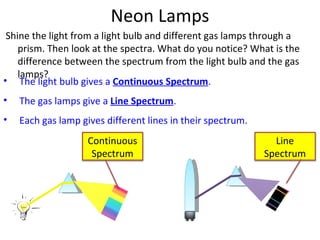
Neon Lamps Shine the light from a light bulb and different gas lamps through a prism. Then look at the spectra. What do you notice? What is the difference between the spectrum from the light bulb and the gas lamps? The light bulb gives a  Continuous Spectrum . The gas lamps give a  Line Spectrum . Each gas lamp gives different lines in their spectrum. Continuous Spectrum Line Spectrum
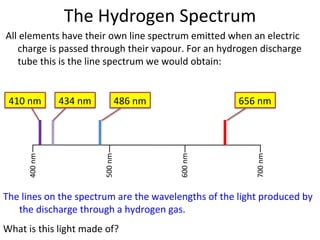
The Hydrogen Spectrum All elements have their own line spectrum emitted when an electric charge is passed through their vapour. For an hydrogen discharge tube this is the line spectrum we would obtain: The lines on the spectrum are the wavelengths of the light produced by the discharge through a hydrogen gas. What is this light made of? 400 nm 500 nm 600 nm 700 nm 656 nm 486 nm 434 nm 410 nm
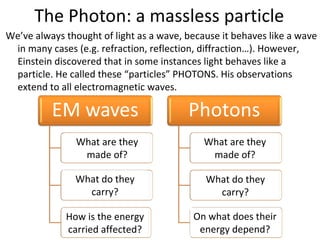
The Photon: a massless particle We’ve always thought of light as a wave, because it behaves like a wave in many cases (e.g. refraction, reflection, diffraction…). However, Einstein discovered that in some instances light behaves like a particle. He called these “particles” PHOTONS. His observations extend to all electromagnetic waves. What are they made of? What are they made of? What do they carry? What do they carry? How is the energy carried affected? On what does their energy depend?
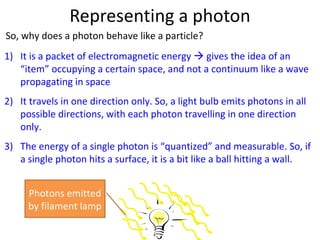
Representing a photon So, why does a photon behave like a particle? It is a packet of electromagnetic energy    gives the idea of an “item” occupying a certain space, and not a continuum like a wave propagating in space It travels in one direction only. So, a light bulb emits photons in all possible directions, with each photon travelling in one direction only. The energy of a single photon is “quantized” and measurable. So, if a single photon hits a surface, it is a bit like a ball hitting a wall. Photons emitted by filament lamp
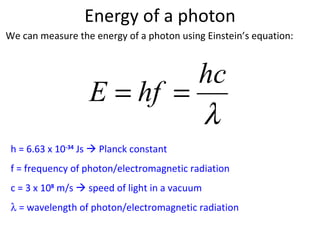
Energy of a photon We can measure the energy of a photon using Einstein’s equation: h = 6.63 x 10 -34  Js    Planck constant f = frequency of photon/electromagnetic radiation c = 3 x 10 8  m/s    speed of light in a vacuum    = wavelength of photon/electromagnetic radiation
Energy Levels So, what causes the hydrogen in the discharge tube to emit just four wavelengths of light? The electrons in the atom can only orbit at certain distances from the nucleus, i.e. the radius of the orbit is “quantized” Each “orbit” represents the energy of the electrons. So, electrons on the lower level (orbit) is at  Ground State  and have the lowest potential energy, while the other states are called  Excited States  because the electrons are at a higher potential energy The electric discharge gives the electrons the energy to jump on to higher energy levels Eventually (pretty quickly), these electrons will jump down to a lower energy level, or even the ground level In jumping down the electrons emit a photon of energy equal to the difference in the energy between the two levels
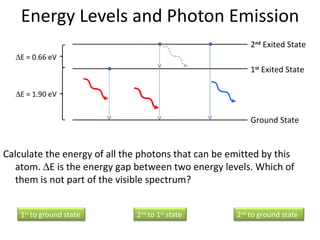
Energy Levels and Photon Emission Calculate the energy of all the photons that can be emitted by this atom.   E is the energy gap between two energy levels. Which of them is not part of the visible spectrum?  E = 0.66 eV  E = 1.90 eV Ground State 1 st  Exited State 2 nd  Exited State 1 st  to ground state 2 nd  to 1 st  state 2 nd  to ground state
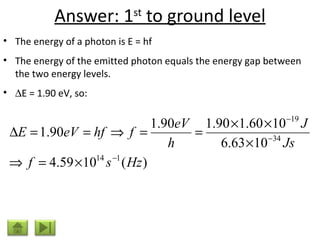
Answer: 1 st  to ground level The energy of a photon is E = hf The energy of the emitted photon equals the energy gap between the two energy levels.   E = 1.90 eV, so:
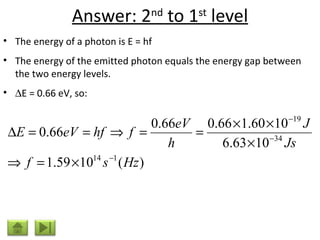
Answer: 2 nd  to 1 st  level The energy of a photon is E = hf The energy of the emitted photon equals the energy gap between the two energy levels.   E = 0.66 eV, so:
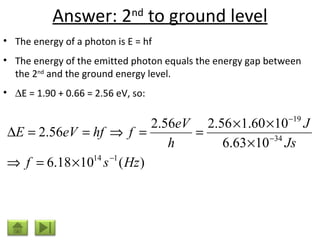
Answer: 2 nd  to ground level The energy of a photon is E = hf The energy of the emitted photon equals the energy gap between the 2 nd  and the ground energy level.   E = 1.90 + 0.66 = 2.56 eV, so:

Photon and energy levels

  • 1.
    Quantum Phenomena Electron-volt Photons Energy levels Monday 26 September 2011
  • 2.
    The electron Thompsonwas studying the conductivity of gases in fluorescent tubes (neon) when he discovered the electron. An electric current flows through a low pressure gas when a high potential difference is applied between two electrodes The Cathode (negative electrode) gave off some invisible rays ( Cathode rays ) These rays could be deflected by electric fields  they were negatively charged particles called ELECTRONS . Anode Cathode Low pressure gas
  • 3.
    Thermionic emission Itis possible to produce electron emission from metals using low voltage between the anode and the cathode. The cathode has to be heated up to high temperatures (by a current flowing through a filament) Electrons will escape from the filament ( Cathode ) Cathode Electrons
  • 4.
    Thermionic emission Whatwould happen to the electrons if an anode (positive electrode) is placed near the cathode? The emitted electrons are attracted by the anode The anode exerts a force on each electron  the electrons gain K.E. Cathode Anode Vacuum
  • 5.
    Electron deflection So,how did Thompson realised that the “cathode rays” are streams of negative particles? The cathode rays could be deflected by electric, or magnetic fields. Draw the path of the electrons that go through the hole in the anode and between the positive and negative electrodes. Cathode Anode Electrodes
  • 6.
    Electron-volt We canmeasure the E k (Kinetic Energy) of a charge which is accelerated across a potential difference using this formula: Kinetic Energy (J) = Charge (C) x Voltage (V) The charge of the electron (elementary charge) is e = 1.60 x 10 -19 C So, we can define a new unit of energy, the ELECTRONVOLT: One electronvolt is the Kinetic Energy gained by an electron when it is accelerated through a potential difference of one volt .
  • 7.
    Neon Lamps But,why do fluorescent tubes emit light of different… The gas that fills the tubes is different, so it emits different colour light when an electric current flows through it. C O L O U R S And why do different gases emit different colours? To answer this question we must understand the nature of light and electromagnetic radiation, and the structure of the atom.
  • 8.
    Neon Lamps Shinethe light from a light bulb and different gas lamps through a prism. Then look at the spectra. What do you notice? What is the difference between the spectrum from the light bulb and the gas lamps? The light bulb gives a Continuous Spectrum . The gas lamps give a Line Spectrum . Each gas lamp gives different lines in their spectrum. Continuous Spectrum Line Spectrum
  • 9.
    The Hydrogen SpectrumAll elements have their own line spectrum emitted when an electric charge is passed through their vapour. For an hydrogen discharge tube this is the line spectrum we would obtain: The lines on the spectrum are the wavelengths of the light produced by the discharge through a hydrogen gas. What is this light made of? 400 nm 500 nm 600 nm 700 nm 656 nm 486 nm 434 nm 410 nm
  • 10.
    The Photon: amassless particle We’ve always thought of light as a wave, because it behaves like a wave in many cases (e.g. refraction, reflection, diffraction…). However, Einstein discovered that in some instances light behaves like a particle. He called these “particles” PHOTONS. His observations extend to all electromagnetic waves. What are they made of? What are they made of? What do they carry? What do they carry? How is the energy carried affected? On what does their energy depend?
  • 11.
    Representing a photonSo, why does a photon behave like a particle? It is a packet of electromagnetic energy  gives the idea of an “item” occupying a certain space, and not a continuum like a wave propagating in space It travels in one direction only. So, a light bulb emits photons in all possible directions, with each photon travelling in one direction only. The energy of a single photon is “quantized” and measurable. So, if a single photon hits a surface, it is a bit like a ball hitting a wall. Photons emitted by filament lamp
  • 12.
    Energy of aphoton We can measure the energy of a photon using Einstein’s equation: h = 6.63 x 10 -34 Js  Planck constant f = frequency of photon/electromagnetic radiation c = 3 x 10 8 m/s  speed of light in a vacuum  = wavelength of photon/electromagnetic radiation
  • 13.
    Energy Levels So,what causes the hydrogen in the discharge tube to emit just four wavelengths of light? The electrons in the atom can only orbit at certain distances from the nucleus, i.e. the radius of the orbit is “quantized” Each “orbit” represents the energy of the electrons. So, electrons on the lower level (orbit) is at Ground State and have the lowest potential energy, while the other states are called Excited States because the electrons are at a higher potential energy The electric discharge gives the electrons the energy to jump on to higher energy levels Eventually (pretty quickly), these electrons will jump down to a lower energy level, or even the ground level In jumping down the electrons emit a photon of energy equal to the difference in the energy between the two levels
  • 14.
    Energy Levels andPhoton Emission Calculate the energy of all the photons that can be emitted by this atom.  E is the energy gap between two energy levels. Which of them is not part of the visible spectrum?  E = 0.66 eV  E = 1.90 eV Ground State 1 st Exited State 2 nd Exited State 1 st to ground state 2 nd to 1 st state 2 nd to ground state
  • 15.
    Answer: 1 st to ground level The energy of a photon is E = hf The energy of the emitted photon equals the energy gap between the two energy levels.  E = 1.90 eV, so:
  • 16.
    Answer: 2 nd to 1 st level The energy of a photon is E = hf The energy of the emitted photon equals the energy gap between the two energy levels.  E = 0.66 eV, so:
  • 17.
    Answer: 2 nd to ground level The energy of a photon is E = hf The energy of the emitted photon equals the energy gap between the 2 nd and the ground energy level.  E = 1.90 + 0.66 = 2.56 eV, so: