1
Atomic Theory and Spectral Lines -- Chemical Physics
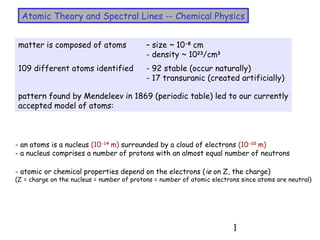
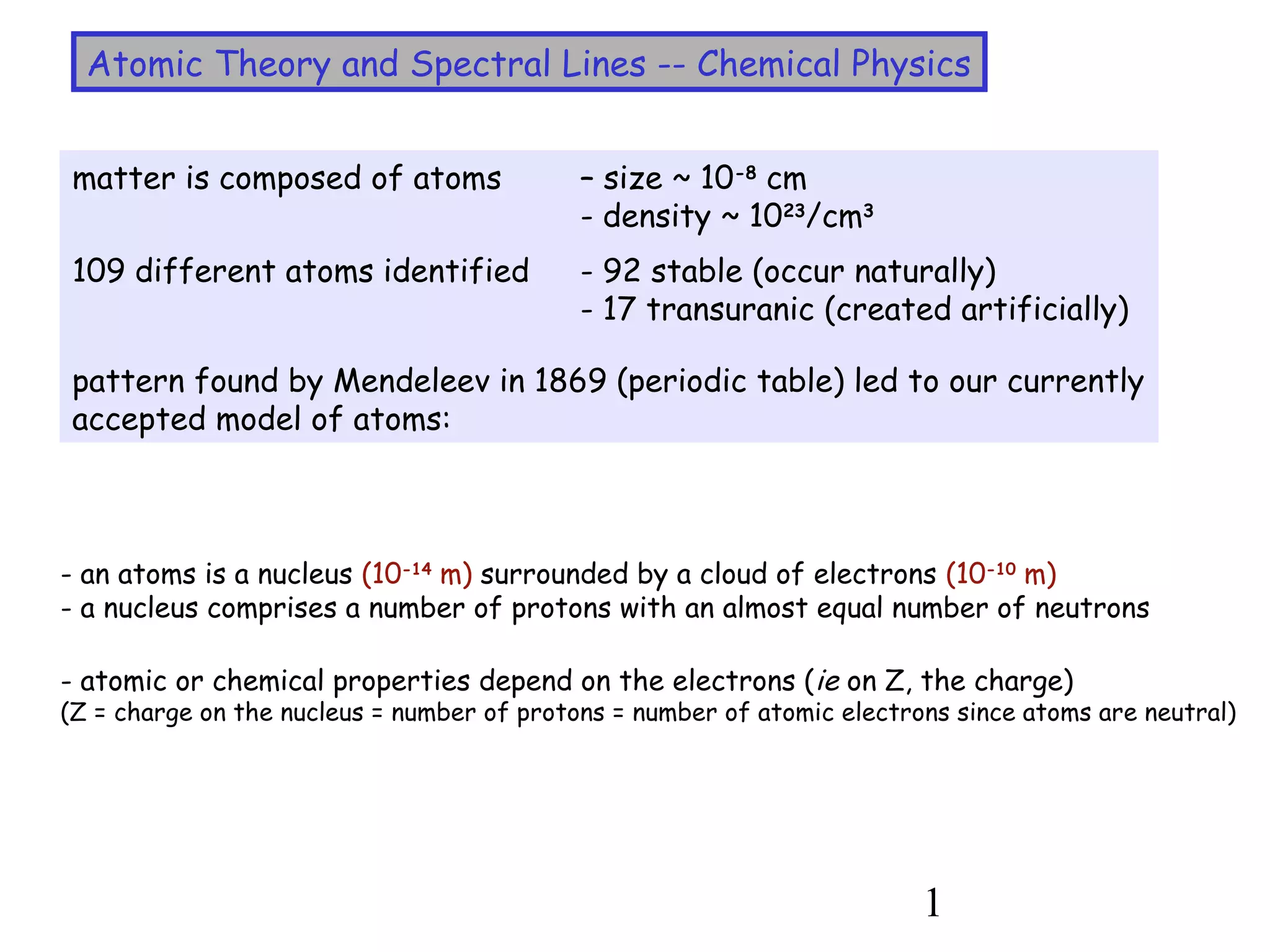
matter is composed of atoms – size ~ 10-8
cm
- density ~ 1023
/cm3
109 different atoms identified - 92 stable (occur naturally)
- 17 transuranic (created artificially)
pattern found by Mendeleev in 1869 (periodic table) led to our currently
accepted model of atoms:
- an atoms is a nucleus (10-14
m) surrounded by a cloud of electrons (10-10
m)
- a nucleus comprises a number of protons with an almost equal number of neutrons
- atomic or chemical properties depend on the electrons (ie on Z, the charge)
(Z = charge on the nucleus = number of protons = number of atomic electrons since atoms are neutral)
2
reminder:
office hours next week only tuesday 2-4
3
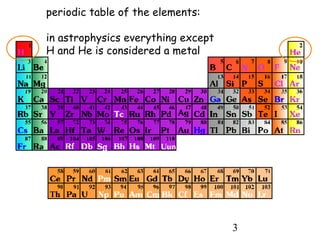
periodic table of the elements:
in astrophysics everything except
H and He is considered a metal
4
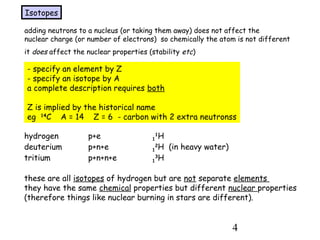
adding neutrons to a nucleus (or taking them away) does not affect the
nuclear charge (or number of electrons) so chemically the atom is not different
it does affect the nuclear properties (stability etc)
Isotopes
- specify an element by Z
- specify an isotope by A
a complete description requires both
Z is implied by the historical name
eg 14
C A = 14 Z = 6 - carbon with 2 extra neutronss
hydrogen p+e 1
1
H
deuterium p+n+e 1
2
H (in heavy water)
tritium p+n+n+e 1
3
H
these are all isotopes of hydrogen but are not separate elements
they have the same chemical properties but different nuclear properties
(therefore things like nuclear burning in stars are different).
5
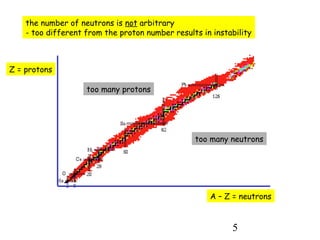
the number of neutrons is not arbitrary
- too different from the proton number results in instability
A – Z = neutrons
Z = protons
too many protons
too many neutrons
6
Bohr-Rutherford Model of the Atom
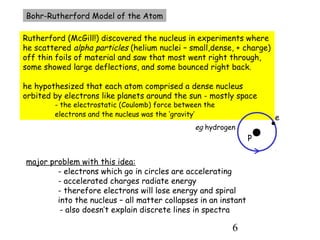
Rutherford (McGill!) discovered the nucleus in experiments where
he scattered alpha particles (helium nuclei – small,dense, + charge)
off thin foils of material and saw that most went right through,
some showed large deflections, and some bounced right back.
he hypothesized that each atom comprised a dense nucleus
orbited by electrons like planets around the sun - mostly space
- the electrostatic (Coulomb) force between the
electrons and the nucleus was the ‘gravity’
major problem with this idea:
- electrons which go in circles are accelerating
- accelerated charges radiate energy
- therefore electrons will lose energy and spiral
into the nucleus – all matter collapses in an instant
- also doesn’t explain discrete lines in spectra
p
e
eg hydrogen
7
Bohr’s hypothesis: classical physics does not apply: quantum theory
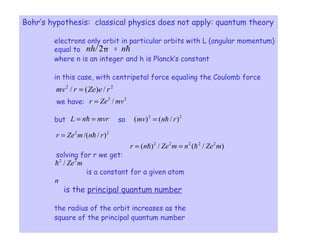
electrons only orbit in particular orbits with L (angular momentum)
equal to
where n is an integer and h is Planck’s constant
in this case, with centripetal force equaling the Coulomb force
we have:
but so
solving for r we get:
is a constant for a given atom
is the principal quantum number
the radius of the orbit increases as the
square of the principal quantum number
hn∂nh/ =2
22
/)(/ reZermv =
22
/ mvZer =
mvrnL == h 22
)/()( rnmv h=
22
)//( rnmZer h=
)/(/)( 22222
mZenmZenr hh ==
mZe22
/h
n
π
8
another route to Bohr’s quantum condition: wave/particle duality
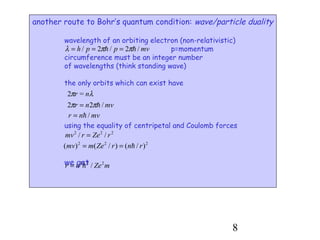
wavelength of an orbiting electron (non-relativistic)
p=momentum
circumference must be an integer number
of wavelengths (think standing wave)
the only orbits which can exist have
using the equality of centripetal and Coulomb forces
we get
mvpph /2/2/ hh ππλ ===
λπ nr =2
mvnr /22 hππ =
mvnr /h=
222
// rZermv =
222
)/()/()( rnrZemmv h==
mZenr 222
/h=
9
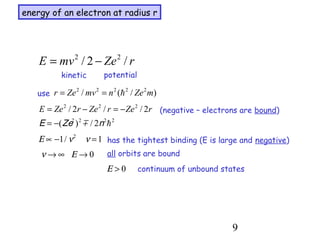
energy of an electron at radius r
rZemvE /2/ 22
−=
kinetic potential
use )/(/ 22222
mZenmvZer h==
rZerZerZeE 2//2/ 222
−=−= (negative – electrons are bound)
2222
2/)( hnmZeE −=
1/1 2
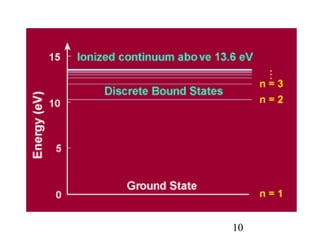
=−∝ ννΕ has the tightest binding (E is large and negative)
all orbits are bound0→∞→ Εν
0>Ε continuum of unbound states
10
11
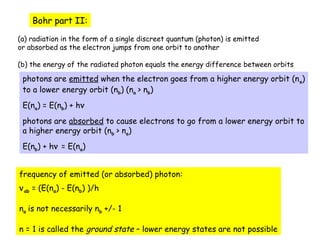
Bohr part II:
(a) radiation in the form of a single discreet quantum (photon) is emitted
or absorbed as the electron jumps from one orbit to another
(b) the energy of the radiated photon equals the energy difference between orbits
photons are emitted when the electron goes from a higher energy orbit (na)
to a lower energy orbit (nb) (na > nb)
E(na) = E(nb) + hν
photons are absorbed to cause electrons to go from a lower energy orbit to
a higher energy orbit (nb > na)
E(nb) + hν = E(na)
frequency of emitted (or absorbed) photon:
νab = (E(na) - E(nb) )/h
na is not necessarily nb +/- 1
n = 1 is called the ground state – lower energy states are not possible
12
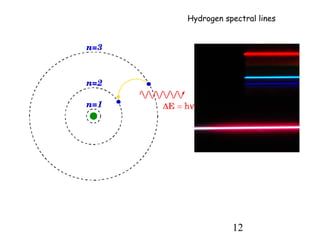
Hydrogen spectral lines
13
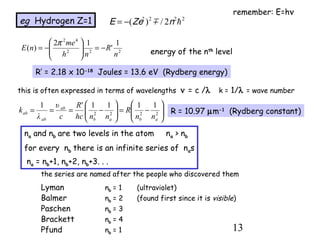
eg Hydrogen Z=1
222
42
1
'
12
)(
n
R
nh
me
nE −=





−=
π
energy of the nth
level
R’ = 2.18 x 10⁻¹⁸
Joules = 13.6 eV (Rydberg energy)
this is often expressed in terms of wavelengths ν = c /λ k = 1/λ = wave number






−=





−=== 2222
1111'1
abab
ab
ab
ab
nn
R
nnhc
R
c
k
υ
λ
R = 10.97 µm-1
(Rydberg constant)
na and nb are two levels in the atom na > nb
for every nb there is an infinite series of nas
na = nb+1, nb+2, nb+3. . .
the series are named after the people who discovered them
Lyman nb = 1 (ultraviolet)
Balmer nb = 2 (found first since it is visible)
Paschen nb = 3
Brackett nb = 4
Pfund nb = 1
remember: E=hν
2222
2/)( hnmZeE −=
14
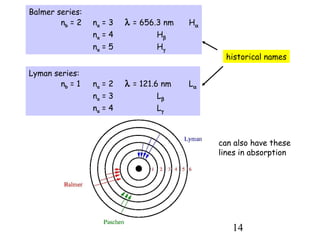
Balmer series:
nb = 2 na = 3 λ = 656.3 nm Hα
na = 4 Hβ
na = 5 Hγ
Lyman series:
nb = 1 na = 2 λ = 121.6 nm Lα
na = 3 Lβ
na = 4 Lγ
historical names
can also have these
lines in absorption
15
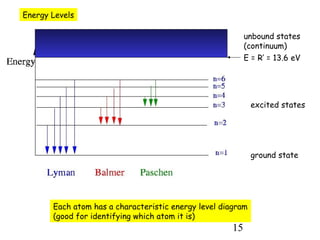
Energy Levels
ground state
excited states
E = R’ = 13.6 eV
unbound states
(continuum)
Each atom has a characteristic energy level diagram
(good for identifying which atom it is)
16
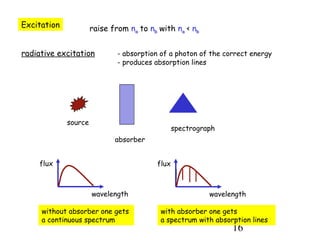
Excitation raise from na to nb with na < nb
radiative excitation - absorption of a photon of the correct energy
- produces absorption lines
source
absorber
spectrograph
flux
wavelength
flux
wavelength
without absorber one gets
a continuous spectrum
with absorber one gets
a spectrum with absorption lines
17
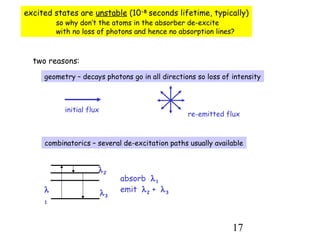
excited states are unstable (10-8
seconds lifetime, typically)
so why don’t the atoms in the absorber de-excite
with no loss of photons and hence no absorption lines?
two reasons:
geometry – decays photons go in all directions so loss of intensity
combinatorics – several de-excitation paths usually available
initial flux
re-emitted flux
λ3
λ2
λ
1
absorb λ1
emit λ2 + λ3
18
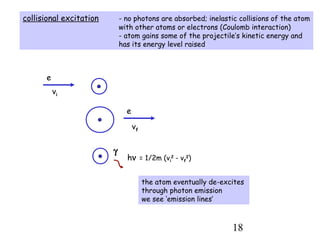
collisional excitation - no photons are absorbed; inelastic collisions of the atom
with other atoms or electrons (Coulomb interaction)
- atom gains some of the projectile’s kinetic energy and
has its energy level raised
e
e
vi
vf
γ
hν = 1/2m (vi
2
- vf
2
)
the atom eventually de-excites
through photon emission
we see ‘emission lines’
19
de-excitation
radiative – emission of photon(s) 10-8
seconds typically
collisional – super-elastic collision: excited atom is hit by a particle
or atom which then gains energy from the the collision
forbidden transitions – special form of radiative de-excitation – long
lifetimes since they violate quantum mechanics rules to first
order – have to proceed in a more complicated way which takes
more time. Observation of these implies low temperature and
low density of the region. Otherwise collisions would de-excite
the atoms much sooner.
generally only seen in astrophysics!
20






−=





−=== 2222
1111'1
abab
ab
ab
ab
nn
R
nnhc
R
c
k
υ
λ
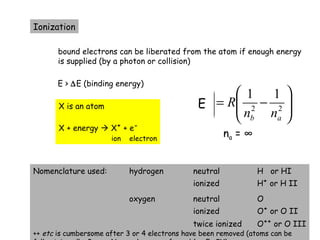
Ionization
bound electrons can be liberated from the atom if enough energy
is supplied (by a photon or collision)
E > ∆E (binding energy)
X is an atom
X + energy  X+
+ e-
ion electron
Nomenclature used: hydrogen neutral H or HI
ionized H+
or H II
oxygen neutral O
ionized O+
or O II
twice ionized O++
or O III
++ etc is cumbersome after 3 or 4 electrons have been removed (atoms can be
E
na = ∞
21
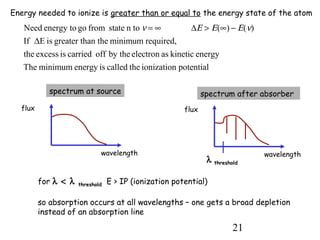
Energy needed to ionize is greater than or equal to the energy state of the atom
potentialionizationthecalledisenergyminimumThe
energykineticaselectronby theoffcarriedisexcessthe
required,minimuman thegreater thisEIf
)()(n tostatefromgoenergy toNeed
∆
−∞>∆∞= νΕΕΕν
flux
wavelength
flux
wavelength
spectrum at source spectrum after absorber
λ threshold
for λ < λ threshold E > IP (ionization potential)
so absorption occurs at all wavelengths – one gets a broad depletion
instead of an absorption line
22
Emission continua exist by inverse analogy; if there is a plasma
(ions plus electrons) some recombination can occur if the electron
emits a photon of E = KE + IP
KE = electron’s kinetic energy
IP = ionization potential of the level into which
the electron will fall (not necessarily the ground state)

Atomic theory

  • 1.
    1 Atomic Theory andSpectral Lines -- Chemical Physics matter is composed of atoms – size ~ 10-8 cm - density ~ 1023 /cm3 109 different atoms identified - 92 stable (occur naturally) - 17 transuranic (created artificially) pattern found by Mendeleev in 1869 (periodic table) led to our currently accepted model of atoms: - an atoms is a nucleus (10-14 m) surrounded by a cloud of electrons (10-10 m) - a nucleus comprises a number of protons with an almost equal number of neutrons - atomic or chemical properties depend on the electrons (ie on Z, the charge) (Z = charge on the nucleus = number of protons = number of atomic electrons since atoms are neutral)
  • 2.
    2 reminder: office hours nextweek only tuesday 2-4
  • 3.
    3 periodic table ofthe elements: in astrophysics everything except H and He is considered a metal
  • 4.
    4 adding neutrons toa nucleus (or taking them away) does not affect the nuclear charge (or number of electrons) so chemically the atom is not different it does affect the nuclear properties (stability etc) Isotopes - specify an element by Z - specify an isotope by A a complete description requires both Z is implied by the historical name eg 14 C A = 14 Z = 6 - carbon with 2 extra neutronss hydrogen p+e 1 1 H deuterium p+n+e 1 2 H (in heavy water) tritium p+n+n+e 1 3 H these are all isotopes of hydrogen but are not separate elements they have the same chemical properties but different nuclear properties (therefore things like nuclear burning in stars are different).
  • 5.
    5 the number ofneutrons is not arbitrary - too different from the proton number results in instability A – Z = neutrons Z = protons too many protons too many neutrons
  • 6.
    6 Bohr-Rutherford Model ofthe Atom Rutherford (McGill!) discovered the nucleus in experiments where he scattered alpha particles (helium nuclei – small,dense, + charge) off thin foils of material and saw that most went right through, some showed large deflections, and some bounced right back. he hypothesized that each atom comprised a dense nucleus orbited by electrons like planets around the sun - mostly space - the electrostatic (Coulomb) force between the electrons and the nucleus was the ‘gravity’ major problem with this idea: - electrons which go in circles are accelerating - accelerated charges radiate energy - therefore electrons will lose energy and spiral into the nucleus – all matter collapses in an instant - also doesn’t explain discrete lines in spectra p e eg hydrogen
  • 7.
    7 Bohr’s hypothesis: classicalphysics does not apply: quantum theory electrons only orbit in particular orbits with L (angular momentum) equal to where n is an integer and h is Planck’s constant in this case, with centripetal force equaling the Coulomb force we have: but so solving for r we get: is a constant for a given atom is the principal quantum number the radius of the orbit increases as the square of the principal quantum number hn∂nh/ =2 22 /)(/ reZermv = 22 / mvZer = mvrnL == h 22 )/()( rnmv h= 22 )//( rnmZer h= )/(/)( 22222 mZenmZenr hh == mZe22 /h n π
  • 8.
    8 another route toBohr’s quantum condition: wave/particle duality wavelength of an orbiting electron (non-relativistic) p=momentum circumference must be an integer number of wavelengths (think standing wave) the only orbits which can exist have using the equality of centripetal and Coulomb forces we get mvpph /2/2/ hh ππλ === λπ nr =2 mvnr /22 hππ = mvnr /h= 222 // rZermv = 222 )/()/()( rnrZemmv h== mZenr 222 /h=
  • 9.
    9 energy of anelectron at radius r rZemvE /2/ 22 −= kinetic potential use )/(/ 22222 mZenmvZer h== rZerZerZeE 2//2/ 222 −=−= (negative – electrons are bound) 2222 2/)( hnmZeE −= 1/1 2 =−∝ ννΕ has the tightest binding (E is large and negative) all orbits are bound0→∞→ Εν 0>Ε continuum of unbound states
  • 10.
  • 11.
    11 Bohr part II: (a)radiation in the form of a single discreet quantum (photon) is emitted or absorbed as the electron jumps from one orbit to another (b) the energy of the radiated photon equals the energy difference between orbits photons are emitted when the electron goes from a higher energy orbit (na) to a lower energy orbit (nb) (na > nb) E(na) = E(nb) + hν photons are absorbed to cause electrons to go from a lower energy orbit to a higher energy orbit (nb > na) E(nb) + hν = E(na) frequency of emitted (or absorbed) photon: νab = (E(na) - E(nb) )/h na is not necessarily nb +/- 1 n = 1 is called the ground state – lower energy states are not possible
  • 12.
  • 13.
    13 eg Hydrogen Z=1 222 42 1 ' 12 )( n R nh me nE−=      −= π energy of the nth level R’ = 2.18 x 10⁻¹⁸ Joules = 13.6 eV (Rydberg energy) this is often expressed in terms of wavelengths ν = c /λ k = 1/λ = wave number       −=      −=== 2222 1111'1 abab ab ab ab nn R nnhc R c k υ λ R = 10.97 µm-1 (Rydberg constant) na and nb are two levels in the atom na > nb for every nb there is an infinite series of nas na = nb+1, nb+2, nb+3. . . the series are named after the people who discovered them Lyman nb = 1 (ultraviolet) Balmer nb = 2 (found first since it is visible) Paschen nb = 3 Brackett nb = 4 Pfund nb = 1 remember: E=hν 2222 2/)( hnmZeE −=
  • 14.
    14 Balmer series: nb =2 na = 3 λ = 656.3 nm Hα na = 4 Hβ na = 5 Hγ Lyman series: nb = 1 na = 2 λ = 121.6 nm Lα na = 3 Lβ na = 4 Lγ historical names can also have these lines in absorption
  • 15.
    15 Energy Levels ground state excitedstates E = R’ = 13.6 eV unbound states (continuum) Each atom has a characteristic energy level diagram (good for identifying which atom it is)
  • 16.
    16 Excitation raise fromna to nb with na < nb radiative excitation - absorption of a photon of the correct energy - produces absorption lines source absorber spectrograph flux wavelength flux wavelength without absorber one gets a continuous spectrum with absorber one gets a spectrum with absorption lines
  • 17.
    17 excited states areunstable (10-8 seconds lifetime, typically) so why don’t the atoms in the absorber de-excite with no loss of photons and hence no absorption lines? two reasons: geometry – decays photons go in all directions so loss of intensity combinatorics – several de-excitation paths usually available initial flux re-emitted flux λ3 λ2 λ 1 absorb λ1 emit λ2 + λ3
  • 18.
    18 collisional excitation -no photons are absorbed; inelastic collisions of the atom with other atoms or electrons (Coulomb interaction) - atom gains some of the projectile’s kinetic energy and has its energy level raised e e vi vf γ hν = 1/2m (vi 2 - vf 2 ) the atom eventually de-excites through photon emission we see ‘emission lines’
  • 19.
    19 de-excitation radiative – emissionof photon(s) 10-8 seconds typically collisional – super-elastic collision: excited atom is hit by a particle or atom which then gains energy from the the collision forbidden transitions – special form of radiative de-excitation – long lifetimes since they violate quantum mechanics rules to first order – have to proceed in a more complicated way which takes more time. Observation of these implies low temperature and low density of the region. Otherwise collisions would de-excite the atoms much sooner. generally only seen in astrophysics!
  • 20.
    20       −=      −=== 2222 1111'1 abab ab ab ab nn R nnhc R c k υ λ Ionization bound electronscan be liberated from the atom if enough energy is supplied (by a photon or collision) E > ∆E (binding energy) X is an atom X + energy  X+ + e- ion electron Nomenclature used: hydrogen neutral H or HI ionized H+ or H II oxygen neutral O ionized O+ or O II twice ionized O++ or O III ++ etc is cumbersome after 3 or 4 electrons have been removed (atoms can be E na = ∞
  • 21.
    21 Energy needed toionize is greater than or equal to the energy state of the atom potentialionizationthecalledisenergyminimumThe energykineticaselectronby theoffcarriedisexcessthe required,minimuman thegreater thisEIf )()(n tostatefromgoenergy toNeed ∆ −∞>∆∞= νΕΕΕν flux wavelength flux wavelength spectrum at source spectrum after absorber λ threshold for λ < λ threshold E > IP (ionization potential) so absorption occurs at all wavelengths – one gets a broad depletion instead of an absorption line
  • 22.
    22 Emission continua existby inverse analogy; if there is a plasma (ions plus electrons) some recombination can occur if the electron emits a photon of E = KE + IP KE = electron’s kinetic energy IP = ionization potential of the level into which the electron will fall (not necessarily the ground state)