ATOMIC ENERGY LEVEL
SYED MOHSIN ABBAS
PIEAS
WHAT ARE ENERGY LEVELS (SHELLS)?
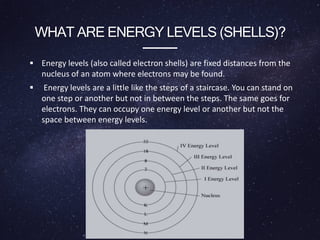
 Energy levels (also called electron shells) are fixed distances from the
nucleus of an atom where electrons may be found.
 Energy levels are a little like the steps of a staircase. You can stand on
one step or another but not in between the steps. The same goes for
electrons. They can occupy one energy level or another but not the
space between energy levels.
ENERGY LEVELS IN THE ATOM
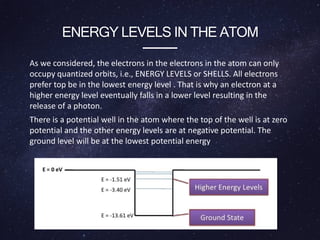
As we considered, the electrons in the electrons in the atom can only
occupy quantized orbits, i.e., ENERGY LEVELS or SHELLS. All electrons
prefer top be in the lowest energy level . That is why an electron at a
higher energy level eventually falls in a lower level resulting in the
release of a photon.
There is a potential well in the atom where the top of the well is at zero
potential and the other energy levels are at negative potential. The
ground level will be at the lowest potential energy
SUB ENERGY LEVEL OR ORBITALS
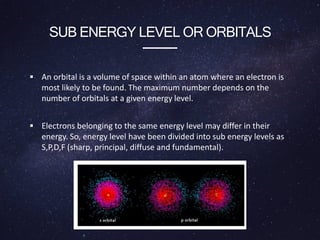
 An orbital is a volume of space within an atom where an electron is
most likely to be found. The maximum number depends on the
number of orbitals at a given energy level.
 Electrons belonging to the same energy level may differ in their
energy. So, energy level have been divided into sub energy levels as
S,P,D,F (sharp, principal, diffuse and fundamental).
SUB ENERGYLEVELS OR ORBITALS
 Regardless of its shape, each orbital can hold a maximum of two
electrons. Energy level I has just one orbital, so two electrons will fill
this energy level. Energy level II has four orbitals, so it takes eight
electrons to fill this energy level.
 According to Schrodinger, electrons are present in orbitals in the
space around the nucleus in three dimensions where possibility of
finding the electrons is maximum.
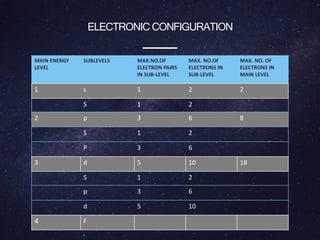
ELECTRONIC CONFIGURATION
MAIN ENERGY
LEVEL
SUBLEVELS MAX.NO.OF
ELECTRON PAIRS
IN SUB-LEVEL
MAX. NO.OF
ELECTRONS IN
SUB-LEVEL
MAX. NO. OF
ELECTRONS IN
MAIN LEVEL
1 s 1 2 2
S 1 2
2 p 3 6 8
S 1 2
P 3 6
3 d 5 10 18
S 1 2
p 3 6
d 5 10
4 F
Electrons in the outermost energy level of an
atom have a special significance. These
electrons are called valence electrons, and they
determine many of the properties of an atom.
An atom is most stable if its outermost energy
level contains as many electrons as it can hold.
THE OUTERMOST SHELL
THE OUTERMOST SHELL
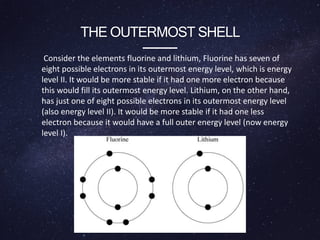
Consider the elements fluorine and lithium, Fluorine has seven of
eight possible electrons in its outermost energy level, which is energy
level II. It would be more stable if it had one more electron because
this would fill its outermost energy level. Lithium, on the other hand,
has just one of eight possible electrons in its outermost energy level
(also energy level II). It would be more stable if it had one less
electron because it would have a full outer energy level (now energy
level I).
THE OUTERMOST SHELL
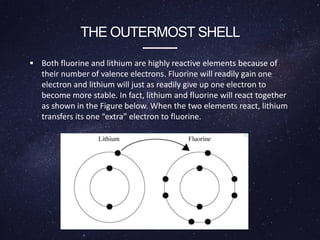
 Both fluorine and lithium are highly reactive elements because of
their number of valence electrons. Fluorine will readily gain one
electron and lithium will just as readily give up one electron to
become more stable. In fact, lithium and fluorine will react together
as shown in the Figure below. When the two elements react, lithium
transfers its one “extra” electron to fluorine.
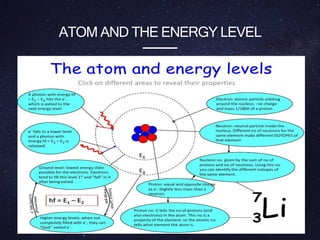
ATOM AND THE ENERGY LEVEL
You may ask questions now!!!

Atomic energy level

  • 1.
    ATOMIC ENERGY LEVEL SYEDMOHSIN ABBAS PIEAS
  • 2.
    WHAT ARE ENERGYLEVELS (SHELLS)?  Energy levels (also called electron shells) are fixed distances from the nucleus of an atom where electrons may be found.  Energy levels are a little like the steps of a staircase. You can stand on one step or another but not in between the steps. The same goes for electrons. They can occupy one energy level or another but not the space between energy levels.
  • 3.
    ENERGY LEVELS INTHE ATOM As we considered, the electrons in the electrons in the atom can only occupy quantized orbits, i.e., ENERGY LEVELS or SHELLS. All electrons prefer top be in the lowest energy level . That is why an electron at a higher energy level eventually falls in a lower level resulting in the release of a photon. There is a potential well in the atom where the top of the well is at zero potential and the other energy levels are at negative potential. The ground level will be at the lowest potential energy
  • 4.
    SUB ENERGY LEVELOR ORBITALS  An orbital is a volume of space within an atom where an electron is most likely to be found. The maximum number depends on the number of orbitals at a given energy level.  Electrons belonging to the same energy level may differ in their energy. So, energy level have been divided into sub energy levels as S,P,D,F (sharp, principal, diffuse and fundamental).
  • 5.
    SUB ENERGYLEVELS ORORBITALS  Regardless of its shape, each orbital can hold a maximum of two electrons. Energy level I has just one orbital, so two electrons will fill this energy level. Energy level II has four orbitals, so it takes eight electrons to fill this energy level.  According to Schrodinger, electrons are present in orbitals in the space around the nucleus in three dimensions where possibility of finding the electrons is maximum.
  • 6.
    ELECTRONIC CONFIGURATION MAIN ENERGY LEVEL SUBLEVELSMAX.NO.OF ELECTRON PAIRS IN SUB-LEVEL MAX. NO.OF ELECTRONS IN SUB-LEVEL MAX. NO. OF ELECTRONS IN MAIN LEVEL 1 s 1 2 2 S 1 2 2 p 3 6 8 S 1 2 P 3 6 3 d 5 10 18 S 1 2 p 3 6 d 5 10 4 F
  • 7.
    Electrons in theoutermost energy level of an atom have a special significance. These electrons are called valence electrons, and they determine many of the properties of an atom. An atom is most stable if its outermost energy level contains as many electrons as it can hold. THE OUTERMOST SHELL
  • 8.
    THE OUTERMOST SHELL Considerthe elements fluorine and lithium, Fluorine has seven of eight possible electrons in its outermost energy level, which is energy level II. It would be more stable if it had one more electron because this would fill its outermost energy level. Lithium, on the other hand, has just one of eight possible electrons in its outermost energy level (also energy level II). It would be more stable if it had one less electron because it would have a full outer energy level (now energy level I).
  • 9.
    THE OUTERMOST SHELL Both fluorine and lithium are highly reactive elements because of their number of valence electrons. Fluorine will readily gain one electron and lithium will just as readily give up one electron to become more stable. In fact, lithium and fluorine will react together as shown in the Figure below. When the two elements react, lithium transfers its one “extra” electron to fluorine.
  • 10.
    ATOM AND THEENERGY LEVEL
  • 11.
    You may askquestions now!!!