QUANTUM NUMBERS
CAPE Unit 1
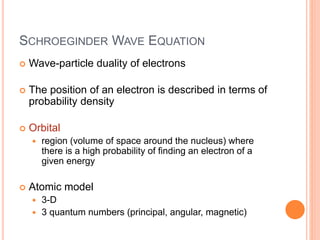
SCHROEGINDER WAVE EQUATION
 Wave-particle duality of electrons
 The position of an electron is described in terms of
probability density
 Orbital
 region (volume of space around the nucleus) where
there is a high probability of finding an electron of a
given energy
 Atomic model
 3-D
 3 quantum numbers (principal, angular, magnetic)
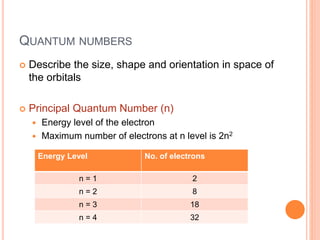
QUANTUM NUMBERS
 Describe the size, shape and orientation in space of
the orbitals
 Principal Quantum Number (n)
 Energy level of the electron
 Maximum number of electrons at n level is 2n2
Energy Level No. of electrons
n = 1 2
n = 2 8
n = 3 18
n = 4 32
QUANTUM NUMBERS
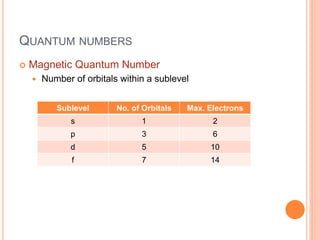
 Angular Quantum Number (l)
 Sublevels in n & Shape of the orbitals
 s, p, d, f
 Each energy level has n sublevels
Energy Level No. of
Sublevels
Sublevels
n = 1 1 1s
n = 2 2 2s, 2p
n = 3 3 3s, 3p, 3d
n = 4 4 4s, 4p, 4d, 4f
QUANTUM NUMBERS
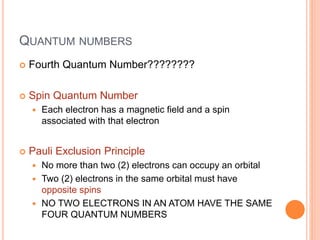
 Magnetic Quantum Number
 Number of orbitals within a sublevel
Sublevel No. of Orbitals Max. Electrons
s 1 2
p 3 6
d 5 10
f 7 14
QUANTUM NUMBERS
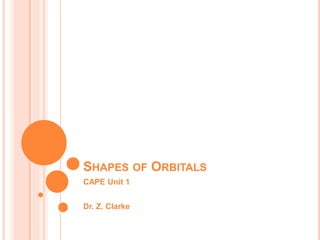
 Fourth Quantum Number????????
 Spin Quantum Number
 Each electron has a magnetic field and a spin
associated with that electron
 Pauli Exclusion Principle
 No more than two (2) electrons can occupy an orbital
 Two (2) electrons in the same orbital must have
opposite spins
 NO TWO ELECTRONS IN AN ATOM HAVE THE SAME
FOUR QUANTUM NUMBERS
SHAPES OF ORBITALS
CAPE Unit 1
Dr. Z. Clarke
SHAPES OF ORBITALS
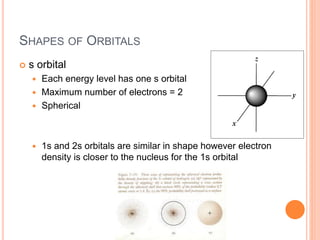
 s orbital
 Each energy level has one s orbital
 Maximum number of electrons = 2
 Spherical
 1s and 2s orbitals are similar in shape however electron
density is closer to the nucleus for the 1s orbital
SHAPES OF ORBITALS
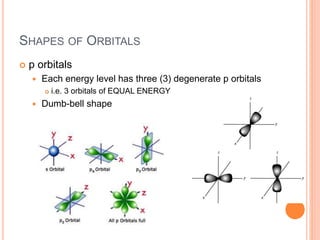
 p orbitals
 Each energy level has three (3) degenerate p orbitals
 i.e. 3 orbitals of EQUAL ENERGY
 Dumb-bell shape
ELECTRONIC CONFIGURATION
CAPE Unit 1
Dr. Z. Clarke
ELECTRONIC CONFIGURATIONS
 s orbitals have slightly lower energy than the p
orbitals at the same energy level i.e. 2s < 2p
 s orbital will ALWAYS fill before corresponding p
orbitals
 s orbital have the lowest energy then p, d, f
 s < p < d < f
ELECTRONIC CONFIGURATIONS
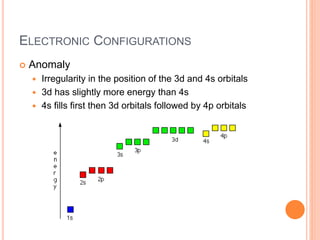
 Anomaly
 Irregularity in the position of the 3d and 4s orbitals
 3d has slightly more energy than 4s
 4s fills first then 3d orbitals followed by 4p orbitals
ELECTRONIC CONFIGURATIONS
 Describes the arrangement of electrons in the
orbitals of an atom
 How are electronic configurations worked out?
 Electrons are added one at a time, starting with the
lowest energy orbital (Aufbau Principle)
 No more than two electrons can occupy an orbital (Pauli
Exclusion Principle)
 Electrons fill degenerate orbitals one at a time with
parallel spin before a second electron is added with
opposite spin (Hund’s Rule)
ELECTRONIC CONFIGURATIONS
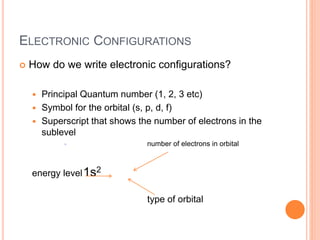
 How do we write electronic configurations?
 Principal Quantum number (1, 2, 3 etc)
 Symbol for the orbital (s, p, d, f)
 Superscript that shows the number of electrons in the
sublevel
 number of electrons in orbital
energy level1s2
type of orbital
ELECTRONIC CONFIGURATIONS
Atomic Number Symbol Electronic
Configuration
1 H 1s1
2 He 1s2 or [He]
3 Li [He] 2s1
4 Be [He] 2s2
5 B [He] 2s2 2p1
6 C [He] 2s2 2p2
7 N [He] 2s2 2p3
8 O [He] 2s2 2p4
9 F [He] 2s2 2p5
10 Ne [He] 2s2 2p6 or [Ne]
ELECTRONIC CONFIGURATIONS
Atomic Number Symbol Electronic
Configuration
11 Na [Ne] 3s1
12 Mg [Ne] 3s2
13 Al [Ne] 3s2 3p1
14 Si [Ne] 3s2 3p2
15 P [Ne] 3s2 3p3
16 S [Ne] 3s2 3p4
17 Cl [Ne] 3s2 3p5
18 Ar [Ne] 3s2 3p6 or [Ar]
19 K [Ar] 4s1
20 Ca [Ar] 4s2
ELECTRONIC CONFIGURATIONS
Atomic Number Symbol Electronic
Configuration
21 Sc [Ar] 4s2 3d1
22 Ti [Ar] 4s2 3d2
23 V [Ar] 4s2 3d3
24 Cr [Ar] 4s1 3d5
25 Mn [Ar] 4s2 3d5
26 Fe [Ar] 4s2 3d6
27 Co [Ar] 4s2 3d7
28 Ni [Ar] 4s2 3d8
29 Cu [Ar] 4s1 3d10
30 Zn [Ar] 4s2 3d10
ELECTRONIC CONFIGURATIONS –
ABBREVIATED
 He, Ne and Ar have electronic configurations with
filled shells of orbitals
 Abbreviated electronic configurations
He = 1s2 or [He]
Ne = 1s2 2s2 2p6 or [Ne]
Ar = 1s2 2s2 2p6 3s2 3p6 or [Ar]
ELECTRONIC CONFIGURATIONS - SPECIAL
 After 3p orbitals are filled, 4s orbital is filled before
the 3d orbital
 4s orbital is at a slightly lower energy than the 3d
 K is [Ar] 4s1
 Ca is [Ar] 4s2
 Sc is [Ar] 4s2 3d1
ELECTRONIC CONFIGURATIONS - SPECIAL
 After Sc, the 3d orbitals are filled
 Irregularity is seen in the electronic configuration of
Cr and Cu
 Cr is [Ar] 4s1 3d5
 Cu is [Ar] 4s1 3d10
ELECTRONIC CONFIGURATIONS - SPECIAL
 One electron has been transferred from the 4s
orbital to the 3d orbital
 Half-filled and filled sublevels of 3d orbitals decreases
 Energy
 Spin pairing of the 4s orbital increases
 Energy
IONIZATION ENERGY
CAPE Unit 1
Dr. Z. Clarke
IONIZATION ENERGY
 1st Ionization Energy of an element
 Energy needed to convert 1 mole of its gaseous atoms
into gaseous ions with a single positive charge
M(g) M+
(g) + e-
 Energy required to remove each successive
electron is called the 2nd, 3rd, 4th, etc. ionization
energy
 Ionization energies are positive because it requires
energy to remove an electron
IONIZATION ENERGY –
INFLUENCING FACTORS
 Magnitude of ionization energy
 how strongly the electron to be lost is attracted to the
nucleus
 Factors that influence ionization energy
 Atomic Radii
 Nuclear Charge
 Shielding (Screening)
IONIZATION ENERGY – ATOMIC RADII
 Atomic Radii
 Distance of the outer electron is from the nucleus
 As distance increases ( ), nuclear attraction for the
outer electron decreases ( ), ionization energy
decreases( )
IONIZATION ENERGY – ATOMIC RADII
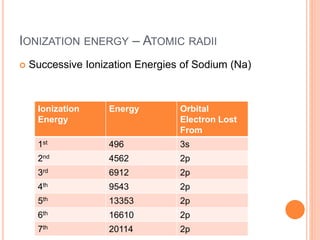
 Successive Ionization Energies of Sodium (Na)
Ionization
Energy
Energy Orbital
Electron Lost
From
1st 496 3s
2nd 4562 2p
3rd 6912 2p
4th 9543 2p
5th 13353 2p
6th 16610 2p
7th 20114 2p
IONIZATION ENERGY – NUCLEAR CHARGE
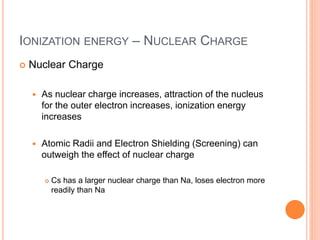
 Nuclear Charge
 As nuclear charge increases, attraction of the nucleus
for the outer electron increases, ionization energy
increases
 Atomic Radii and Electron Shielding (Screening) can
outweigh the effect of nuclear charge
 Cs has a larger nuclear charge than Na, loses electron more
readily than Na
IONIZATION ENERGY –
SHIELDING (SCREENING)
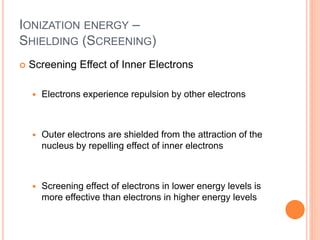
 Screening Effect of Inner Electrons
 Electrons experience repulsion by other electrons
 Outer electrons are shielded from the attraction of the
nucleus by repelling effect of inner electrons
 Screening effect of electrons in lower energy levels is
more effective than electrons in higher energy levels
IONIZATION ENERGY –
SHIELDING (SCREENING)
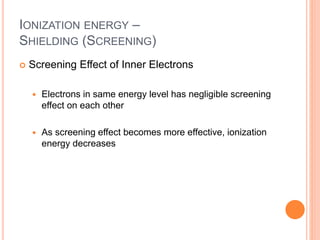
 Screening Effect of Inner Electrons
 Electrons in same energy level has negligible screening
effect on each other
 As screening effect becomes more effective, ionization
energy decreases

Quantum Numbers

  • 1.
  • 2.
    SCHROEGINDER WAVE EQUATION Wave-particle duality of electrons  The position of an electron is described in terms of probability density  Orbital  region (volume of space around the nucleus) where there is a high probability of finding an electron of a given energy  Atomic model  3-D  3 quantum numbers (principal, angular, magnetic)
  • 3.
    QUANTUM NUMBERS  Describethe size, shape and orientation in space of the orbitals  Principal Quantum Number (n)  Energy level of the electron  Maximum number of electrons at n level is 2n2 Energy Level No. of electrons n = 1 2 n = 2 8 n = 3 18 n = 4 32
  • 4.
    QUANTUM NUMBERS  AngularQuantum Number (l)  Sublevels in n & Shape of the orbitals  s, p, d, f  Each energy level has n sublevels Energy Level No. of Sublevels Sublevels n = 1 1 1s n = 2 2 2s, 2p n = 3 3 3s, 3p, 3d n = 4 4 4s, 4p, 4d, 4f
  • 5.
    QUANTUM NUMBERS  MagneticQuantum Number  Number of orbitals within a sublevel Sublevel No. of Orbitals Max. Electrons s 1 2 p 3 6 d 5 10 f 7 14
  • 6.
    QUANTUM NUMBERS  FourthQuantum Number????????  Spin Quantum Number  Each electron has a magnetic field and a spin associated with that electron  Pauli Exclusion Principle  No more than two (2) electrons can occupy an orbital  Two (2) electrons in the same orbital must have opposite spins  NO TWO ELECTRONS IN AN ATOM HAVE THE SAME FOUR QUANTUM NUMBERS
  • 7.
    SHAPES OF ORBITALS CAPEUnit 1 Dr. Z. Clarke
  • 8.
    SHAPES OF ORBITALS s orbital  Each energy level has one s orbital  Maximum number of electrons = 2  Spherical  1s and 2s orbitals are similar in shape however electron density is closer to the nucleus for the 1s orbital
  • 9.
    SHAPES OF ORBITALS p orbitals  Each energy level has three (3) degenerate p orbitals  i.e. 3 orbitals of EQUAL ENERGY  Dumb-bell shape
  • 10.
  • 11.
    ELECTRONIC CONFIGURATIONS  sorbitals have slightly lower energy than the p orbitals at the same energy level i.e. 2s < 2p  s orbital will ALWAYS fill before corresponding p orbitals  s orbital have the lowest energy then p, d, f  s < p < d < f
  • 12.
    ELECTRONIC CONFIGURATIONS  Anomaly Irregularity in the position of the 3d and 4s orbitals  3d has slightly more energy than 4s  4s fills first then 3d orbitals followed by 4p orbitals
  • 13.
    ELECTRONIC CONFIGURATIONS  Describesthe arrangement of electrons in the orbitals of an atom  How are electronic configurations worked out?  Electrons are added one at a time, starting with the lowest energy orbital (Aufbau Principle)  No more than two electrons can occupy an orbital (Pauli Exclusion Principle)  Electrons fill degenerate orbitals one at a time with parallel spin before a second electron is added with opposite spin (Hund’s Rule)
  • 14.
    ELECTRONIC CONFIGURATIONS  Howdo we write electronic configurations?  Principal Quantum number (1, 2, 3 etc)  Symbol for the orbital (s, p, d, f)  Superscript that shows the number of electrons in the sublevel  number of electrons in orbital energy level1s2 type of orbital
  • 15.
    ELECTRONIC CONFIGURATIONS Atomic NumberSymbol Electronic Configuration 1 H 1s1 2 He 1s2 or [He] 3 Li [He] 2s1 4 Be [He] 2s2 5 B [He] 2s2 2p1 6 C [He] 2s2 2p2 7 N [He] 2s2 2p3 8 O [He] 2s2 2p4 9 F [He] 2s2 2p5 10 Ne [He] 2s2 2p6 or [Ne]
  • 16.
    ELECTRONIC CONFIGURATIONS Atomic NumberSymbol Electronic Configuration 11 Na [Ne] 3s1 12 Mg [Ne] 3s2 13 Al [Ne] 3s2 3p1 14 Si [Ne] 3s2 3p2 15 P [Ne] 3s2 3p3 16 S [Ne] 3s2 3p4 17 Cl [Ne] 3s2 3p5 18 Ar [Ne] 3s2 3p6 or [Ar] 19 K [Ar] 4s1 20 Ca [Ar] 4s2
  • 17.
    ELECTRONIC CONFIGURATIONS Atomic NumberSymbol Electronic Configuration 21 Sc [Ar] 4s2 3d1 22 Ti [Ar] 4s2 3d2 23 V [Ar] 4s2 3d3 24 Cr [Ar] 4s1 3d5 25 Mn [Ar] 4s2 3d5 26 Fe [Ar] 4s2 3d6 27 Co [Ar] 4s2 3d7 28 Ni [Ar] 4s2 3d8 29 Cu [Ar] 4s1 3d10 30 Zn [Ar] 4s2 3d10
  • 18.
    ELECTRONIC CONFIGURATIONS – ABBREVIATED He, Ne and Ar have electronic configurations with filled shells of orbitals  Abbreviated electronic configurations He = 1s2 or [He] Ne = 1s2 2s2 2p6 or [Ne] Ar = 1s2 2s2 2p6 3s2 3p6 or [Ar]
  • 19.
    ELECTRONIC CONFIGURATIONS -SPECIAL  After 3p orbitals are filled, 4s orbital is filled before the 3d orbital  4s orbital is at a slightly lower energy than the 3d  K is [Ar] 4s1  Ca is [Ar] 4s2  Sc is [Ar] 4s2 3d1
  • 20.
    ELECTRONIC CONFIGURATIONS -SPECIAL  After Sc, the 3d orbitals are filled  Irregularity is seen in the electronic configuration of Cr and Cu  Cr is [Ar] 4s1 3d5  Cu is [Ar] 4s1 3d10
  • 21.
    ELECTRONIC CONFIGURATIONS -SPECIAL  One electron has been transferred from the 4s orbital to the 3d orbital  Half-filled and filled sublevels of 3d orbitals decreases  Energy  Spin pairing of the 4s orbital increases  Energy
  • 22.
  • 23.
    IONIZATION ENERGY  1stIonization Energy of an element  Energy needed to convert 1 mole of its gaseous atoms into gaseous ions with a single positive charge M(g) M+ (g) + e-  Energy required to remove each successive electron is called the 2nd, 3rd, 4th, etc. ionization energy  Ionization energies are positive because it requires energy to remove an electron
  • 24.
    IONIZATION ENERGY – INFLUENCINGFACTORS  Magnitude of ionization energy  how strongly the electron to be lost is attracted to the nucleus  Factors that influence ionization energy  Atomic Radii  Nuclear Charge  Shielding (Screening)
  • 25.
    IONIZATION ENERGY –ATOMIC RADII  Atomic Radii  Distance of the outer electron is from the nucleus  As distance increases ( ), nuclear attraction for the outer electron decreases ( ), ionization energy decreases( )
  • 26.
    IONIZATION ENERGY –ATOMIC RADII  Successive Ionization Energies of Sodium (Na) Ionization Energy Energy Orbital Electron Lost From 1st 496 3s 2nd 4562 2p 3rd 6912 2p 4th 9543 2p 5th 13353 2p 6th 16610 2p 7th 20114 2p
  • 27.
    IONIZATION ENERGY –NUCLEAR CHARGE  Nuclear Charge  As nuclear charge increases, attraction of the nucleus for the outer electron increases, ionization energy increases  Atomic Radii and Electron Shielding (Screening) can outweigh the effect of nuclear charge  Cs has a larger nuclear charge than Na, loses electron more readily than Na
  • 28.
    IONIZATION ENERGY – SHIELDING(SCREENING)  Screening Effect of Inner Electrons  Electrons experience repulsion by other electrons  Outer electrons are shielded from the attraction of the nucleus by repelling effect of inner electrons  Screening effect of electrons in lower energy levels is more effective than electrons in higher energy levels
  • 29.
    IONIZATION ENERGY – SHIELDING(SCREENING)  Screening Effect of Inner Electrons  Electrons in same energy level has negligible screening effect on each other  As screening effect becomes more effective, ionization energy decreases