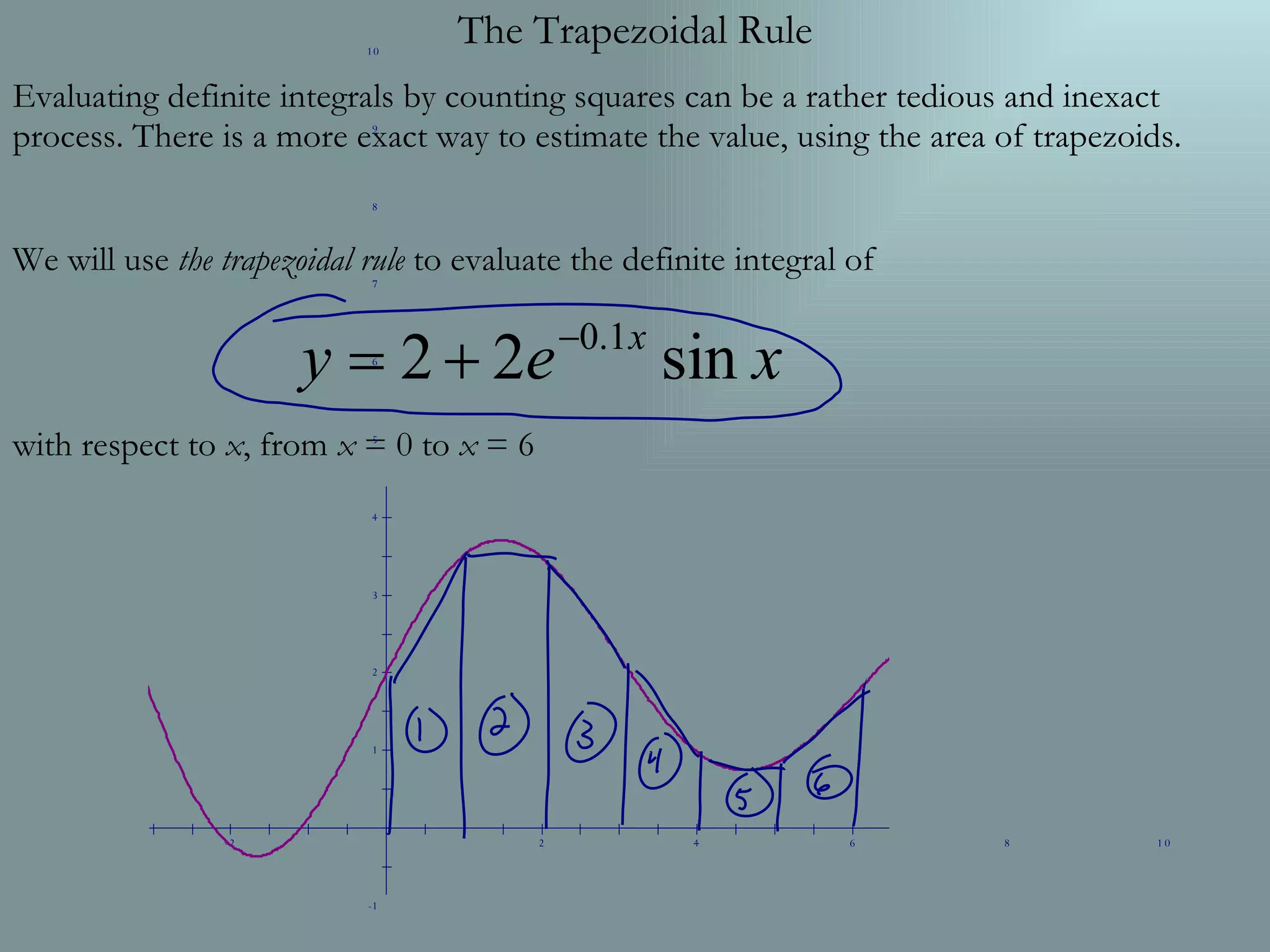
The Trapezoidal Rule Evaluating definite integrals by counting squares can be a rather tedious and inexact process. There is a more exact way to estimate the value, using the area of trapezoids. We will use  the trapezoidal rule  to evaluate the definite integral of  with respect to  x , from  x  = 0 to  x  = 6
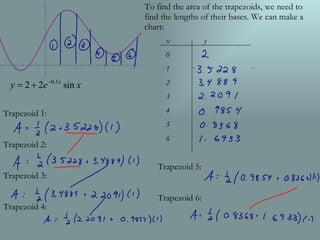
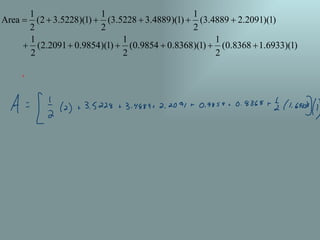
x   y 0 1 2 3 4 5 6 To find the area of the trapezoids, we need to find the lengths of their bases. We can make a chart: Trapezoid 1: Trapezoid 2: Trapezoid 3: Trapezoid 4: Trapezoid 5: Trapezoid 6:
Ā 
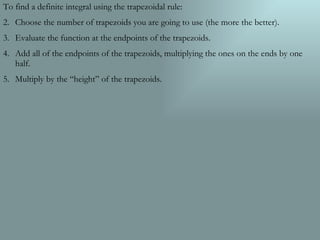
To find a definite integral using the trapezoidal rule: Choose the number of trapezoids you are going to use (the more the better). Evaluate the function at the endpoints of the trapezoids. Add all of the endpoints of the trapezoids, multiplying the ones on the ends by one half. Multiply by the ā€œheightā€ of the trapezoids.

Section 1-4 -- Trapezoid Rule

  • 1.
    The Trapezoidal RuleEvaluating definite integrals by counting squares can be a rather tedious and inexact process. There is a more exact way to estimate the value, using the area of trapezoids. We will use the trapezoidal rule to evaluate the definite integral of with respect to x , from x = 0 to x = 6
  • 2.
    x y 0 1 2 3 4 5 6 To find the area of the trapezoids, we need to find the lengths of their bases. We can make a chart: Trapezoid 1: Trapezoid 2: Trapezoid 3: Trapezoid 4: Trapezoid 5: Trapezoid 6:
  • 3.
  • 4.
    To find adefinite integral using the trapezoidal rule: Choose the number of trapezoids you are going to use (the more the better). Evaluate the function at the endpoints of the trapezoids. Add all of the endpoints of the trapezoids, multiplying the ones on the ends by one half. Multiply by the ā€œheightā€ of the trapezoids.