Evaluate a definite integral using the fundamental theorem of calculus Understand and use the mean value theorem Find the Average Value of a function over a closed interval
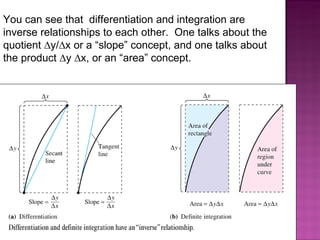
You can see that  differentiation and integration are inverse relationships to each other.  One talks about the quotient ∆y/∆x or a “slope” concept, and one talks about the product ∆y ∆x, or an “area” concept.
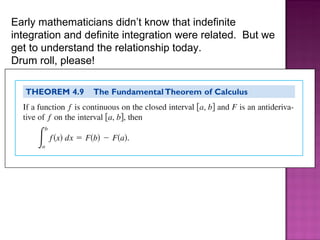
Early mathematicians didn’t know that indefinite integration and definite integration were related.  But we get to understand the relationship today. Drum roll, please!
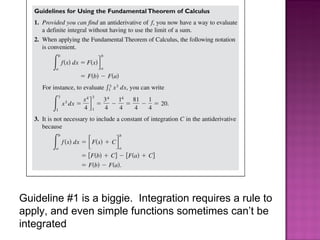
Guideline #1 is a biggie.  Integration requires a rule to apply, and even simple functions sometimes can’t be integrated
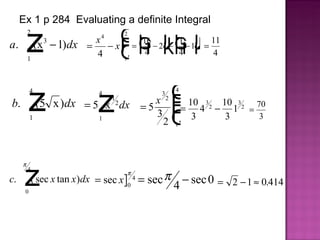
Ex 1 p 284  Evaluating a definite Integral
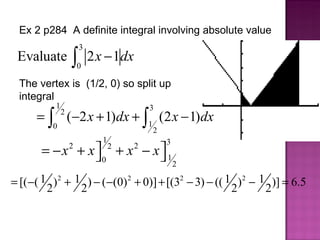
Ex 2 p284  A definite integral involving absolute value The vertex is  (1/2, 0) so split up integral
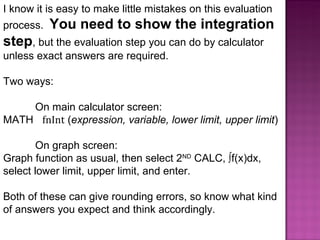
I know it is easy to make little mistakes on this evaluation process.  You need to show the integration step , but the evaluation step you can do by calculator unless exact answers are required. Two ways: On main calculator screen: MATH  fnInt  ( expression,   variable, lower limit, upper limit )  On graph screen: Graph function as usual, then select 2 ND  CALC, ∫f(x)dx, select lower limit, upper limit, and enter. Both of these can give rounding errors, so know what kind  of answers you expect and think accordingly.
Ex 3 p284  Using the Fundamental Theorem for Area Notice that the function lies above the x-axis for interval [0, 1] so result can be thought of as area. Find the area bounded by graph of  f(x) = 2x 2  - 3x + 2, y=0, x=0, and x = 1
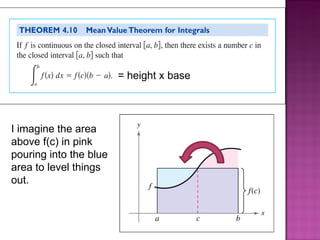
= height x base I imagine the area above f(c) in pink pouring into the blue area to level things out.
The value of f(c) from the Mean Value Theorem ends up being called the Average value of  f  on the interval [a, b].
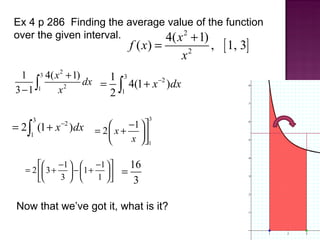
Ex 4 p 286  Finding the average value of the function over the given interval. Now that we’ve got it, what is it?
4.4a p. 291/ 1-45 every other odd, 47, 49, 55-60

Calc 4.4a

  • 1.
    Evaluate a definiteintegral using the fundamental theorem of calculus Understand and use the mean value theorem Find the Average Value of a function over a closed interval
  • 2.
    You can seethat differentiation and integration are inverse relationships to each other. One talks about the quotient ∆y/∆x or a “slope” concept, and one talks about the product ∆y ∆x, or an “area” concept.
  • 3.
    Early mathematicians didn’tknow that indefinite integration and definite integration were related. But we get to understand the relationship today. Drum roll, please!
  • 4.
    Guideline #1 isa biggie. Integration requires a rule to apply, and even simple functions sometimes can’t be integrated
  • 5.
    Ex 1 p284 Evaluating a definite Integral
  • 6.
    Ex 2 p284 A definite integral involving absolute value The vertex is (1/2, 0) so split up integral
  • 7.
    I know itis easy to make little mistakes on this evaluation process. You need to show the integration step , but the evaluation step you can do by calculator unless exact answers are required. Two ways: On main calculator screen: MATH fnInt ( expression, variable, lower limit, upper limit ) On graph screen: Graph function as usual, then select 2 ND CALC, ∫f(x)dx, select lower limit, upper limit, and enter. Both of these can give rounding errors, so know what kind of answers you expect and think accordingly.
  • 8.
    Ex 3 p284 Using the Fundamental Theorem for Area Notice that the function lies above the x-axis for interval [0, 1] so result can be thought of as area. Find the area bounded by graph of f(x) = 2x 2 - 3x + 2, y=0, x=0, and x = 1
  • 9.
    = height xbase I imagine the area above f(c) in pink pouring into the blue area to level things out.
  • 10.
    The value off(c) from the Mean Value Theorem ends up being called the Average value of f on the interval [a, b].
  • 11.
    Ex 4 p286 Finding the average value of the function over the given interval. Now that we’ve got it, what is it?
  • 12.
    4.4a p. 291/1-45 every other odd, 47, 49, 55-60