21: Simpson’s Rule21: Simpson’s Rule
© Christine Crisp
““Teach A Level Maths”Teach A Level Maths”
Vol. 1: AS Core ModulesVol. 1: AS Core Modules
Simpson’s Rule
"Certain images and/or photos on this presentation are the copyrighted property of JupiterImages and are being used with
permission under license. These images and/or photos may not be copied or downloaded without permission from JupiterImages"
Module C3
AQA
OCR
Simpson’s Rule
As you saw with the Trapezium rule ( and for
AQA students with the mid-ordinate rule ), the
area under the curve is divided into a number of
strips of equal width.
A very good approximation to a definite integral
can be found with Simpson’s rule.
However, this time, there must be an even
number of strips as they are taken in pairs.
I’ll show you briefly how the rule is found but
you just need to know the result.
Simpson’s Rule
2x
ey −
=
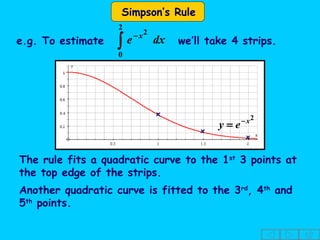
e.g. To estimate we’ll take 4 strips.∫
−
2
0
2
dxe x
The rule fits a quadratic curve to the 1st
3 points at
the top edge of the strips.
x
x
x
Simpson’s Rule
2x
ey −
=
x
x
x
e.g. To estimate we’ll take 4 strips.∫
−
2
0
2
dxe x
The rule fits a quadratic curve to the 1st
3 points at
the top edge of the strips.
Another quadratic curve is fitted to the 3rd
, 4th
and
5th
points.
Simpson’s Rule
2x
ey −
=
x
e.g. To estimate we’ll take 4 strips.∫
−
2
0
2
dxe x
The rule fits a quadratic curve to the 1st
3 points at
the top edge of the strips.
Another quadratic curve is fitted to the 3rd
, 4th
and
5th
points.
x
x
Simpson’s Rule
2x
ey −
=x
x
x
e.g. To estimate we’ll take 4 strips.∫
−
2
0
2
dxe x
The rule fits a quadratic curve to the 1st
3 points at
the top edge of the strips.
Another quadratic curve is fitted to the 3rd
, 4th
and
5th
points.
Simpson’s Rule
2x
ey −
=
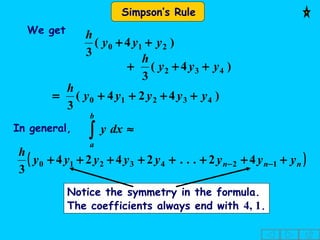
The formula for the 1st
2 strips is
)4(
3
210 yyy
h
++
x 0y
x 1y
h
For the 2nd
2 strips,
)4(
3
432 yyy
h
++
x 3y
4y
x
2y
x
Simpson’s Rule
Notice the symmetry in the formula.
The coefficients always end with 4, 1.
)4(
3
210 yyy
h
++
We get
)4(
3
432 yyy
h
+++
)424(
3
43210 yyyyy
h
++++=
In general, ≈∫
b
a
dxy
( )nnn yyyyyyyy
h
++++++++ −− 1243210 42...2424
3
Simpson’s Rule
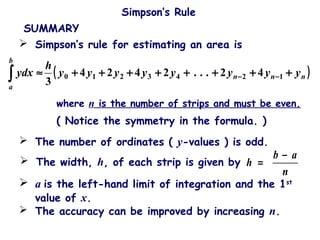
SUMMARY
where n is the number of strips and must be even.
n
ab
h
−
= The width, h, of each strip is given by
 Simpson’s rule for estimating an area is
 The accuracy can be improved by increasing n.
 a is the left-hand limit of integration and the 1st
value of x.
( )nnn
b
a
yyyyyyyy
h
ydx ++++++++≈ −−∫ 1243210 42...2424
3
 The number of ordinates ( y-values ) is odd.
( Notice the symmetry in the formula. )
Simpson’s Rule
∫ +
1
0
2
1
1
dx
x
e.g. (a) Use Simpson’s rule with 4 strips to
estimate
giving your answer to 4 d.p.
(b) Use your formula book to help you find the exact
value of the integral and hence find an
approximation for to 3 s.f.π
Solution: (a) ( )43210 424
3
yyyyy
h
A ++++≈
( It’s a good idea to write down the formula with
the correct number of ordinates. Always one
more than the number of strips. )
Simpson’s Rule
1750502500 ⋅⋅⋅x
Solution:
250
4
01
,4 ⋅=
−
== hn
∫ +
1
0
2
1
1
dx
x
( )43210 424
3
yyyyy
h
++++≈
50640809411801 ⋅⋅⋅⋅y
)d.p.( 478540⋅≈
∫ +
1
0
2
1
1
dx
x
( )43210 424
3
250
yyyyy ++++
⋅
≈
Simpson’s Rule
Solution: =
+
∫
1
0
2
1
1
dx
x
[ ]1
0
1
tan x−
[ ] [ ]0tan1tan 11 −−
−=
4
π
=
)d.p.( 478540⋅≈∫ +
1
0
2
1
1
dx
x
(a)
The answers to (a) and (b) are approximately equal:
78540
4
⋅≈
π
So,
785404 ⋅×≈⇒ π
)s.f.3(143⋅≈
(b) Use your formula book to help you find the exact
value of the integral and hence find an
approximation for to 3 s.f.π
Simpson’s Rule
Exercise
∫
3
1
1
dx
x
using Simpson’s rule
with 4 strips, giving your answer to 4 d.p.
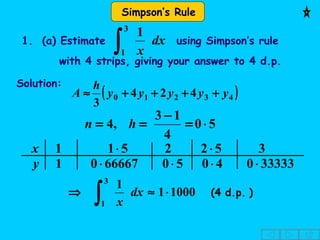
1. (a) Estimate
(b) Find the exact value of the integral and give
this correct to 4 d.p. Calculate to 1 s.f. the
percentage error in (a).
Simpson’s Rule
( )43210 424
3
yyyyy
h
A ++++≈
Solution:
using Simpson’s rule
with 4 strips, giving your answer to 4 d.p.
1. (a) Estimate
∫
3
1
1
dx
x
50
4
13
,4 ⋅=
−
== hn
3522511 ⋅⋅x
33333040506666701 ⋅⋅⋅⋅y
)d.p.4(10001
13
1
⋅≈⇒
∫ dx
x
Simpson’s Rule
)d.p.4((a) 10001
13
1
⋅≈
∫ dx
x
[ ] 3
1
3
1
ln
1
xdx
x
=
∫
(b) Find the exact value of the integral and give
this correct to 4 d.p. Calculate to 1 s.f. the
percentage error in (a).
[ ] [ ]1ln3ln −=
3ln=
)d.p.4(09861⋅≈
Percentage error 100
09861
0986110001
×
⋅
⋅−⋅
≈
)s.f.1(%10⋅≈
Simpson’s Rule
Simpson’s Rule
The following slides contain repeats of
information on earlier slides, shown without
colour, so that they can be printed and
photocopied.
For most purposes the slides can be printed
as “Handouts” with up to 6 slides per sheet.
Simpson’s Rule
As before, the area under the curve is divided
into a number of strips of equal width.
A very good approximation to a definite integral
can be found with Simpson’s rule.
However, this time, there must be an even
number of strips as they are taken in pairs.
Simpson’s Rule
SUMMARY
where n is the number of strips and must be even.
n
ab
h
−
= The width, h, of each strip is given by
 Simpson’s rule for estimating an area is
 The accuracy can be improved by increasing n.
( )nnn
b
a
yyyyyyyy
h
ydx ++++++++≈ −−∫ 1243210 42...2424
3
 The number of ordinates ( y-values ) is odd.
( Notice the symmetry in the formula. )
 a is the left-hand limit of integration and the 1st
value of x.
Simpson’s Rule
∫ +
1
0
2
1
1
dx
x
e.g. (a) Use Simpson’s rule with 4 strips to
estimate
giving your answer to 4 d.p.
(b) Use your formula book to help you find the exact
value of the integral and hence find an
approximation for to 3 s.f.π
Solution: (a) ( )43210 424
3
yyyyy
h
A ++++≈
( It’s a good idea to write down the formula with
the correct number of ordinates. Always one
more than the number of strips. )
Simpson’s Rule
1750502500 ⋅⋅⋅x
Solution:
250
4
01
,4 ⋅=
−
== hn
∫ +
1
0
2
1
1
dx
x
( )43210 424
3
yyyyy
h
++++≈
50640809411801 ⋅⋅⋅⋅y
)d.p.( 478540⋅≈
∫ +
1
0
2
1
1
dx
x
( )43210 424
3
250
yyyyy ++++
⋅
≈
Simpson’s Rule
Solution:
(b) =
+
∫
1
0
2
1
1
dx
x
[ ]1
0
1
tan x−
[ ] [ ]0tan1tan 11 −−
−=
4
π
=
The answers to (a) and (b) are approximately equal:
78540
4
⋅≈
π
So,
)s.f.3(143⋅≈⇒ π

21 simpson's rule

  • 1.
    21: Simpson’s Rule21:Simpson’s Rule © Christine Crisp ““Teach A Level Maths”Teach A Level Maths” Vol. 1: AS Core ModulesVol. 1: AS Core Modules
  • 2.
    Simpson’s Rule "Certain imagesand/or photos on this presentation are the copyrighted property of JupiterImages and are being used with permission under license. These images and/or photos may not be copied or downloaded without permission from JupiterImages" Module C3 AQA OCR
  • 3.
    Simpson’s Rule As yousaw with the Trapezium rule ( and for AQA students with the mid-ordinate rule ), the area under the curve is divided into a number of strips of equal width. A very good approximation to a definite integral can be found with Simpson’s rule. However, this time, there must be an even number of strips as they are taken in pairs. I’ll show you briefly how the rule is found but you just need to know the result.
  • 4.
    Simpson’s Rule 2x ey − = e.g.To estimate we’ll take 4 strips.∫ − 2 0 2 dxe x The rule fits a quadratic curve to the 1st 3 points at the top edge of the strips. x x x
  • 5.
    Simpson’s Rule 2x ey − = x x x e.g.To estimate we’ll take 4 strips.∫ − 2 0 2 dxe x The rule fits a quadratic curve to the 1st 3 points at the top edge of the strips. Another quadratic curve is fitted to the 3rd , 4th and 5th points.
  • 6.
    Simpson’s Rule 2x ey − = x e.g.To estimate we’ll take 4 strips.∫ − 2 0 2 dxe x The rule fits a quadratic curve to the 1st 3 points at the top edge of the strips. Another quadratic curve is fitted to the 3rd , 4th and 5th points. x x
  • 7.
    Simpson’s Rule 2x ey − =x x x e.g.To estimate we’ll take 4 strips.∫ − 2 0 2 dxe x The rule fits a quadratic curve to the 1st 3 points at the top edge of the strips. Another quadratic curve is fitted to the 3rd , 4th and 5th points.
  • 8.
    Simpson’s Rule 2x ey − = Theformula for the 1st 2 strips is )4( 3 210 yyy h ++ x 0y x 1y h For the 2nd 2 strips, )4( 3 432 yyy h ++ x 3y 4y x 2y x
  • 9.
    Simpson’s Rule Notice thesymmetry in the formula. The coefficients always end with 4, 1. )4( 3 210 yyy h ++ We get )4( 3 432 yyy h +++ )424( 3 43210 yyyyy h ++++= In general, ≈∫ b a dxy ( )nnn yyyyyyyy h ++++++++ −− 1243210 42...2424 3
  • 10.
    Simpson’s Rule SUMMARY where nis the number of strips and must be even. n ab h − = The width, h, of each strip is given by  Simpson’s rule for estimating an area is  The accuracy can be improved by increasing n.  a is the left-hand limit of integration and the 1st value of x. ( )nnn b a yyyyyyyy h ydx ++++++++≈ −−∫ 1243210 42...2424 3  The number of ordinates ( y-values ) is odd. ( Notice the symmetry in the formula. )
  • 11.
    Simpson’s Rule ∫ + 1 0 2 1 1 dx x e.g.(a) Use Simpson’s rule with 4 strips to estimate giving your answer to 4 d.p. (b) Use your formula book to help you find the exact value of the integral and hence find an approximation for to 3 s.f.π Solution: (a) ( )43210 424 3 yyyyy h A ++++≈ ( It’s a good idea to write down the formula with the correct number of ordinates. Always one more than the number of strips. )
  • 12.
    Simpson’s Rule 1750502500 ⋅⋅⋅x Solution: 250 4 01 ,4⋅= − == hn ∫ + 1 0 2 1 1 dx x ( )43210 424 3 yyyyy h ++++≈ 50640809411801 ⋅⋅⋅⋅y )d.p.( 478540⋅≈ ∫ + 1 0 2 1 1 dx x ( )43210 424 3 250 yyyyy ++++ ⋅ ≈
  • 13.
    Simpson’s Rule Solution: = + ∫ 1 0 2 1 1 dx x []1 0 1 tan x− [ ] [ ]0tan1tan 11 −− −= 4 π = )d.p.( 478540⋅≈∫ + 1 0 2 1 1 dx x (a) The answers to (a) and (b) are approximately equal: 78540 4 ⋅≈ π So, 785404 ⋅×≈⇒ π )s.f.3(143⋅≈ (b) Use your formula book to help you find the exact value of the integral and hence find an approximation for to 3 s.f.π
  • 14.
    Simpson’s Rule Exercise ∫ 3 1 1 dx x using Simpson’srule with 4 strips, giving your answer to 4 d.p. 1. (a) Estimate (b) Find the exact value of the integral and give this correct to 4 d.p. Calculate to 1 s.f. the percentage error in (a).
  • 15.
    Simpson’s Rule ( )43210424 3 yyyyy h A ++++≈ Solution: using Simpson’s rule with 4 strips, giving your answer to 4 d.p. 1. (a) Estimate ∫ 3 1 1 dx x 50 4 13 ,4 ⋅= − == hn 3522511 ⋅⋅x 33333040506666701 ⋅⋅⋅⋅y )d.p.4(10001 13 1 ⋅≈⇒ ∫ dx x
  • 16.
    Simpson’s Rule )d.p.4((a) 10001 13 1 ⋅≈ ∫dx x [ ] 3 1 3 1 ln 1 xdx x = ∫ (b) Find the exact value of the integral and give this correct to 4 d.p. Calculate to 1 s.f. the percentage error in (a). [ ] [ ]1ln3ln −= 3ln= )d.p.4(09861⋅≈ Percentage error 100 09861 0986110001 × ⋅ ⋅−⋅ ≈ )s.f.1(%10⋅≈
  • 17.
  • 18.
    Simpson’s Rule The followingslides contain repeats of information on earlier slides, shown without colour, so that they can be printed and photocopied. For most purposes the slides can be printed as “Handouts” with up to 6 slides per sheet.
  • 19.
    Simpson’s Rule As before,the area under the curve is divided into a number of strips of equal width. A very good approximation to a definite integral can be found with Simpson’s rule. However, this time, there must be an even number of strips as they are taken in pairs.
  • 20.
    Simpson’s Rule SUMMARY where nis the number of strips and must be even. n ab h − = The width, h, of each strip is given by  Simpson’s rule for estimating an area is  The accuracy can be improved by increasing n. ( )nnn b a yyyyyyyy h ydx ++++++++≈ −−∫ 1243210 42...2424 3  The number of ordinates ( y-values ) is odd. ( Notice the symmetry in the formula. )  a is the left-hand limit of integration and the 1st value of x.
  • 21.
    Simpson’s Rule ∫ + 1 0 2 1 1 dx x e.g.(a) Use Simpson’s rule with 4 strips to estimate giving your answer to 4 d.p. (b) Use your formula book to help you find the exact value of the integral and hence find an approximation for to 3 s.f.π Solution: (a) ( )43210 424 3 yyyyy h A ++++≈ ( It’s a good idea to write down the formula with the correct number of ordinates. Always one more than the number of strips. )
  • 22.
    Simpson’s Rule 1750502500 ⋅⋅⋅x Solution: 250 4 01 ,4⋅= − == hn ∫ + 1 0 2 1 1 dx x ( )43210 424 3 yyyyy h ++++≈ 50640809411801 ⋅⋅⋅⋅y )d.p.( 478540⋅≈ ∫ + 1 0 2 1 1 dx x ( )43210 424 3 250 yyyyy ++++ ⋅ ≈
  • 23.
    Simpson’s Rule Solution: (b) = + ∫ 1 0 2 1 1 dx x []1 0 1 tan x− [ ] [ ]0tan1tan 11 −− −= 4 π = The answers to (a) and (b) are approximately equal: 78540 4 ⋅≈ π So, )s.f.3(143⋅≈⇒ π