Trapizoidal Rule
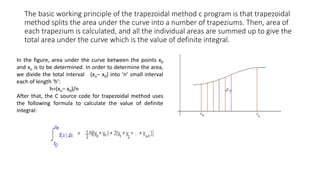
The basic working principle of the trapezoidal method c program is that trapezoidal
method splits the area under the curve into a number of trapeziums. Then, area of
each trapezium is calculated, and all the individual areas are summed up to give the
total area under the curve which is the value of definite integral.
In the figure, area under the curve between the points x0
and xn is to be determined. In order to determine the area,
we divide the total interval (xn– x0) into ‘n’ small interval
each of length ‘h’:
h=(xn– x0)/n
After that, the C source code for trapezoidal method uses
the following formula to calculate the value of definite
integral:
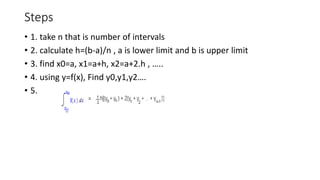
Steps
• 1. take n that is number of intervals
• 2. calculate h=(b-a)/n , a is lower limit and b is upper limit
• 3. find x0=a, x1=a+h, x2=a+2.h , …..
• 4. using y=f(x), Find y0,y1,y2….
• 5.
Example:
• ⌠1
4 (x2 +2X)dx with n=6
• ANSWER:
• n=6, h=(b-a)/n=3/6=0.5
•
• ⌠1
4 (x2 +2X)dx=h/2[(3+24)+ 2*(5.25+8+11.25+15+19.25)]=36.125
•
X 1 1.5 2 2.5 3 3.5 4
Y 3 5.25 8 11.25 15 19.25 24
Simpson’s 1/3rd Rule:
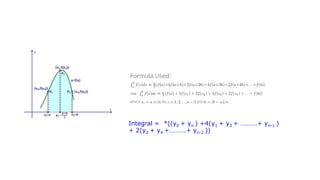
• Simpson’s Rule is a Numerical technique to find the definite
integral of a function within a given interval.
• The function is divided into many sub-intervals and each
interval is approximated by a quadratic curve. And the area is
then calculated to find the integral. The more is the number of
sub-intervals used, the better is the approximation.
•
NOTE: The no. of sub-intervals should be EVEN.
Integral = *((y0 + yn ) +4(y1 + y3 + ……….+ yn-1 )
+ 2(y2 + y4 +……….+ yn-2 ))
Numerical

Numerical

  • 1.
  • 2.
    The basic workingprinciple of the trapezoidal method c program is that trapezoidal method splits the area under the curve into a number of trapeziums. Then, area of each trapezium is calculated, and all the individual areas are summed up to give the total area under the curve which is the value of definite integral. In the figure, area under the curve between the points x0 and xn is to be determined. In order to determine the area, we divide the total interval (xn– x0) into ‘n’ small interval each of length ‘h’: h=(xn– x0)/n After that, the C source code for trapezoidal method uses the following formula to calculate the value of definite integral:
  • 3.
    Steps • 1. taken that is number of intervals • 2. calculate h=(b-a)/n , a is lower limit and b is upper limit • 3. find x0=a, x1=a+h, x2=a+2.h , ….. • 4. using y=f(x), Find y0,y1,y2…. • 5.
  • 4.
    Example: • ⌠1 4 (x2+2X)dx with n=6 • ANSWER: • n=6, h=(b-a)/n=3/6=0.5 • • ⌠1 4 (x2 +2X)dx=h/2[(3+24)+ 2*(5.25+8+11.25+15+19.25)]=36.125 • X 1 1.5 2 2.5 3 3.5 4 Y 3 5.25 8 11.25 15 19.25 24
  • 5.
    Simpson’s 1/3rd Rule: •Simpson’s Rule is a Numerical technique to find the definite integral of a function within a given interval. • The function is divided into many sub-intervals and each interval is approximated by a quadratic curve. And the area is then calculated to find the integral. The more is the number of sub-intervals used, the better is the approximation. • NOTE: The no. of sub-intervals should be EVEN.
  • 6.
    Integral = *((y0+ yn ) +4(y1 + y3 + ……….+ yn-1 ) + 2(y2 + y4 +……….+ yn-2 ))