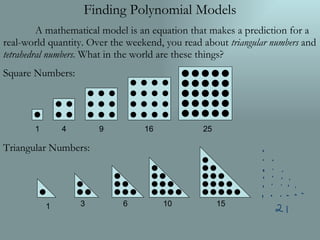
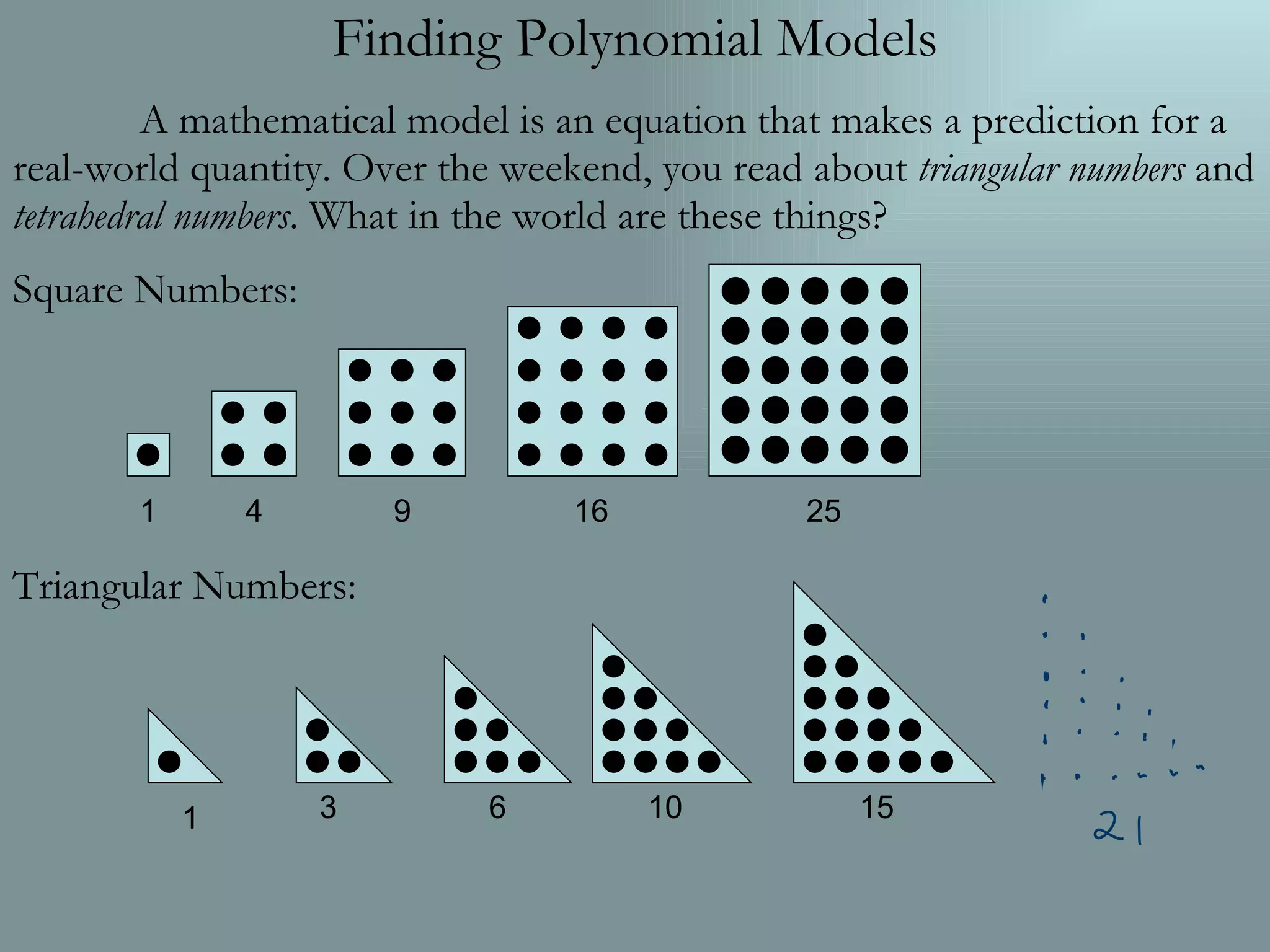
Finding Polynomial Models A mathematical model is an equation that makes a prediction for a real-world quantity. Over the weekend, you read about  triangular numbers  and  tetrahedral numbers . What in the world are these things? Square Numbers: Triangular Numbers: 1 4 9 25 16 1 3 6 10 15
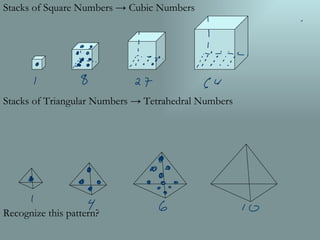
Stacks of Square Numbers -> Cubic Numbers Stacks of Triangular Numbers -> Tetrahedral Numbers Recognize this pattern?
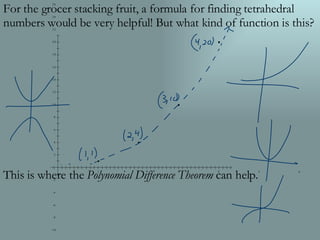
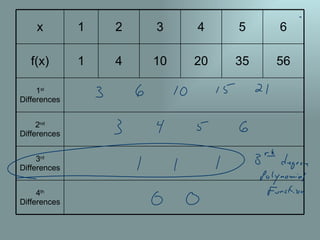
For the grocer stacking fruit, a formula for finding tetrahedral numbers would be very helpful! But what kind of function is this? This is where the  Polynomial Difference Theorem  can help.
4 th  Differences 3 rd  Differences 2 nd  Differences 1 st  Differences 56 35 20 10 4 1 f(x) 6 5 4 3 2 1 x
 
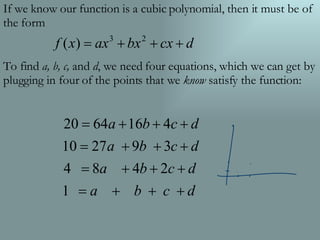
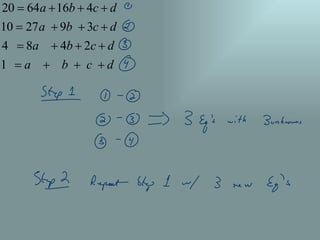
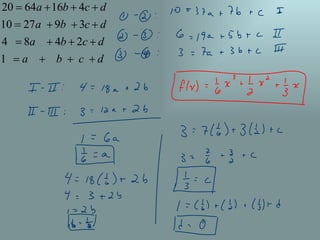
If we know our function is a cubic polynomial, then it must be of the form To find  a, b, c,  and  d , we need four equations, which we can get by plugging in four of the points that we  know  satisfy the function:
 
 
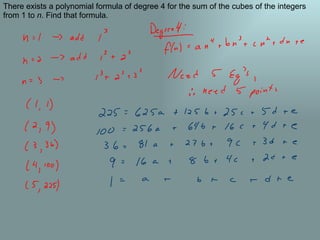
There exists a polynomial formula of degree 4 for the sum of the cubes of the integers from 1 to  n . Find that formula.

4.14.08 Finding Polynomial Models1 2

  • 1.
    Finding Polynomial ModelsA mathematical model is an equation that makes a prediction for a real-world quantity. Over the weekend, you read about triangular numbers and tetrahedral numbers . What in the world are these things? Square Numbers: Triangular Numbers: 1 4 9 25 16 1 3 6 10 15
  • 2.
    Stacks of SquareNumbers -> Cubic Numbers Stacks of Triangular Numbers -> Tetrahedral Numbers Recognize this pattern?
  • 3.
    For the grocerstacking fruit, a formula for finding tetrahedral numbers would be very helpful! But what kind of function is this? This is where the Polynomial Difference Theorem can help.
  • 4.
    4 th Differences 3 rd Differences 2 nd Differences 1 st Differences 56 35 20 10 4 1 f(x) 6 5 4 3 2 1 x
  • 5.
  • 6.
    If we knowour function is a cubic polynomial, then it must be of the form To find a, b, c, and d , we need four equations, which we can get by plugging in four of the points that we know satisfy the function:
  • 7.
  • 8.
  • 9.
    There exists apolynomial formula of degree 4 for the sum of the cubes of the integers from 1 to n . Find that formula.