Problem Statement: Define trapezoidal formula for, write the algorithm, draw the
flowchart, and develop a python program for trapezoidal formula.
Trapezoidal Formula:
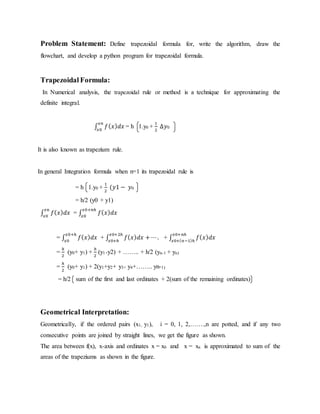
In Numerical analysis, the trapezoidal rule or method is a technique for approximating the
definite integral.
∫ 𝑓( 𝑥) 𝑑𝑥
𝑥𝑛
𝑥0
= h 1.y0 +
1
2
∆𝑦0
It is also known as trapezium rule.
In general Integration formula when n=1 its trapezoidal rule is
= h 1.y0 +
1
2
(𝑦1 − 𝑦0
= h/2 (y0 + y1)
∫ 𝑓( 𝑥) 𝑑𝑥
𝑥n
𝑥0
= ∫ 𝑓( 𝑥) 𝑑𝑥
𝑥0+𝑛ℎ
𝑥0
= ∫ 𝑓( 𝑥) 𝑑𝑥
𝑥0+ℎ
𝑥0
+ ∫ 𝑓( 𝑥) 𝑑𝑥 + ⋯.
𝑥0+2ℎ
𝑥0+ℎ
+ ∫ 𝑓( 𝑥) 𝑑𝑥
𝑥0+𝑛ℎ
𝑥0+( 𝑛−1)ℎ
=
ℎ
2
(y0+ y1) +
ℎ
2
(y1+y2) + …….. + h/2 (yn-1 + yn)
=
ℎ
2
(y0+ y1) + 2(y1+y2+ y3+ y4+…….. yn-1)
= h/2 sum of the first and last ordinates + 2(sum of the remaining ordinates)
Geometrical Interpretation:
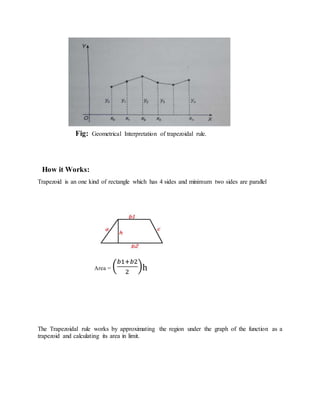
Geometrically, if the ordered pairs (x1, y1), i = 0, 1, 2,…….,n are potted, and if any two
consecutive points are joined by straight lines, we get the figure as shown.
The area between f(x), x-axis and ordinates x = x0 and x = xn is approximated to sum of the
areas of the trapeziums as shown in the figure.
Fig: Geometrical Interpretation of trapezoidal rule.
How it Works:
Trapezoid is an one kind of rectangle which has 4 sides and minimum two sides are parallel
Area = (
𝑏1+𝑏2
2
)h
The Trapezoidal rule works by approximating the region under the graph of the function as a
trapezoid and calculating its area in limit.
It follows that,
∫ 𝑓( 𝑥) 𝑑𝑥 ≈ (
𝑏 − 𝑎
2
)[ 𝑓( 𝑎) + 𝑓(𝑏)]
𝑏
𝑎
The Trapezoidal rule approximation improves with more strips, from this figure we can clearly see
it
Truncation error in Trapezoidal rule:
In the neighbourhood of x = x0, we can expand y = f(x), by Tailor series in power of x-x0, that
is,
Y(x) = y0 +
(𝑥−𝑥0)
1!
(y0’) +
(𝑥−𝑥0)2
2!
(y0”) + …… + …
Algorithm:
 Start
 Define and Declare the function
 Input initial boundary value, final boundary value and length of interval
 Calculate number of strips, n=(final boundary value-initial boundary value)/length of
interval
 Perform the following operations in loop
x[i]=x0+i*h
y[i]=f(x[i])
print y[i]
 Initialize se=0,s0=0
 Do the following using a loop
if i%2=0
s0=s0+y[i]
Otherwise
se=se+y[i]
 ans=h/3*(y[0]+y[n]+4*s0+2*se
 print the ans
 stop
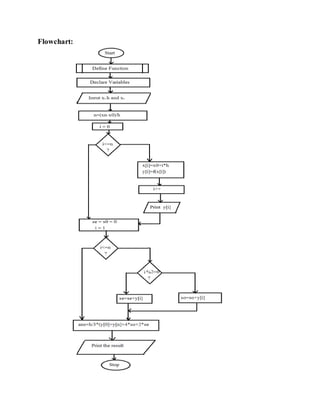
Flowchart:
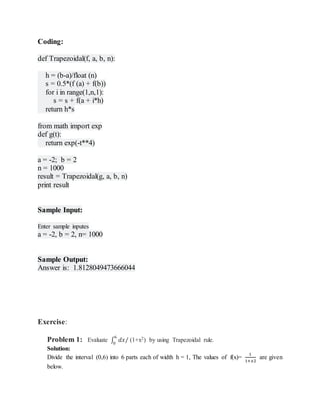
Coding:
def Trapezoidal(f, a, b, n):
h = (b-a)/float (n)
s = 0.5*(f (a) + f(b))
for i in range(1,n,1):
s = s + f(a + i*h)
return h*s
from math import exp
def g(t):
return exp(-t**4)
a = -2; b = 2
n = 1000
result = Trapezoidal(g, a, b, n)
print result
Sample Input:
Enter sample inputes
a = -2, b = 2, n= 1000
Sample Output:
Answer is: 1.8128049473666044
Exercise:
Problem 1: Evaluate ∫ 𝑑𝑥/
6
0
(1+x2) by using Trapezoidal rule.
Solution:
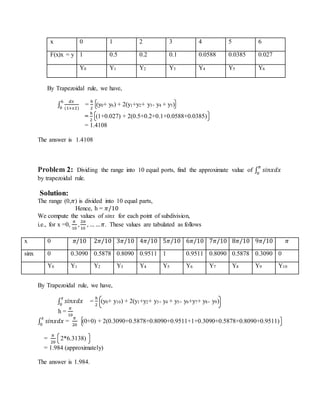
Divide the interval (0,6) into 6 parts each of width h = 1, The values of f(x)=
1
1+𝑥2
are given
below.
x 0 1 2 3 4 5 6
F(x)x = y 1 0.5 0.2 0.1 0.0588 0.0385 0.027
Y0 Y1 Y2 Y3 Y4 Y5 Y6
By Trapezoidal rule, we have,
∫
𝑑𝑥
(1+𝑥2)
6
0
=
ℎ
2
(y0+ y6) + 2(y1+y2+ y3+ y4 + y5)
=
ℎ
2
(1+0.027) + 2(0.5+0.2+0.1+0.0588+0.0385)
= 1.4108
The answer is 1.4108
Problem 2: Dividing the range into 10 equal ports, find the approximate value of ∫ 𝑠𝑖𝑛𝑥𝑑𝑥
𝜋
0
by trapezoidal rule.
Solution:
The range (0,𝜋) is divided into 10 equal parts,
Hence, h = 𝜋/10
We compute the values of sinx for each point of subdivision,
i.e., for x =0,
𝜋
10
,
2𝜋
10
, … … 𝜋. These values are tabulated as follows
x 0 𝜋/10 2𝜋/10 3𝜋/10 4𝜋/10 5𝜋/10 6𝜋/10 7𝜋/10 8𝜋/10 9𝜋/10 𝜋
sinx 0 0.3090 0.5878 0.8090 0.9511 1 0.9511 0.8090 0.5878 0.3090 0
Y0 Y1 Y2 Y3 Y4 Y5 Y6 Y7 Y8 Y9 Y10
By Trapezoidal rule, we have,
∫ 𝑠𝑖𝑛𝑥𝑑𝑥
𝑥
0
=
ℎ
2
(y0+ y10) + 2(y1+y2+ y3+ y4 + y5+ y6+y7+ y8+ y9)
h =
𝜋
10
∫ 𝑠𝑖𝑛𝑥𝑑𝑥
𝑥
0
=
𝜋
20
(0+0) + 2(0.3090+0.5878+0.8090+0.9511+1+0.3090+0.5878+0.8090+0.9511)
=
𝜋
20
2*6.3138)
= 1.984 (approximately)
The answer is 1.984.
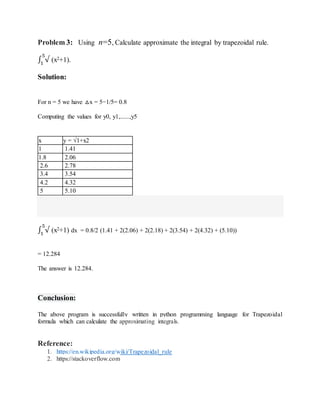
Problem 3: Using n=5, Calculate approximate the integral by trapezoidal rule.
∫ √
5
1
(x2+1).
Solution:
For n = 5 we have △x = 5−1/5= 0.8
Computing the values for y0, y1,......,y5
x y = √1+x2
1 1.41
1.8 2.06
2.6 2.78
3.4 3.54
4.2 4.32
5 5.10
∫ √
5
1
(x2+1) dx = 0.8/2 (1.41 + 2(2.06) + 2(2.18) + 2(3.54) + 2(4.32) + (5.10))
= 12.284
The answer is 12.284.
Conclusion:
The above program is successfully written in python programming language for Trapezoidal
formula which can calculate the approximating integrals.
Reference:
1. https://en.wikipedia.org/wiki/Trapezoidal_rule
2. https://stackoverflow.com
Trapezoidal Method IN  Numerical Analysis

Trapezoidal Method IN Numerical Analysis

  • 1.
    Problem Statement: Definetrapezoidal formula for, write the algorithm, draw the flowchart, and develop a python program for trapezoidal formula. Trapezoidal Formula: In Numerical analysis, the trapezoidal rule or method is a technique for approximating the definite integral. ∫ 𝑓( 𝑥) 𝑑𝑥 𝑥𝑛 𝑥0 = h 1.y0 + 1 2 ∆𝑦0 It is also known as trapezium rule. In general Integration formula when n=1 its trapezoidal rule is = h 1.y0 + 1 2 (𝑦1 − 𝑦0 = h/2 (y0 + y1) ∫ 𝑓( 𝑥) 𝑑𝑥 𝑥n 𝑥0 = ∫ 𝑓( 𝑥) 𝑑𝑥 𝑥0+𝑛ℎ 𝑥0 = ∫ 𝑓( 𝑥) 𝑑𝑥 𝑥0+ℎ 𝑥0 + ∫ 𝑓( 𝑥) 𝑑𝑥 + ⋯. 𝑥0+2ℎ 𝑥0+ℎ + ∫ 𝑓( 𝑥) 𝑑𝑥 𝑥0+𝑛ℎ 𝑥0+( 𝑛−1)ℎ = ℎ 2 (y0+ y1) + ℎ 2 (y1+y2) + …….. + h/2 (yn-1 + yn) = ℎ 2 (y0+ y1) + 2(y1+y2+ y3+ y4+…….. yn-1) = h/2 sum of the first and last ordinates + 2(sum of the remaining ordinates) Geometrical Interpretation: Geometrically, if the ordered pairs (x1, y1), i = 0, 1, 2,…….,n are potted, and if any two consecutive points are joined by straight lines, we get the figure as shown. The area between f(x), x-axis and ordinates x = x0 and x = xn is approximated to sum of the areas of the trapeziums as shown in the figure.
  • 2.
    Fig: Geometrical Interpretationof trapezoidal rule. How it Works: Trapezoid is an one kind of rectangle which has 4 sides and minimum two sides are parallel Area = ( 𝑏1+𝑏2 2 )h The Trapezoidal rule works by approximating the region under the graph of the function as a trapezoid and calculating its area in limit.
  • 3.
    It follows that, ∫𝑓( 𝑥) 𝑑𝑥 ≈ ( 𝑏 − 𝑎 2 )[ 𝑓( 𝑎) + 𝑓(𝑏)] 𝑏 𝑎 The Trapezoidal rule approximation improves with more strips, from this figure we can clearly see it Truncation error in Trapezoidal rule: In the neighbourhood of x = x0, we can expand y = f(x), by Tailor series in power of x-x0, that is, Y(x) = y0 + (𝑥−𝑥0) 1! (y0’) + (𝑥−𝑥0)2 2! (y0”) + …… + …
  • 4.
    Algorithm:  Start  Defineand Declare the function  Input initial boundary value, final boundary value and length of interval  Calculate number of strips, n=(final boundary value-initial boundary value)/length of interval  Perform the following operations in loop x[i]=x0+i*h y[i]=f(x[i]) print y[i]  Initialize se=0,s0=0  Do the following using a loop if i%2=0 s0=s0+y[i] Otherwise se=se+y[i]  ans=h/3*(y[0]+y[n]+4*s0+2*se  print the ans  stop
  • 5.
  • 6.
    Coding: def Trapezoidal(f, a,b, n): h = (b-a)/float (n) s = 0.5*(f (a) + f(b)) for i in range(1,n,1): s = s + f(a + i*h) return h*s from math import exp def g(t): return exp(-t**4) a = -2; b = 2 n = 1000 result = Trapezoidal(g, a, b, n) print result Sample Input: Enter sample inputes a = -2, b = 2, n= 1000 Sample Output: Answer is: 1.8128049473666044 Exercise: Problem 1: Evaluate ∫ 𝑑𝑥/ 6 0 (1+x2) by using Trapezoidal rule. Solution: Divide the interval (0,6) into 6 parts each of width h = 1, The values of f(x)= 1 1+𝑥2 are given below.
  • 7.
    x 0 12 3 4 5 6 F(x)x = y 1 0.5 0.2 0.1 0.0588 0.0385 0.027 Y0 Y1 Y2 Y3 Y4 Y5 Y6 By Trapezoidal rule, we have, ∫ 𝑑𝑥 (1+𝑥2) 6 0 = ℎ 2 (y0+ y6) + 2(y1+y2+ y3+ y4 + y5) = ℎ 2 (1+0.027) + 2(0.5+0.2+0.1+0.0588+0.0385) = 1.4108 The answer is 1.4108 Problem 2: Dividing the range into 10 equal ports, find the approximate value of ∫ 𝑠𝑖𝑛𝑥𝑑𝑥 𝜋 0 by trapezoidal rule. Solution: The range (0,𝜋) is divided into 10 equal parts, Hence, h = 𝜋/10 We compute the values of sinx for each point of subdivision, i.e., for x =0, 𝜋 10 , 2𝜋 10 , … … 𝜋. These values are tabulated as follows x 0 𝜋/10 2𝜋/10 3𝜋/10 4𝜋/10 5𝜋/10 6𝜋/10 7𝜋/10 8𝜋/10 9𝜋/10 𝜋 sinx 0 0.3090 0.5878 0.8090 0.9511 1 0.9511 0.8090 0.5878 0.3090 0 Y0 Y1 Y2 Y3 Y4 Y5 Y6 Y7 Y8 Y9 Y10 By Trapezoidal rule, we have, ∫ 𝑠𝑖𝑛𝑥𝑑𝑥 𝑥 0 = ℎ 2 (y0+ y10) + 2(y1+y2+ y3+ y4 + y5+ y6+y7+ y8+ y9) h = 𝜋 10 ∫ 𝑠𝑖𝑛𝑥𝑑𝑥 𝑥 0 = 𝜋 20 (0+0) + 2(0.3090+0.5878+0.8090+0.9511+1+0.3090+0.5878+0.8090+0.9511) = 𝜋 20 2*6.3138) = 1.984 (approximately) The answer is 1.984.
  • 8.
    Problem 3: Usingn=5, Calculate approximate the integral by trapezoidal rule. ∫ √ 5 1 (x2+1). Solution: For n = 5 we have △x = 5−1/5= 0.8 Computing the values for y0, y1,......,y5 x y = √1+x2 1 1.41 1.8 2.06 2.6 2.78 3.4 3.54 4.2 4.32 5 5.10 ∫ √ 5 1 (x2+1) dx = 0.8/2 (1.41 + 2(2.06) + 2(2.18) + 2(3.54) + 2(4.32) + (5.10)) = 12.284 The answer is 12.284. Conclusion: The above program is successfully written in python programming language for Trapezoidal formula which can calculate the approximating integrals. Reference: 1. https://en.wikipedia.org/wiki/Trapezoidal_rule 2. https://stackoverflow.com