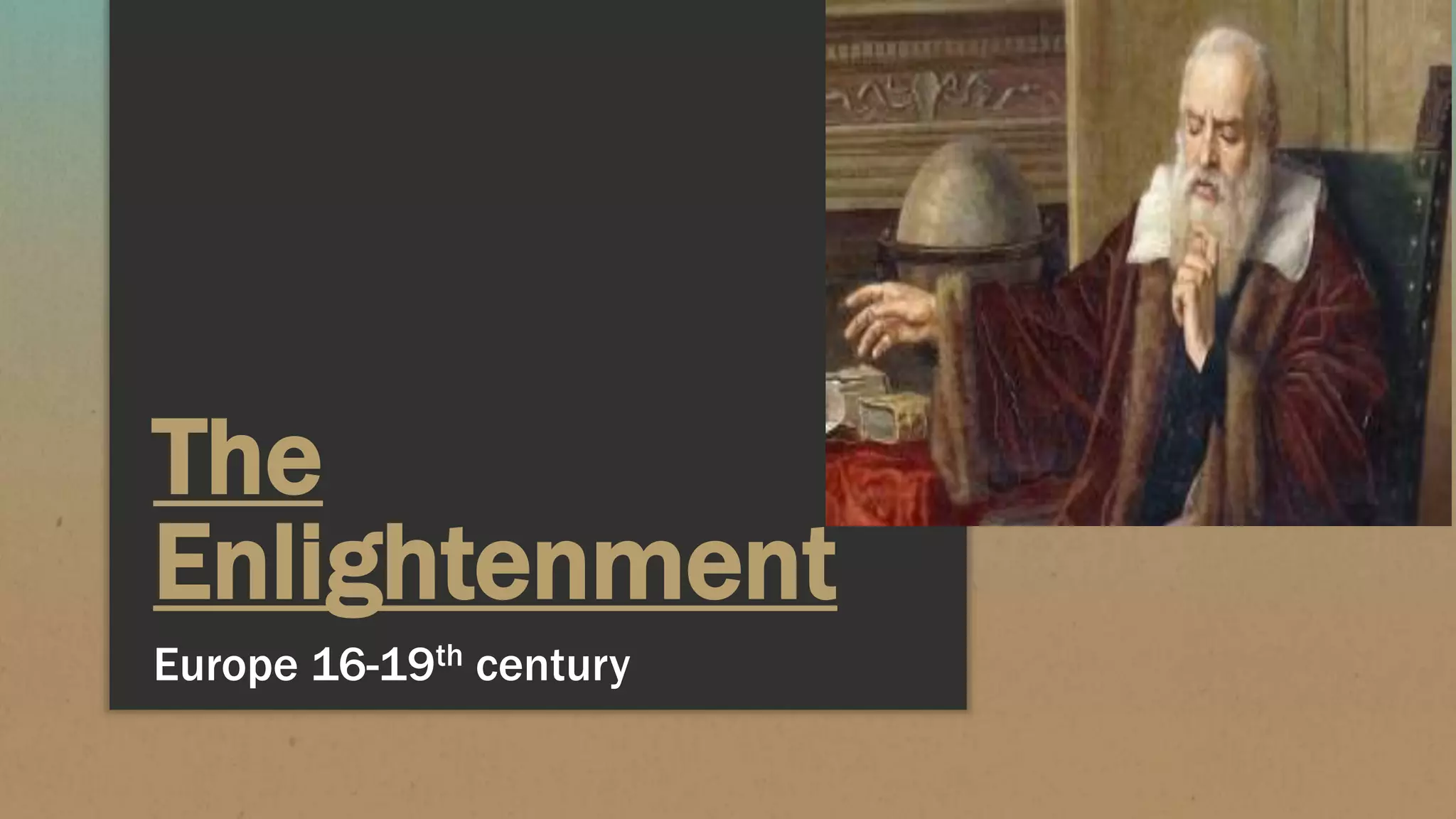
The
Enlightenment
Europe 16-19th century
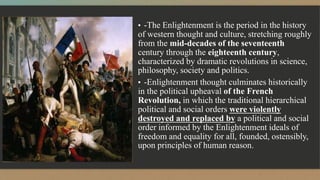
▪ -The Enlightenment is the period in the history
of western thought and culture, stretching roughly
from the mid-decades of the seventeenth
century through the eighteenth century,
characterized by dramatic revolutions in science,
philosophy, society and politics.
▪ -Enlightenment thought culminates historically
in the political upheaval of the French
Revolution, in which the traditional hierarchical
political and social orders were violently
destroyed and replaced by a political and social
order informed by the Enlightenment ideals of
freedom and equality for all, founded, ostensibly,
upon principles of human reason.
▪ The Enlightenment produced numerous books,
essays, inventions, scientific discoveries, laws, wars
and revolutions.
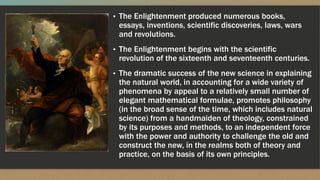
▪ The Enlightenment begins with the scientific
revolution of the sixteenth and seventeenth centuries.
▪ The dramatic success of the new science in explaining
the natural world, in accounting for a wide variety of
phenomena by appeal to a relatively small number of
elegant mathematical formulae, promotes philosophy
(in the broad sense of the time, which includes natural
science) from a handmaiden of theology, constrained
by its purposes and methods, to an independent force
with the power and authority to challenge the old and
construct the new, in the realms both of theory and
practice, on the basis of its own principles.
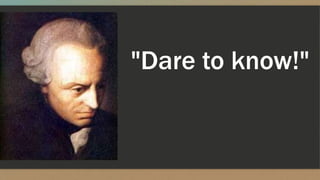
"Dare to know!"
▪ -As a result, the enlightenment may be divided up into three general
time periods and three different themes:
▪ -Time Periods:
1. THE EARLY ENLIGHTENMENT: 1685-1730
2. THE HIGH ENLIGHTENMENT: 1730-1780
3. THE LATE ENLIGHTENMENT AND BEYOND: 1780-1815
▪ -Themes:
1. The True: Science, Epistemology and Metaphysics
2. The Good: Political Theory, Ethical Theory and Religion
3. The Beautiful: Aesthetics
1. THE EARLY ENLIGHTENMENT: 1685-1730
▪ -The Enlightenment’s important 17th-century
precursors included the Englishmen Francis Bacon
and Thomas Hobbes, the Frenchman Renee
Descartes and the key natural philosophers of the
Scientific Revolution, including Galileo, Kepler and
Leibniz.
▪ -There was no single, unified Enlightenment.
Instead, it is possible to speak of the French
Enlightenment, the Scottish Enlightenment and
the English, German, Swiss or American
Enlightenment.
▪ -Individual Enlightenment thinkers often had
very different approaches. Locke differed from
Hume, Rousseau from Voltaire, Thomas
Jefferson from Frederick the Great.
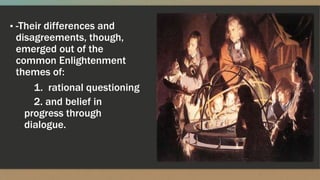
▪ -Their differences and
disagreements, though,
emerged out of the
common Enlightenment
themes of:
1. rational questioning
2. and belief in
progress through
dialogue.
Epistemology and Metaphysics in the Enlightenment
▪ -In this era dedicated to human progress, the advancement of the natural
sciences is regarded as the main exemplification of, and fuel for, such
progress.
▪ -The conception of nature, and of how we know it, changes significantly with
the rise of modern science.
▪ -It belongs centrally to the agenda of Enlightenment philosophy to contribute
to the new knowledge of nature, and to provide a metaphysical framework
within which to place and interpret this new knowledge.
▪ -Three principle epistemological positions emerge in the enlgihhtment that
would have a deep impact on western thought:
▪ 1. Rationalism
▪ 2. Empiricism
▪ 3. Skepticism
Rationalism
▪ Rationalism, in Western philosophy, the view that regards reason as the chief source and test of
knowledge.
▪ Holding that reality itself has an inherently logical structure, the rationalist asserts that a class of
truths exists that the intellect can grasp directly.
▪ There are, according to the rationalists, certain rational principles—especially in logic and
mathematics, and even in ethics and metaphysics—that are so fundamental that to deny them is to
fall into contradiction.
▪ - Descartes (1596–1650) undertakes to establish the sciences upon a secure metaphysical
foundation. The famous method of doubt Descartes employs for this purpose exemplifies (in part
through exaggerating) an attitude characteristic of the Enlightenment.
▪ -Rationalism holds that at least some human knowledge is gained through a priori (prior to
experience), or rational, insight as distinct from sense experience, which too often provides a
confused and merely tentative approach.
▪ -Two types of knowledge:
▪ 1. a priori
▪ 2. a posteriori
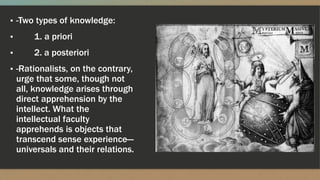
▪ -Rationalists, on the contrary,
urge that some, though not
all, knowledge arises through
direct apprehension by the
intellect. What the
intellectual faculty
apprehends is objects that
transcend sense experience—
universals and their relations.
Empiricism
▪ Empiricism, in philosophy, the view that all concepts originate in experience, that all concepts are about or
applicable to things that can be experienced, or that all rationally acceptable beliefs or propositions are justifiable
or knowable only through experience.
▪ This broad definition accords with the derivation of the term empiricism from the ancient Greek word
empeiria, “experience.”
▪ Concepts are said to be “a posteriori” if they can be applied only on the basis of experience, and they are
called “a priori” if they can be applied independently of experience. Beliefs or propositions are said to be
a posteriori if they are knowable only on the basis of experience and a priori if they are knowable
independently of experience (see a posteriori knowledge).
▪ - Thus, according to the second and third definitions of empiricism above, empiricism is the view that all
concepts, or all rationally acceptable beliefs or propositions, are a posteriori rather than a priori.
▪ - It views beliefs, or at least some vital classes of belief as depending ultimately and necessarily on
experience for their justification. An equivalent way of stating this thesis is to say that all human
knowledge is derived from experience.
Skepticism
▪ - Skepticism or scepticism (see spelling differences) is generally any questioning
attitude towards unempirical knowledge or opinions/beliefs stated as facts, or doubt
regarding claims that are taken for granted elsewhere.
▪ - Philosophical skepticism is a systematic approach that questions the notion that
absolutely certain knowledge is possible.
▪ -Skeptics may even doubt the reliability of their own senses. Religious skepticism, on
the other hand, is "doubt concerning basic religious principles (such as immortality,
providence, and revelation)". Scientific skepticism is about testing beliefs for reliability, by
subjecting them to systematic investigation using the scientific method, to discover
empirical evidence for them.
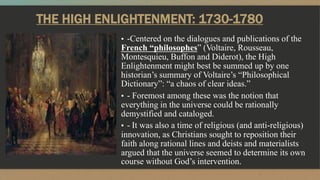
THE HIGH ENLIGHTENMENT: 1730-1780
▪ -Centered on the dialogues and publications of the
French “philosophes” (Voltaire, Rousseau,
Montesquieu, Buffon and Diderot), the High
Enlightenment might best be summed up by one
historian’s summary of Voltaire’s “Philosophical
Dictionary”: “a chaos of clear ideas.”
▪ - Foremost among these was the notion that
everything in the universe could be rationally
demystified and cataloged.
▪ - It was also a time of religious (and anti-religious)
innovation, as Christians sought to reposition their
faith along rational lines and deists and materialists
argued that the universe seemed to determine its own
course without God’s intervention.
The Good: Political Theory, Ethical Theory
and Religion in the Enlightenment
▪ 2.1 Political Theory
▪ -The Enlightenment is most identified with its political accomplishments.
▪ - The era is marked by three political revolutions, which together lay the
basis for modern, republican, constitutional democracies:
1. The English Revolution (1688)
2. the American Revolution (1775–83),
3. the French Revolution (1789–99).
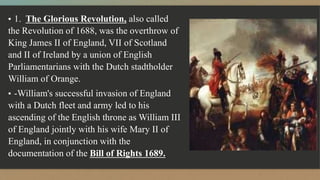
▪ 1. The Glorious Revolution, also called
the Revolution of 1688, was the overthrow of
King James II of England, VII of Scotland
and II of Ireland by a union of English
Parliamentarians with the Dutch stadtholder
William of Orange.
▪ -William's successful invasion of England
with a Dutch fleet and army led to his
ascending of the English throne as William III
of England jointly with his wife Mary II of
England, in conjunction with the
documentation of the Bill of Rights 1689.
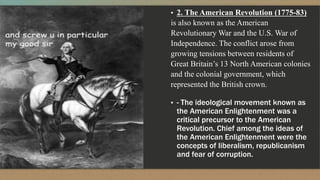
▪ 2. The American Revolution (1775-83)
is also known as the American
Revolutionary War and the U.S. War of
Independence. The conflict arose from
growing tensions between residents of
Great Britain’s 13 North American colonies
and the colonial government, which
represented the British crown.
▪ - The ideological movement known as
the American Enlightenment was a
critical precursor to the American
Revolution. Chief among the ideas of
the American Enlightenment were the
concepts of liberalism, republicanism
and fear of corruption.
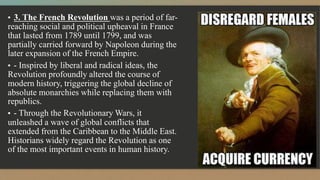
▪ 3. The French Revolution was a period of far-
reaching social and political upheaval in France
that lasted from 1789 until 1799, and was
partially carried forward by Napoleon during the
later expansion of the French Empire.
▪ - Inspired by liberal and radical ideas, the
Revolution profoundly altered the course of
modern history, triggering the global decline of
absolute monarchies while replacing them with
republics.
▪ - Through the Revolutionary Wars, it
unleashed a wave of global conflicts that
extended from the Caribbean to the Middle East.
Historians widely regard the Revolution as one
of the most important events in human history.
▪ Political Philosophy:
▪ - The success at explaining and understanding the natural world encourages
the Enlightenment project of re-making the social/political world, in accord
with the true models we allegedly find in our reason.
▪ - Enlightenment philosophers find that the existing social and political
orders do not withstand critical scrutiny; they find that existing political and
social authority is shrouded in religious myth and mystery and founded on
obscure traditions.
▪ - The political revolutions of the Enlightenment, especially the French and
the American, were informed and guided to a significant extent by prior
political philosophy in the period.
▪ Though Thomas Hobbes, in his Leviathan (1651), defends the absolute power of the political
sovereign, and is to that extent opposed to the revolutionaries and reformers in England, this work is a
founding work of Enlightenment political theory.
According to the general social contract model, political authority is grounded in an agreement (often
understood as ideal, rather than real) among individuals, each of whom aims in this agreement to
advance his rational self-interest by establishing a common political authority over all.
▪ - Thus, according to the general contract model (though this is more clear in later contract theorists
such as Locke and Rousseau than in Hobbes himself), political authority is grounded not in
conquest, natural or divinely instituted hierarchy, or in obscure myths and traditions, but rather in
the rational consent of the governed.
- In initiating this model, Hobbes takes a naturalistic, scientific approach to the question of how
political society ought to be organized (against the background of a clear-eyed, unsentimental
conception of human nature), and thus decisively influences the Enlightenment process of
secularization and rationalization in political and social philosophy.
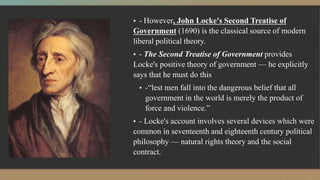
▪ - However, John Locke's Second Treatise of
Government (1690) is the classical source of modern
liberal political theory.
▪ - The Second Treatise of Government provides
Locke's positive theory of government — he explicitly
says that he must do this
▪ -“lest men fall into the dangerous belief that all
government in the world is merely the product of
force and violence.”
▪ - Locke's account involves several devices which were
common in seventeenth and eighteenth century political
philosophy — natural rights theory and the social
contract.
▪ 1. Natural rights are those rights which we are supposed to have as human beings
before ever government comes into being.
▪ - We might suppose, that like other animals, we have a natural right to struggle for our
survival. Locke will argue that we have a right to the means to survive.
▪ - When Locke comes to explain how government comes into being, he uses the idea
that people agree that their condition in the state of nature is unsatisfactory, and so
agree to transfer some of their rights to a central government, while retaining others.
▪ 2. This is the theory of the social contract. There are many versions of natural rights
theory and the social contract in seventeenth and eighteenth century European political
philosophy, some conservative and some radical.
▪ - Locke's version belongs on the radical side of the spectrum. These radical natural right
theories influenced the ideologies of the American and French revolutions.
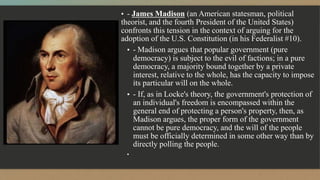
▪ - James Madison (an American statesman, political
theorist, and the fourth President of the United States)
confronts this tension in the context of arguing for the
adoption of the U.S. Constitution (in his Federalist #10).
▪ - Madison argues that popular government (pure
democracy) is subject to the evil of factions; in a pure
democracy, a majority bound together by a private
interest, relative to the whole, has the capacity to impose
its particular will on the whole.
▪ - If, as in Locke's theory, the government's protection of
an individual's freedom is encompassed within the
general end of protecting a person's property, then, as
Madison argues, the proper form of the government
cannot be pure democracy, and the will of the people
must be officially determined in some other way than by
directly polling the people.
▪
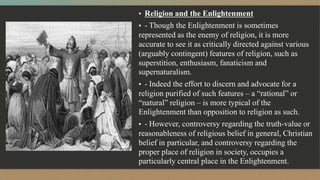
▪ Religion and the Enlightenment
▪ - Though the Enlightenment is sometimes
represented as the enemy of religion, it is more
accurate to see it as critically directed against various
(arguably contingent) features of religion, such as
superstition, enthusiasm, fanaticism and
supernaturalism.
▪ - Indeed the effort to discern and advocate for a
religion purified of such features – a “rational” or
“natural” religion – is more typical of the
Enlightenment than opposition to religion as such.
▪ - However, controversy regarding the truth-value or
reasonableness of religious belief in general, Christian
belief in particular, and controversy regarding the
proper place of religion in society, occupies a
particularly central place in the Enlightenment.
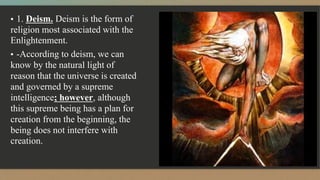
▪ 1. Deism. Deism is the form of
religion most associated with the
Enlightenment.
▪ -According to deism, we can
know by the natural light of
reason that the universe is created
and governed by a supreme
intelligence; however, although
this supreme being has a plan for
creation from the beginning, the
being does not interfere with
creation.
▪ 2. Religion of the Heart. Opposition to deism derives sometimes from the perception of it
as coldly rationalistic.
▪ - The God of the deists, arrived at through a priori or empirical argument and referred to as
the Prime Mover or Original Architect, is often perceived as distant and unconcerned with
the daily struggles of human existence, and thus as not answering the human needs from
which religion springs in the first place.
▪ - Some important thinkers of the Enlightenment – notably Shaftesbury and Rousseau –
present religion as founded on natural human sentiments, rather than on the operations of the
intellect.
▪ - This “natural” religion – opposed to the “artificial” religions enforced in the institutions
– is often classed as a form of deism. But it deserves separate mention, because of its
grounding in natural human sentiments, rather than in metaphysical or natural scientific
problems of Cosmology.
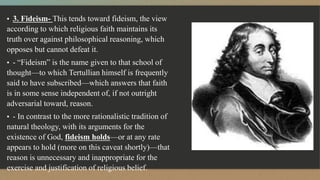
▪ 3. Fideism- This tends toward fideism, the view
according to which religious faith maintains its
truth over against philosophical reasoning, which
opposes but cannot defeat it.
▪ - “Fideism” is the name given to that school of
thought—to which Tertullian himself is frequently
said to have subscribed—which answers that faith
is in some sense independent of, if not outright
adversarial toward, reason.
▪ - In contrast to the more rationalistic tradition of
natural theology, with its arguments for the
existence of God, fideism holds—or at any rate
appears to hold (more on this caveat shortly)—that
reason is unnecessary and inappropriate for the
exercise and justification of religious belief.
▪ 4. Atheism- Atheism is more present in the French Enlightenment than elsewhere.
▪ - In the writings of Denis Diderot, atheism is partly supported by an expansive, dynamic
conception of nature.
▪ - According to the viewpoint developed by Diderot, we ought to search for the principles of
natural order within natural processes themselves, not in a supernatural being.
▪ - Even if we don't yet know the internal principles for the ordering and development of
natural forms, the appeal to a transcendent author of such things is reminiscent, to Diderot's
ear, of the appeal to Aristotelian “substantial forms” that was expressly rejected at the
beginning of modern science as explaining nothing.
▪ - The appeal to a transcendent author does not extend our understanding, but merely marks
and fixes the limits of it.
▪ - Atheism (combined with materialism) in the French Enlightenment is perhaps most
identified with the Baron d'Holbach, whose System of Nature (1770) generated a great deal
of controversy at the time for urging the case for atheism explicitly and emphatically.
▪ THE LATE ENLIGHTENMENT AND BEYOND: 1780-1815
▪ -The French Revolution of 1789 was the culmination of the High
Enlightenment vision of throwing out the old authorities to remake society
along rational lines, but it devolved into bloody terror that showed the limits of
its own ideas and led, a decade later, to the rise of Napoleon.
▪ -Still, its goal of egalitarianism attracted the admiration of the early feminist
Mary Wollstonecraft and inspired both the Haitian war of independence and the
radical racial inclusivism of Paraguay’s first post-independence government.
▪ -Enlightened rationality gave way to the wildness of Romanticism, but 19th-
century Liberalism and Classicism—not to mention 20th-century Modernism—
all owe a heavy debt to the thinkers of the Enlightenment.
▪ 3. The Beautiful: Aesthetics
▪ -Modern systematic philosophical aesthetics not only first emerges in the context of the
Enlightenment, but also flowers brilliantly there.
▪ - As Ernst Cassirer notes, the eighteenth century not only thinks of itself as the “century
of philosophy”, but also as “the age of criticism,” where criticism is centrally (though not
only) art and literary criticism.
▪ - The Enlightenment in general re-discovers the value of the senses, not only in cognition,
but in human lives in general, and so, given the intimate connection between beauty and
human sensibility, the Enlightenment is naturally particularly interested in aesthetics.
▪ - Also, the Enlightenment includes a general recovery and affirmation of
the value of pleasure in human lives, against the past of Christian
asceticism, and the flourishing of the arts, of the criticism of the arts and of
the philosophical theorizing about beauty, promotes and is promoted by this
recovery and affirmation.
▪ - It seems to many theorists in the Enlightenment that the faculty of taste,
the faculty by which we discern beauty, reveals to us some part of this order,
a distinctive harmony, unities amidst variety. Thus, in the phenomenon of
aesthetic pleasure, human sensibility discloses to us rational order, thus
binding together two enthusiasms of the Enlightenment.

WH1112 The enlightenment

  • 1.
  • 2.
    ▪ -The Enlightenmentis the period in the history of western thought and culture, stretching roughly from the mid-decades of the seventeenth century through the eighteenth century, characterized by dramatic revolutions in science, philosophy, society and politics. ▪ -Enlightenment thought culminates historically in the political upheaval of the French Revolution, in which the traditional hierarchical political and social orders were violently destroyed and replaced by a political and social order informed by the Enlightenment ideals of freedom and equality for all, founded, ostensibly, upon principles of human reason.
  • 3.
    ▪ The Enlightenmentproduced numerous books, essays, inventions, scientific discoveries, laws, wars and revolutions. ▪ The Enlightenment begins with the scientific revolution of the sixteenth and seventeenth centuries. ▪ The dramatic success of the new science in explaining the natural world, in accounting for a wide variety of phenomena by appeal to a relatively small number of elegant mathematical formulae, promotes philosophy (in the broad sense of the time, which includes natural science) from a handmaiden of theology, constrained by its purposes and methods, to an independent force with the power and authority to challenge the old and construct the new, in the realms both of theory and practice, on the basis of its own principles.
  • 4.
  • 5.
    ▪ -As aresult, the enlightenment may be divided up into three general time periods and three different themes: ▪ -Time Periods: 1. THE EARLY ENLIGHTENMENT: 1685-1730 2. THE HIGH ENLIGHTENMENT: 1730-1780 3. THE LATE ENLIGHTENMENT AND BEYOND: 1780-1815 ▪ -Themes: 1. The True: Science, Epistemology and Metaphysics 2. The Good: Political Theory, Ethical Theory and Religion 3. The Beautiful: Aesthetics
  • 6.
    1. THE EARLYENLIGHTENMENT: 1685-1730 ▪ -The Enlightenment’s important 17th-century precursors included the Englishmen Francis Bacon and Thomas Hobbes, the Frenchman Renee Descartes and the key natural philosophers of the Scientific Revolution, including Galileo, Kepler and Leibniz. ▪ -There was no single, unified Enlightenment. Instead, it is possible to speak of the French Enlightenment, the Scottish Enlightenment and the English, German, Swiss or American Enlightenment. ▪ -Individual Enlightenment thinkers often had very different approaches. Locke differed from Hume, Rousseau from Voltaire, Thomas Jefferson from Frederick the Great.
  • 7.
    ▪ -Their differencesand disagreements, though, emerged out of the common Enlightenment themes of: 1. rational questioning 2. and belief in progress through dialogue.
  • 8.
    Epistemology and Metaphysicsin the Enlightenment ▪ -In this era dedicated to human progress, the advancement of the natural sciences is regarded as the main exemplification of, and fuel for, such progress. ▪ -The conception of nature, and of how we know it, changes significantly with the rise of modern science. ▪ -It belongs centrally to the agenda of Enlightenment philosophy to contribute to the new knowledge of nature, and to provide a metaphysical framework within which to place and interpret this new knowledge. ▪ -Three principle epistemological positions emerge in the enlgihhtment that would have a deep impact on western thought: ▪ 1. Rationalism ▪ 2. Empiricism ▪ 3. Skepticism
  • 9.
    Rationalism ▪ Rationalism, inWestern philosophy, the view that regards reason as the chief source and test of knowledge. ▪ Holding that reality itself has an inherently logical structure, the rationalist asserts that a class of truths exists that the intellect can grasp directly. ▪ There are, according to the rationalists, certain rational principles—especially in logic and mathematics, and even in ethics and metaphysics—that are so fundamental that to deny them is to fall into contradiction. ▪ - Descartes (1596–1650) undertakes to establish the sciences upon a secure metaphysical foundation. The famous method of doubt Descartes employs for this purpose exemplifies (in part through exaggerating) an attitude characteristic of the Enlightenment. ▪ -Rationalism holds that at least some human knowledge is gained through a priori (prior to experience), or rational, insight as distinct from sense experience, which too often provides a confused and merely tentative approach.
  • 10.
    ▪ -Two typesof knowledge: ▪ 1. a priori ▪ 2. a posteriori ▪ -Rationalists, on the contrary, urge that some, though not all, knowledge arises through direct apprehension by the intellect. What the intellectual faculty apprehends is objects that transcend sense experience— universals and their relations.
  • 11.
    Empiricism ▪ Empiricism, inphilosophy, the view that all concepts originate in experience, that all concepts are about or applicable to things that can be experienced, or that all rationally acceptable beliefs or propositions are justifiable or knowable only through experience. ▪ This broad definition accords with the derivation of the term empiricism from the ancient Greek word empeiria, “experience.” ▪ Concepts are said to be “a posteriori” if they can be applied only on the basis of experience, and they are called “a priori” if they can be applied independently of experience. Beliefs or propositions are said to be a posteriori if they are knowable only on the basis of experience and a priori if they are knowable independently of experience (see a posteriori knowledge). ▪ - Thus, according to the second and third definitions of empiricism above, empiricism is the view that all concepts, or all rationally acceptable beliefs or propositions, are a posteriori rather than a priori. ▪ - It views beliefs, or at least some vital classes of belief as depending ultimately and necessarily on experience for their justification. An equivalent way of stating this thesis is to say that all human knowledge is derived from experience.
  • 12.
    Skepticism ▪ - Skepticismor scepticism (see spelling differences) is generally any questioning attitude towards unempirical knowledge or opinions/beliefs stated as facts, or doubt regarding claims that are taken for granted elsewhere. ▪ - Philosophical skepticism is a systematic approach that questions the notion that absolutely certain knowledge is possible. ▪ -Skeptics may even doubt the reliability of their own senses. Religious skepticism, on the other hand, is "doubt concerning basic religious principles (such as immortality, providence, and revelation)". Scientific skepticism is about testing beliefs for reliability, by subjecting them to systematic investigation using the scientific method, to discover empirical evidence for them.
  • 13.
    THE HIGH ENLIGHTENMENT:1730-1780 ▪ -Centered on the dialogues and publications of the French “philosophes” (Voltaire, Rousseau, Montesquieu, Buffon and Diderot), the High Enlightenment might best be summed up by one historian’s summary of Voltaire’s “Philosophical Dictionary”: “a chaos of clear ideas.” ▪ - Foremost among these was the notion that everything in the universe could be rationally demystified and cataloged. ▪ - It was also a time of religious (and anti-religious) innovation, as Christians sought to reposition their faith along rational lines and deists and materialists argued that the universe seemed to determine its own course without God’s intervention.
  • 14.
    The Good: PoliticalTheory, Ethical Theory and Religion in the Enlightenment ▪ 2.1 Political Theory ▪ -The Enlightenment is most identified with its political accomplishments. ▪ - The era is marked by three political revolutions, which together lay the basis for modern, republican, constitutional democracies: 1. The English Revolution (1688) 2. the American Revolution (1775–83), 3. the French Revolution (1789–99).
  • 15.
    ▪ 1. TheGlorious Revolution, also called the Revolution of 1688, was the overthrow of King James II of England, VII of Scotland and II of Ireland by a union of English Parliamentarians with the Dutch stadtholder William of Orange. ▪ -William's successful invasion of England with a Dutch fleet and army led to his ascending of the English throne as William III of England jointly with his wife Mary II of England, in conjunction with the documentation of the Bill of Rights 1689.
  • 16.
    ▪ 2. TheAmerican Revolution (1775-83) is also known as the American Revolutionary War and the U.S. War of Independence. The conflict arose from growing tensions between residents of Great Britain’s 13 North American colonies and the colonial government, which represented the British crown. ▪ - The ideological movement known as the American Enlightenment was a critical precursor to the American Revolution. Chief among the ideas of the American Enlightenment were the concepts of liberalism, republicanism and fear of corruption.
  • 17.
    ▪ 3. TheFrench Revolution was a period of far- reaching social and political upheaval in France that lasted from 1789 until 1799, and was partially carried forward by Napoleon during the later expansion of the French Empire. ▪ - Inspired by liberal and radical ideas, the Revolution profoundly altered the course of modern history, triggering the global decline of absolute monarchies while replacing them with republics. ▪ - Through the Revolutionary Wars, it unleashed a wave of global conflicts that extended from the Caribbean to the Middle East. Historians widely regard the Revolution as one of the most important events in human history.
  • 18.
    ▪ Political Philosophy: ▪- The success at explaining and understanding the natural world encourages the Enlightenment project of re-making the social/political world, in accord with the true models we allegedly find in our reason. ▪ - Enlightenment philosophers find that the existing social and political orders do not withstand critical scrutiny; they find that existing political and social authority is shrouded in religious myth and mystery and founded on obscure traditions. ▪ - The political revolutions of the Enlightenment, especially the French and the American, were informed and guided to a significant extent by prior political philosophy in the period.
  • 19.
    ▪ Though ThomasHobbes, in his Leviathan (1651), defends the absolute power of the political sovereign, and is to that extent opposed to the revolutionaries and reformers in England, this work is a founding work of Enlightenment political theory. According to the general social contract model, political authority is grounded in an agreement (often understood as ideal, rather than real) among individuals, each of whom aims in this agreement to advance his rational self-interest by establishing a common political authority over all. ▪ - Thus, according to the general contract model (though this is more clear in later contract theorists such as Locke and Rousseau than in Hobbes himself), political authority is grounded not in conquest, natural or divinely instituted hierarchy, or in obscure myths and traditions, but rather in the rational consent of the governed. - In initiating this model, Hobbes takes a naturalistic, scientific approach to the question of how political society ought to be organized (against the background of a clear-eyed, unsentimental conception of human nature), and thus decisively influences the Enlightenment process of secularization and rationalization in political and social philosophy.
  • 20.
    ▪ - However,John Locke's Second Treatise of Government (1690) is the classical source of modern liberal political theory. ▪ - The Second Treatise of Government provides Locke's positive theory of government — he explicitly says that he must do this ▪ -“lest men fall into the dangerous belief that all government in the world is merely the product of force and violence.” ▪ - Locke's account involves several devices which were common in seventeenth and eighteenth century political philosophy — natural rights theory and the social contract.
  • 21.
    ▪ 1. Naturalrights are those rights which we are supposed to have as human beings before ever government comes into being. ▪ - We might suppose, that like other animals, we have a natural right to struggle for our survival. Locke will argue that we have a right to the means to survive. ▪ - When Locke comes to explain how government comes into being, he uses the idea that people agree that their condition in the state of nature is unsatisfactory, and so agree to transfer some of their rights to a central government, while retaining others. ▪ 2. This is the theory of the social contract. There are many versions of natural rights theory and the social contract in seventeenth and eighteenth century European political philosophy, some conservative and some radical. ▪ - Locke's version belongs on the radical side of the spectrum. These radical natural right theories influenced the ideologies of the American and French revolutions.
  • 22.
    ▪ - JamesMadison (an American statesman, political theorist, and the fourth President of the United States) confronts this tension in the context of arguing for the adoption of the U.S. Constitution (in his Federalist #10). ▪ - Madison argues that popular government (pure democracy) is subject to the evil of factions; in a pure democracy, a majority bound together by a private interest, relative to the whole, has the capacity to impose its particular will on the whole. ▪ - If, as in Locke's theory, the government's protection of an individual's freedom is encompassed within the general end of protecting a person's property, then, as Madison argues, the proper form of the government cannot be pure democracy, and the will of the people must be officially determined in some other way than by directly polling the people. ▪
  • 23.
    ▪ Religion andthe Enlightenment ▪ - Though the Enlightenment is sometimes represented as the enemy of religion, it is more accurate to see it as critically directed against various (arguably contingent) features of religion, such as superstition, enthusiasm, fanaticism and supernaturalism. ▪ - Indeed the effort to discern and advocate for a religion purified of such features – a “rational” or “natural” religion – is more typical of the Enlightenment than opposition to religion as such. ▪ - However, controversy regarding the truth-value or reasonableness of religious belief in general, Christian belief in particular, and controversy regarding the proper place of religion in society, occupies a particularly central place in the Enlightenment.
  • 24.
    ▪ 1. Deism.Deism is the form of religion most associated with the Enlightenment. ▪ -According to deism, we can know by the natural light of reason that the universe is created and governed by a supreme intelligence; however, although this supreme being has a plan for creation from the beginning, the being does not interfere with creation.
  • 25.
    ▪ 2. Religionof the Heart. Opposition to deism derives sometimes from the perception of it as coldly rationalistic. ▪ - The God of the deists, arrived at through a priori or empirical argument and referred to as the Prime Mover or Original Architect, is often perceived as distant and unconcerned with the daily struggles of human existence, and thus as not answering the human needs from which religion springs in the first place. ▪ - Some important thinkers of the Enlightenment – notably Shaftesbury and Rousseau – present religion as founded on natural human sentiments, rather than on the operations of the intellect. ▪ - This “natural” religion – opposed to the “artificial” religions enforced in the institutions – is often classed as a form of deism. But it deserves separate mention, because of its grounding in natural human sentiments, rather than in metaphysical or natural scientific problems of Cosmology.
  • 26.
    ▪ 3. Fideism-This tends toward fideism, the view according to which religious faith maintains its truth over against philosophical reasoning, which opposes but cannot defeat it. ▪ - “Fideism” is the name given to that school of thought—to which Tertullian himself is frequently said to have subscribed—which answers that faith is in some sense independent of, if not outright adversarial toward, reason. ▪ - In contrast to the more rationalistic tradition of natural theology, with its arguments for the existence of God, fideism holds—or at any rate appears to hold (more on this caveat shortly)—that reason is unnecessary and inappropriate for the exercise and justification of religious belief.
  • 27.
    ▪ 4. Atheism-Atheism is more present in the French Enlightenment than elsewhere. ▪ - In the writings of Denis Diderot, atheism is partly supported by an expansive, dynamic conception of nature. ▪ - According to the viewpoint developed by Diderot, we ought to search for the principles of natural order within natural processes themselves, not in a supernatural being. ▪ - Even if we don't yet know the internal principles for the ordering and development of natural forms, the appeal to a transcendent author of such things is reminiscent, to Diderot's ear, of the appeal to Aristotelian “substantial forms” that was expressly rejected at the beginning of modern science as explaining nothing. ▪ - The appeal to a transcendent author does not extend our understanding, but merely marks and fixes the limits of it. ▪ - Atheism (combined with materialism) in the French Enlightenment is perhaps most identified with the Baron d'Holbach, whose System of Nature (1770) generated a great deal of controversy at the time for urging the case for atheism explicitly and emphatically.
  • 28.
    ▪ THE LATEENLIGHTENMENT AND BEYOND: 1780-1815 ▪ -The French Revolution of 1789 was the culmination of the High Enlightenment vision of throwing out the old authorities to remake society along rational lines, but it devolved into bloody terror that showed the limits of its own ideas and led, a decade later, to the rise of Napoleon. ▪ -Still, its goal of egalitarianism attracted the admiration of the early feminist Mary Wollstonecraft and inspired both the Haitian war of independence and the radical racial inclusivism of Paraguay’s first post-independence government. ▪ -Enlightened rationality gave way to the wildness of Romanticism, but 19th- century Liberalism and Classicism—not to mention 20th-century Modernism— all owe a heavy debt to the thinkers of the Enlightenment.
  • 29.
    ▪ 3. TheBeautiful: Aesthetics ▪ -Modern systematic philosophical aesthetics not only first emerges in the context of the Enlightenment, but also flowers brilliantly there. ▪ - As Ernst Cassirer notes, the eighteenth century not only thinks of itself as the “century of philosophy”, but also as “the age of criticism,” where criticism is centrally (though not only) art and literary criticism. ▪ - The Enlightenment in general re-discovers the value of the senses, not only in cognition, but in human lives in general, and so, given the intimate connection between beauty and human sensibility, the Enlightenment is naturally particularly interested in aesthetics.
  • 30.
    ▪ - Also,the Enlightenment includes a general recovery and affirmation of the value of pleasure in human lives, against the past of Christian asceticism, and the flourishing of the arts, of the criticism of the arts and of the philosophical theorizing about beauty, promotes and is promoted by this recovery and affirmation. ▪ - It seems to many theorists in the Enlightenment that the faculty of taste, the faculty by which we discern beauty, reveals to us some part of this order, a distinctive harmony, unities amidst variety. Thus, in the phenomenon of aesthetic pleasure, human sensibility discloses to us rational order, thus binding together two enthusiasms of the Enlightenment.