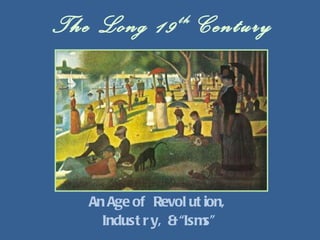
The Long 19 th  Century An Age of  Revolution,  Industry,  & “Isms”
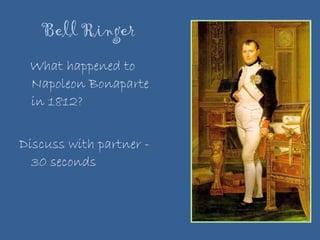
Bell Ringer What happened to Napoleon Bonaparte in 1812? Discuss with partner - 30 seconds
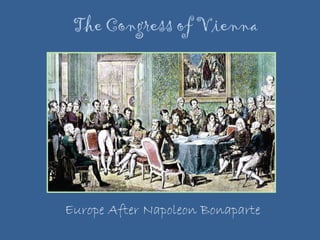
The Congress of Vienna Europe After Napoleon Bonaparte
Congress of Vienna  WHAT:  The Congress of Vienna WHEN:  September 1814 to June 1815 WHO:  representatives of major European powers  WHERE:  Vienna, Austria WHY:  reorganize Europe post-Napoleon
Congress of Vienna Five Great European Powers: Prussia – Frederick Wilhelm III Russia – Tsar Alexander Austria – Klemens von Metternich Great Britain – Lord Castleraugh France - Tallyrand
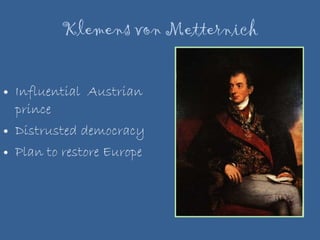
Klemens von Metternich Influential  Austrian prince Distrusted democracy Plan to restore Europe
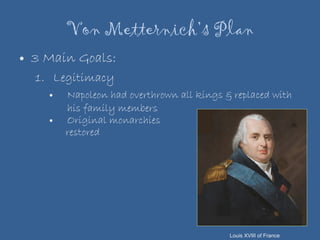
Von Metternich’s Plan 3 Main Goals: Legitimacy Napoleon had overthrown all kings & replaced with his family members Original monarchies  restored Louis XVIII of France
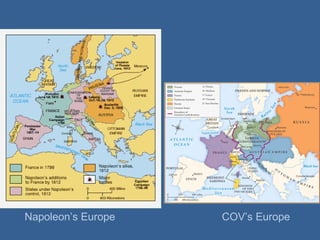
Von Metternich’s Plan 2. Contain France Napoleon  was power hungry & had instilled strong sense of nationalism in France Many surrounding countries felt threatened VM, gave back power to countries surrounding France (containment)
Napoleon’s Europe COV’s Europe
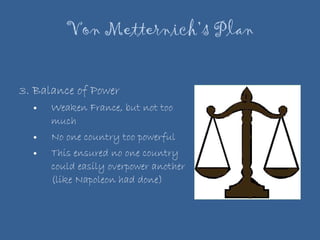
Von Metternich’s Plan 3. Balance of Power Weaken France, but not too much No one country too powerful  This ensured no one country could easily overpower another (like Napoleon had done)
Carlsbad Decrees Response to nationalist student society ( Burschenschaften ) Society led by Friedrich Jahn: Nationalist (wanted unified Germany) Racist (wanted racially pure German nation) Xenophobic (anti-foreigner)  Metternich issued to dissolve such societies & censor press (incorrectly doubted their motives)
More Challenges 1820s full of rebellions that challenged COV Spain, Portugal & Italy demanded constitutional gov’ts Von Metternich urged conservatives to crush them Slowed things down, but did not stop them By mid 1800s, the socialists of the Industrial Revolution were pushing workers to rebel
Political Revolts in the 1820’s
Political Revolts in the 1820’s Spain Italy Russia  Greece
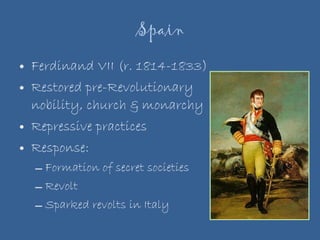
Spain Ferdinand VII (r. 1814-1833) Restored pre-Revolutionary nobility, church & monarchy Repressive practices Response: Formation of secret societies Revolt  Sparked revolts in Italy
Italy Naples, Piedmont-Sardinia Demanded constitution Too much disagreement Result: emergence of nationalism (fight Austrians for independence) Laid groundwork for Italian unification
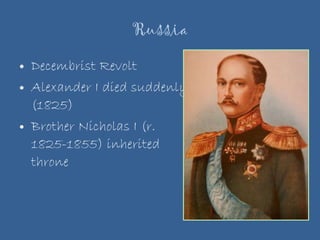
Russia Decembrist Revolt  Alexander I died suddenly (1825) Brother Nicholas I (r. 1825-1855) inherited throne
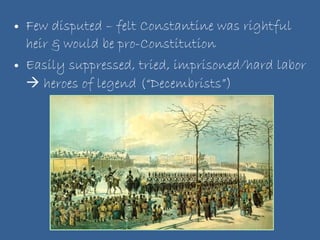
Few disputed – felt Constantine was rightful heir & would be pro-Constitution Easily suppressed, tried, imprisoned/hard labor    heroes of legend (“Decembrists”)
Balkans/Greece Wanted independence from Ottoman Turks Serbia = successful revolt (independence in 1817) Greece = 1820-21 – massacred Turks; Turks retaliated w/ own massacres against Greeks, sold women into slavery
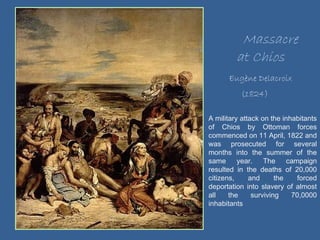
Massacre at Chios Eugène Delacroix (1824) A military attack on the inhabitants of Chios by Ottoman forces commenced on 11 April, 1822 and was prosecuted for several months into the summer of the same year. The campaign resulted in the deaths of 20,000 citizens, and the forced deportation into slavery of almost all the surviving 70,0000 inhabitants
Greece Austria sided w/ Ottomans Rest of Europe sided w/ Greece Rec’d help from GB, France & Russia 1830: Greece declared independent Significance: nationalism + public opinion = 1 st  breach in Metternich’s system
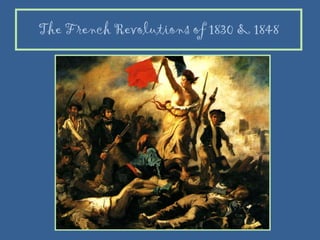
The French Revolutions of 1830 & 1848
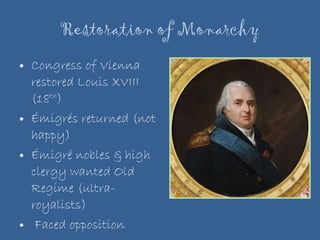
Restoration of Monarchy Congress of Vienna restored Louis XVIII (18 th ) Émigrés returned (not happy) Émigré nobles & high clergy wanted Old Regime (ultra-royalists) Faced opposition
Liberals in France Wanted for middle class: Suffrage Power in gov’t Republic Decent pay for working class Food for all
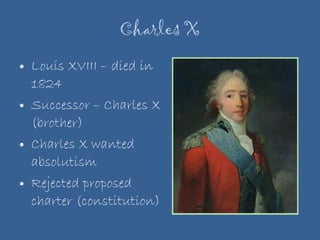
Charles X Louis XVIII – died in 1824 Successor – Charles X (brother) Charles X wanted absolutism Rejected proposed charter (constitution)
The July Revolution - 1830 July 1830 – Charles X: Suspended legislature Limited right to vote Restricted press Naturally, what happened?
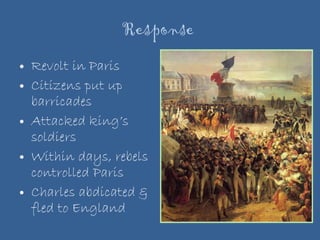
Response  Revolt in Paris Citizens put up barricades Attacked king’s soldiers Within days, rebels controlled Paris Charles abdicated & fled to England
Republic or  Constitutional Monarchy? Radical rebels wanted a republic Moderates wanted a constitutional monarchy Moderates got their way…
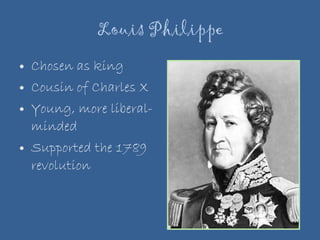
Louis Philippe Chosen as king Cousin of Charles X Young, more liberal-minded Supported the 1789 revolution
The Citizen King Nickname for Louis Philippe Owed the throne to the French citizens Was “one of them” Got along well  Dressed down (frock coat & top hat) Walked the streets Extended suffrage, but…
Problems Policies favored the wealthier bourgeoisie – often at the expense of the working class Extended suffrage to the wealthiest citizens Most people – no suffrage
Discontent Radicals went underground – worked toward Republic Many began to accuse Louis Philippe of corruption Demand for universal suffrage
Economic Slump By 1848: Many factories shut down Poor harvests Unemployment Bread prices soared Sound familiar??
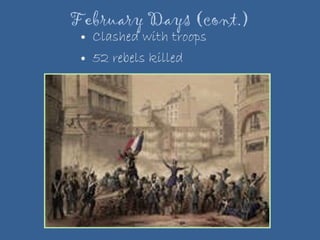
February Days (1848) Gov’t tried to stop public meetings Angry crowds sang  La Marseillaise  & built blockades out of: Iron rails Overturned carts Paving stones Toppled trees
February Days (cont.) Clashed with troops 52 rebels killed
Results of February Days Louis Philippe abdicated Liberals, radicals, socialists, claimed the Second Republic of France Currently (since 1958) France is on its Fifth…
A Republic Divided Deep differences Bourgeois liberals  – constitution/political reform Socialists   – social & economic reform Set up national workshops – provided work for unemployed
June Days Bourgeoisie won control of gov’t Got rid of workshops Ticked off the Socialists & workers Workers – “Bread or Lead!”
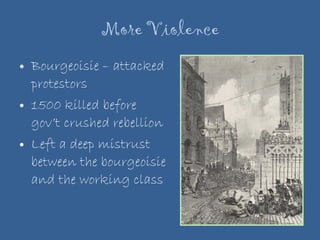
More Violence Bourgeoisie – attacked protestors 1500 killed before gov’t crushed rebellion Left a deep mistrust between the bourgeoisie and the working class
Constitution By end of 1848, National Assembly had created a constitution Strong president Unicameral legislature Universal manhood suffrage
Election Over 9 million could vote (up from 200,000) Elected Louis Napoleon Nephew of Napoleon Bonaparte Appealed to liberals – sympathy for working class Appealed to conservatives – name = restore order
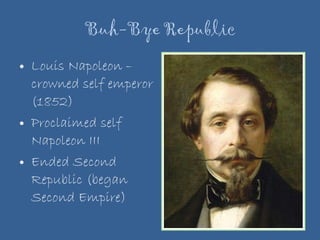
Buh-Bye Republic Louis Napoleon – crowned self emperor (1852) Proclaimed self Napoleon III Ended Second Republic (began Second Empire)
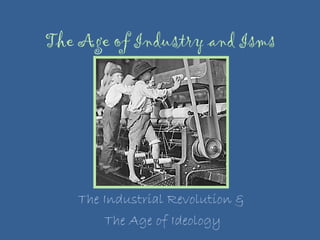
The Age of Industry and Isms The Industrial Revolution &  The Age of Ideology
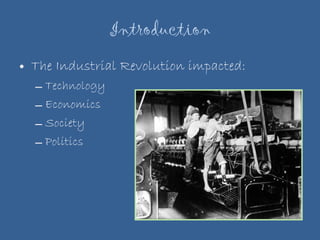
Introduction The Industrial Revolution impacted: Technology Economics Society Politics
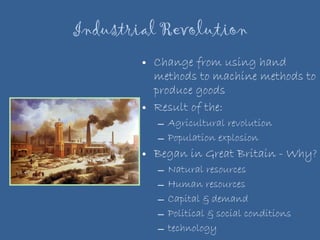
Industrial Revolution Change from using hand methods to machine methods to produce goods Result of the: Agricultural revolution  Population explosion Began in Great Britain - Why? Natural resources Human resources Capital & demand Political & social conditions technology
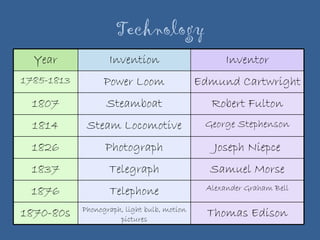
Technology Year Invention Inventor 1785-1813 Power Loom Edmund Cartwright 1807 Steamboat Robert Fulton 1814 Steam Locomotive George Stephenson 1826 Photograph Joseph Niepce 1837 Telegraph Samuel Morse 1876 Telephone Alexander Graham Bell 1870-80s Phonograph, light bulb, motion pictures Thomas Edison
Laissez-Faire Economics Adam Smith Free market $  more goods at lower price $  no government involved Capitalism = driving force of the industrial age
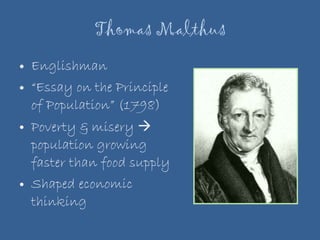
Thomas Malthus Englishman “ Essay on the Principle of Population” (1798) Poverty & misery    population growing faster than food supply Shaped economic thinking
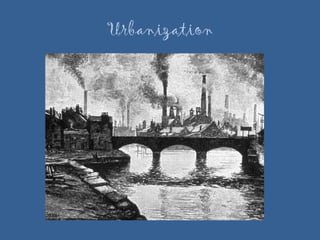
Urbanization
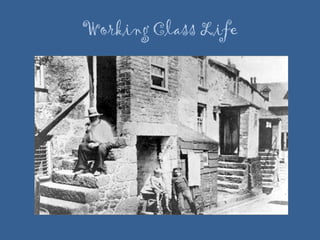
Working Class Life
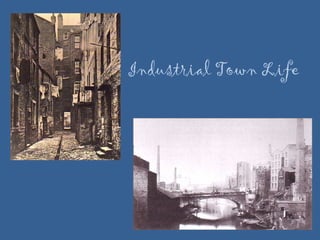
Industrial Town Life
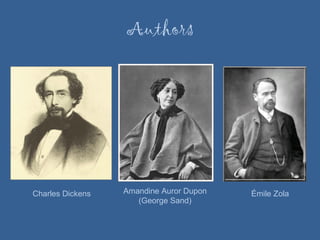
Authors Charles Dickens Amandine Auror Dupon (George Sand) Émile Zola
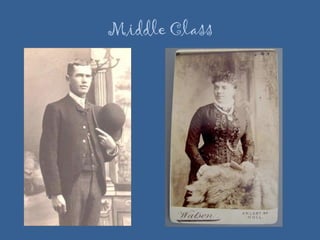
Middle Class
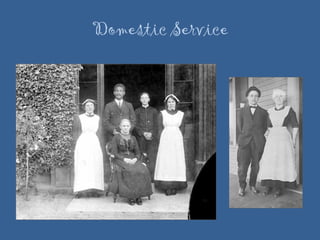
Domestic Service
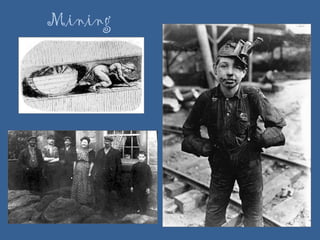
Mining
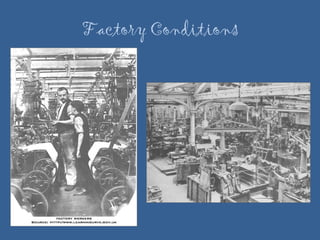
Factory Conditions
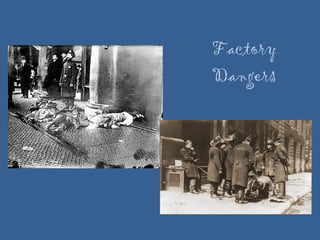
Factory Dangers
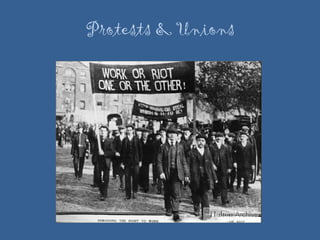
Protests & Unions
Child Labor


Workhouses


19 th  Century Isms
Impact of Industrial Revolution Social concerns    social reform 19 th  Century = new ways of Thinking Believing Looking at the world
19 th  Century “Isms” “ ism” = belief or ideology Ideology:  a coherent set of beliefs about the way the social and political order should be organized 2 basic ways to define any ideology: What does it oppose? What does it advocate?
Nationalism All people derive their identities from their nations, which are defined by: Common language Shared cultural traditions & history Religion (sometimes)
Nationalism: Western Europe Spokespeople:  Hegel, Mazzini Members:  Entire countries of France, England, Spain, Italy, and parts of Germany Gov’t:  Used national pride to unify & get citizens to do things (war, colonies, etc)
Nationalism: Western Europe Advocated: Cultural nationalism:  had own language, history & culture – wanted to perfect it Political nationalism:  preserve national culture, ensure liberty & justice  for individual
Nationalism: Eastern Europe Spokesperson:  Vuk Karadzic (Serbian Nationalist) & many others COV – lumped different cultures together Advocated:  independence from other empires (Austrian, Ottoman, etc) preservation of own historic culture borders based on culture
Nationalism: Eastern Europe Poland:  undo partitions of Polish territory & reestablish Polish state Magyars:  autonomy of Hungary within Hapsburg Empire Russia:  Pan-Slavism – unite all Slavic people under Russia’s leadership (opposed by many Slavic nations)
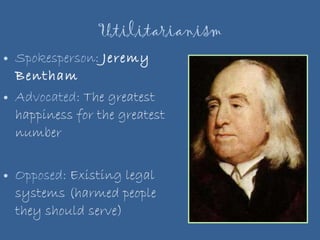
Utilitarianism Spokesperson:  Jeremy Bentham Advocated:  The greatest happiness for the greatest number Opposed:  Existing legal systems (harmed people they should serve)
Radicalism Spokesman:  Jeremy Bentham Members:  working class leaders & industrial capitalists Advocated:  Find a government best for your people Universal manhood suffrage
Radicalism Advocated (cont.): Reform/reconstruct: Criminal & civil law Prison & poor relief Municipal organization & rotten boroughs Opposed: Conservatives
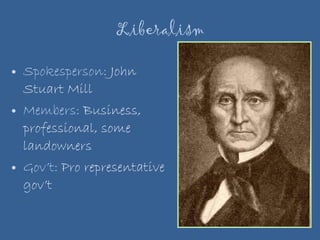
Liberalism Spokesperson:  John Stuart Mill Members:  Business, professional, some landowners Gov’t:  Pro representative gov’t
Liberalism Advocated:  Change through legislation NOT revolution A way for people & gov’t to coexist without Harming majority Stifling individuality Individual rights & freedoms Universal suffrage (late 19 th  C onward)
Liberalism (cont.) Opposed: Use of force to compel citizens to believe something (anti-military) Inequality People not helping society/others Government & church interference  Universal suffrage (feared mob rule) – this changed by late 19 th  C
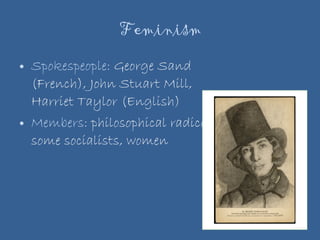
Feminism Spokespeople:  George Sand (French), John Stuart Mill, Harriet Taylor (English) Members:  philosophical radicals, some socialists, women
Feminism: Continental Europe Advocated: Social & economic equality Better education Reform in women’s property & divorce laws NOT fighting for political rights at this time
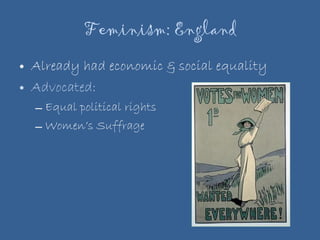
Feminism: England Already had economic & social equality Advocated: Equal political rights Women’s Suffrage
Republicanism Members:  intelligentsia, students, writers, working class, veterans (outgrowth of Jacobins) Gov’t:  Pro Republic Advocated: Political equality Universal male suffrage Reform by violence & force (met in secret societies)
Republicanism Opposed: Monarchy Constitutional monarchy Aristocracy  Catholic Church Liberals Please note: this is NOT referring to the US political party or their beliefs
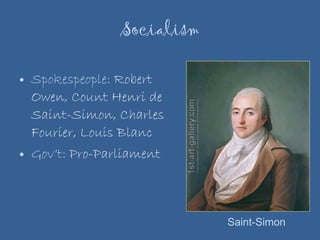
Socialism Spokespeople:  Robert Owen, Count Henri de Saint-Simon, Charles Fourier, Louis Blanc Gov’t:  Pro-Parliament Saint-Simon
Socialism  Advocated  Economic equality Equal distribution of income (useful members) Social equality & harmony through communities based on cooperation Communal ownership of assets
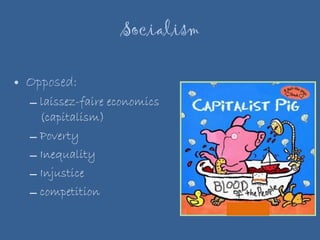
Socialism Opposed: laissez-faire economics (capitalism)  Poverty  Inequality Injustice  competition
Utopian Socialism Built self-sufficient communities All shared workload Common property If gap between rich & poor disappeared, fighting would cease All live as peaceful, happy family – a “Utopia”
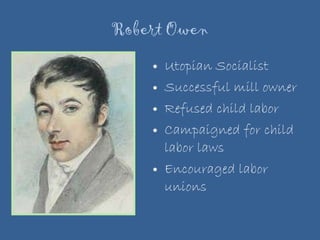
Robert Owen Utopian Socialist Successful mill owner Refused child labor Campaigned for child labor laws Encouraged labor unions
Owen’s Utopia Believed that living conditions shaped people’s character New Lanark, Scotland factory – model Built homes Opened a school Treated employees well Point: one could still make money while providing decent conditions for workers
Conservativism Spokespeople:  Edmund Burke, Von Metternich Gov’t:  monarchy Advocated: Monarchy Catholic Church Aristocracy Status quo Opposed: Liberals Radicals Republicans Rapid change
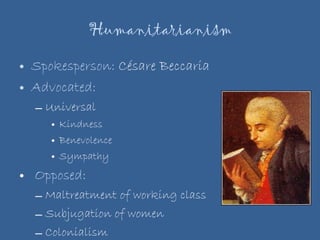
Humanitarianism Spokesperson:  Césare Beccaria Advocated: Universal  Kindness Benevolence Sympathy Opposed: Maltreatment of working class Subjugation of women Colonialism
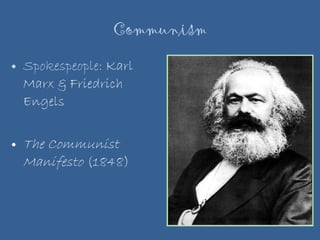
Communism Spokespeople:  Karl Marx & Friedrich Engels The Communist Manifesto  (1848)
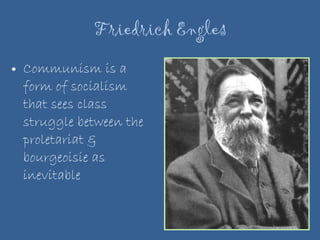
Friedrich Engles Communism is a form of socialism that sees class struggle between the proletariat & bourgeoisie as inevitable
Marxism Heavily influenced by Hegel & his dialectical method Work with your partner to diagram the Hegelian Dialectic (1 MINUTE)
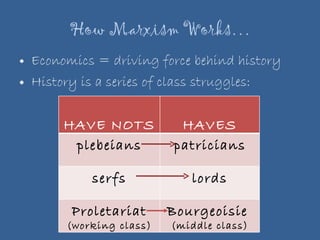
How Marxism Works… Economics = driving force behind history History is a series of class struggles: HAVE NOTS HAVES plebeians patricians serfs lords Proletariat (working class) Bourgeoisie  (middle class)
End of History Marx theorized that history would end with communism Why?
End of History Communism would end the struggles of the past because wealth and power would be equally shared
Weakness & Impact Claimed to be based on “scientific law” Predicted worldwide misery & revolution (was wrong) Not popular in 1848, but would have major impact Influenced many governments & is active today
Interpreting Marx “  The Communists  disdain to conceal their views and aims. They openly declare that their ends can be attained only by the forcible overthrow of all existing social conditions. Let the ruling classes tremble at a Communist revolution. The proletarians have nothing to lose but their chains. They have a world to win. Workingmen of all countries, unite!” Karl Marx, Communist Manifesto
AP Long 19th Century

  • 1.
    The Long 19th Century An Age of Revolution, Industry, & “Isms”
  • 2.
    Bell Ringer Whathappened to Napoleon Bonaparte in 1812? Discuss with partner - 30 seconds
  • 3.
    The Congress ofVienna Europe After Napoleon Bonaparte
  • 4.
    Congress of Vienna WHAT: The Congress of Vienna WHEN: September 1814 to June 1815 WHO: representatives of major European powers WHERE: Vienna, Austria WHY: reorganize Europe post-Napoleon
  • 5.
    Congress of ViennaFive Great European Powers: Prussia – Frederick Wilhelm III Russia – Tsar Alexander Austria – Klemens von Metternich Great Britain – Lord Castleraugh France - Tallyrand
  • 6.
    Klemens von MetternichInfluential Austrian prince Distrusted democracy Plan to restore Europe
  • 7.
    Von Metternich’s Plan3 Main Goals: Legitimacy Napoleon had overthrown all kings & replaced with his family members Original monarchies restored Louis XVIII of France
  • 8.
    Von Metternich’s Plan2. Contain France Napoleon was power hungry & had instilled strong sense of nationalism in France Many surrounding countries felt threatened VM, gave back power to countries surrounding France (containment)
  • 9.
  • 10.
    Von Metternich’s Plan3. Balance of Power Weaken France, but not too much No one country too powerful This ensured no one country could easily overpower another (like Napoleon had done)
  • 11.
    Carlsbad Decrees Responseto nationalist student society ( Burschenschaften ) Society led by Friedrich Jahn: Nationalist (wanted unified Germany) Racist (wanted racially pure German nation) Xenophobic (anti-foreigner) Metternich issued to dissolve such societies & censor press (incorrectly doubted their motives)
  • 12.
    More Challenges 1820sfull of rebellions that challenged COV Spain, Portugal & Italy demanded constitutional gov’ts Von Metternich urged conservatives to crush them Slowed things down, but did not stop them By mid 1800s, the socialists of the Industrial Revolution were pushing workers to rebel
  • 13.
  • 14.
    Political Revolts inthe 1820’s Spain Italy Russia Greece
  • 15.
    Spain Ferdinand VII(r. 1814-1833) Restored pre-Revolutionary nobility, church & monarchy Repressive practices Response: Formation of secret societies Revolt Sparked revolts in Italy
  • 16.
    Italy Naples, Piedmont-SardiniaDemanded constitution Too much disagreement Result: emergence of nationalism (fight Austrians for independence) Laid groundwork for Italian unification
  • 17.
    Russia Decembrist Revolt Alexander I died suddenly (1825) Brother Nicholas I (r. 1825-1855) inherited throne
  • 18.
    Few disputed –felt Constantine was rightful heir & would be pro-Constitution Easily suppressed, tried, imprisoned/hard labor  heroes of legend (“Decembrists”)
  • 19.
    Balkans/Greece Wanted independencefrom Ottoman Turks Serbia = successful revolt (independence in 1817) Greece = 1820-21 – massacred Turks; Turks retaliated w/ own massacres against Greeks, sold women into slavery
  • 20.
    Massacre at ChiosEugène Delacroix (1824) A military attack on the inhabitants of Chios by Ottoman forces commenced on 11 April, 1822 and was prosecuted for several months into the summer of the same year. The campaign resulted in the deaths of 20,000 citizens, and the forced deportation into slavery of almost all the surviving 70,0000 inhabitants
  • 21.
    Greece Austria sidedw/ Ottomans Rest of Europe sided w/ Greece Rec’d help from GB, France & Russia 1830: Greece declared independent Significance: nationalism + public opinion = 1 st breach in Metternich’s system
  • 22.
    The French Revolutionsof 1830 & 1848
  • 23.
    Restoration of MonarchyCongress of Vienna restored Louis XVIII (18 th ) Émigrés returned (not happy) Émigré nobles & high clergy wanted Old Regime (ultra-royalists) Faced opposition
  • 24.
    Liberals in FranceWanted for middle class: Suffrage Power in gov’t Republic Decent pay for working class Food for all
  • 25.
    Charles X LouisXVIII – died in 1824 Successor – Charles X (brother) Charles X wanted absolutism Rejected proposed charter (constitution)
  • 26.
    The July Revolution- 1830 July 1830 – Charles X: Suspended legislature Limited right to vote Restricted press Naturally, what happened?
  • 27.
    Response Revoltin Paris Citizens put up barricades Attacked king’s soldiers Within days, rebels controlled Paris Charles abdicated & fled to England
  • 28.
    Republic or Constitutional Monarchy? Radical rebels wanted a republic Moderates wanted a constitutional monarchy Moderates got their way…
  • 29.
    Louis Philippe Chosenas king Cousin of Charles X Young, more liberal-minded Supported the 1789 revolution
  • 30.
    The Citizen KingNickname for Louis Philippe Owed the throne to the French citizens Was “one of them” Got along well Dressed down (frock coat & top hat) Walked the streets Extended suffrage, but…
  • 31.
    Problems Policies favoredthe wealthier bourgeoisie – often at the expense of the working class Extended suffrage to the wealthiest citizens Most people – no suffrage
  • 32.
    Discontent Radicals wentunderground – worked toward Republic Many began to accuse Louis Philippe of corruption Demand for universal suffrage
  • 33.
    Economic Slump By1848: Many factories shut down Poor harvests Unemployment Bread prices soared Sound familiar??
  • 34.
    February Days (1848)Gov’t tried to stop public meetings Angry crowds sang La Marseillaise & built blockades out of: Iron rails Overturned carts Paving stones Toppled trees
  • 35.
    February Days (cont.)Clashed with troops 52 rebels killed
  • 36.
    Results of FebruaryDays Louis Philippe abdicated Liberals, radicals, socialists, claimed the Second Republic of France Currently (since 1958) France is on its Fifth…
  • 37.
    A Republic DividedDeep differences Bourgeois liberals – constitution/political reform Socialists – social & economic reform Set up national workshops – provided work for unemployed
  • 38.
    June Days Bourgeoisiewon control of gov’t Got rid of workshops Ticked off the Socialists & workers Workers – “Bread or Lead!”
  • 39.
    More Violence Bourgeoisie– attacked protestors 1500 killed before gov’t crushed rebellion Left a deep mistrust between the bourgeoisie and the working class
  • 40.
    Constitution By endof 1848, National Assembly had created a constitution Strong president Unicameral legislature Universal manhood suffrage
  • 41.
    Election Over 9million could vote (up from 200,000) Elected Louis Napoleon Nephew of Napoleon Bonaparte Appealed to liberals – sympathy for working class Appealed to conservatives – name = restore order
  • 42.
    Buh-Bye Republic LouisNapoleon – crowned self emperor (1852) Proclaimed self Napoleon III Ended Second Republic (began Second Empire)
  • 43.
    The Age ofIndustry and Isms The Industrial Revolution & The Age of Ideology
  • 44.
    Introduction The IndustrialRevolution impacted: Technology Economics Society Politics
  • 45.
    Industrial Revolution Changefrom using hand methods to machine methods to produce goods Result of the: Agricultural revolution Population explosion Began in Great Britain - Why? Natural resources Human resources Capital & demand Political & social conditions technology
  • 46.
    Technology Year InventionInventor 1785-1813 Power Loom Edmund Cartwright 1807 Steamboat Robert Fulton 1814 Steam Locomotive George Stephenson 1826 Photograph Joseph Niepce 1837 Telegraph Samuel Morse 1876 Telephone Alexander Graham Bell 1870-80s Phonograph, light bulb, motion pictures Thomas Edison
  • 47.
    Laissez-Faire Economics AdamSmith Free market $ more goods at lower price $ no government involved Capitalism = driving force of the industrial age
  • 48.
    Thomas Malthus Englishman“ Essay on the Principle of Population” (1798) Poverty & misery  population growing faster than food supply Shaped economic thinking
  • 49.
  • 50.
  • 51.
  • 52.
    Authors Charles DickensAmandine Auror Dupon (George Sand) Émile Zola
  • 53.
  • 54.
  • 55.
  • 56.
  • 57.
  • 58.
  • 59.
  • 60.
  • 61.
  • 62.
  • 63.
  • 64.
  • 65.
  • 66.
  • 67.
  • 68.
  • 69.
  • 70.
    19 th Century Isms
  • 71.
    Impact of IndustrialRevolution Social concerns  social reform 19 th Century = new ways of Thinking Believing Looking at the world
  • 72.
    19 th Century “Isms” “ ism” = belief or ideology Ideology: a coherent set of beliefs about the way the social and political order should be organized 2 basic ways to define any ideology: What does it oppose? What does it advocate?
  • 73.
    Nationalism All peoplederive their identities from their nations, which are defined by: Common language Shared cultural traditions & history Religion (sometimes)
  • 74.
    Nationalism: Western EuropeSpokespeople: Hegel, Mazzini Members: Entire countries of France, England, Spain, Italy, and parts of Germany Gov’t: Used national pride to unify & get citizens to do things (war, colonies, etc)
  • 75.
    Nationalism: Western EuropeAdvocated: Cultural nationalism: had own language, history & culture – wanted to perfect it Political nationalism: preserve national culture, ensure liberty & justice for individual
  • 76.
    Nationalism: Eastern EuropeSpokesperson: Vuk Karadzic (Serbian Nationalist) & many others COV – lumped different cultures together Advocated: independence from other empires (Austrian, Ottoman, etc) preservation of own historic culture borders based on culture
  • 77.
    Nationalism: Eastern EuropePoland: undo partitions of Polish territory & reestablish Polish state Magyars: autonomy of Hungary within Hapsburg Empire Russia: Pan-Slavism – unite all Slavic people under Russia’s leadership (opposed by many Slavic nations)
  • 78.
    Utilitarianism Spokesperson: Jeremy Bentham Advocated: The greatest happiness for the greatest number Opposed: Existing legal systems (harmed people they should serve)
  • 79.
    Radicalism Spokesman: Jeremy Bentham Members: working class leaders & industrial capitalists Advocated: Find a government best for your people Universal manhood suffrage
  • 80.
    Radicalism Advocated (cont.):Reform/reconstruct: Criminal & civil law Prison & poor relief Municipal organization & rotten boroughs Opposed: Conservatives
  • 81.
    Liberalism Spokesperson: John Stuart Mill Members: Business, professional, some landowners Gov’t: Pro representative gov’t
  • 82.
    Liberalism Advocated: Change through legislation NOT revolution A way for people & gov’t to coexist without Harming majority Stifling individuality Individual rights & freedoms Universal suffrage (late 19 th C onward)
  • 83.
    Liberalism (cont.) Opposed:Use of force to compel citizens to believe something (anti-military) Inequality People not helping society/others Government & church interference Universal suffrage (feared mob rule) – this changed by late 19 th C
  • 84.
    Feminism Spokespeople: George Sand (French), John Stuart Mill, Harriet Taylor (English) Members: philosophical radicals, some socialists, women
  • 85.
    Feminism: Continental EuropeAdvocated: Social & economic equality Better education Reform in women’s property & divorce laws NOT fighting for political rights at this time
  • 86.
    Feminism: England Alreadyhad economic & social equality Advocated: Equal political rights Women’s Suffrage
  • 87.
    Republicanism Members: intelligentsia, students, writers, working class, veterans (outgrowth of Jacobins) Gov’t: Pro Republic Advocated: Political equality Universal male suffrage Reform by violence & force (met in secret societies)
  • 88.
    Republicanism Opposed: MonarchyConstitutional monarchy Aristocracy Catholic Church Liberals Please note: this is NOT referring to the US political party or their beliefs
  • 89.
    Socialism Spokespeople: Robert Owen, Count Henri de Saint-Simon, Charles Fourier, Louis Blanc Gov’t: Pro-Parliament Saint-Simon
  • 90.
    Socialism Advocated Economic equality Equal distribution of income (useful members) Social equality & harmony through communities based on cooperation Communal ownership of assets
  • 91.
    Socialism Opposed: laissez-faireeconomics (capitalism) Poverty Inequality Injustice competition
  • 92.
    Utopian Socialism Builtself-sufficient communities All shared workload Common property If gap between rich & poor disappeared, fighting would cease All live as peaceful, happy family – a “Utopia”
  • 93.
    Robert Owen UtopianSocialist Successful mill owner Refused child labor Campaigned for child labor laws Encouraged labor unions
  • 94.
    Owen’s Utopia Believedthat living conditions shaped people’s character New Lanark, Scotland factory – model Built homes Opened a school Treated employees well Point: one could still make money while providing decent conditions for workers
  • 95.
    Conservativism Spokespeople: Edmund Burke, Von Metternich Gov’t: monarchy Advocated: Monarchy Catholic Church Aristocracy Status quo Opposed: Liberals Radicals Republicans Rapid change
  • 96.
    Humanitarianism Spokesperson: Césare Beccaria Advocated: Universal Kindness Benevolence Sympathy Opposed: Maltreatment of working class Subjugation of women Colonialism
  • 97.
    Communism Spokespeople: Karl Marx & Friedrich Engels The Communist Manifesto (1848)
  • 98.
    Friedrich Engles Communismis a form of socialism that sees class struggle between the proletariat & bourgeoisie as inevitable
  • 99.
    Marxism Heavily influencedby Hegel & his dialectical method Work with your partner to diagram the Hegelian Dialectic (1 MINUTE)
  • 100.
    How Marxism Works…Economics = driving force behind history History is a series of class struggles: HAVE NOTS HAVES plebeians patricians serfs lords Proletariat (working class) Bourgeoisie (middle class)
  • 101.
    End of HistoryMarx theorized that history would end with communism Why?
  • 102.
    End of HistoryCommunism would end the struggles of the past because wealth and power would be equally shared
  • 103.
    Weakness & ImpactClaimed to be based on “scientific law” Predicted worldwide misery & revolution (was wrong) Not popular in 1848, but would have major impact Influenced many governments & is active today
  • 104.
    Interpreting Marx “ The Communists disdain to conceal their views and aims. They openly declare that their ends can be attained only by the forcible overthrow of all existing social conditions. Let the ruling classes tremble at a Communist revolution. The proletarians have nothing to lose but their chains. They have a world to win. Workingmen of all countries, unite!” Karl Marx, Communist Manifesto