Life’s
first
Lesson 2
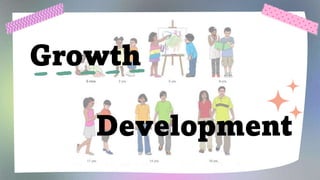
Growth
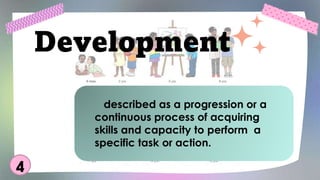
Development
Growth
refers to an increase in the physical
size of an individual. It is
quantitative in nature, it means that
it can be measured.
3
described as a progression or a
continuous process of acquiring
skills and capacity to perform a
specific task or action.
Development
4
Genetics Environment
determine the
physical
appearance of a
person such as
hair and eye color,
body size and
others.
influences the
person as he or
she grows and
develops .
5
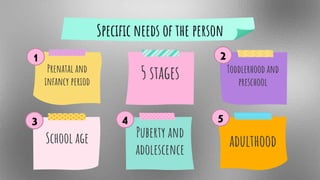
Specific needs of the person
Prenatal and
infancy period
5 stages Toddlerhood and
preschool
School age Puberty and
adolescence
adulthood
1 2
3 4 5
Prenatal and Infancy Period
 fertilization – 1 y.o.
 This is the stage where
there is a spurt of
growth in the body.
The body grows in
length and width as
the organs develop.
Prenatal and Infancy Period (MILESTONES)
 Begins to crawl, sit and stand
with support
 Communicate through crying
 Begins to enjoy playing
 Grasps objects using fingers and
puts them in the mouth
Prenatal and Infancy Period (NEEDS)
• Attention and care to establish emotional
bonds
• Healthy food to support speedy growth
and development of the body
• Discipline to establish value system
• Regular consultation with the doctor
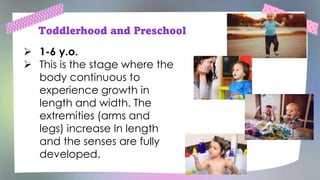
Toddlerhood and Preschool
 1-6 y.o.
 This is the stage where the
body continuous to
experience growth in
length and width. The
extremities (arms and
legs) increase In length
and the senses are fully
developed.
Toddlerhood and Preschool (MILESTONES)
 Walks and runs without support
 Knows how to do self-care
 Better communication skills in terms of
speech
 Begins to write and draw
 Develops interests for sports and other
activities
 Develops sense of independence
 Begins to make relationships with people
and other than family
• Support interests
• Continue to instill discipline to develop values
• Teach health habits to avoid concerns such as
tooth decay and malnutrition
• Teach how to socialize with other people
• Teach safety to avoid injuries while playing
• Consult physician to provide immunization
against common childhood diseases
Toddlerhood and Preschool (NEEDS)
School Age
 6-11 y.o.
 This period is characterized
by slow and steady growth
while development of skills
continue to occur. This is
also the stage where the
child begins to put more
importance in peer
relationships.
School Age (MILESTONES)
 Loses milk teeth and grows permanent
ones
 Develops more sophisticated and flexible
movements
 Develops mature digestive system that
helps in the prevention of food
intolerances
 Develops more sophisticated
communication skills as learned in school
 Begins to develop curiosity about sexuality
School Age (NEEDS)
• Establish health habits to keep body fit
and well
• Establish safety habits avoid injury
• Instill discipline to manage studies
• Keep a partnership with the school to
monitor behavior and performance
Identify the developmental stage for each milestone given
below.
Prenatal and Infancy Toddlerhood and
Preschool
School Age
1. Develops more sophisticated and flexible movements.
2. Begins to make relationship with people other than family.
3. Develops interests for sports.
4. Communicated through crying.
5. Begins to enjoy playing.
6. Loses milk teeth and grows permanent ones.
7. Begins to develop curiosity about sexuality.
8. Begins to write and draw.
9. Grasps objects using fingers.
10. Develops sense of independence.
Specific needs of the person
Prenatal and
infancy period
5 stages Toddlerhood and
preschool
School age Puberty and
adolescence
adulthood
Puberty and Adolescence
 11 – 18 y.o.
Puberty
is the period of rapid growth and
development of secondary sex
characteristics
Puberty and Adolescence
 11 – 18 y.o.
Adolescence
is the period od maturation of the
reproductive system marked by the onset
of females menarche and males
production of sperm.
Puberty and Adolescence
Puberty and Adolescence (Needs)
 Teach safety habits to avoid injuries
 Teach health habits to avoid diseases
 Provide emotional support by listening to
their concerns and providing advices
Adulthood
 Early adulthood : 20 – 40 y.o.
 Middle adulthood : 40 – 60 y.o.
 Late adulthood : 60 y.o.
Adulthood (Milestones : Early adulthood)
Adulthood (Milestones : Middle & Late
adulthood)
Stage Description Milestones Needs
Prenatal
and
Infancy
Period
o 0 – 1 y.o.
o This is the stage
where there is a
spurt of growth in
the body. The
body grows in
length and width
as the organs
develop.
• Begins to crawl,
sit and stand
with support
• Communicate
through crying
• Begins to enjoy
playing
• Grasps objects
using fingers and
puts them in the
mouth
• Attention and care to
establish emotional
bonds
• Healthy food to
support speedy
growth and
development of the
body
• Discipline to
establish value
system
• Regular consultation
with the doctor

Growth & Development

  • 1.
  • 2.
  • 3.
    Growth refers to anincrease in the physical size of an individual. It is quantitative in nature, it means that it can be measured. 3
  • 4.
    described as aprogression or a continuous process of acquiring skills and capacity to perform a specific task or action. Development 4
  • 5.
    Genetics Environment determine the physical appearanceof a person such as hair and eye color, body size and others. influences the person as he or she grows and develops . 5
  • 6.
    Specific needs ofthe person Prenatal and infancy period 5 stages Toddlerhood and preschool School age Puberty and adolescence adulthood 1 2 3 4 5
  • 7.
    Prenatal and InfancyPeriod  fertilization – 1 y.o.  This is the stage where there is a spurt of growth in the body. The body grows in length and width as the organs develop.
  • 8.
    Prenatal and InfancyPeriod (MILESTONES)  Begins to crawl, sit and stand with support  Communicate through crying  Begins to enjoy playing  Grasps objects using fingers and puts them in the mouth
  • 9.
    Prenatal and InfancyPeriod (NEEDS) • Attention and care to establish emotional bonds • Healthy food to support speedy growth and development of the body • Discipline to establish value system • Regular consultation with the doctor
  • 10.
    Toddlerhood and Preschool 1-6 y.o.  This is the stage where the body continuous to experience growth in length and width. The extremities (arms and legs) increase In length and the senses are fully developed.
  • 11.
    Toddlerhood and Preschool(MILESTONES)  Walks and runs without support  Knows how to do self-care  Better communication skills in terms of speech  Begins to write and draw  Develops interests for sports and other activities  Develops sense of independence  Begins to make relationships with people and other than family
  • 12.
    • Support interests •Continue to instill discipline to develop values • Teach health habits to avoid concerns such as tooth decay and malnutrition • Teach how to socialize with other people • Teach safety to avoid injuries while playing • Consult physician to provide immunization against common childhood diseases Toddlerhood and Preschool (NEEDS)
  • 13.
    School Age  6-11y.o.  This period is characterized by slow and steady growth while development of skills continue to occur. This is also the stage where the child begins to put more importance in peer relationships.
  • 14.
    School Age (MILESTONES) Loses milk teeth and grows permanent ones  Develops more sophisticated and flexible movements  Develops mature digestive system that helps in the prevention of food intolerances  Develops more sophisticated communication skills as learned in school  Begins to develop curiosity about sexuality
  • 15.
    School Age (NEEDS) •Establish health habits to keep body fit and well • Establish safety habits avoid injury • Instill discipline to manage studies • Keep a partnership with the school to monitor behavior and performance
  • 16.
    Identify the developmentalstage for each milestone given below. Prenatal and Infancy Toddlerhood and Preschool School Age 1. Develops more sophisticated and flexible movements. 2. Begins to make relationship with people other than family. 3. Develops interests for sports. 4. Communicated through crying. 5. Begins to enjoy playing. 6. Loses milk teeth and grows permanent ones. 7. Begins to develop curiosity about sexuality. 8. Begins to write and draw. 9. Grasps objects using fingers. 10. Develops sense of independence.
  • 17.
    Specific needs ofthe person Prenatal and infancy period 5 stages Toddlerhood and preschool School age Puberty and adolescence adulthood
  • 18.
    Puberty and Adolescence 11 – 18 y.o. Puberty is the period of rapid growth and development of secondary sex characteristics
  • 19.
    Puberty and Adolescence 11 – 18 y.o. Adolescence is the period od maturation of the reproductive system marked by the onset of females menarche and males production of sperm.
  • 20.
  • 21.
    Puberty and Adolescence(Needs)  Teach safety habits to avoid injuries  Teach health habits to avoid diseases  Provide emotional support by listening to their concerns and providing advices
  • 22.
    Adulthood  Early adulthood: 20 – 40 y.o.  Middle adulthood : 40 – 60 y.o.  Late adulthood : 60 y.o.
  • 23.
    Adulthood (Milestones :Early adulthood)
  • 24.
    Adulthood (Milestones :Middle & Late adulthood)
  • 25.
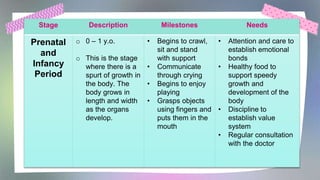
    Stage Description MilestonesNeeds Prenatal and Infancy Period o 0 – 1 y.o. o This is the stage where there is a spurt of growth in the body. The body grows in length and width as the organs develop. • Begins to crawl, sit and stand with support • Communicate through crying • Begins to enjoy playing • Grasps objects using fingers and puts them in the mouth • Attention and care to establish emotional bonds • Healthy food to support speedy growth and development of the body • Discipline to establish value system • Regular consultation with the doctor

Editor's Notes

  • #2 Growth and development are two health concepts that holistically describe the life of an individual. In here you will learn about different growth and development milestones that every individual experiences at different rates and time.
  • #3 People often recognize growth and development as having the same meaning. They may occur at the same time but g and d have different characteristics.
  • #4 For ex. A person experiences growth if he became two inches taller from standing at 5 feet. Growth is also evident when an individual gains weight as measure in pounds or kg.
  • #5 It occurs as a Result of a person's ability to model what he or she experiences in the environment . it is qualitative and may not be described in numbers unlike in growth it is being described in numbers or it is quantitative. for example a child experience says development in speech when he or she begins to speak words fluently from baby talking .development also occurs when a person acquires skills in dancing sports and others .
  • #6 There are two factors that influence the growth and development of a person these are genetics and environment . genetics determine the physical appearance of a person such as hair and eye color body size and others on the other hand environment influences the person as he or she grows and develops .
  • #7 To gain a better understanding of growth and development among individuals it is important to study significant phases in the life of a person. these phases or stages describe how growth and development is experienced by each person .we have here the following diagram shows the phases of growth and development .
  • #10 As one person grows and develops he or she needs support from the people around him or her and from the environment where he or she lives .
  • #14 This period is characterized by slow and steady growth while development of skills continue to occur. This is also the stage where the child begins to put more importance in peer relationships. Loses milkteeth and grows permanent ones Develops more sophisticated and flexible movements Develops mature digestive system that helps in the prevention of food intolerances Develops more sophisticated communication skills as learned in school Begins to develop curiosity about sexuality
  • #17  School age Toddler Toddler Prenatal Prenatal School age School age Toddler Prenatal toddler
  • #19 What is the difference between the two . Just remember that puberty occurs before adolescence. Examples of puberty are growth of body hair, enlargement of breasts, deepening of voice, broadening of shoulders, Puberty ends when adolescence begins.
  • #20 What is the difference between the two . Just remember that puberty occurs before adolescence. Examples of puberty are growth of body hair, enlargement of breasts, deepening of voice, broadening of shoulders, Puberty ends when adolescence begins. Menarche (first menstruation). The maturation of the reproductive system is cause by hormones which bring changes in the body.
  • #21 Milestones May exhibit clumsiness because of not being able to control movement due to rapid growth Develops sexual feelings towards others Develops own sexuality Demands privacy and independence Carries responsibilities seriously Develops more logical and abstract thinking Develops own set of values and morals
  • #23 This period covers the rest of the life’s years after adolescence. It is often described by further dividing into early, middle and late adulthood.
  • #24 Fully develops body systems Completes physical growth in terms of height May begin to build own family and bear children Manages own resources May live independently and away from the family Reaches peak of physical efficiency and movement Establishes career and identity
  • #25 E
  • #26 This is the stage where the body continuous to experience growth in length and width. The extremities (arms an d legs) increase In length and the senses are fully developed.