Nomenclature
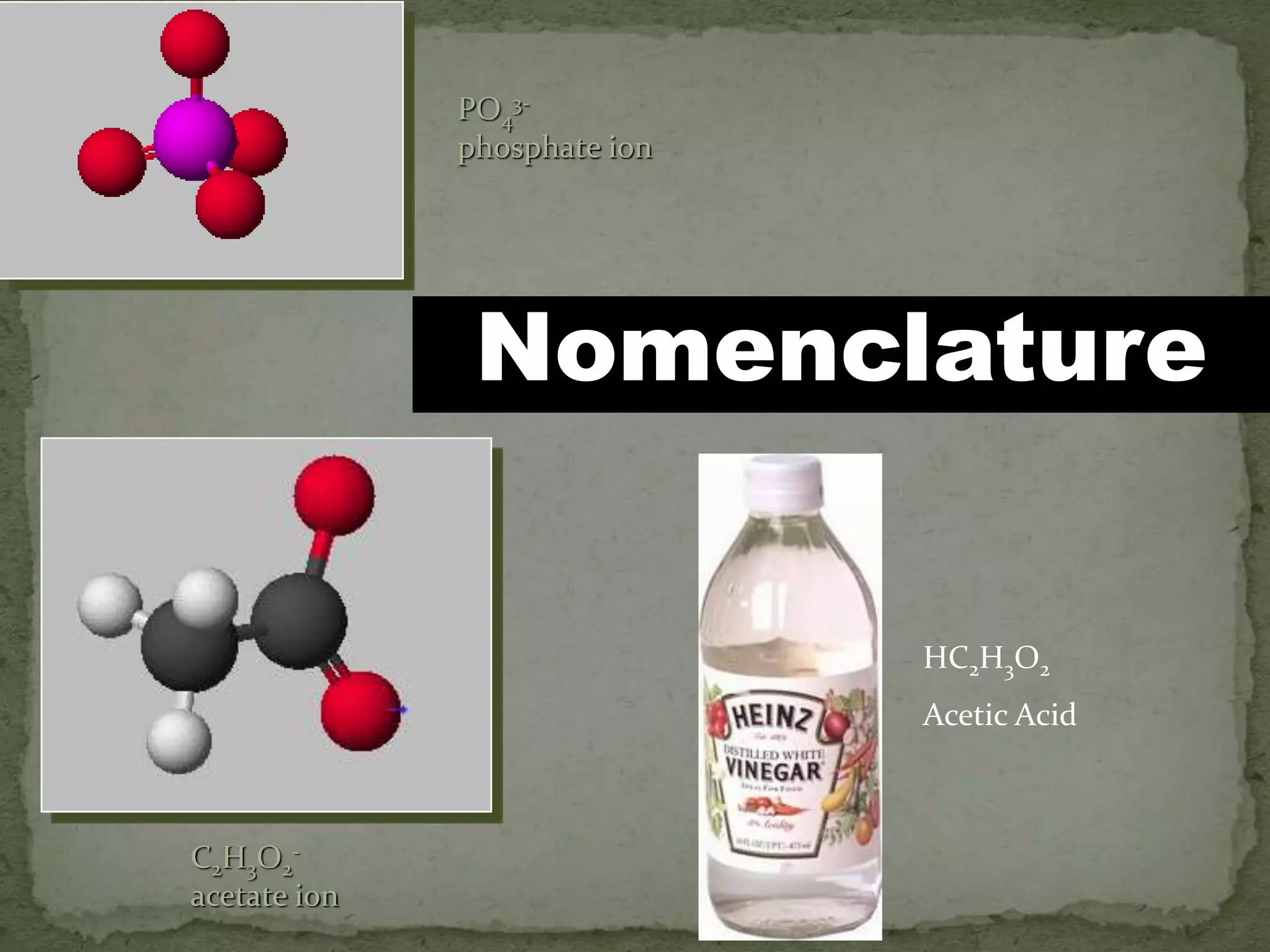
PO4
3-
phosphate ion
C2H3O2
-
acetate ion
HC2H3O2
Acetic Acid
 There are 3 forms bonding atoms:
 Ionic—complete transfer of 1 or more
electrons from one atom to another (one
loses, the other gains)
 Covalent—some valence electrons
shared between atoms
 _________ – holds atoms of a metal
together
 A lot of chemicals have common
names as well as the proper IUPAC
name.
 Chemicals that should always be
named by common name and
never named by the IUPAC
method are:
 H2O water, not dihydrogen
monoxide
 NH3 ammonia, not nitrogen
trihydride
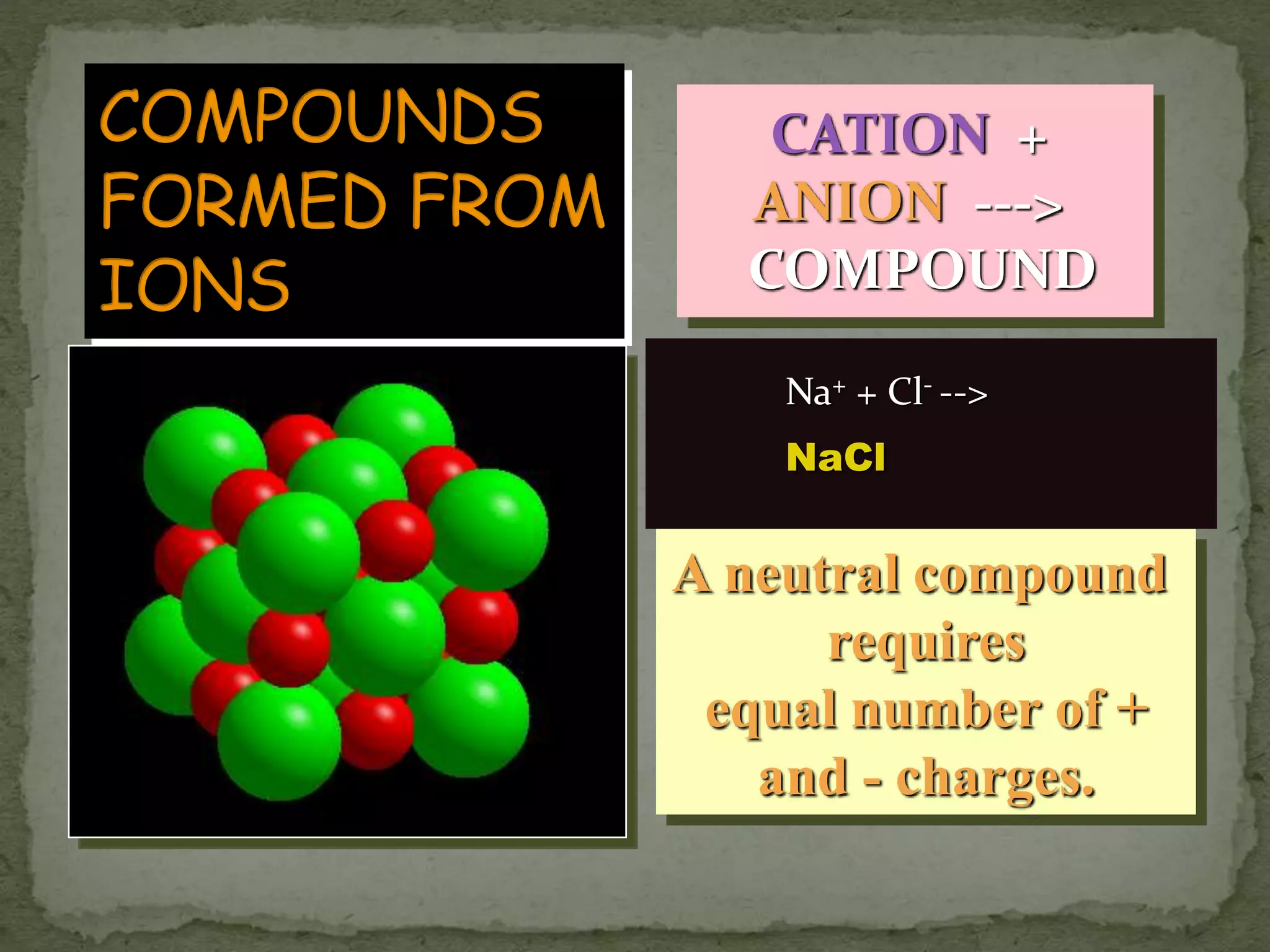
CATION +
ANION --->
COMPOUND
A neutral compound
requires
equal number of +
and - charges.
Na+ + Cl- -->
NaCl
Predicting Charges on Monatomic Ions
KNOW THESE !!!!
+1 +2 -3 -2 -1 0
Cd+2
 A metal atom can transfer
an electron to a nonmetal.
 The resulting cation and
anion are attracted to each
other by electrostatic
forces.
NH4
+
Cl-
ammonium chloride, NH4Cl
Mg2+ + N-3 ---->
Mg3N2
magnesium nitride
Sn4+ + O2- ---->
SnO2
Tin (IV) oxide
calcium fluoride
Ca2+ + 2 F- ---> CaF2
Formulas of ionic compounds are determined
from the charges on the ions
atoms ions
    –
Na  +  F :  Na+ : F :  NaF
   
sodium + fluorine sodium fluoride formula
Charge balance: 1+ 1- = 0
Write the formula for the ionic compound that
will form between Ba2+ and Cl.
Solution:
1. Balance charge with + and – ions
2. Write the positive ion of metal first, and the
negative ion Ba2+ Cl
Cl
3. Write the number of ions needed as
subscripts BaCl2
Write the correct formula for the
compounds containing the following ions:
1. Na+, S2-
a) NaS b) Na2S c) NaS2
2. Al3+, Cl-
a) AlCl3 b) AlCl c) Al3Cl
3. Mg2+, N3-
a) MgN b) Mg2N3c) Mg3N2
1. Na+, S2-
b) Na2S
2. Al3+, Cl-
a) AlCl3
3. Mg2+, N3-
c) Mg3N2
 1. Cation first, then anion
 2. Monatomic cation = name of the element
 Ca2+ = calcium ion
 3. Monatomic anion = root + -ide
 Cl = chloride
 CaCl2 = calcium chloride
Binary Ionic Compounds:
 Examples:
NaCl
ZnI2
Al2O3
sodium chloride
zinc iodide
aluminum oxide
Complete the names of the following binary
compounds:
Na3N sodium ________________
KBr potassium ________________
Al2O3 aluminum ________________
MgS _________________________
Elements that can have more than one possible
charge MUST have a Roman Numeral to indicate
the charge on the individual ion.
1+ or 2+ 2+ or 3+
Cu+, Cu2+ Fe2+, Fe3+
copper(I) ion iron(II) ion
copper (II) ion iron(III) ion
These elements REQUIRE Roman Numerals
because they can have more than one possible
charge:
anything except Group 1A, 2A, Ag, Zn, Cd, and Al
(You should already know the charges on these!)
Or another way to say it is: Transition metals and the metals in groups 4A and
5A (except Ag, Zn, Cd, and Al) require a Roman Numeral.
FeCl3 (Fe3+) iron (III) chloride
CuCl (Cu+ ) copper (I) chloride
SnF4 (Sn4+) tin (IV) fluoride
PbCl2 (Pb2+) lead (II) chloride
Fe2S3 (Fe3+)iron (III) sulfide
Complete the names of the following binary
compounds with variable metal ions:
FeBr2 iron (_____) bromide
CuCl copper (_____) chloride
SnO2 ___(_____ ) ______________
Fe2O3 ________________________
Hg2S ________________________
NO3
-
nitrate ion
NO2
-
nitrite ion
You can make additional polyatomic
ions by adding a H+ to the ion!
CO3
-2 is carbonate
HCO3
– is hydrogen carbonate
H2PO4
– is dihydrogen phosphate
HSO4
– is hydrogen sulfate
Writing Formulas
 Write each ion, cation first. Don’t show charges in
the final formula.
 Overall charge must equal zero.
 If charges cancel, just write symbols.
 If not, use subscripts to balance charges.
 Use parentheses to show more than one of a
particular polyatomic ion.
 Use Roman numerals indicate the ion’s charge
when needed (stock system)
Sodium Sulfate
Na+ and SO4
-2
Na2SO4
Iron (III) hydroxide
Fe+3 and OH-
Fe(OH)3
Ammonium carbonate
NH4
+ and CO3
–2
(NH4)2CO3
1. aluminum nitrate
a) AlNO3 b) Al(NO)3 c) Al(NO3)3
2. copper(II) nitrate
a) CuNO3 b) Cu(NO3)2 c) Cu2(NO3)
3. Iron (III) hydroxide
a) FeOH b) Fe3OH c) Fe(OH)3
4. Tin(IV) hydroxide
a) Sn(OH)4 b) Sn(OH)2 c) Sn4(OH)
 Contains at least 3 elements
 There MUST be at least one polyatomic ion
(it helps to circle the ions)
 Examples:
NaNO3 Sodium nitrate
K2SO4 Potassium sulfate
Al(HCO3)3Aluminum bicarbonate
or
Aluminum hydrogen carbonate
Match each set with the correct name:
1. Na2CO3 a) magnesium sulfite
MgSO3 b) magnesium sulfate
MgSO4 c) sodium carbonate
2 . Ca(HCO3)2 a) calcium carbonate
CaCO3 b) calcium phosphate
Ca3(PO4)2 c) calcium bicarbonate
Name the following:
1. Na2O
2. CaCO3
3. PbS2
4. Sn3N2
5. Cu3PO4
6. HgF2
Write the formula:
1. Copper (II) chlorate
2. Calcium nitride
3. Aluminum carbonate
4. Potassium bromide
5. Barium fluoride
6. Cesium hydroxide
CH4 methane
BCl3
boron trichloride
CO2 Carbon dioxide
All are
formed from
two or more
nonmetals.
Ionic
compounds
generally
involve a metal
and nonmetal
(NaCl)
Prefix System (binary compounds)
1. Less electronegative atom
comes first.
2. Add prefixes to indicate # of atoms.
Omit mono- prefix on the FIRST
element. Mono- is OPTIONAL on the
SECOND element (in this class, it’s
NOT optional!).
3. Change the ending of the
second element to -ide.
PREFIX
mono-
di-
tri-
tetra-
penta-
hexa-
hepta-
octa-
nona-
deca-
NUMBER
1
2
3
4
5
6
7
8
9
10
• CCl4
• N2O
• SF6
• carbon tetrachloride
• dinitrogen monoxide
• sulfur hexafluoride
• arsenic trichloride
• dinitrogen pentoxide
• tetraphosphorus decoxide
• AsCl3
• N2O5
• P4O10
Fill in the blanks to complete the following
names of covalent compounds.
CO carbon ______oxide
CO2 carbon _______________
PCl3 phosphorus _______chloride
CCl4 carbon ________chloride
N2O _____nitrogen _____oxide
1. P2O5 a) phosphorus oxide
b) phosphorus pentoxide
c) diphosphorus pentoxide
2. Cl2O7 a) dichlorine
heptoxide
b) dichlorine oxide
c) chlorine heptoxide
3. Cl2 a) chlorine
b) dichlorine
c) dichloride
Name the following compounds:
1. CaO
a) calcium oxide b) calcium(I) oxide
c) calcium (II) oxide
2. SnCl4
a) tin tetrachloride b) tin(II) chloride
c) tin(IV) chloride
3. N2O3
a) nitrogen oxide b) dinitrogen trioxide
c) nitrogen trioxide
Name the following compounds:
1. CaO
2. SnCl4
3. N2O3
a) calcium oxide
c) tin(IV) chloride
b) Dinitrogen trioxide
1. Dinitrogen monoxide
2. Potassium sulfide
3. Copper (II) nitrate
4. Dichlorine heptoxide
5. Chromium (III) sulfate
6. Iron (III) sulfite
7. Calcium oxide
8. Barium carbonate
9. Iodine monochloride
1. BaI2
2. P4S3
3. Ca(OH)2
4. FeCO3
5. Na2Cr2O7
6. I2O5
7. Cu(ClO4)2
8. CS2
9. B2Cl4
 Acids
Compounds that form H+ in water.
Formulas usually begin with ‘H’.
In order to be an acid instead of a gas,
binary acids must be aqueous
(dissolved in water)
Ternary acids are ALL aqueous
Examples:
HCl (aq) – hydrochloric acid
HNO3 – nitric acid
H2SO4 – sulfuric acid
Anion
Ending Acid Name
-ide hydro-(stem)-ic acid
-ate (stem)-ic acid
-ite (stem)-ous acid
No Oxygen
w/Oxygen
An easy way to remember which goes with which…
“In the cafeteria, you ATE something ICky”
hydro- prefix
-ic ending
2 elements
-ate ending
becomes
-ic ending
-ite ending
becomes
-ous ending
no hydro- prefix
3 elements
ACIDS
start with 'H'
• HBr (aq)
• H2CO3
• H2SO3
• No oxygen, -ide
• Has oxygen, -ate
• Has oxygen, -ite
 hydrobromic acid
 carbonic acid
 sulfurous acid
• hydrofluoric acid
• sulfuric acid
• nitrous acid
• 2 elements
• 3 elements, -ic
• 3 elements, -ous
 HF (aq)
 H2SO4
 HNO2
 H+ F-
 H+ SO4
2-
 H+ NO2
-
HI (aq)
HCl
H2SO3
HNO3
HIO4
 Hydrobromic acid
 Nitrous acid
 Carbonic acid
 Phosphoric acid
 Hydrotelluric acid
Nomenclature Summary Flowchart
 Link on Chemistry Geek.com on Chemistry
I page
 http://chemistrygeek.com/rainbow
Use [ ] to represent subscripts since you can’t
enter subscripts into the computer
So H2O would be H[2]O
And Al2(SO4)3 would be Al[2](SO[4])[3]
Additional Polyatomic Ions (you do not have
to memorize these, but they are in the
game!)
Borate = BO3
-3 ; Silicate = SiO4
-4 ;
Manganate = MnO4
-2 (permanganate is -1)

Compound Naming.pptx

  • 1.
  • 2.
     There are3 forms bonding atoms:  Ionic—complete transfer of 1 or more electrons from one atom to another (one loses, the other gains)  Covalent—some valence electrons shared between atoms  _________ – holds atoms of a metal together
  • 3.
     A lotof chemicals have common names as well as the proper IUPAC name.  Chemicals that should always be named by common name and never named by the IUPAC method are:  H2O water, not dihydrogen monoxide  NH3 ammonia, not nitrogen trihydride
  • 4.
    CATION + ANION ---> COMPOUND Aneutral compound requires equal number of + and - charges. Na+ + Cl- --> NaCl
  • 5.
    Predicting Charges onMonatomic Ions KNOW THESE !!!! +1 +2 -3 -2 -1 0 Cd+2
  • 6.
     A metalatom can transfer an electron to a nonmetal.  The resulting cation and anion are attracted to each other by electrostatic forces.
  • 7.
  • 8.
    Mg2+ + N-3----> Mg3N2 magnesium nitride Sn4+ + O2- ----> SnO2 Tin (IV) oxide calcium fluoride Ca2+ + 2 F- ---> CaF2
  • 9.
    Formulas of ioniccompounds are determined from the charges on the ions atoms ions     – Na  +  F :  Na+ : F :  NaF     sodium + fluorine sodium fluoride formula Charge balance: 1+ 1- = 0
  • 11.
    Write the formulafor the ionic compound that will form between Ba2+ and Cl. Solution: 1. Balance charge with + and – ions 2. Write the positive ion of metal first, and the negative ion Ba2+ Cl Cl 3. Write the number of ions needed as subscripts BaCl2
  • 12.
    Write the correctformula for the compounds containing the following ions: 1. Na+, S2- a) NaS b) Na2S c) NaS2 2. Al3+, Cl- a) AlCl3 b) AlCl c) Al3Cl 3. Mg2+, N3- a) MgN b) Mg2N3c) Mg3N2
  • 13.
    1. Na+, S2- b)Na2S 2. Al3+, Cl- a) AlCl3 3. Mg2+, N3- c) Mg3N2
  • 14.
     1. Cationfirst, then anion  2. Monatomic cation = name of the element  Ca2+ = calcium ion  3. Monatomic anion = root + -ide  Cl = chloride  CaCl2 = calcium chloride Binary Ionic Compounds:
  • 15.
  • 16.
    Complete the namesof the following binary compounds: Na3N sodium ________________ KBr potassium ________________ Al2O3 aluminum ________________ MgS _________________________
  • 17.
    Elements that canhave more than one possible charge MUST have a Roman Numeral to indicate the charge on the individual ion. 1+ or 2+ 2+ or 3+ Cu+, Cu2+ Fe2+, Fe3+ copper(I) ion iron(II) ion copper (II) ion iron(III) ion
  • 18.
    These elements REQUIRERoman Numerals because they can have more than one possible charge: anything except Group 1A, 2A, Ag, Zn, Cd, and Al (You should already know the charges on these!) Or another way to say it is: Transition metals and the metals in groups 4A and 5A (except Ag, Zn, Cd, and Al) require a Roman Numeral. FeCl3 (Fe3+) iron (III) chloride CuCl (Cu+ ) copper (I) chloride SnF4 (Sn4+) tin (IV) fluoride PbCl2 (Pb2+) lead (II) chloride Fe2S3 (Fe3+)iron (III) sulfide
  • 20.
    Complete the namesof the following binary compounds with variable metal ions: FeBr2 iron (_____) bromide CuCl copper (_____) chloride SnO2 ___(_____ ) ______________ Fe2O3 ________________________ Hg2S ________________________
  • 21.
  • 22.
    You can makeadditional polyatomic ions by adding a H+ to the ion! CO3 -2 is carbonate HCO3 – is hydrogen carbonate H2PO4 – is dihydrogen phosphate HSO4 – is hydrogen sulfate
  • 23.
    Writing Formulas  Writeeach ion, cation first. Don’t show charges in the final formula.  Overall charge must equal zero.  If charges cancel, just write symbols.  If not, use subscripts to balance charges.  Use parentheses to show more than one of a particular polyatomic ion.  Use Roman numerals indicate the ion’s charge when needed (stock system)
  • 24.
    Sodium Sulfate Na+ andSO4 -2 Na2SO4 Iron (III) hydroxide Fe+3 and OH- Fe(OH)3 Ammonium carbonate NH4 + and CO3 –2 (NH4)2CO3
  • 25.
    1. aluminum nitrate a)AlNO3 b) Al(NO)3 c) Al(NO3)3 2. copper(II) nitrate a) CuNO3 b) Cu(NO3)2 c) Cu2(NO3) 3. Iron (III) hydroxide a) FeOH b) Fe3OH c) Fe(OH)3 4. Tin(IV) hydroxide a) Sn(OH)4 b) Sn(OH)2 c) Sn4(OH)
  • 26.
     Contains atleast 3 elements  There MUST be at least one polyatomic ion (it helps to circle the ions)  Examples: NaNO3 Sodium nitrate K2SO4 Potassium sulfate Al(HCO3)3Aluminum bicarbonate or Aluminum hydrogen carbonate
  • 27.
    Match each setwith the correct name: 1. Na2CO3 a) magnesium sulfite MgSO3 b) magnesium sulfate MgSO4 c) sodium carbonate 2 . Ca(HCO3)2 a) calcium carbonate CaCO3 b) calcium phosphate Ca3(PO4)2 c) calcium bicarbonate
  • 28.
    Name the following: 1.Na2O 2. CaCO3 3. PbS2 4. Sn3N2 5. Cu3PO4 6. HgF2
  • 29.
    Write the formula: 1.Copper (II) chlorate 2. Calcium nitride 3. Aluminum carbonate 4. Potassium bromide 5. Barium fluoride 6. Cesium hydroxide
  • 30.
    CH4 methane BCl3 boron trichloride CO2Carbon dioxide All are formed from two or more nonmetals. Ionic compounds generally involve a metal and nonmetal (NaCl)
  • 31.
    Prefix System (binarycompounds) 1. Less electronegative atom comes first.
  • 32.
    2. Add prefixesto indicate # of atoms. Omit mono- prefix on the FIRST element. Mono- is OPTIONAL on the SECOND element (in this class, it’s NOT optional!). 3. Change the ending of the second element to -ide.
  • 33.
  • 34.
    • CCl4 • N2O •SF6 • carbon tetrachloride • dinitrogen monoxide • sulfur hexafluoride
  • 35.
    • arsenic trichloride •dinitrogen pentoxide • tetraphosphorus decoxide • AsCl3 • N2O5 • P4O10
  • 36.
    Fill in theblanks to complete the following names of covalent compounds. CO carbon ______oxide CO2 carbon _______________ PCl3 phosphorus _______chloride CCl4 carbon ________chloride N2O _____nitrogen _____oxide
  • 37.
    1. P2O5 a)phosphorus oxide b) phosphorus pentoxide c) diphosphorus pentoxide 2. Cl2O7 a) dichlorine heptoxide b) dichlorine oxide c) chlorine heptoxide 3. Cl2 a) chlorine b) dichlorine c) dichloride
  • 40.
    Name the followingcompounds: 1. CaO a) calcium oxide b) calcium(I) oxide c) calcium (II) oxide 2. SnCl4 a) tin tetrachloride b) tin(II) chloride c) tin(IV) chloride 3. N2O3 a) nitrogen oxide b) dinitrogen trioxide c) nitrogen trioxide
  • 41.
    Name the followingcompounds: 1. CaO 2. SnCl4 3. N2O3 a) calcium oxide c) tin(IV) chloride b) Dinitrogen trioxide
  • 42.
    1. Dinitrogen monoxide 2.Potassium sulfide 3. Copper (II) nitrate 4. Dichlorine heptoxide 5. Chromium (III) sulfate 6. Iron (III) sulfite 7. Calcium oxide 8. Barium carbonate 9. Iodine monochloride
  • 43.
    1. BaI2 2. P4S3 3.Ca(OH)2 4. FeCO3 5. Na2Cr2O7 6. I2O5 7. Cu(ClO4)2 8. CS2 9. B2Cl4
  • 44.
     Acids Compounds thatform H+ in water. Formulas usually begin with ‘H’. In order to be an acid instead of a gas, binary acids must be aqueous (dissolved in water) Ternary acids are ALL aqueous
  • 45.
    Examples: HCl (aq) –hydrochloric acid HNO3 – nitric acid H2SO4 – sulfuric acid
  • 46.
    Anion Ending Acid Name -idehydro-(stem)-ic acid -ate (stem)-ic acid -ite (stem)-ous acid No Oxygen w/Oxygen An easy way to remember which goes with which… “In the cafeteria, you ATE something ICky”
  • 47.
    hydro- prefix -ic ending 2elements -ate ending becomes -ic ending -ite ending becomes -ous ending no hydro- prefix 3 elements ACIDS start with 'H'
  • 48.
    • HBr (aq) •H2CO3 • H2SO3 • No oxygen, -ide • Has oxygen, -ate • Has oxygen, -ite  hydrobromic acid  carbonic acid  sulfurous acid
  • 49.
    • hydrofluoric acid •sulfuric acid • nitrous acid • 2 elements • 3 elements, -ic • 3 elements, -ous  HF (aq)  H2SO4  HNO2  H+ F-  H+ SO4 2-  H+ NO2 -
  • 50.
  • 51.
     Hydrobromic acid Nitrous acid  Carbonic acid  Phosphoric acid  Hydrotelluric acid
  • 52.
  • 54.
     Link onChemistry Geek.com on Chemistry I page  http://chemistrygeek.com/rainbow Use [ ] to represent subscripts since you can’t enter subscripts into the computer So H2O would be H[2]O And Al2(SO4)3 would be Al[2](SO[4])[3] Additional Polyatomic Ions (you do not have to memorize these, but they are in the game!) Borate = BO3 -3 ; Silicate = SiO4 -4 ; Manganate = MnO4 -2 (permanganate is -1)