English
VII
Jeri Mayah “Ayah” P. Asuncion
Teacher
Week 1
Unit 1
Precolonial
Times:
Bridges to the
Past
2
3
Literature
written works, especially
those considered of
superior or lasting artistic
merit.
Examples:
Fiction
Nonfiction
Manuscripts
Poetry
Theses
textbooks
Lesson 1
Timeless Stories:
Mankind’s Quest
for Understanding
Legend
One of the earliest forms of folklore
of most, if not all, cultures.
A narrative that is partly true and
partly imaginary about particular
person, event, place or natural
feature.
5
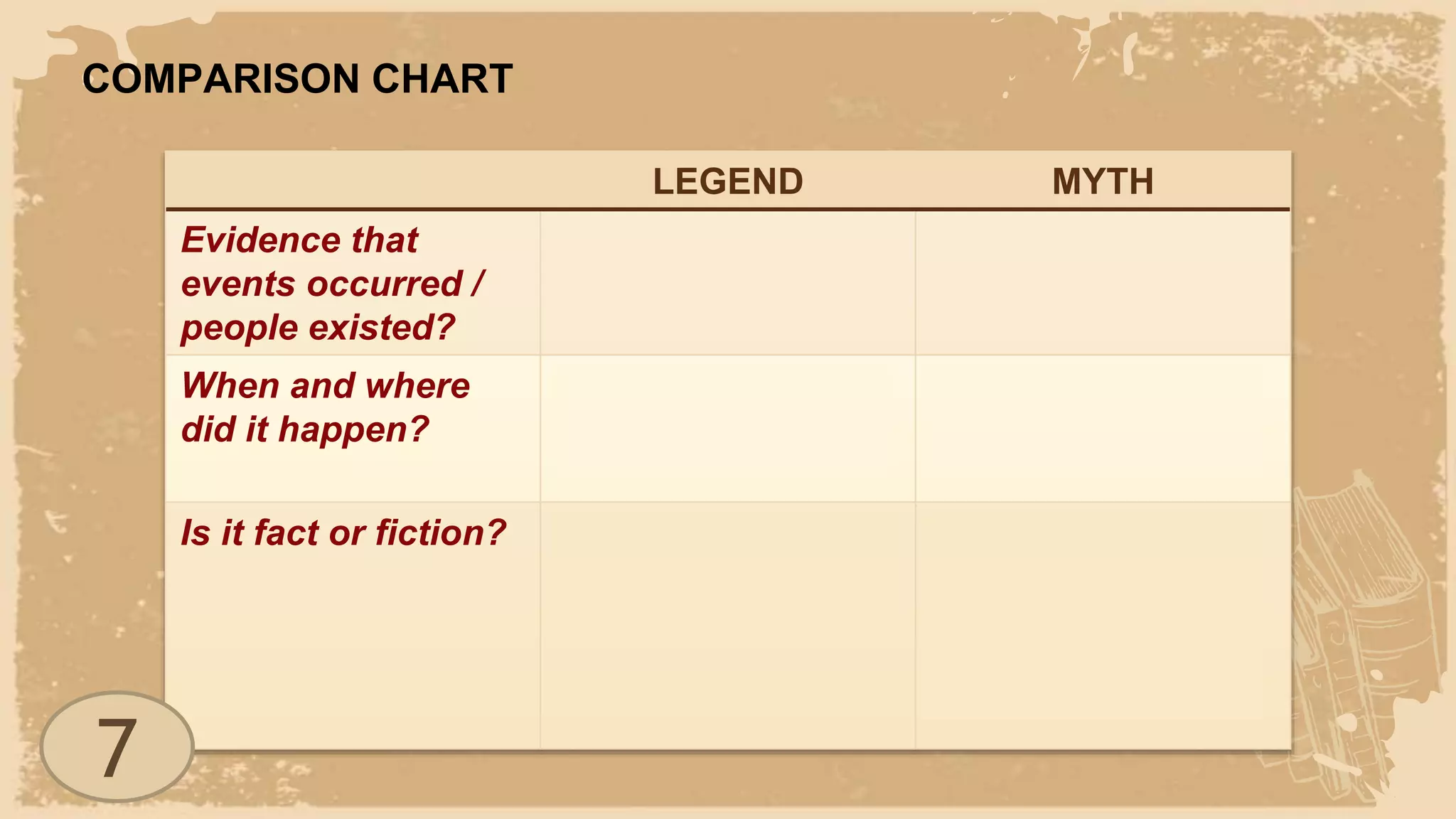
COMPARISON CHART
LEGEND MYTH
Evidence that
events occurred /
people existed?
Yes No
When and where
did it happen?
Typically in more recent
historical past.
Usually the ancient past
from a specific ancient
culture.
Is it fact or fiction? Facts are distorted or
exaggerated. Some fiction.
No evidence to prove it as
fact. Fictional stories
explaining how "the world
was created" or some type
of natural situation that
occurred on Earth.
7
COMPARISON CHART
LEGEND MYTH
Who are they
about?
Notable people from
history.
Gods, supernatural
realm, supernatural
creatures.
What are they
about?
Often about heroic
deeds, overcoming
obstacles, but may also
be about evil doing.
Traditional narrative
that explains natural
phenomena through
symbolism and
metaphor — often
involves the gods of
ancient cultures.
8
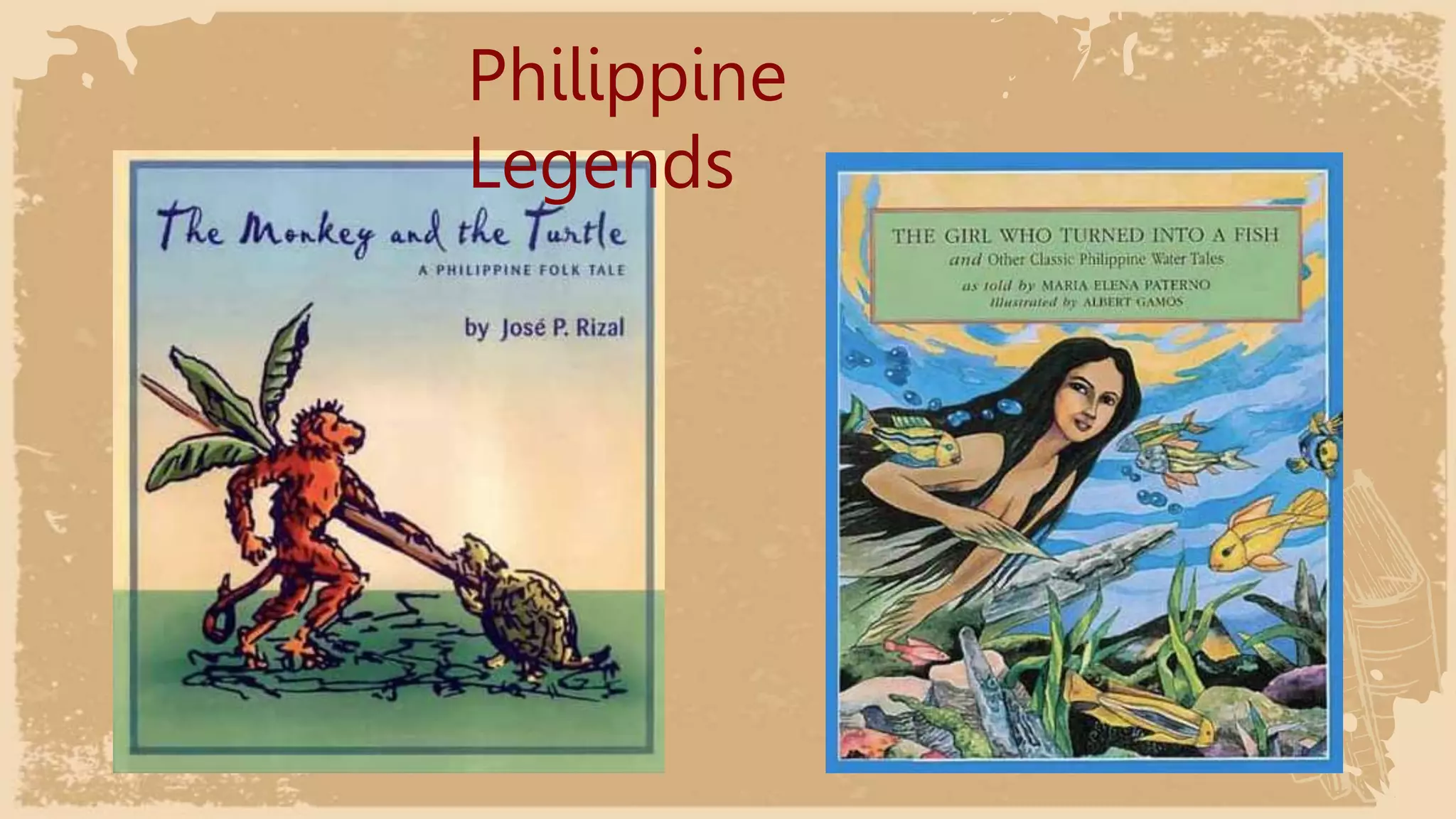
Philippine
Legends
Philippine
Legends
Philippine
Legends
Philippine
Legends
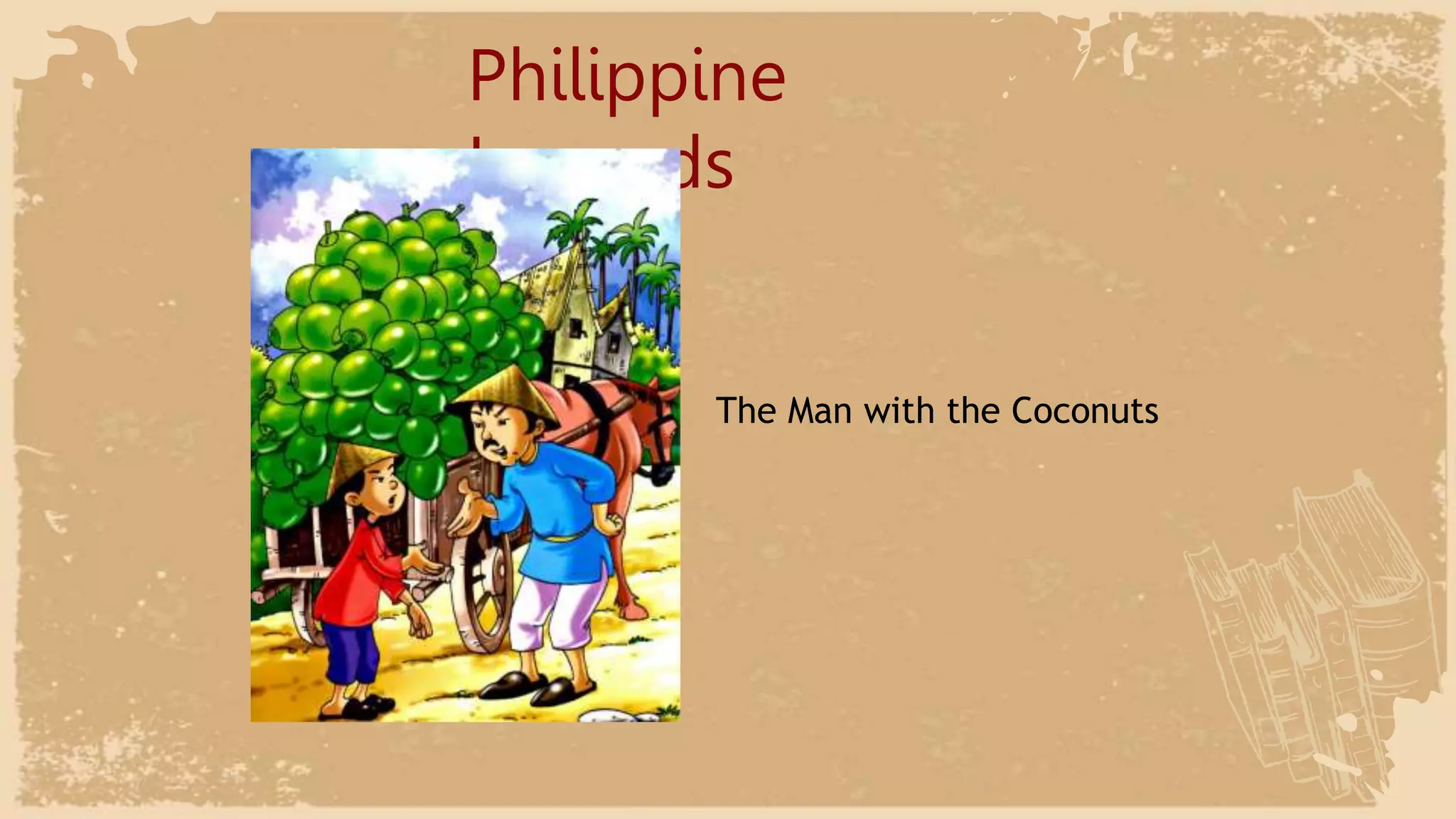
The Man with the Coconuts
Context Clues
 the scheming bird
 decided to don a blue color
 became indignant upon hearing this
 heaved a deep breath
 intentionally pelting the sky 1
Why Does the Philippines Have 7000 Islands?
At a time when there was only a single
great mass of land between the great sky and
an equally great water, a large prehistoric
bird got bored of circling around the same
area for millions of years. It had made several
attempts to fly as far as it could, to discover
what lay beyond the far horizons. However,
the big bird was always forced to go back,
because there was no other land on where he
could rest his tired wings.
One day, the bird came up with a
clever idea. The scheming bird told the water
that the sky was irritated by the way the
water kept on copying the sky’s hue. If it
decided to don a blue color, then water also
became blue; if the sky was clear and white,
the water became clear and neutral too.
The sky hated it the most that the water
imitated even the former’s dark mood, because the
water also turned gray and somewhat murky. Water
of course became indignant upon hearing this; and
it heaved a deep breath to which great amounts of
water rose up in the form of gigantic waves, high
enough to reach the sky and fill its clouds with
water.
They sky was puzzled at the water’s behavior
because it seemed that it was intentionally pelting the
sky. The scheming bird approached the sky and told
the latter that the water was resenting the fact that
the sky often made the decisions on what color they
had to have. Even if water wanted to try other colors,
the sky kept on reflecting itself on the water’s surface.
Sky, of course, was furious upon hearing this
that it let out loud roars of thunder and flashes of
lightning that hit not only water but also the
large mass of land. It drained out all the waters
carried in its clouds while water continued to pelt
huge waves against the sky. All these affected the
great mass of land because it slowly softened
and weakened as sky and water fought against
each other’s might.
Soon enough, the great mass of land started to
break into little pieces much to the delight of the bird.
Sky and water saw what had happened, and as a result,
stopped fighting and tried with all their might to bring
back the pieces of land together. It was too late because
there were about 7000 pieces of land that were too far
away from the main land. The bird of course finally
fulfilled his wash of travelling far and wide beyond the
horizons.
Context Clues
 the scheming bird
 decided to don a blue color
 became indignant upon hearing this
 heaved a deep breath
 intentionally pelting the sky
Answer the following:
1. How does the story explain the changing colors of the ocean?
2. What is the prehistoric bird’s motive in getting the sky and the
water into a quarrel?
3. What realization do the sky and the water have at the end of the
story?
4. What human traits do the bird, the sky and the water exhibit?
5. Is there a way the scheming bird could have foreseen the
outcome of its action? Explain your answer.
Copy and answer the following questions:
1. Who are the characters?
2. Where is the setting of the story?
3. What is the moral lesson that you learn
from reading it?
COMPARISON CHART
LEGEND MYTH
Evidence that
events occurred /
people existed?
Yes, but evidence may be
incorrect or insubstantial
No
When and where
did it happen?
Typically in more recent
historical past. Usually from
a specific culture.
Usually the ancient past
from a specific ancient
culture.
Is it fact or fiction? Facts are distorted or
exaggerated. Some fiction.
No evidence to prove it as
fact. Fictional stories
explaining how "the world
was created" or some type
of natural situation that
occurred on Earth.
COMPARISON CHART
LEGEND MYTH
Who are they
about?
Notable people from
history.
Gods, supernatural
realm, supernatural
creatures.
What are they
about?
Often about heroic
deeds, overcoming
obstacles, but may also
be about evildoing.
Traditional narrative
that explains natural
phenomena through
symbolism and
metaphor — often
involves the gods of
ancient cultures.
Understanding
Sensory Details
Sensory Details
It makes the
description more vivid
in the minds of the
readers. By forming
mental images of
Sensory Details Example
Visual
(appealing to the
sense of sight)
• patches of green in the
dry field
• flickers of light on a
moonless night
Sensory Details Example
Auditory (appealing
to the sense of
hearing)
• hearts pounds loudly in
the quiet room
• beating of drums
echoing faintly from the
distant hills
Sensory Details Example
Olfactory
(appealing to the
sense of smell)
• Scents of cheap perfume
from a nearby local store
• Rising smoke from
burning leaves
Sensory Details Example
Gustatory
(appealing to
the sense of
taste)
• spicy leaves and
herbs
• tasty servings of
organic fibers
Sensory Details Example
Tactile
(appealing to
the sense of
touch)
• rough edges of the
ancient cliffs
• the farmer’s coarse
and withered hands
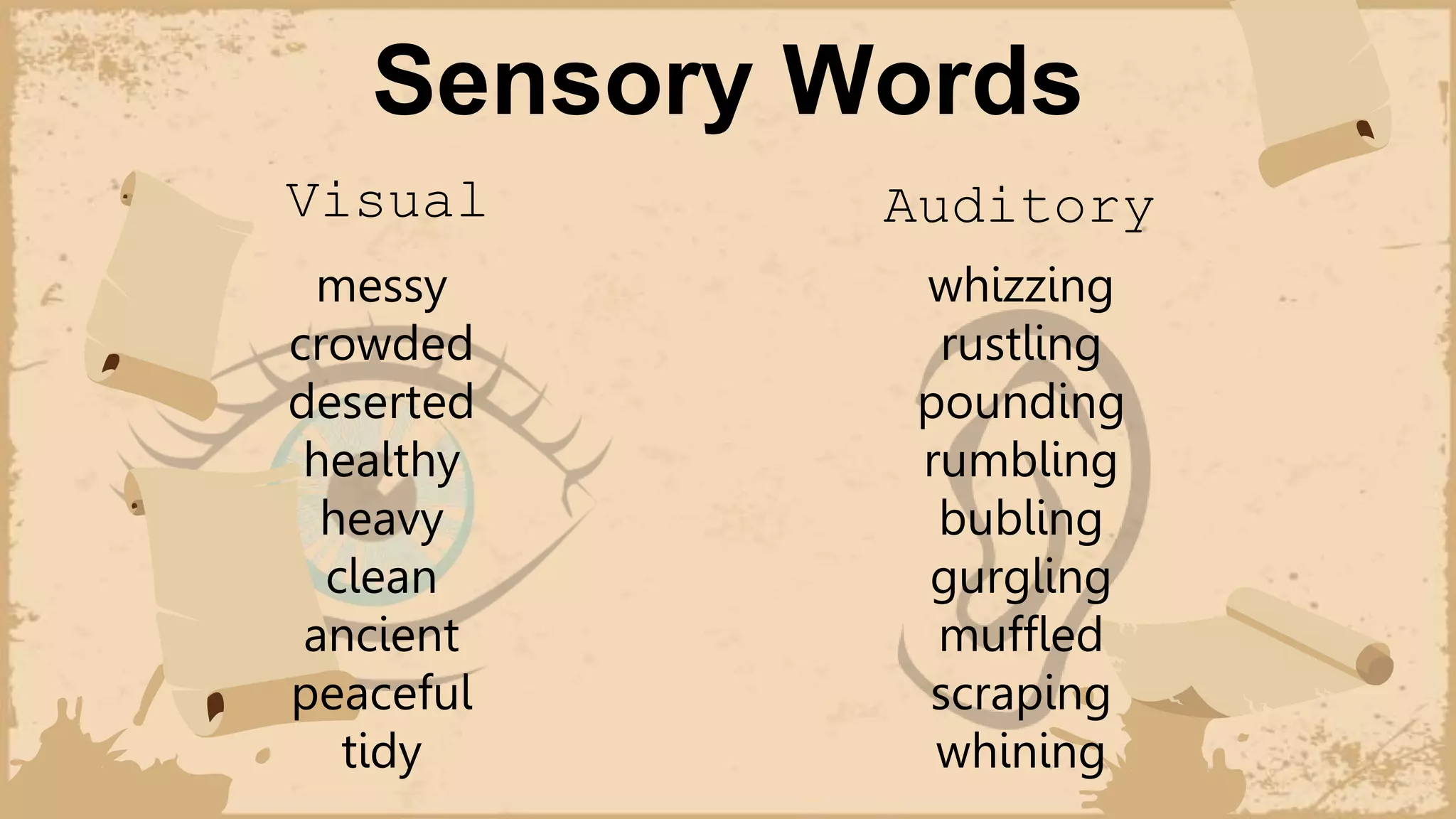
Sensory Words
Visual
messy
crowded
deserted
healthy
heavy
clean
ancient
peaceful
tidy
Auditory
whizzing
rustling
pounding
rumbling
bubling
gurgling
muffled
scraping
whining
Sensory Words
Olfactory
State
Fresh
Mouldy
Burnt
Rotten
Salty
Spicy
Sweaty
slimy
Gustatory
Bitter
Sweet
Sour
Spicy
Salty
Bland
Tangy
Tart
nutty
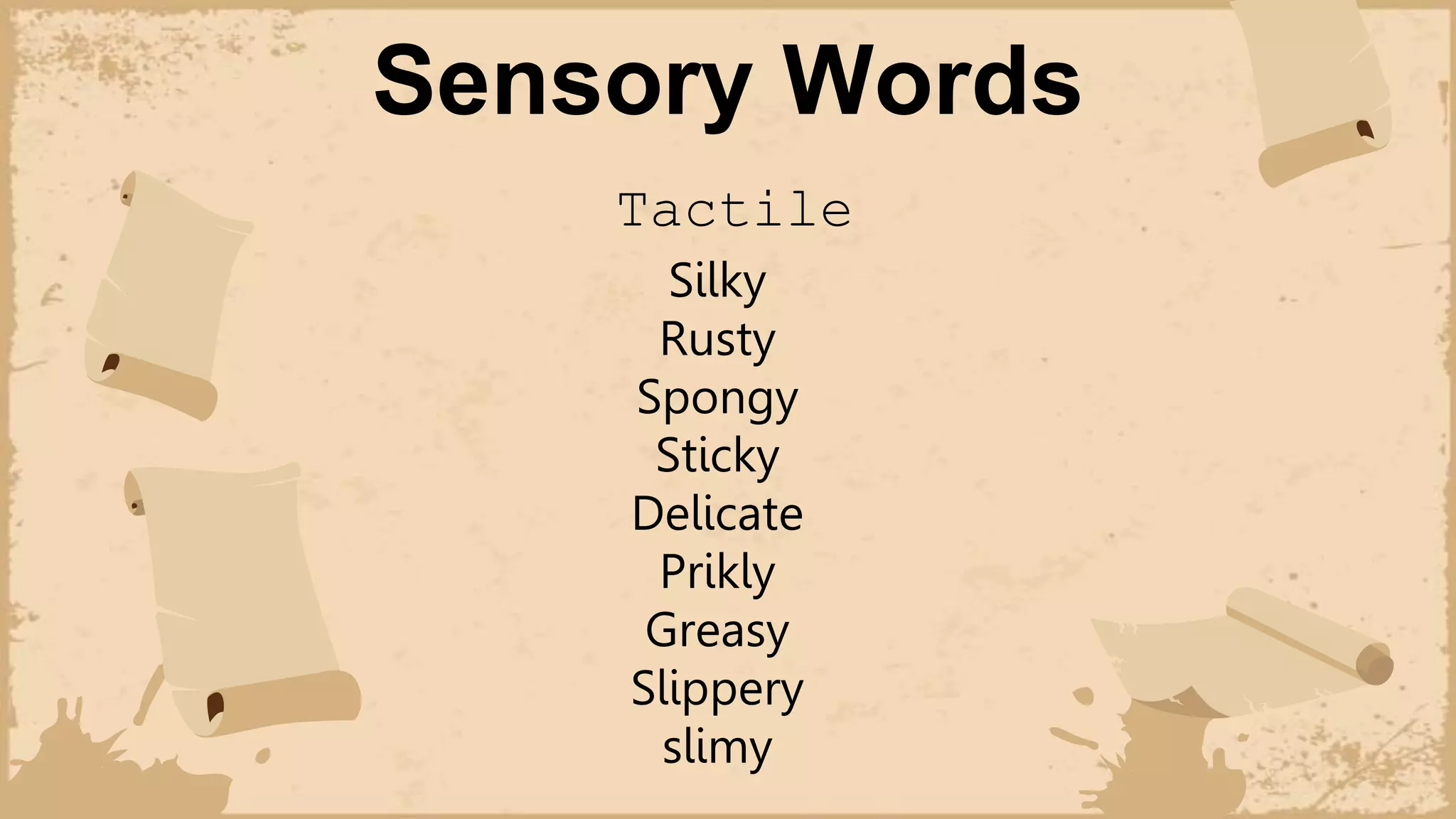
Sensory Words
Tactile
Silky
Rusty
Spongy
Sticky
Delicate
Prikly
Greasy
Slippery
slimy
Sensory Words
Motion
Sparks of flame leap from the burning bushes, rising
toward the sky and swaying fleetingly before
disappearing into space.
crawl
skip
tiptoe
scramble
waddle
run
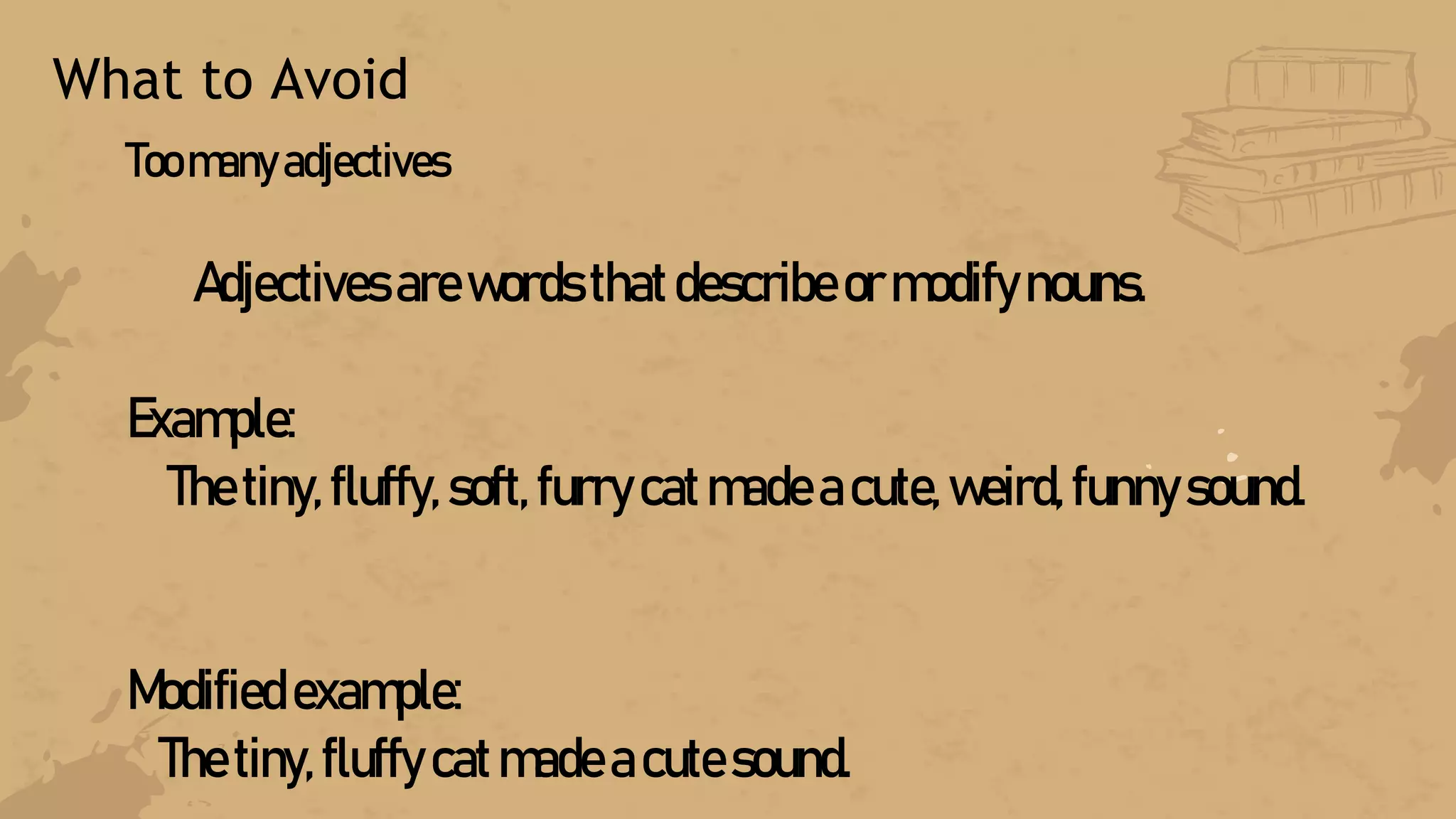
What to Avoid
Toomanyadjectives
Adjectives arewords thatdescribeormodifynouns.
Example:
Thetiny, fluffy, soft, furrycatmadeacute, weird, funnysound.
Modified example:
Thetiny,fluffy catmadeacutesound.
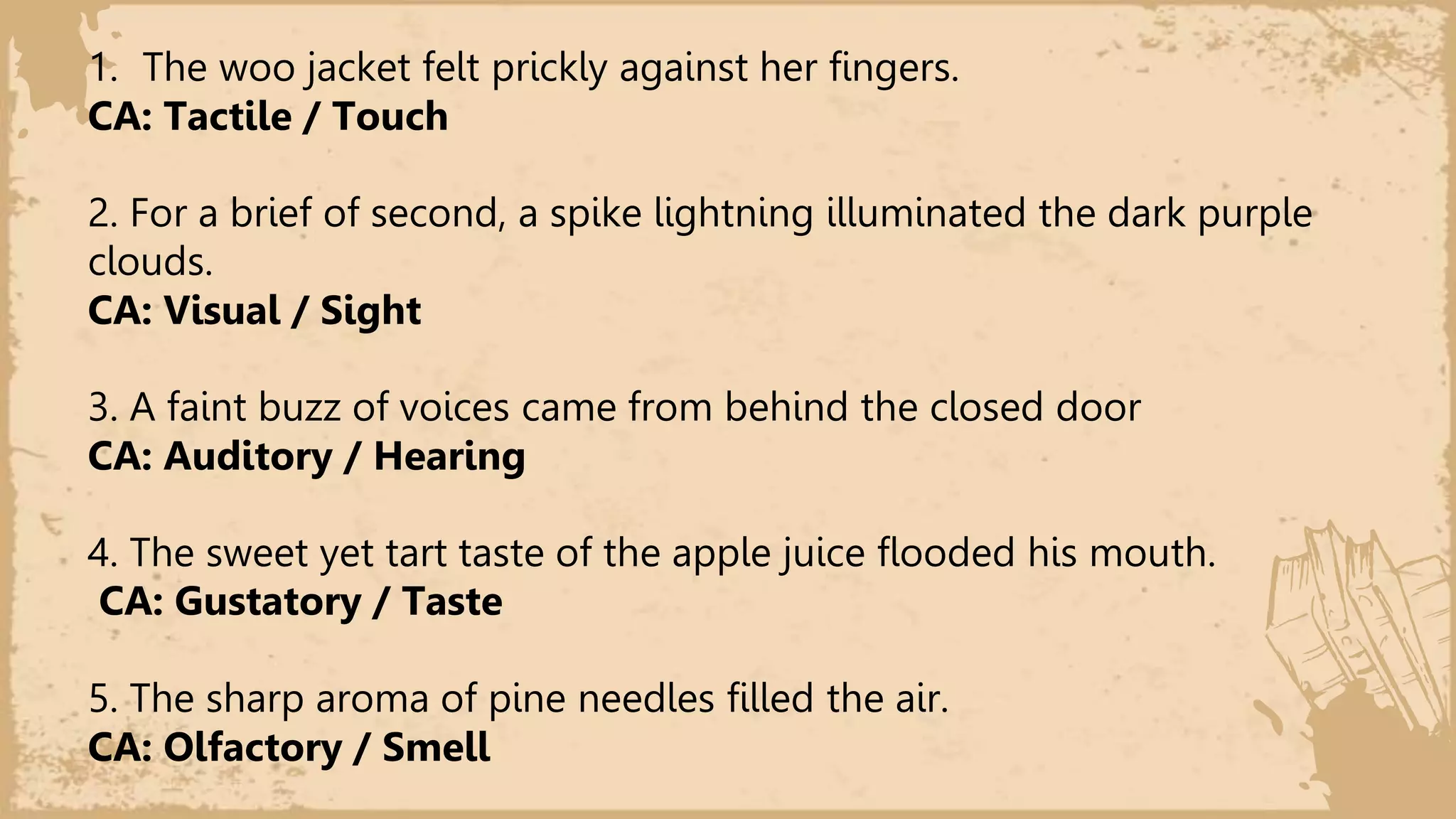
1. The woo jacket felt prickly against her fingers.
CA: Tactile / Touch
2. For a brief of second, a spike lightning illuminated the dark purple
clouds.
CA: Visual / Sight
3. A faint buzz of voices came from behind the closed door
CA: Auditory / Hearing
4. The sweet yet tart taste of the apple juice flooded his mouth.
CA: Gustatory / Taste
5. The sharp aroma of pine needles filled the air.
CA: Olfactory / Smell
1. This desk has a hard smooth surface.
2. The light, flowery scent of my sister’s perfume invaded my nostrils.
3. As I carefully swallowed each delicious morsel, I savored the rich and
creamy chocolate bar.
4. Brightly colored hot air balloons filled the clear sky.
5. The campfire crackled quietly in the night.
1. This desk has a hard smooth surface.
CA: Tactile / Touch
2. The light, flowery scent of my sister’s perfume invaded my nostrils.
CA: Olfactory / Smell
3. As I carefully swallowed each delicious morsel, I savored the rich and
creamy chocolate bar.
CA: Gustatory / Taste
4. Brightly colored hot air balloons filled the clear sky.
CA: Visual / Sight
5. The campfire crackled quietly in the night.
CA: Auditory / Hearing

Legend - Understanding Sensory Details

  • 1.
    English VII Jeri Mayah “Ayah”P. Asuncion Teacher Week 1
  • 2.
  • 3.
    3 Literature written works, especially thoseconsidered of superior or lasting artistic merit. Examples: Fiction Nonfiction Manuscripts Poetry Theses textbooks
  • 4.
  • 5.
    Legend One of theearliest forms of folklore of most, if not all, cultures. A narrative that is partly true and partly imaginary about particular person, event, place or natural feature. 5
  • 7.
    COMPARISON CHART LEGEND MYTH Evidencethat events occurred / people existed? Yes No When and where did it happen? Typically in more recent historical past. Usually the ancient past from a specific ancient culture. Is it fact or fiction? Facts are distorted or exaggerated. Some fiction. No evidence to prove it as fact. Fictional stories explaining how "the world was created" or some type of natural situation that occurred on Earth. 7
  • 8.
    COMPARISON CHART LEGEND MYTH Whoare they about? Notable people from history. Gods, supernatural realm, supernatural creatures. What are they about? Often about heroic deeds, overcoming obstacles, but may also be about evil doing. Traditional narrative that explains natural phenomena through symbolism and metaphor — often involves the gods of ancient cultures. 8
  • 9.
  • 10.
  • 11.
  • 12.
  • 13.
    Context Clues  thescheming bird  decided to don a blue color  became indignant upon hearing this  heaved a deep breath  intentionally pelting the sky 1
  • 14.
    Why Does thePhilippines Have 7000 Islands? At a time when there was only a single great mass of land between the great sky and an equally great water, a large prehistoric bird got bored of circling around the same area for millions of years. It had made several attempts to fly as far as it could, to discover what lay beyond the far horizons. However, the big bird was always forced to go back, because there was no other land on where he could rest his tired wings.
  • 15.
    One day, thebird came up with a clever idea. The scheming bird told the water that the sky was irritated by the way the water kept on copying the sky’s hue. If it decided to don a blue color, then water also became blue; if the sky was clear and white, the water became clear and neutral too.
  • 16.
    The sky hatedit the most that the water imitated even the former’s dark mood, because the water also turned gray and somewhat murky. Water of course became indignant upon hearing this; and it heaved a deep breath to which great amounts of water rose up in the form of gigantic waves, high enough to reach the sky and fill its clouds with water.
  • 17.
    They sky waspuzzled at the water’s behavior because it seemed that it was intentionally pelting the sky. The scheming bird approached the sky and told the latter that the water was resenting the fact that the sky often made the decisions on what color they had to have. Even if water wanted to try other colors, the sky kept on reflecting itself on the water’s surface.
  • 18.
    Sky, of course,was furious upon hearing this that it let out loud roars of thunder and flashes of lightning that hit not only water but also the large mass of land. It drained out all the waters carried in its clouds while water continued to pelt huge waves against the sky. All these affected the great mass of land because it slowly softened and weakened as sky and water fought against each other’s might.
  • 19.
    Soon enough, thegreat mass of land started to break into little pieces much to the delight of the bird. Sky and water saw what had happened, and as a result, stopped fighting and tried with all their might to bring back the pieces of land together. It was too late because there were about 7000 pieces of land that were too far away from the main land. The bird of course finally fulfilled his wash of travelling far and wide beyond the horizons.
  • 20.
    Context Clues  thescheming bird  decided to don a blue color  became indignant upon hearing this  heaved a deep breath  intentionally pelting the sky
  • 21.
    Answer the following: 1.How does the story explain the changing colors of the ocean? 2. What is the prehistoric bird’s motive in getting the sky and the water into a quarrel? 3. What realization do the sky and the water have at the end of the story? 4. What human traits do the bird, the sky and the water exhibit? 5. Is there a way the scheming bird could have foreseen the outcome of its action? Explain your answer.
  • 22.
    Copy and answerthe following questions: 1. Who are the characters? 2. Where is the setting of the story? 3. What is the moral lesson that you learn from reading it?
  • 24.
    COMPARISON CHART LEGEND MYTH Evidencethat events occurred / people existed? Yes, but evidence may be incorrect or insubstantial No When and where did it happen? Typically in more recent historical past. Usually from a specific culture. Usually the ancient past from a specific ancient culture. Is it fact or fiction? Facts are distorted or exaggerated. Some fiction. No evidence to prove it as fact. Fictional stories explaining how "the world was created" or some type of natural situation that occurred on Earth.
  • 25.
    COMPARISON CHART LEGEND MYTH Whoare they about? Notable people from history. Gods, supernatural realm, supernatural creatures. What are they about? Often about heroic deeds, overcoming obstacles, but may also be about evildoing. Traditional narrative that explains natural phenomena through symbolism and metaphor — often involves the gods of ancient cultures.
  • 26.
  • 27.
    Sensory Details It makesthe description more vivid in the minds of the readers. By forming mental images of
  • 28.
    Sensory Details Example Visual (appealingto the sense of sight) • patches of green in the dry field • flickers of light on a moonless night
  • 29.
    Sensory Details Example Auditory(appealing to the sense of hearing) • hearts pounds loudly in the quiet room • beating of drums echoing faintly from the distant hills
  • 30.
    Sensory Details Example Olfactory (appealingto the sense of smell) • Scents of cheap perfume from a nearby local store • Rising smoke from burning leaves
  • 31.
    Sensory Details Example Gustatory (appealingto the sense of taste) • spicy leaves and herbs • tasty servings of organic fibers
  • 32.
    Sensory Details Example Tactile (appealingto the sense of touch) • rough edges of the ancient cliffs • the farmer’s coarse and withered hands
  • 33.
  • 34.
  • 35.
  • 36.
    Sensory Words Motion Sparks offlame leap from the burning bushes, rising toward the sky and swaying fleetingly before disappearing into space. crawl skip tiptoe scramble waddle run
  • 37.
    What to Avoid Toomanyadjectives Adjectivesarewords thatdescribeormodifynouns. Example: Thetiny, fluffy, soft, furrycatmadeacute, weird, funnysound. Modified example: Thetiny,fluffy catmadeacutesound.
  • 38.
    1. The woojacket felt prickly against her fingers. CA: Tactile / Touch 2. For a brief of second, a spike lightning illuminated the dark purple clouds. CA: Visual / Sight 3. A faint buzz of voices came from behind the closed door CA: Auditory / Hearing 4. The sweet yet tart taste of the apple juice flooded his mouth. CA: Gustatory / Taste 5. The sharp aroma of pine needles filled the air. CA: Olfactory / Smell
  • 39.
    1. This deskhas a hard smooth surface. 2. The light, flowery scent of my sister’s perfume invaded my nostrils. 3. As I carefully swallowed each delicious morsel, I savored the rich and creamy chocolate bar. 4. Brightly colored hot air balloons filled the clear sky. 5. The campfire crackled quietly in the night.
  • 40.
    1. This deskhas a hard smooth surface. CA: Tactile / Touch 2. The light, flowery scent of my sister’s perfume invaded my nostrils. CA: Olfactory / Smell 3. As I carefully swallowed each delicious morsel, I savored the rich and creamy chocolate bar. CA: Gustatory / Taste 4. Brightly colored hot air balloons filled the clear sky. CA: Visual / Sight 5. The campfire crackled quietly in the night. CA: Auditory / Hearing

Editor's Notes

  • #3 Before the coming of Spaniards, literature in the Philippines consisted of spoken and orally transmitted genres, mainly legends, myths, proverbs, folk songs and epics. These genres have gone through significant changes that have been passed on to the present. Moving on…
  • #4 … or lasting value.
  • #5 In Lesson 1 we are going to tackle on what a legend is.
  • #6 The Story of pina is an example of what we called LEGEND. When we say legend it’s a genre of folklore that explains the origin of something like a person, a place, or a natural phenomenon. Legends may be transformed over time, in order to keep them fresh and vital.
  • #7 Myth is from europe
  • #8 L - but evidence may be incorrect or insubstantial L - Usually from a specific culture ….. L – FICTION refers to literature created from the imagination
  • #9 L – NOTABLE a famous or important person. …. M – SUPERNATURAL unexplainable by natural law or phenomena
  • #14 So now we are going to read a legend and its title is Why does the Philippines have 70000 Islands? So as we are reading the story we are going to encounter these words. Lets read the meaning of these words for you understand the passage more. Scheming - describes someone who is always doing sneaky things to make things happen Don – to put on Indignant - feeling or showing anger or annoyance at what is perceived as unfair treatment. Heaved – taking a deep breath Intentionally – you are doing it on purpose
  • #21 So now we are going to read a legend and its title is Why does the Philippines have 70000 Islands? So as we are reading the story we are going to encounter these words. Lets read the meaning of these words for you understand the passage more. Scheming - describes someone who is always doing sneaky things to make things happen Don – to put on Indignant - feeling or showing anger or annoyance at what is perceived as unfair treatment. Heaved – taking a deep breath Intentionally – you are doing it on purpose
  • #22 It’s because of the mood of the sky. If it decided to don a blue color, then water also became blue; if the sky was clear and white, the water became clear and neutral too. because there was no other land on where he could rest his tired wings. and as a result, stopped fighting and tried with all their might to bring back the pieces of land together. Selfish, easy to fool
  • #24 That’s the end of our lesson See you next week for another fun day activity! Goodbye!
  • #27 Let move on on understanding How is the use of sensory details in a written text useful to a reader? So lets find out!
  • #28 Sensory details use the five senses (sight, touch, sound, taste, and smell) to add depth of detail to writing. Although sensory details are most commonly used in narratives, they can be incorporated into many types of writing to help your work stand out. Sensory details are powerful and memorable because they allow your reader to see, hear, smell, taste, or feel your words. Now lets study the examples in the following table showing the different kinds of sensory details.
  • #29 When writing a text make sure that the shape, color and appearance is present so that the readers can clearly visualize the text.
  • #30 Look at the words heart pounds and beating of drums, I know that the moment you read it you suddenly heard the sound of a heart pounding at the beat of the drums? Aim I right. That’s how sensory details works
  • #34 Here are some of the examples of Sensory words
  • #38 Retain only the most powerful words in your writing, deleting any unnecessary words All these descriptive terms make it confusing for the reader as to what exactly they are supposed to picture in their heads. Reducing the amount of adjectives used to describe “cat” and “sound” creates a more specific image, concrete image.