REPLICATION
By
Dr. Akhilesh Kumar
Asst. Professor
Himalayan school of Biosciences
Swami Rama Himalayan University Jollygrant
Dehradun
Introduction of Replication
DNA is the genetic material that defines every cell. Before
a cell duplicates and is divided into new daughter cells through
either mitosis or meiosis, biomolecules and organelles must be
copied to be distributed among the cells. DNA, found within
the nucleus, must be replicated in order to ensure that each new
cell receives the correct number of chromosomes. The process of
DNA duplication is called DNA replication. Replication follows
several steps that involve multiple proteins called replication
enzymes and RNA. In eukaryotic cells, such as animal
cells and plant cells, DNA replication occurs in the S phase of
interphase during the cell cycle. The process of DNA replication is
vital for cell growth, repair, and reproduction in organisms.
Replication Is Semi conservative
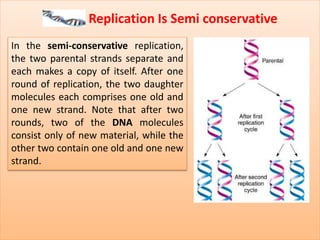
In the semi-conservative replication,
the two parental strands separate and
each makes a copy of itself. After one
round of replication, the two daughter
molecules each comprises one old and
one new strand. Note that after two
rounds, two of the DNA molecules
consist only of new material, while the
other two contain one old and one new
strand.
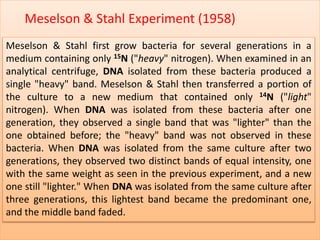
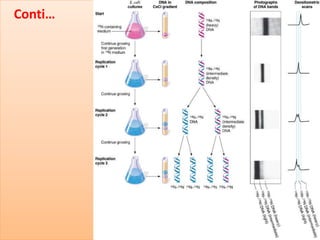
Meselson & Stahl Experiment (1958)
Meselson & Stahl first grow bacteria for several generations in a
medium containing only 15N ("heavy" nitrogen). When examined in an
analytical centrifuge, DNA isolated from these bacteria produced a
single "heavy" band. Meselson & Stahl then transferred a portion of
the culture to a new medium that contained only 14N ("light"
nitrogen). When DNA was isolated from these bacteria after one
generation, they observed a single band that was "lighter" than the
one obtained before; the "heavy" band was not observed in these
bacteria. When DNA was isolated from the same culture after two
generations, they observed two distinct bands of equal intensity, one
with the same weight as seen in the previous experiment, and a new
one still "lighter." When DNA was isolated from the same culture after
three generations, this lightest band became the predominant one,
and the middle band faded.
Conti…
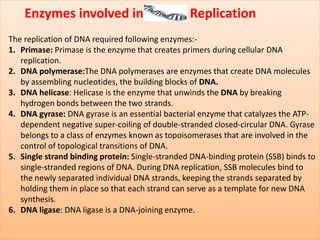
Enzymes involved in Replication
The replication of DNA required following enzymes:-
1. Primase: Primase is the enzyme that creates primers during cellular DNA
replication.
2. DNA polymerase:The DNA polymerases are enzymes that create DNA molecules
by assembling nucleotides, the building blocks of DNA.
3. DNA helicase: Helicase is the enzyme that unwinds the DNA by breaking
hydrogen bonds between the two strands.
4. DNA gyrase: DNA gyrase is an essential bacterial enzyme that catalyzes the ATP-
dependent negative super-coiling of double-stranded closed-circular DNA. Gyrase
belongs to a class of enzymes known as topoisomerases that are involved in the
control of topological transitions of DNA.
5. Single strand binding protein: Single-stranded DNA-binding protein (SSB) binds to
single-stranded regions of DNA. During DNA replication, SSB molecules bind to
the newly separated individual DNA strands, keeping the strands separated by
holding them in place so that each strand can serve as a template for new DNA
synthesis.
6. DNA ligase: DNA ligase is a DNA-joining enzyme.
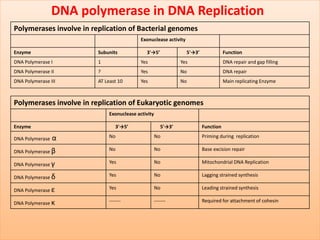
DNA polymerase in DNA Replication
Polymerases involve in replication of Bacterial genomes
Exonuclease activity
Enzyme Subunits 3'→5’ 5'→3’ Function
DNA Polymerase I 1 Yes Yes DNA repair and gap filling
DNA Polymerase II ? Yes No DNA repair
DNA Polymerase III AT Least 10 Yes No Main replicating Enzyme
Polymerases involve in replication of Eukaryotic genomes
Exonuclease activity
Enzyme 3'→5’ 5'→3’ Function
DNA Polymerase α No No Priming during replication
DNA Polymerase β No No Base excision repair
DNA Polymerase γ Yes No Mitochondrial DNA Replication
DNA Polymerase δ Yes No Lagging strained synthesis
DNA Polymerase ε Yes No Leading strained synthesis
DNA Polymerase κ ------- ------- Required for attachment of cohesin
Steps of Replication
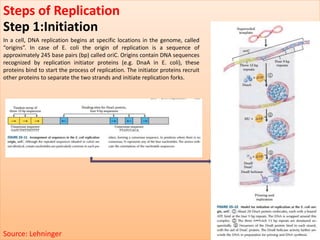
In a cell, DNA replication begins at specific locations in the genome, called
“origins”. In case of E. coli the origin of replication is a sequence of
approximately 245 base pairs (bp) called oriC. Origins contain DNA sequences
recognized by replication initiator proteins (e.g. DnaA in E. coli), these
proteins bind to start the process of replication. The initiator proteins recruit
other proteins to separate the two strands and initiate replication forks.
Source: Lehninger
Step 1:Initiation
Step 2: Elongation
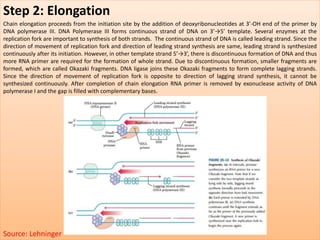
Chain elongation proceeds from the initiation site by the addition of deoxyribonucleotides at 3’-OH end of the primer by
DNA polymerase III. DNA Polymerase III forms continuous strand of DNA on 3’→5’ template. Several enzymes at the
replication fork are important to synthesis of both strands. The continuous strand of DNA is called leading strand. Since the
direction of movement of replication fork and direction of leading strand synthesis are same, leading strand is synthesized
continuously after its initiation. However, in other template strand 5’→3’, there is discontinuous formation of DNA and thus
more RNA primer are required for the formation of whole strand. Due to discontinuous formation, smaller fragments are
formed, which are called Okazaki fragments. DNA ligase joins these Okazaki fragments to form complete lagging strands.
Since the direction of movement of replication fork is opposite to direction of lagging strand synthesis, it cannot be
synthesized continuously. After completion of chain elongation RNA primer is removed by exonuclease activity of DNA
polymerase I and the gap is filled with complementary bases.
Source: Lehninger
Step 3: Termination
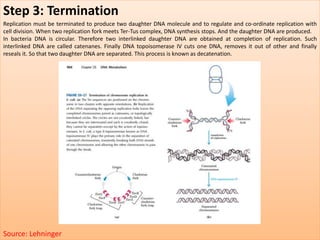
Replication must be terminated to produce two daughter DNA molecule and to regulate and co-ordinate replication with
cell division. When two replication fork meets Ter-Tus complex, DNA synthesis stops. And the daughter DNA are produced.
In bacteria DNA is circular. Therefore two interlinked daughter DNA are obtained at completion of replication. Such
interlinked DNA are called catenanes. Finally DNA topoisomerase IV cuts one DNA, removes it out of other and finally
reseals it. So that two daughter DNA are separated. This process is known as decatenation.
Source: Lehninger
THANKS

DNA replication in Prokaryotes

  • 1.
    REPLICATION By Dr. Akhilesh Kumar Asst.Professor Himalayan school of Biosciences Swami Rama Himalayan University Jollygrant Dehradun
  • 2.
    Introduction of Replication DNAis the genetic material that defines every cell. Before a cell duplicates and is divided into new daughter cells through either mitosis or meiosis, biomolecules and organelles must be copied to be distributed among the cells. DNA, found within the nucleus, must be replicated in order to ensure that each new cell receives the correct number of chromosomes. The process of DNA duplication is called DNA replication. Replication follows several steps that involve multiple proteins called replication enzymes and RNA. In eukaryotic cells, such as animal cells and plant cells, DNA replication occurs in the S phase of interphase during the cell cycle. The process of DNA replication is vital for cell growth, repair, and reproduction in organisms.
  • 3.
    Replication Is Semiconservative In the semi-conservative replication, the two parental strands separate and each makes a copy of itself. After one round of replication, the two daughter molecules each comprises one old and one new strand. Note that after two rounds, two of the DNA molecules consist only of new material, while the other two contain one old and one new strand.
  • 4.
    Meselson & StahlExperiment (1958) Meselson & Stahl first grow bacteria for several generations in a medium containing only 15N ("heavy" nitrogen). When examined in an analytical centrifuge, DNA isolated from these bacteria produced a single "heavy" band. Meselson & Stahl then transferred a portion of the culture to a new medium that contained only 14N ("light" nitrogen). When DNA was isolated from these bacteria after one generation, they observed a single band that was "lighter" than the one obtained before; the "heavy" band was not observed in these bacteria. When DNA was isolated from the same culture after two generations, they observed two distinct bands of equal intensity, one with the same weight as seen in the previous experiment, and a new one still "lighter." When DNA was isolated from the same culture after three generations, this lightest band became the predominant one, and the middle band faded.
  • 5.
  • 6.
    Enzymes involved inReplication The replication of DNA required following enzymes:- 1. Primase: Primase is the enzyme that creates primers during cellular DNA replication. 2. DNA polymerase:The DNA polymerases are enzymes that create DNA molecules by assembling nucleotides, the building blocks of DNA. 3. DNA helicase: Helicase is the enzyme that unwinds the DNA by breaking hydrogen bonds between the two strands. 4. DNA gyrase: DNA gyrase is an essential bacterial enzyme that catalyzes the ATP- dependent negative super-coiling of double-stranded closed-circular DNA. Gyrase belongs to a class of enzymes known as topoisomerases that are involved in the control of topological transitions of DNA. 5. Single strand binding protein: Single-stranded DNA-binding protein (SSB) binds to single-stranded regions of DNA. During DNA replication, SSB molecules bind to the newly separated individual DNA strands, keeping the strands separated by holding them in place so that each strand can serve as a template for new DNA synthesis. 6. DNA ligase: DNA ligase is a DNA-joining enzyme.
  • 7.
    DNA polymerase inDNA Replication Polymerases involve in replication of Bacterial genomes Exonuclease activity Enzyme Subunits 3'→5’ 5'→3’ Function DNA Polymerase I 1 Yes Yes DNA repair and gap filling DNA Polymerase II ? Yes No DNA repair DNA Polymerase III AT Least 10 Yes No Main replicating Enzyme Polymerases involve in replication of Eukaryotic genomes Exonuclease activity Enzyme 3'→5’ 5'→3’ Function DNA Polymerase α No No Priming during replication DNA Polymerase β No No Base excision repair DNA Polymerase γ Yes No Mitochondrial DNA Replication DNA Polymerase δ Yes No Lagging strained synthesis DNA Polymerase ε Yes No Leading strained synthesis DNA Polymerase κ ------- ------- Required for attachment of cohesin
  • 8.
    Steps of Replication Ina cell, DNA replication begins at specific locations in the genome, called “origins”. In case of E. coli the origin of replication is a sequence of approximately 245 base pairs (bp) called oriC. Origins contain DNA sequences recognized by replication initiator proteins (e.g. DnaA in E. coli), these proteins bind to start the process of replication. The initiator proteins recruit other proteins to separate the two strands and initiate replication forks. Source: Lehninger Step 1:Initiation
  • 9.
    Step 2: Elongation Chainelongation proceeds from the initiation site by the addition of deoxyribonucleotides at 3’-OH end of the primer by DNA polymerase III. DNA Polymerase III forms continuous strand of DNA on 3’→5’ template. Several enzymes at the replication fork are important to synthesis of both strands. The continuous strand of DNA is called leading strand. Since the direction of movement of replication fork and direction of leading strand synthesis are same, leading strand is synthesized continuously after its initiation. However, in other template strand 5’→3’, there is discontinuous formation of DNA and thus more RNA primer are required for the formation of whole strand. Due to discontinuous formation, smaller fragments are formed, which are called Okazaki fragments. DNA ligase joins these Okazaki fragments to form complete lagging strands. Since the direction of movement of replication fork is opposite to direction of lagging strand synthesis, it cannot be synthesized continuously. After completion of chain elongation RNA primer is removed by exonuclease activity of DNA polymerase I and the gap is filled with complementary bases. Source: Lehninger
  • 10.
    Step 3: Termination Replicationmust be terminated to produce two daughter DNA molecule and to regulate and co-ordinate replication with cell division. When two replication fork meets Ter-Tus complex, DNA synthesis stops. And the daughter DNA are produced. In bacteria DNA is circular. Therefore two interlinked daughter DNA are obtained at completion of replication. Such interlinked DNA are called catenanes. Finally DNA topoisomerase IV cuts one DNA, removes it out of other and finally reseals it. So that two daughter DNA are separated. This process is known as decatenation. Source: Lehninger
  • 11.