introducing
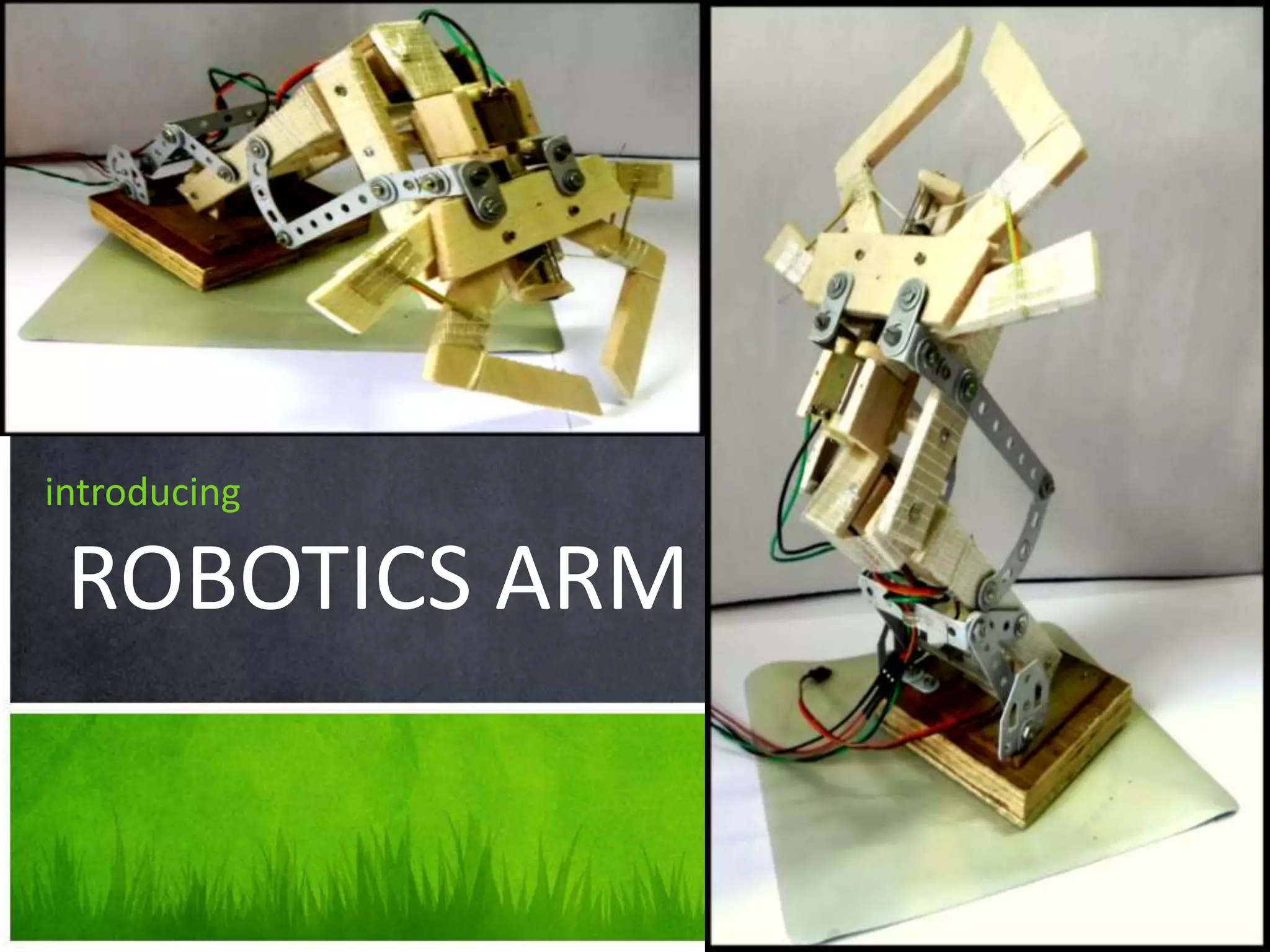
ROBOTICS ARM
a tour of new features
Presentedby
AGNIBHA MUKHOPADHYAY
DEBOLEENA MONDAL
GODHULI BISWAS
PRITAM BANERJEE
SUBHANKAR JANA
AIM OF THE PROJECT
• The main aim of our project is to build a
robotic arm that can grip or pick things
• We have implemented the robotic arm that
can be controlled by gesture commands. We
have proposed a simple algorithm for hand
gesture recognition.
What is a
ROBOTICS ARM???
ROBO ARM & DEGREE OF FREEDOM
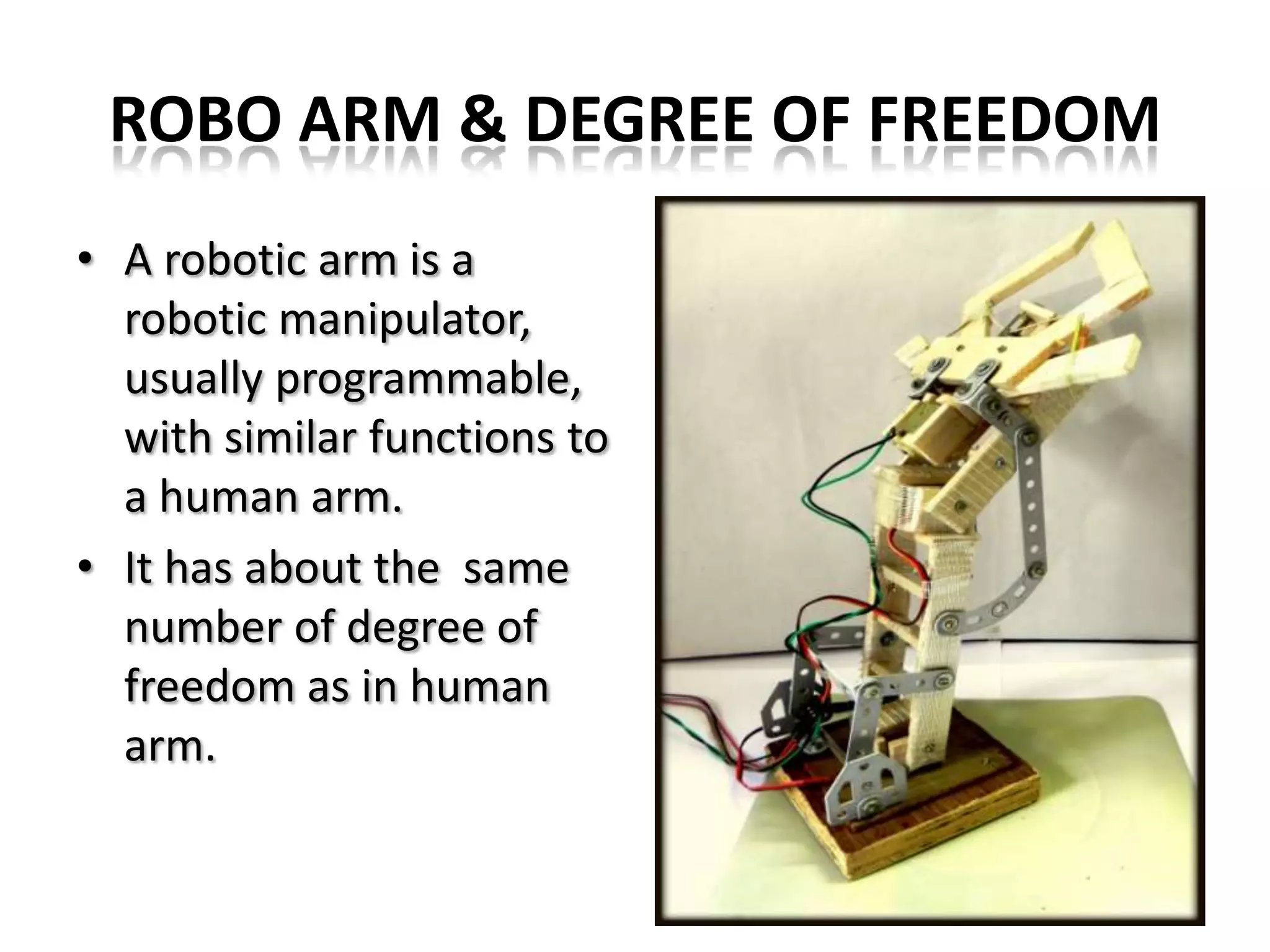
• A robotic arm is a
robotic manipulator,
usually programmable,
with similar functions to
a human arm.
• It has about the same
number of degree of
freedom as in human
arm.
MAKING OF ROBOTICS ARM AT A GLANCE
 The movement of the human arm is sensed by accelerometer
 The accelerometer generates an analog voltage accordingly.
 The movement of fingers is sensed by flex sensors which causes a
change in the resistance
 An impedance follower is used to convert the resistance to
voltage.
 The analog voltages are then digitized using an A/D converter .
 It is then sent to the microcontroller.
 Microcontroller differentiates all data of X-axis, Y-axis & Z-axis.
 These data are used to generate PWM signal for corresponding
servo motors.
 The data from flex sensor are used to drive a motor driver
 This motor driver drives the DC motor of the gripper part
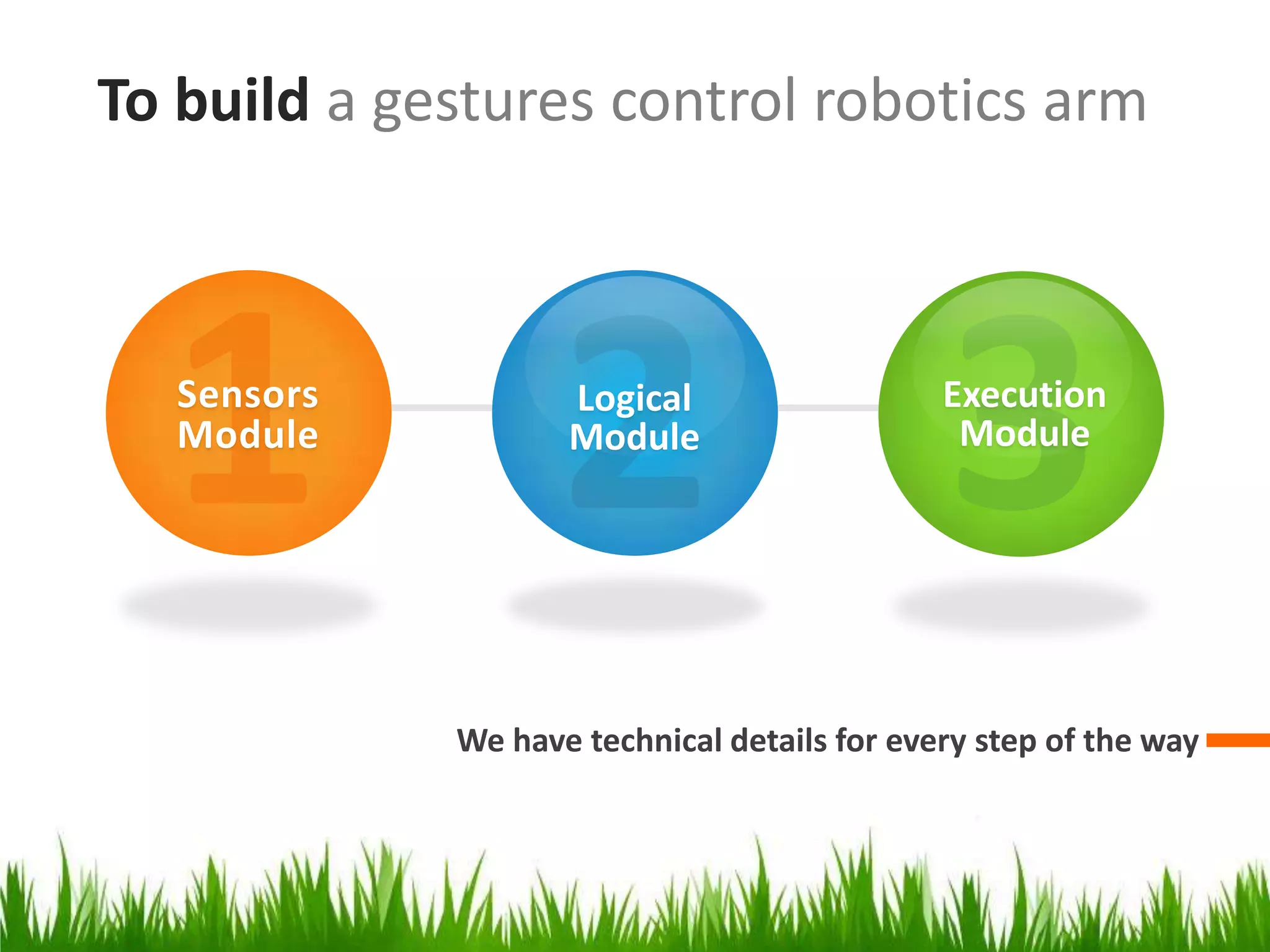
To build a gestures control robotics arm
We have technical details for every step of the way
Sensors
Module
Logical
Module
Execution
Module
SENSORS Module
Capture and Organize
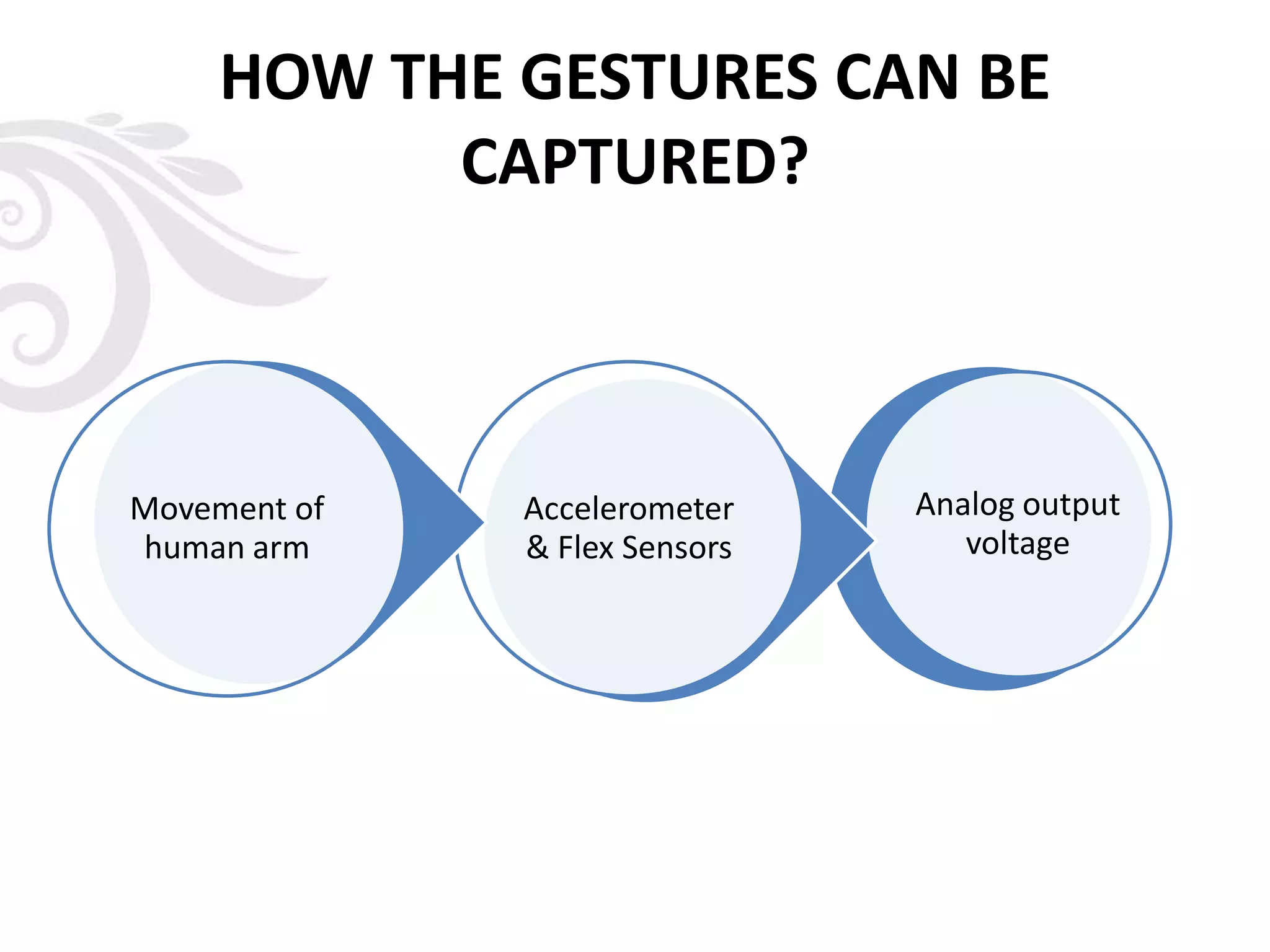
HOW THE GESTURES CAN BE
CAPTURED?
Analog output
voltage
Accelerometer
& Flex Sensors
Movement of
human arm
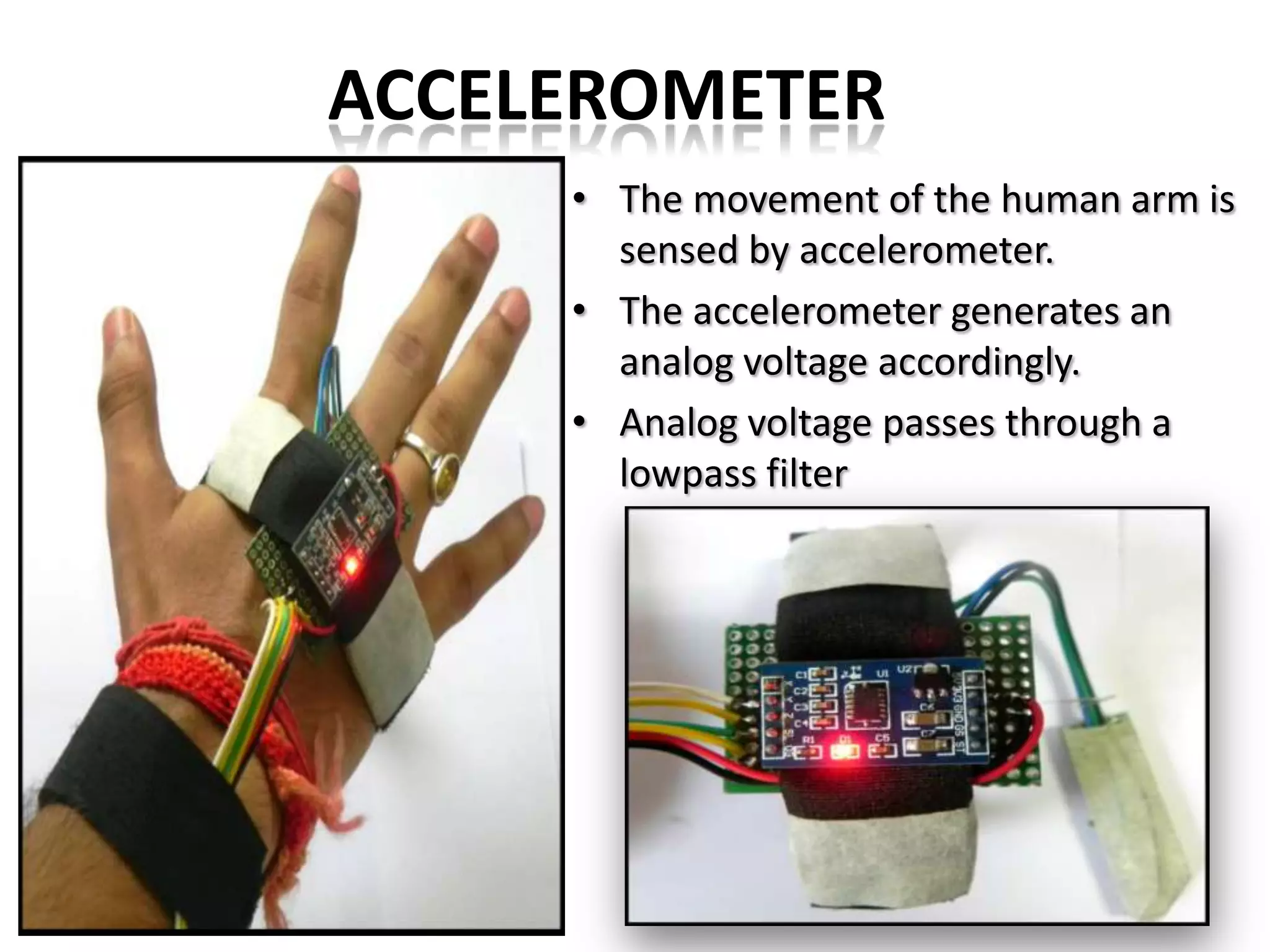
ACCELEROMETER
• The movement of the human arm is
sensed by accelerometer.
• The accelerometer generates an
analog voltage accordingly.
• Analog voltage passes through a
lowpass filter
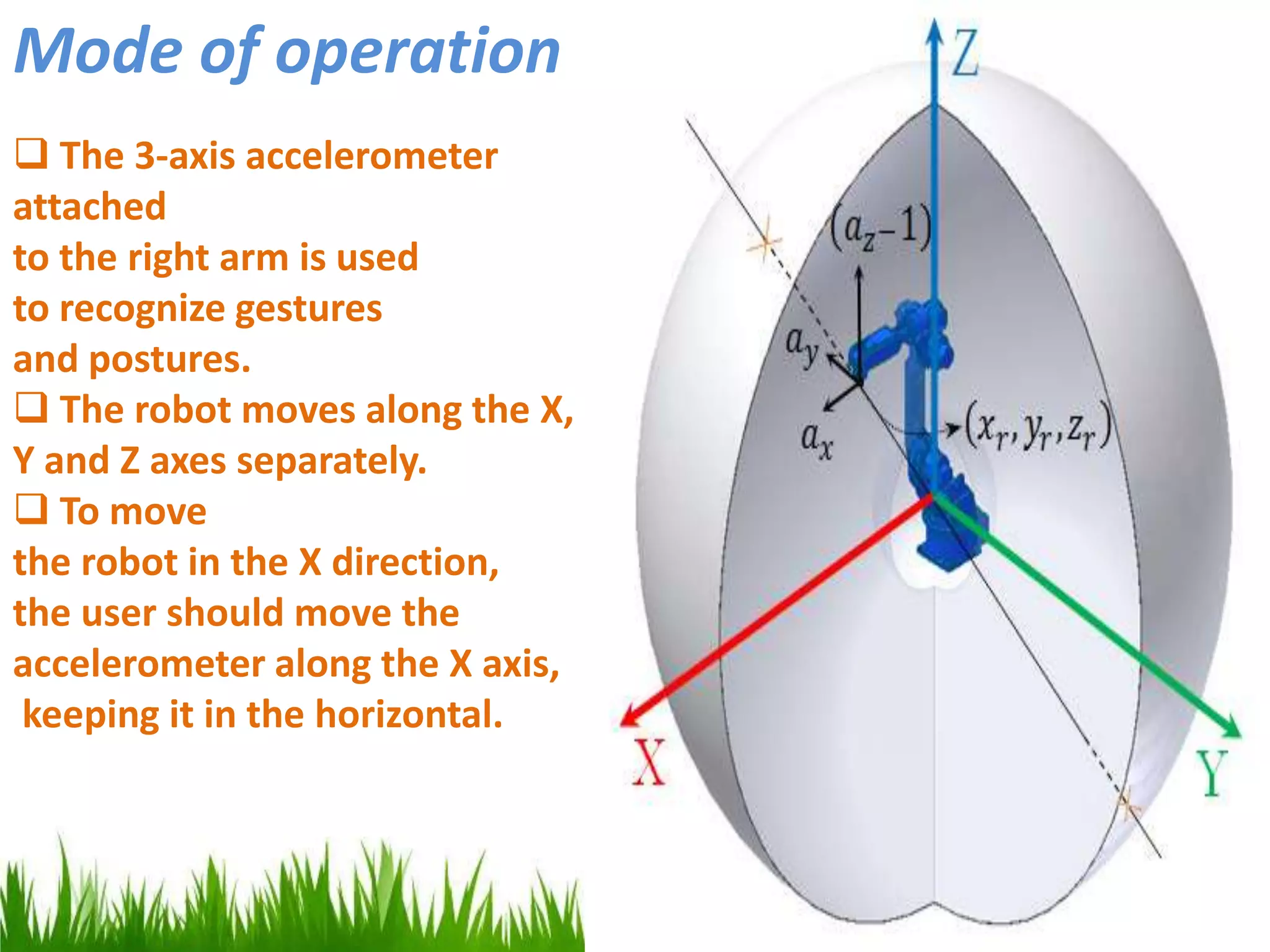
Mode of operation
 The 3-axis accelerometer
attached
to the right arm is used
to recognize gestures
and postures.
 The robot moves along the X,
Y and Z axes separately.
 To move
the robot in the X direction,
the user should move the
accelerometer along the X axis,
keeping it in the horizontal.
Recognition of gestures
and postures
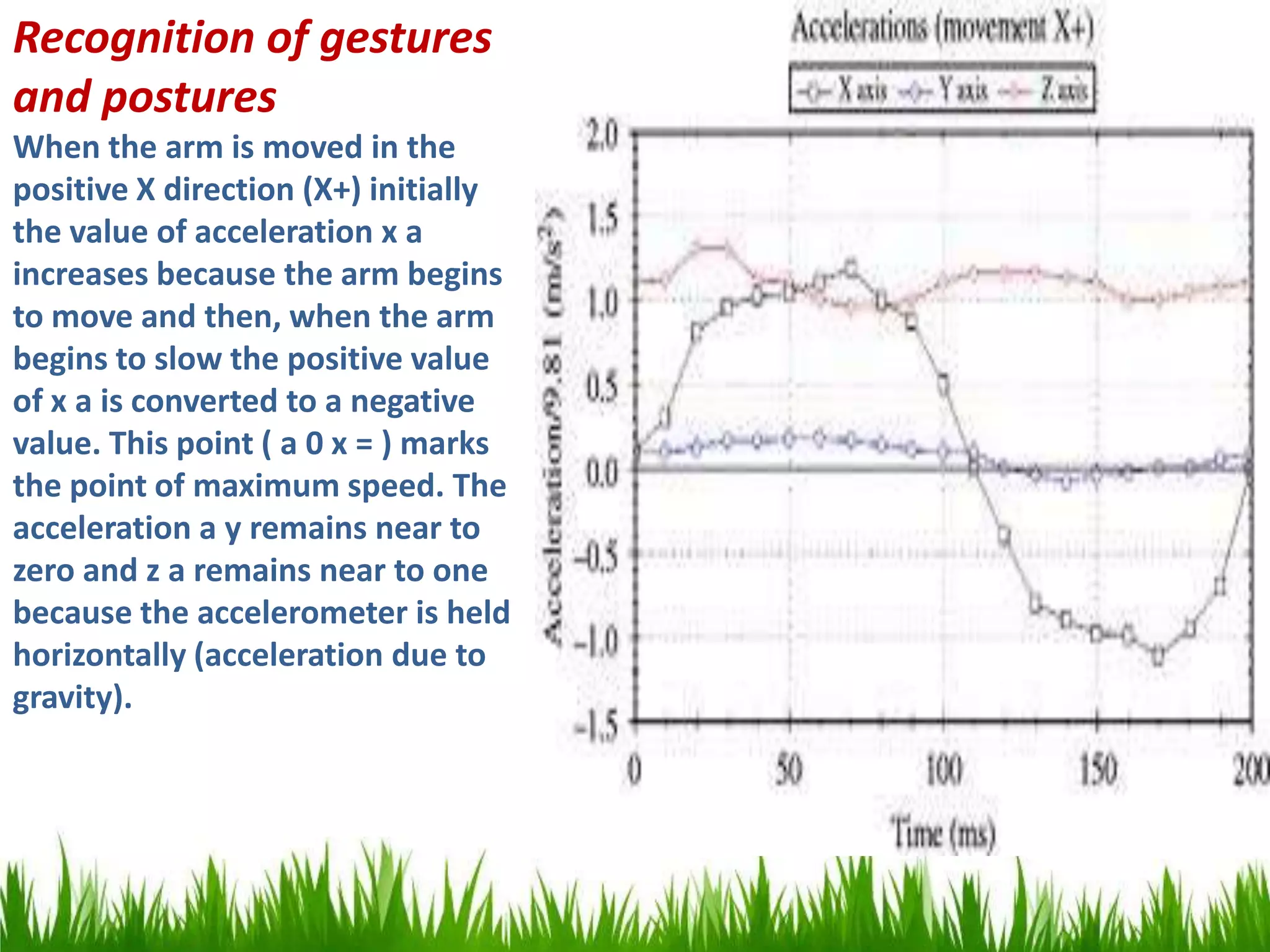
When the arm is moved in the
positive X direction (X+) initially
the value of acceleration x a
increases because the arm begins
to move and then, when the arm
begins to slow the positive value
of x a is converted to a negative
value. This point ( a 0 x = ) marks
the point of maximum speed. The
acceleration a y remains near to
zero and z a remains near to one
because the accelerometer is held
horizontally (acceleration due to
gravity).
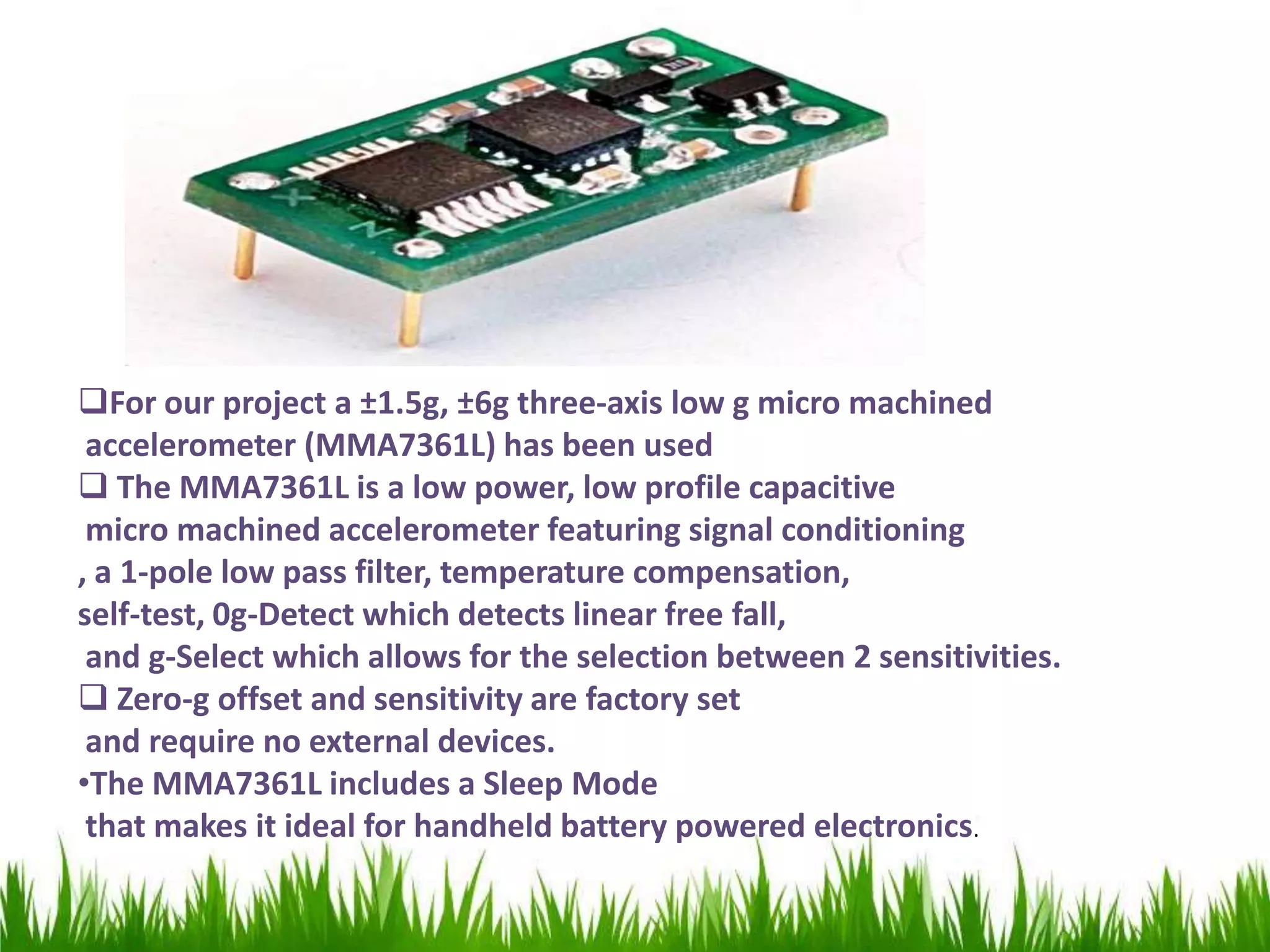
For our project a ±1.5g, ±6g three-axis low g micro machined
accelerometer (MMA7361L) has been used
 The MMA7361L is a low power, low profile capacitive
micro machined accelerometer featuring signal conditioning
, a 1-pole low pass filter, temperature compensation,
self-test, 0g-Detect which detects linear free fall,
and g-Select which allows for the selection between 2 sensitivities.
 Zero-g offset and sensitivity are factory set
and require no external devices.
•The MMA7361L includes a Sleep Mode
that makes it ideal for handheld battery powered electronics.
GRIPPING MECHANISM
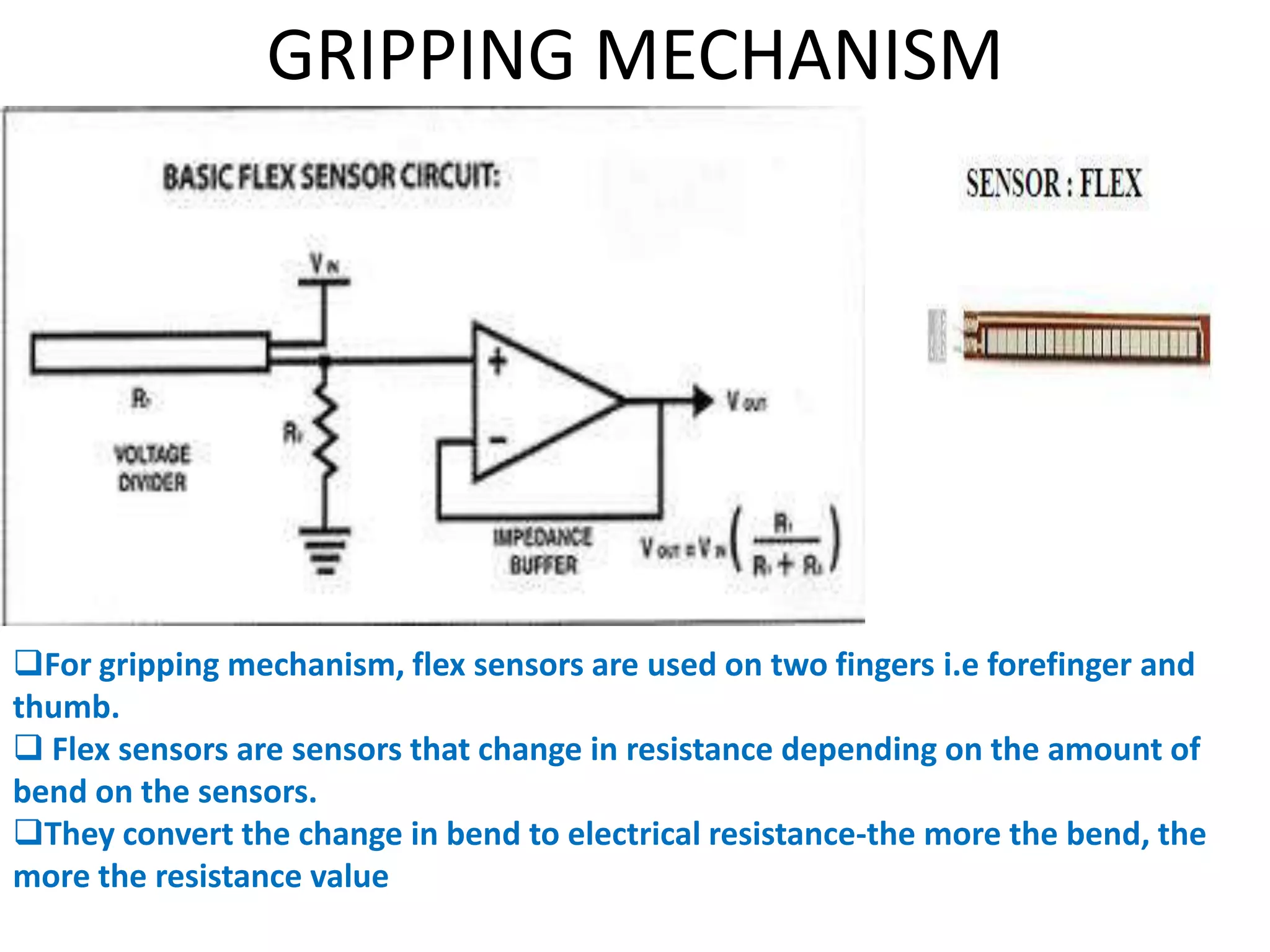
For gripping mechanism, flex sensors are used on two fingers i.e forefinger and
thumb.
 Flex sensors are sensors that change in resistance depending on the amount of
bend on the sensors.
They convert the change in bend to electrical resistance-the more the bend, the
more the resistance value
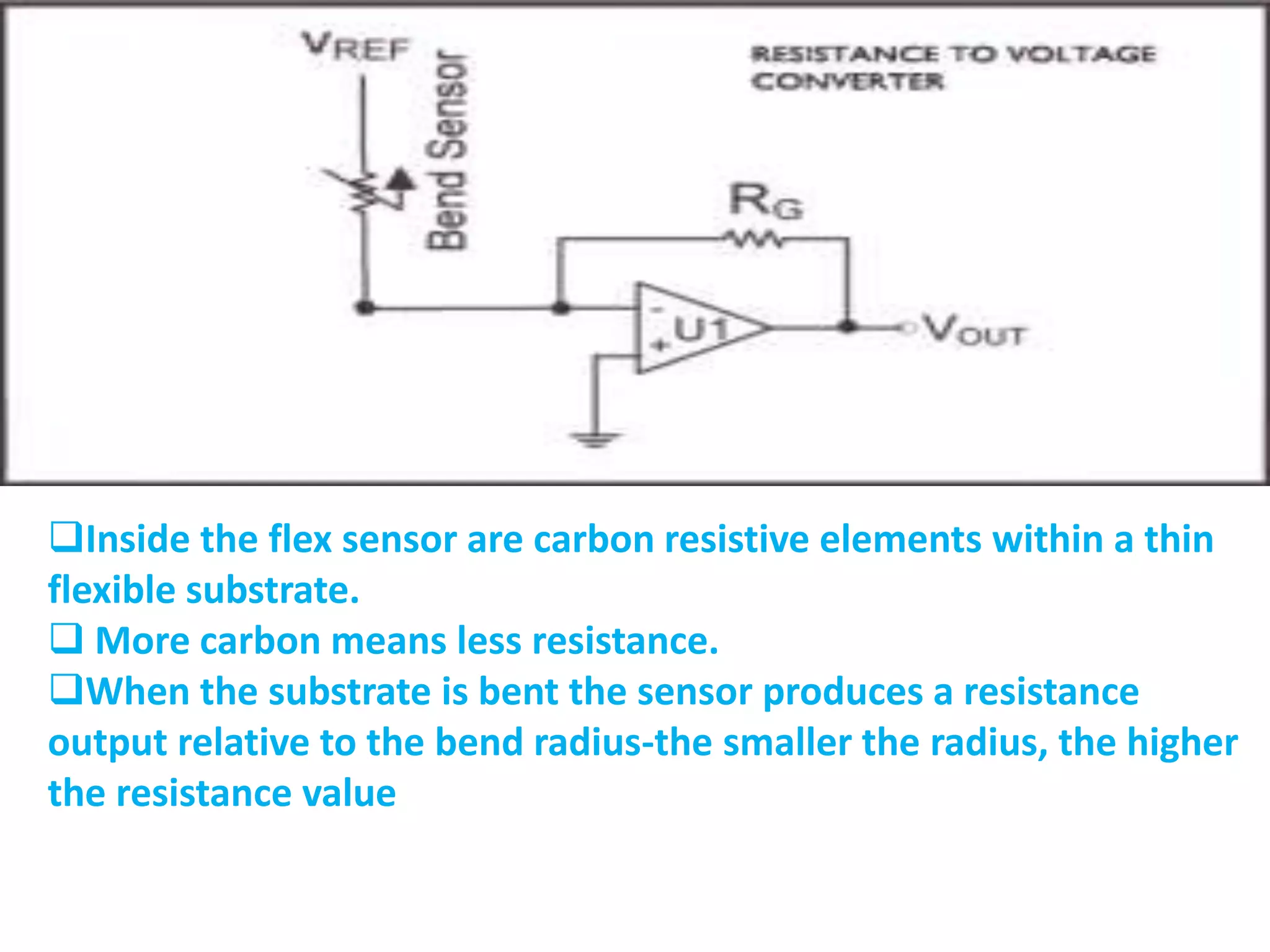
Inside the flex sensor are carbon resistive elements within a thin
flexible substrate.
 More carbon means less resistance.
When the substrate is bent the sensor produces a resistance
output relative to the bend radius-the smaller the radius, the higher
the resistance value
LOGICAL Module
Analysis, Calculate and Making decision
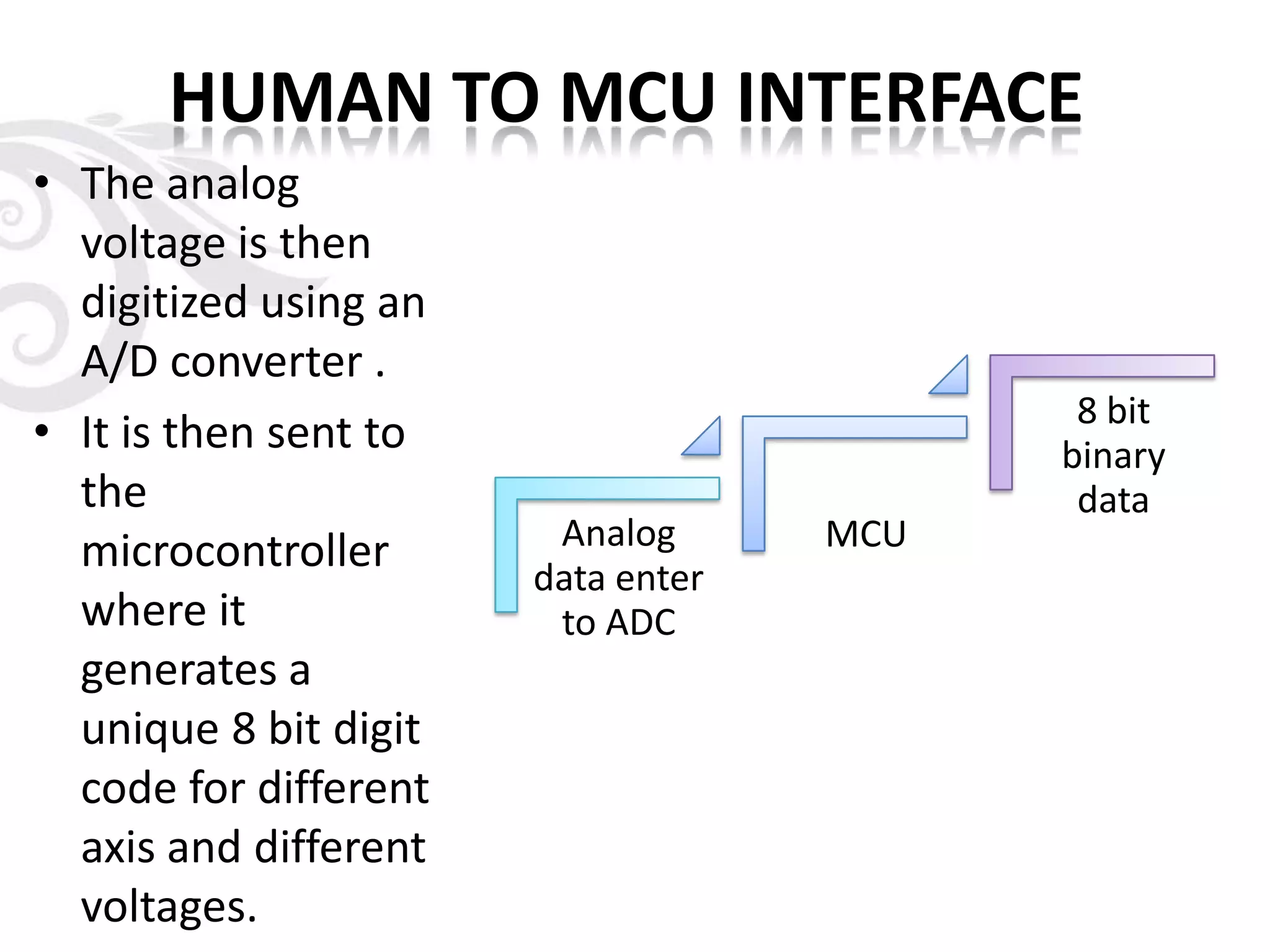
HUMAN TO MCU INTERFACE
• The analog
voltage is then
digitized using an
A/D converter .
• It is then sent to
the
microcontroller
where it
generates a
unique 8 bit digit
code for different
axis and different
voltages.
Analog
data enter
to ADC
MCU
8 bit
binary
data
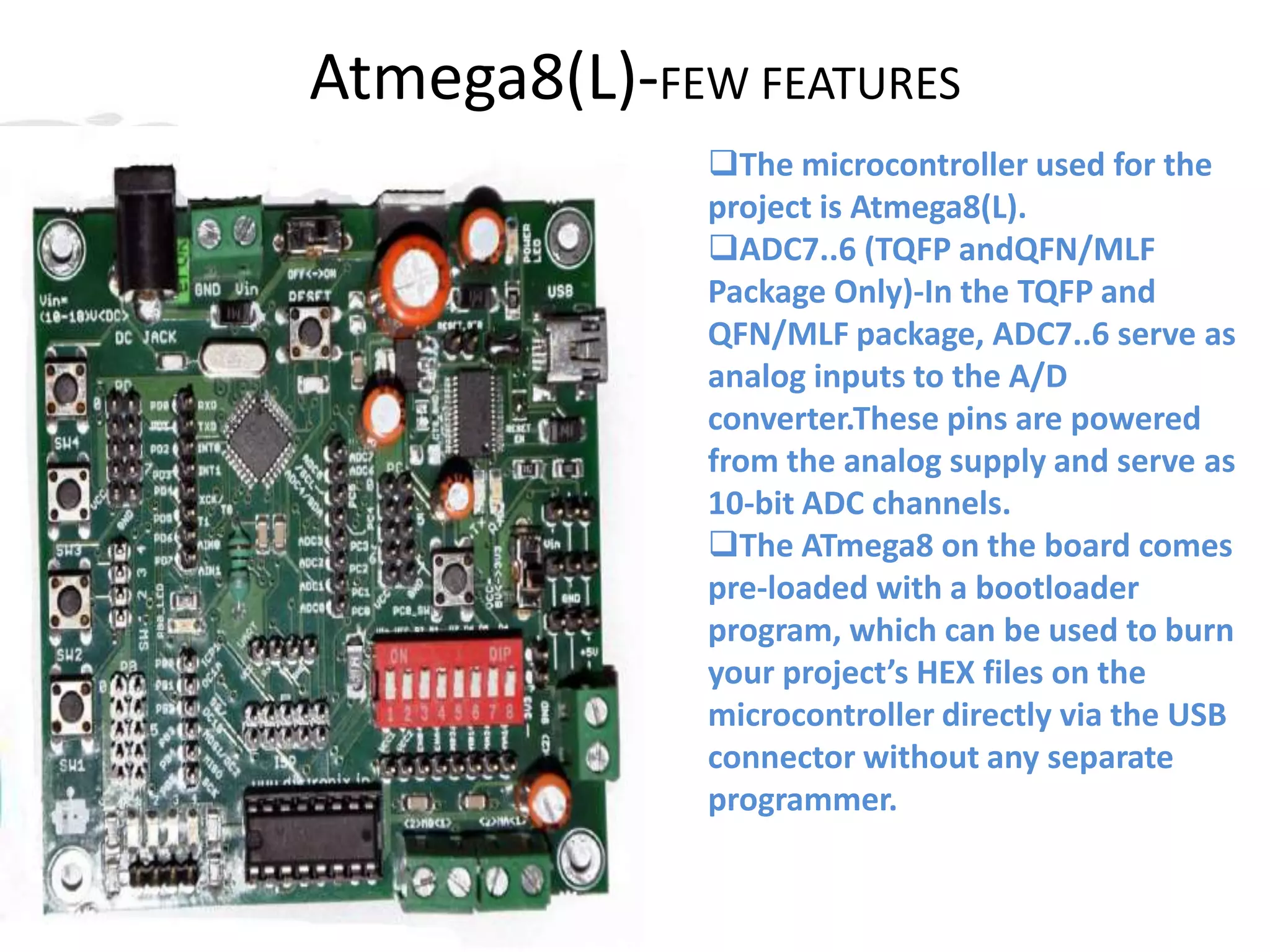
Atmega8(L)-FEW FEATURES
The microcontroller used for the
project is Atmega8(L).
ADC7..6 (TQFP andQFN/MLF
Package Only)-In the TQFP and
QFN/MLF package, ADC7..6 serve as
analog inputs to the A/D
converter.These pins are powered
from the analog supply and serve as
10-bit ADC channels.
The ATmega8 on the board comes

pre-loaded with a bootloader
program, which can be used to burn
your project’s HEX files on the
microcontroller directly via the USB
connector without any separate
programmer.
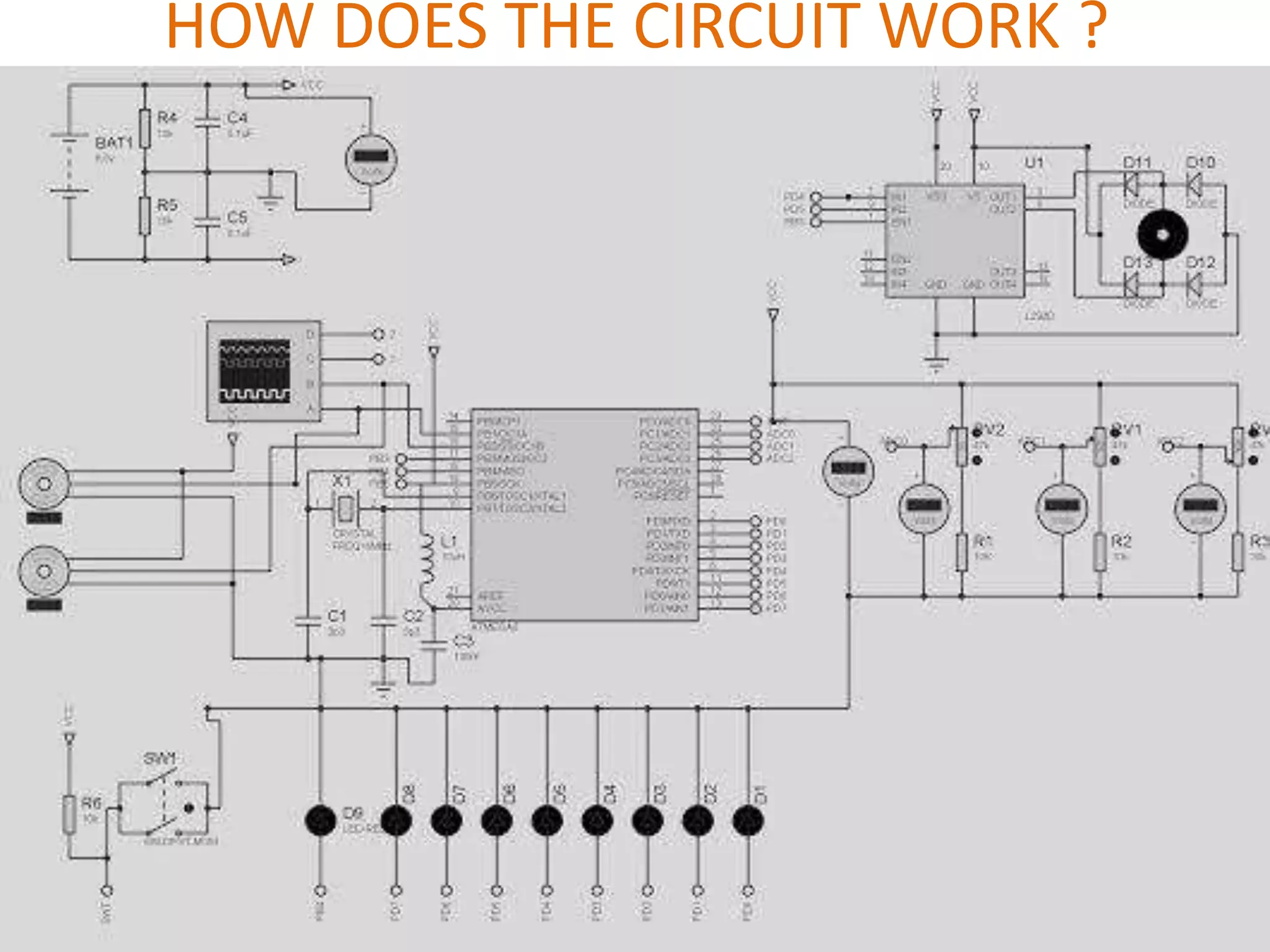
HOW DOES THE CIRCUIT WORK ?
•The Port B of the microcontroller
is set for the output. Reference
voltage is at AVcc.
•The ADC converts an analog input
voltage to a 8-bit digital value
through successive approximation..
•The ADC is enabled by setting the
ADC Enable bit, ADEN in ADCSRA.
•The ADC generates a 10-bit result
which is presented in the ADC Data
Registers, ADCH and ADCL.
•A single conversion is started by
writing a logical one to the ADC
Start Conversion bit, ADSC. This bit
stays high as long as the conversion
is in progress and will be cleared by
hardware when the conversion is
completed.
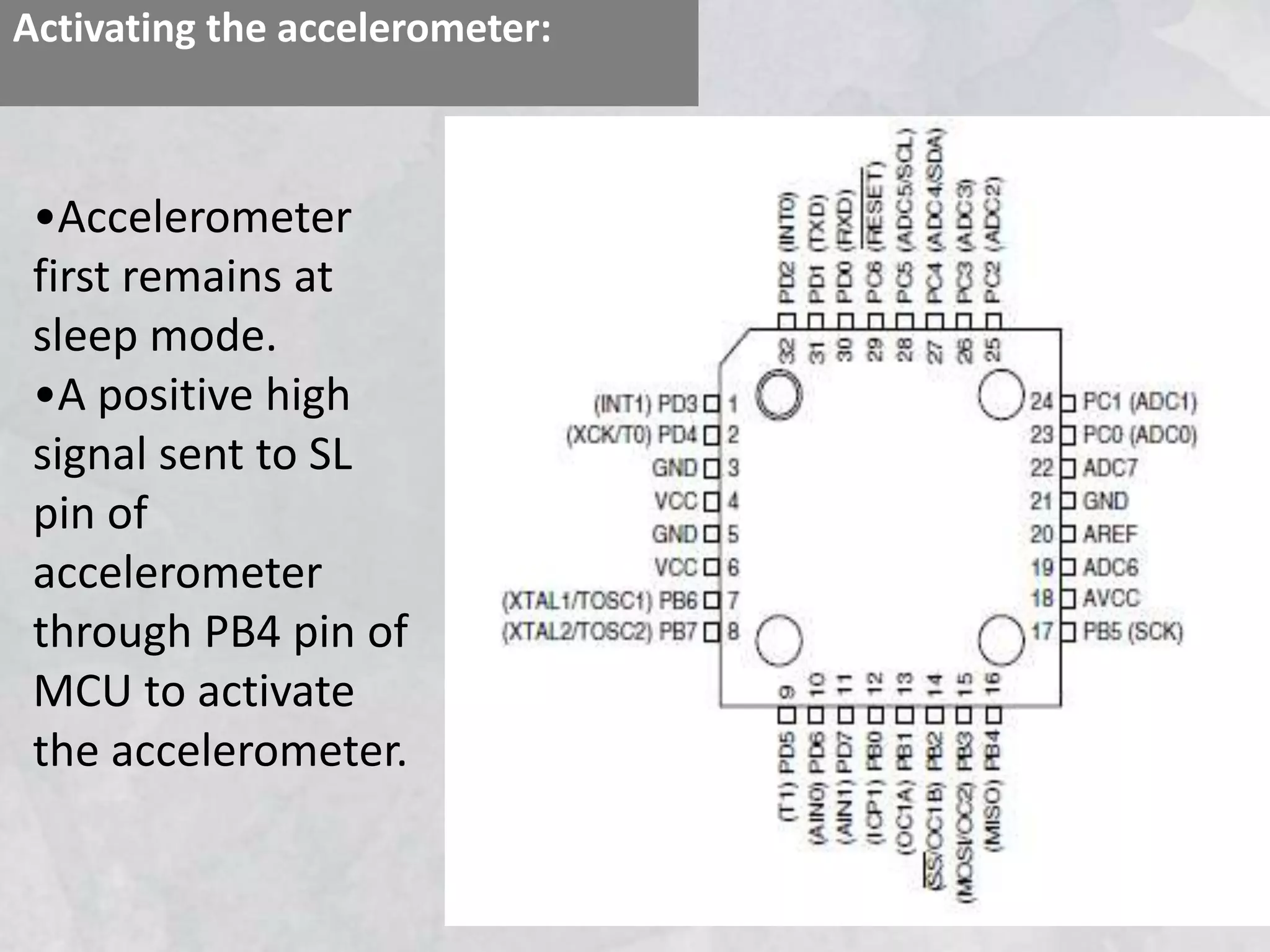
Activating the accelerometer:
•Accelerometer
first remains at
sleep mode.
•A positive high
signal sent to SL
pin of
accelerometer
through PB4 pin of
MCU to activate
the accelerometer.
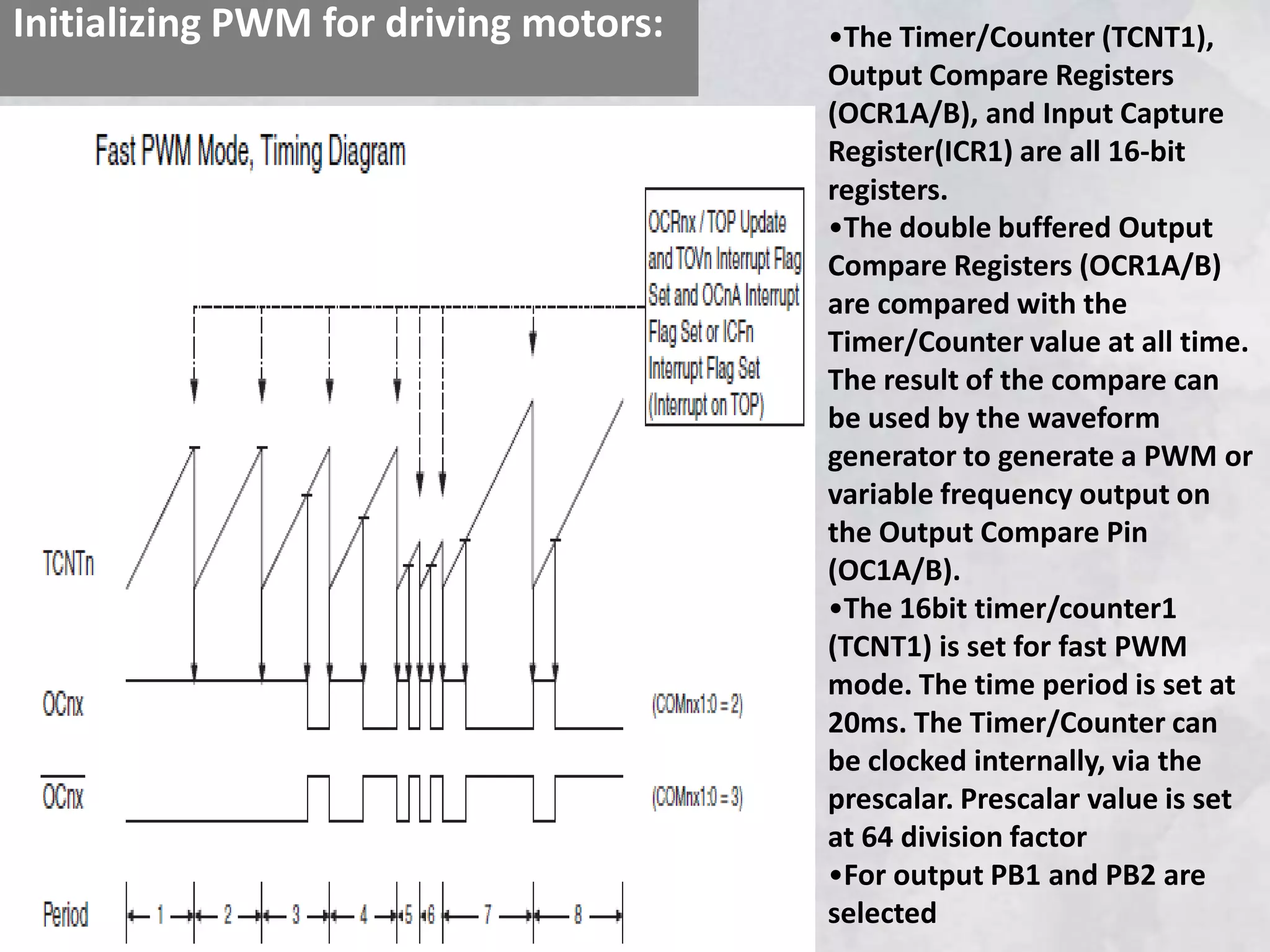
Initializing PWM for driving motors: •The Timer/Counter (TCNT1),
Output Compare Registers
(OCR1A/B), and Input Capture
Register(ICR1) are all 16-bit
registers.
•The double buffered Output
Compare Registers (OCR1A/B)
are compared with the
Timer/Counter value at all time.
The result of the compare can
be used by the waveform
generator to generate a PWM or
variable frequency output on
the Output Compare Pin
(OC1A/B).
•The 16bit timer/counter1
(TCNT1) is set for fast PWM
mode. The time period is set at
20ms. The Timer/Counter can
be clocked internally, via the
prescalar. Prescalar value is set
at 64 division factor
•For output PB1 and PB2 are
selected
MCU TO MECHANICAL PART INTERFACE
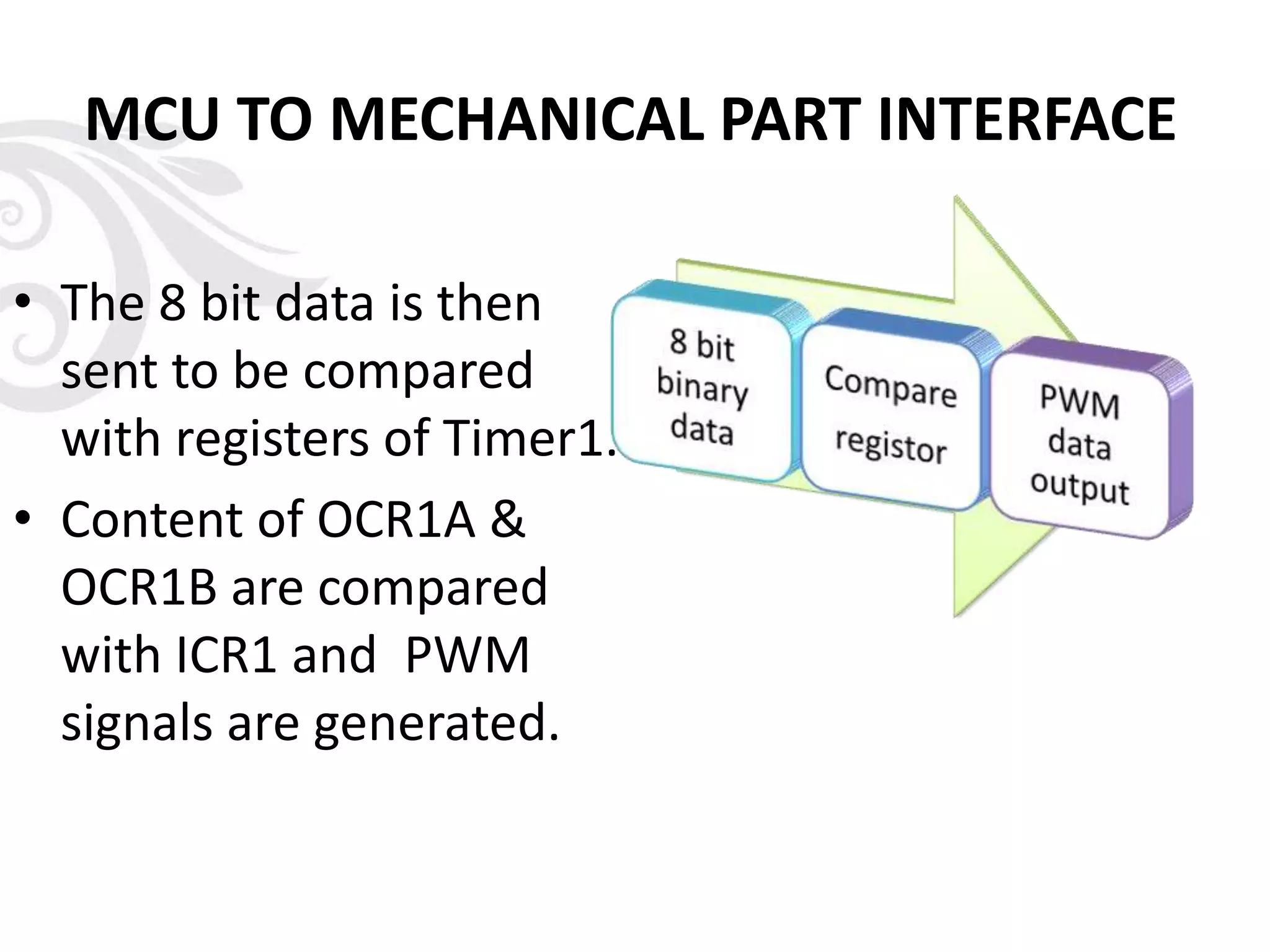
• The 8 bit data is then
sent to be compared
with registers of Timer1.
• Content of OCR1A &
OCR1B are compared
with ICR1 and PWM
signals are generated.
EXECUTION Module
Collect data and Follow instructions
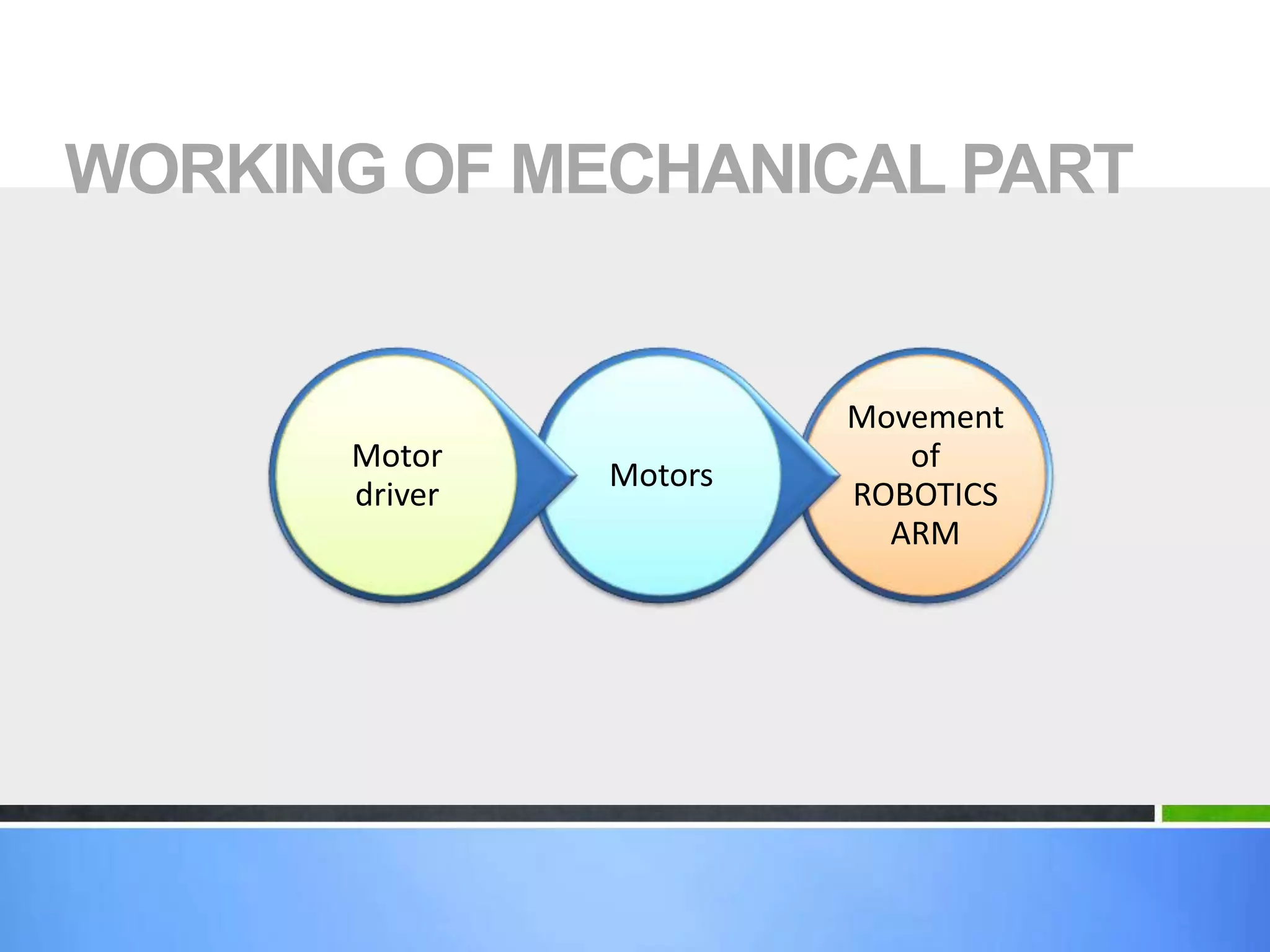
WORKING OF MECHANICAL PART
Movement
of
ROBOTICS
ARM
Motors
Motor
driver
MOTORS
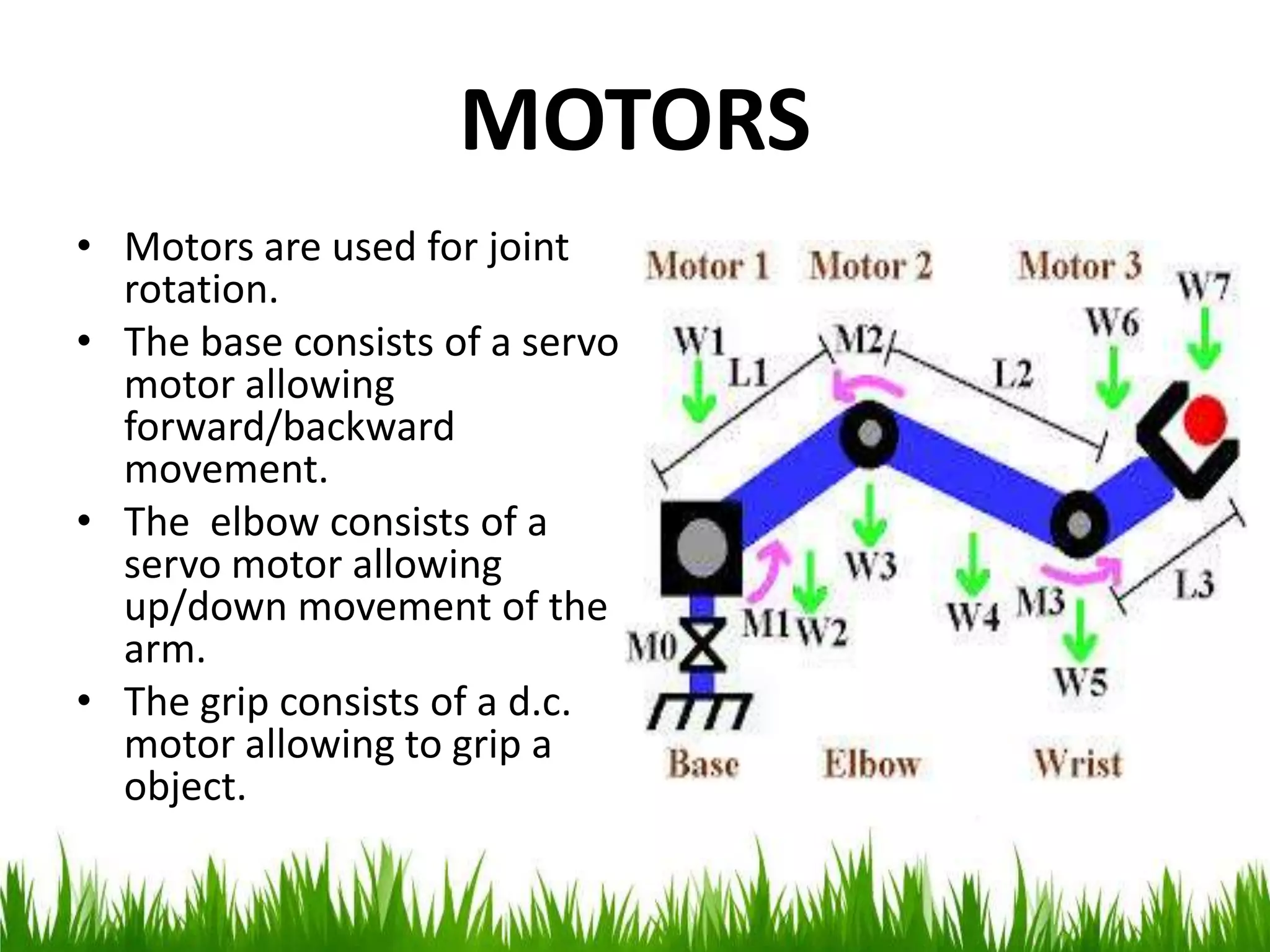
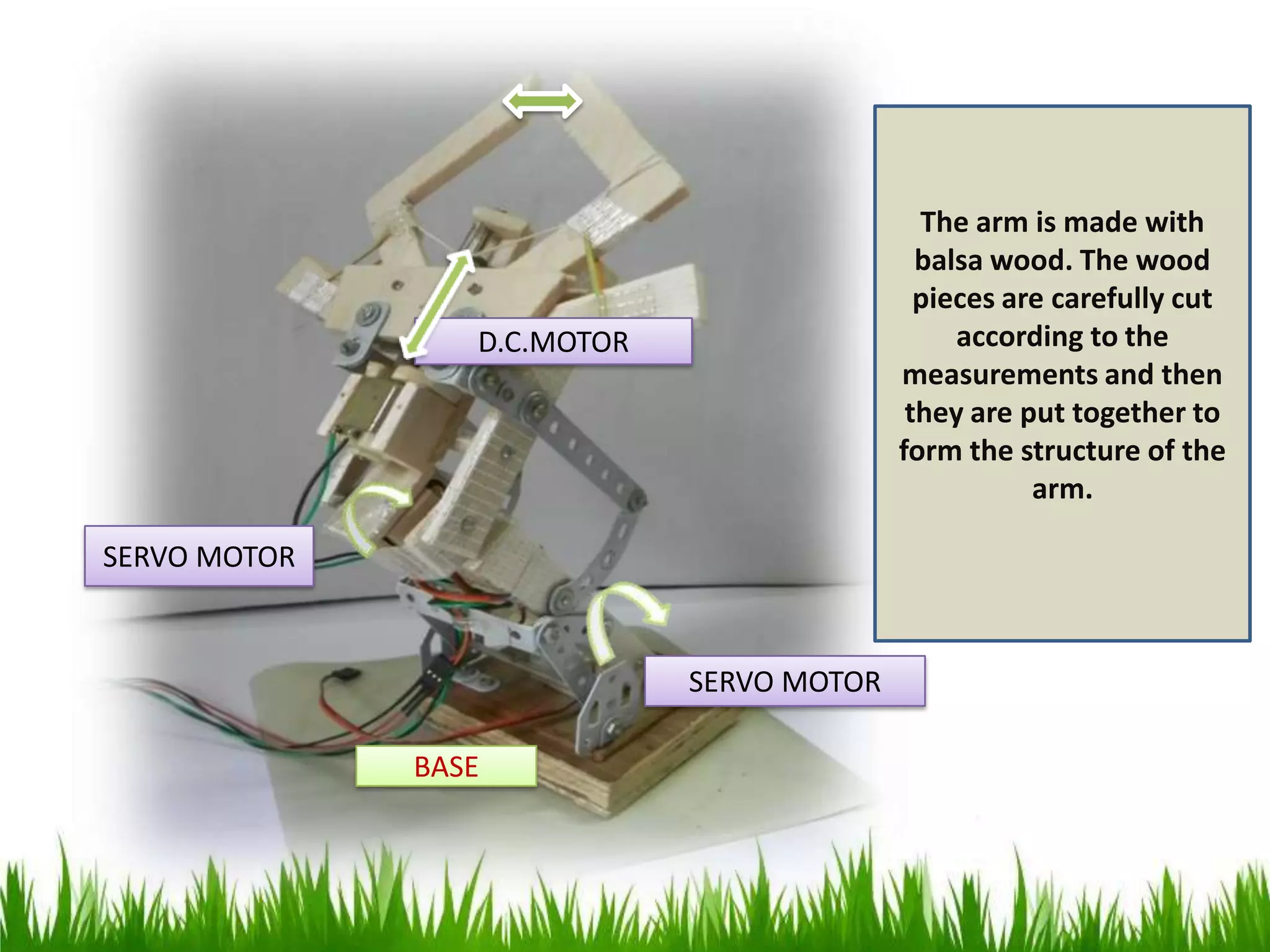
• Motors are used for joint
rotation.
• The base consists of a servo
motor allowing
forward/backward
movement.
• The elbow consists of a
servo motor allowing
up/down movement of the
arm.
• The grip consists of a d.c.
motor allowing to grip a
object.
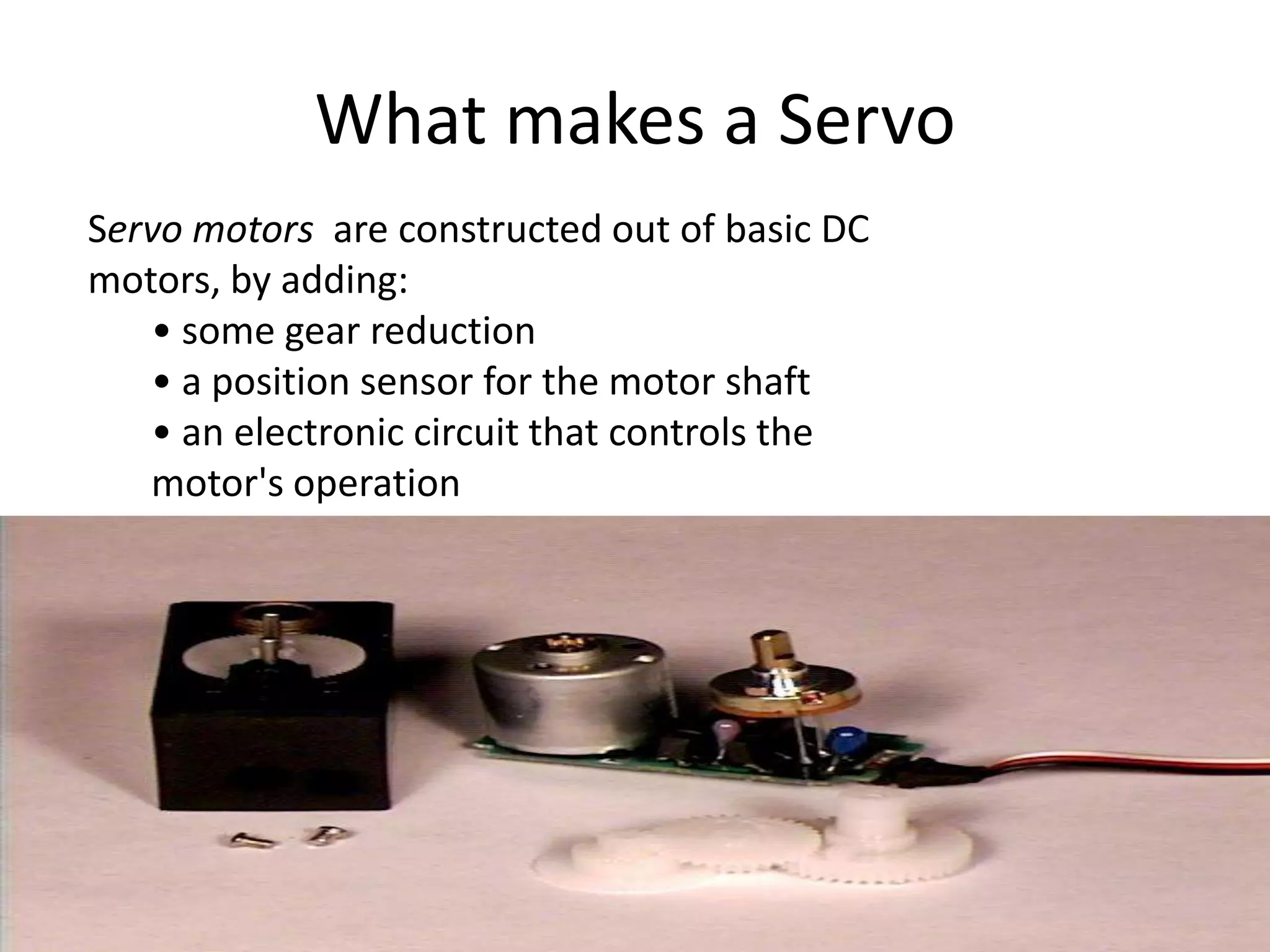
What makes a Servo
Servo motors are constructed out of basic DC
motors, by adding:
• some gear reduction
• a position sensor for the motor shaft
• an electronic circuit that controls the
motor's operation
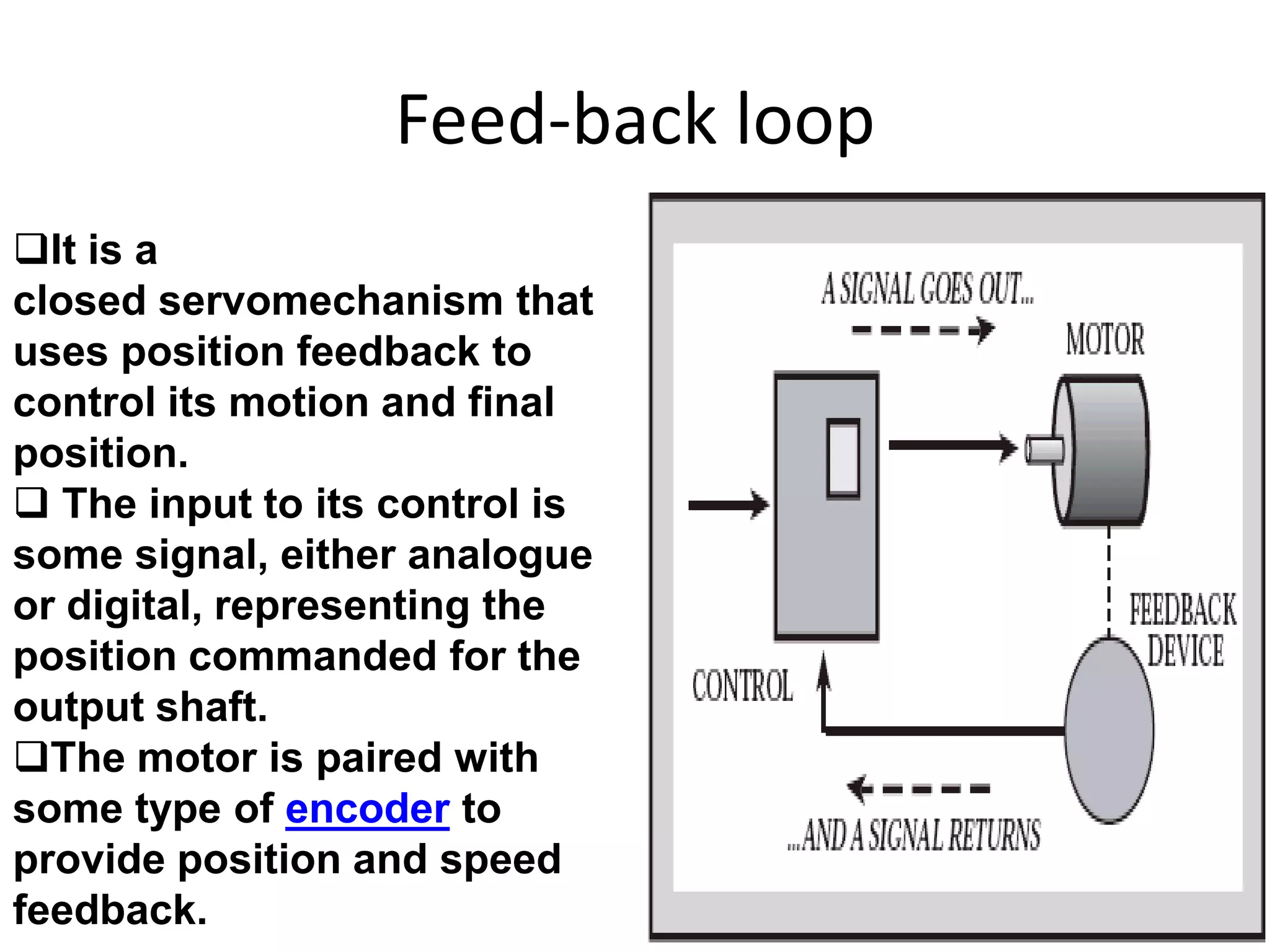
Feed-back loop
It is a
closed servomechanism that
uses position feedback to
control its motion and final
position.
 The input to its control is
some signal, either analogue
or digital, representing the
position commanded for the
output shaft.
The motor is paired with
some type of encoder to
provide position and speed
feedback.
How do servo
motors work ?
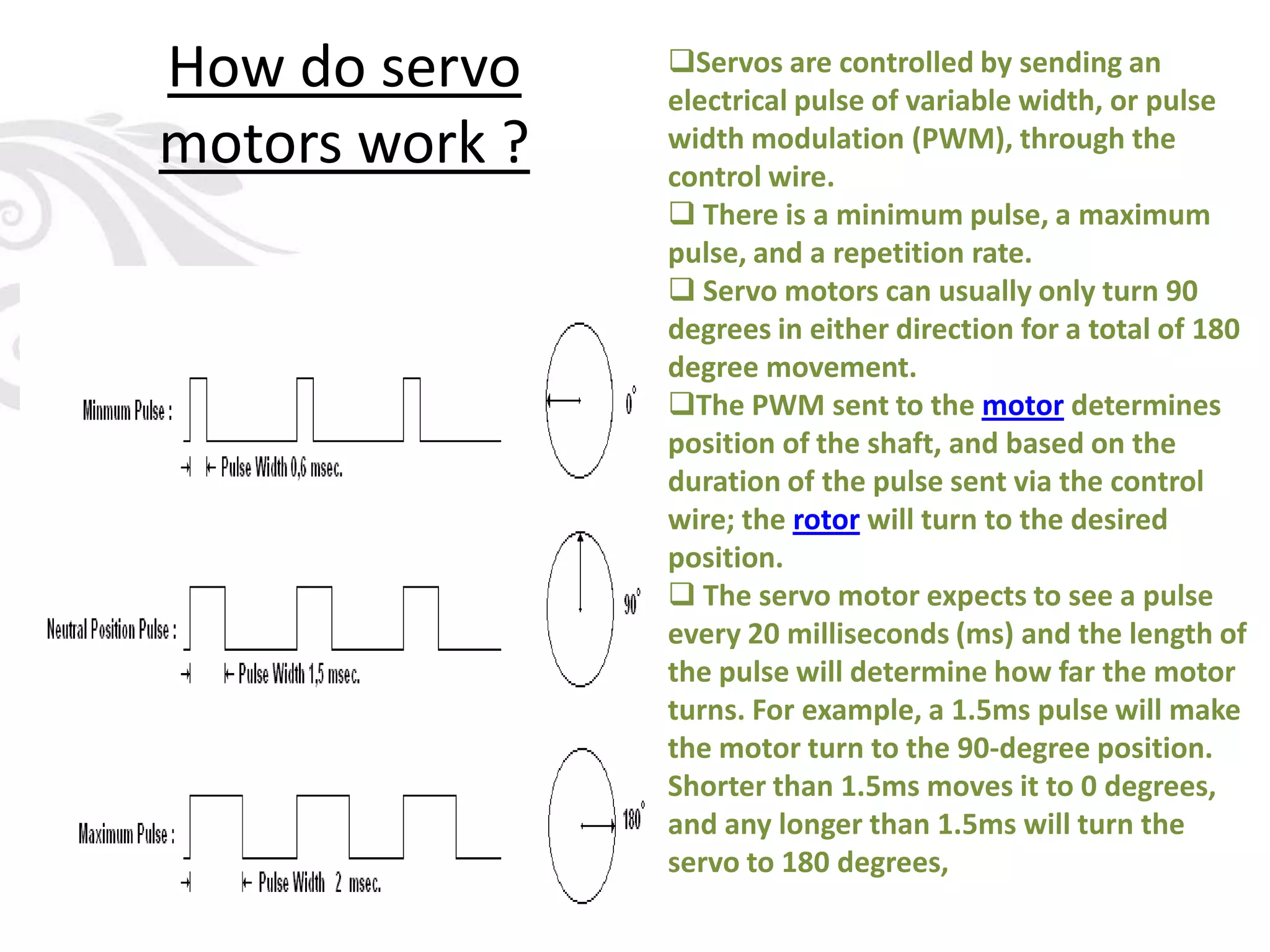
Servos are controlled by sending an
electrical pulse of variable width, or pulse
width modulation (PWM), through the
control wire.
 There is a minimum pulse, a maximum
pulse, and a repetition rate.
 Servo motors can usually only turn 90
degrees in either direction for a total of 180
degree movement.
The PWM sent to the motor determines
position of the shaft, and based on the
duration of the pulse sent via the control
wire; the rotor will turn to the desired
position.
 The servo motor expects to see a pulse
every 20 milliseconds (ms) and the length of
the pulse will determine how far the motor
turns. For example, a 1.5ms pulse will make
the motor turn to the 90-degree position.
Shorter than 1.5ms moves it to 0 degrees,
and any longer than 1.5ms will turn the
servo to 180 degrees,
GRIP
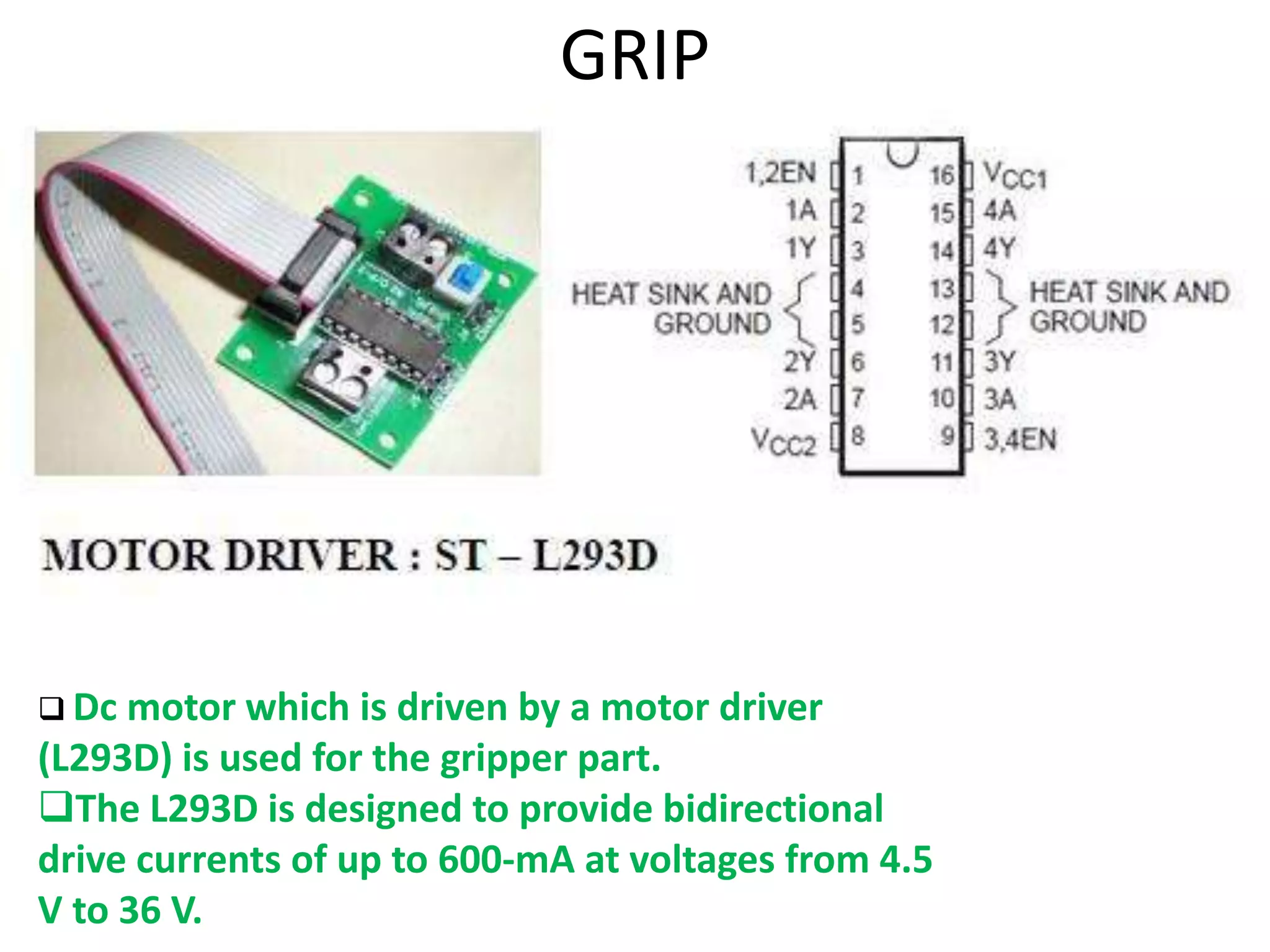
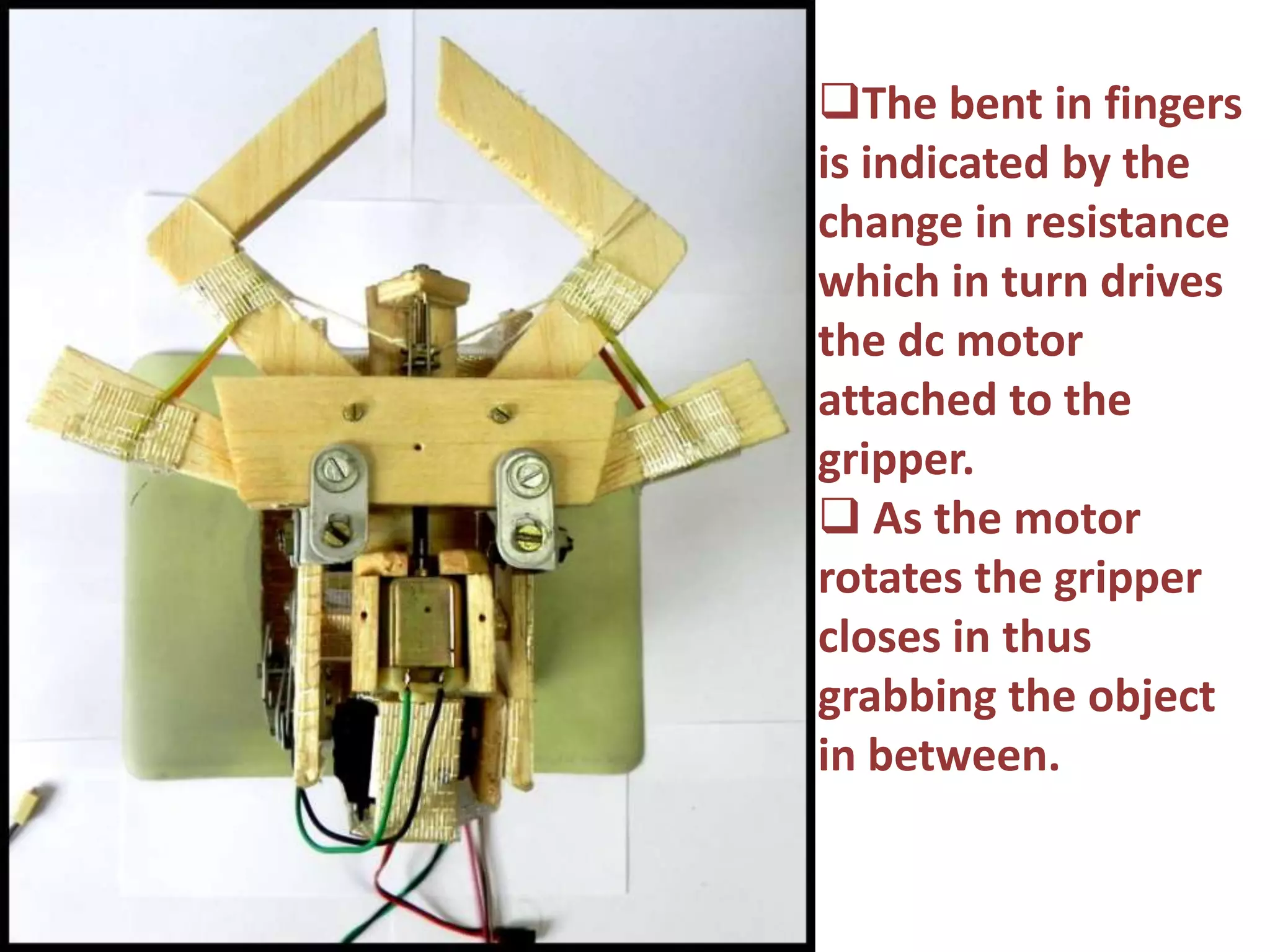
 Dc motor which is driven by a motor driver
(L293D) is used for the gripper part.
The L293D is designed to provide bidirectional
drive currents of up to 600-mA at voltages from 4.5
V to 36 V.
gg The bent in fingers
is indicated by the
change in resistance
which in turn drives
the dc motor
attached to the
gripper.
 As the motor
rotates the gripper
closes in thus
grabbing the object
in between.
D.C.MOTOR
SERVO MOTOR
SERVO MOTOR
BASE
The arm is made with
balsa wood. The wood
pieces are carefully cut
according to the
measurements and then
they are put together to
form the structure of the
arm.
?But wait…
There’s More!
Why we need ROBOTICS ARM???
. The robotic arm can be designed to perform any desired task
such as welding, gripping, spinning etc.
. The space shuttle Remote Manipulator System have multi
degree of freedom robotic arms
. In various industrial or home applications
. In medical science: soft tissue manipulation, needle insertion,
suturing, and cauterization.
SOME APPLICATIONS
FUTURE SCOPE
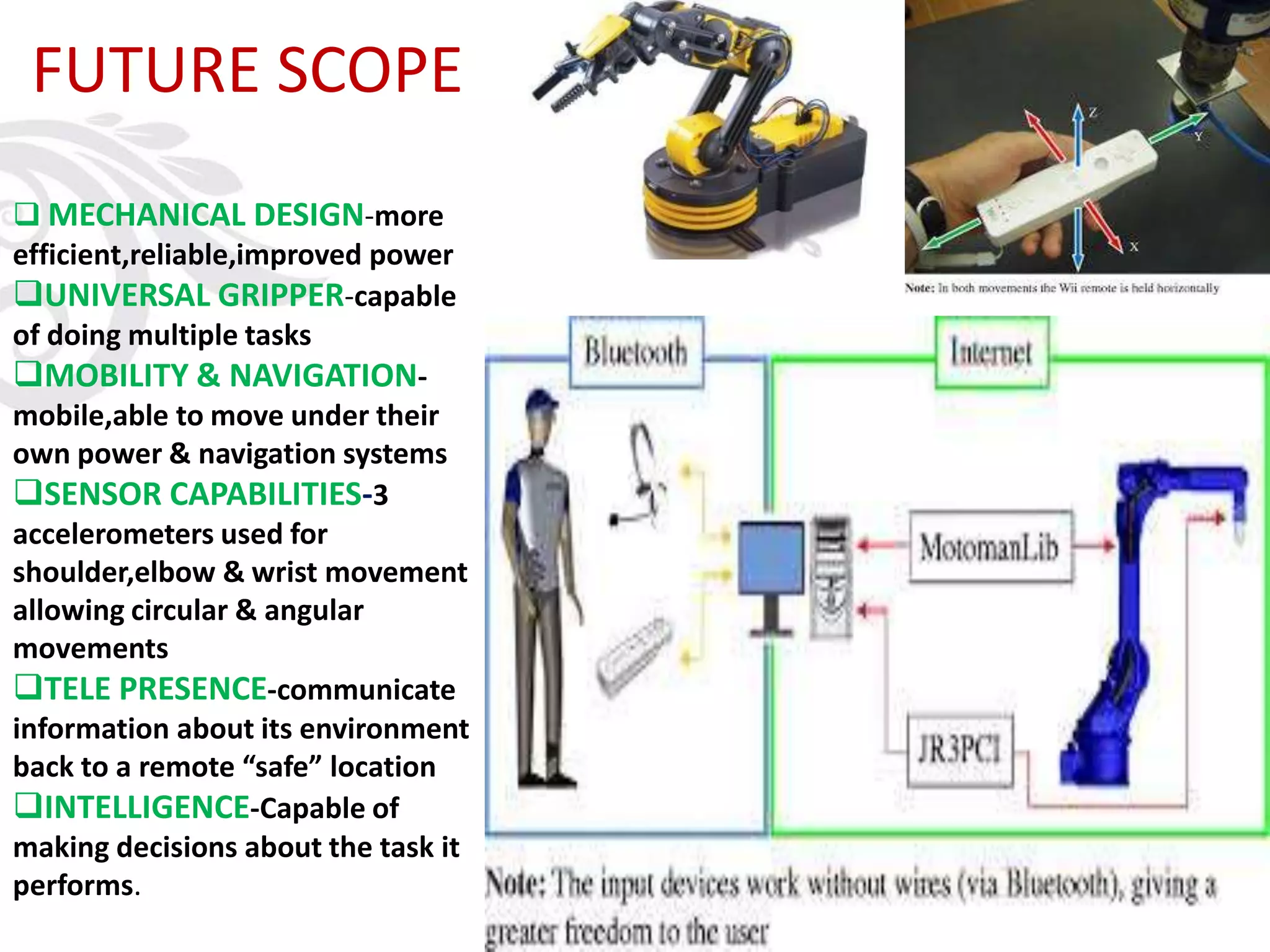
 MECHANICAL DESIGN-more
efficient,reliable,improved power
UNIVERSAL GRIPPER-capable
of doing multiple tasks
MOBILITY & NAVIGATION-
mobile,able to move under their
own power & navigation systems
SENSOR CAPABILITIES-3
accelerometers used for
shoulder,elbow & wrist movement
allowing circular & angular
movements
TELE PRESENCE-communicate
information about its environment
back to a remote “safe” location
INTELLIGENCE-Capable of
making decisions about the task it
performs.
CONCLUSION
Robots help people with tasks that would be
difficult, unsafe, or boring for a real person to do
alone. To conclude, robotic arm, is probably the
most mathematically complex robotic part one
could ever build.
ACKNOWLEDGEMENT
Our deepest thanks to our mentor, Mrs Antara
Mukherjee, for helping us out and guiding us
with her valuable suggestions and support.
Robo arm final  2 (2)

Robo arm final 2 (2)

  • 1.
  • 2.
    Presentedby AGNIBHA MUKHOPADHYAY DEBOLEENA MONDAL GODHULIBISWAS PRITAM BANERJEE SUBHANKAR JANA
  • 3.
    AIM OF THEPROJECT • The main aim of our project is to build a robotic arm that can grip or pick things • We have implemented the robotic arm that can be controlled by gesture commands. We have proposed a simple algorithm for hand gesture recognition.
  • 4.
  • 5.
    ROBO ARM &DEGREE OF FREEDOM • A robotic arm is a robotic manipulator, usually programmable, with similar functions to a human arm. • It has about the same number of degree of freedom as in human arm.
  • 6.
    MAKING OF ROBOTICSARM AT A GLANCE  The movement of the human arm is sensed by accelerometer  The accelerometer generates an analog voltage accordingly.  The movement of fingers is sensed by flex sensors which causes a change in the resistance  An impedance follower is used to convert the resistance to voltage.  The analog voltages are then digitized using an A/D converter .  It is then sent to the microcontroller.  Microcontroller differentiates all data of X-axis, Y-axis & Z-axis.  These data are used to generate PWM signal for corresponding servo motors.  The data from flex sensor are used to drive a motor driver  This motor driver drives the DC motor of the gripper part
  • 7.
    To build agestures control robotics arm We have technical details for every step of the way Sensors Module Logical Module Execution Module
  • 8.
  • 9.
    HOW THE GESTURESCAN BE CAPTURED? Analog output voltage Accelerometer & Flex Sensors Movement of human arm
  • 10.
    ACCELEROMETER • The movementof the human arm is sensed by accelerometer. • The accelerometer generates an analog voltage accordingly. • Analog voltage passes through a lowpass filter
  • 11.
    Mode of operation The 3-axis accelerometer attached to the right arm is used to recognize gestures and postures.  The robot moves along the X, Y and Z axes separately.  To move the robot in the X direction, the user should move the accelerometer along the X axis, keeping it in the horizontal.
  • 12.
    Recognition of gestures andpostures When the arm is moved in the positive X direction (X+) initially the value of acceleration x a increases because the arm begins to move and then, when the arm begins to slow the positive value of x a is converted to a negative value. This point ( a 0 x = ) marks the point of maximum speed. The acceleration a y remains near to zero and z a remains near to one because the accelerometer is held horizontally (acceleration due to gravity).
  • 13.
    For our projecta ±1.5g, ±6g three-axis low g micro machined accelerometer (MMA7361L) has been used  The MMA7361L is a low power, low profile capacitive micro machined accelerometer featuring signal conditioning , a 1-pole low pass filter, temperature compensation, self-test, 0g-Detect which detects linear free fall, and g-Select which allows for the selection between 2 sensitivities.  Zero-g offset and sensitivity are factory set and require no external devices. •The MMA7361L includes a Sleep Mode that makes it ideal for handheld battery powered electronics.
  • 14.
    GRIPPING MECHANISM For grippingmechanism, flex sensors are used on two fingers i.e forefinger and thumb.  Flex sensors are sensors that change in resistance depending on the amount of bend on the sensors. They convert the change in bend to electrical resistance-the more the bend, the more the resistance value
  • 15.
    Inside the flexsensor are carbon resistive elements within a thin flexible substrate.  More carbon means less resistance. When the substrate is bent the sensor produces a resistance output relative to the bend radius-the smaller the radius, the higher the resistance value
  • 16.
  • 17.
    HUMAN TO MCUINTERFACE • The analog voltage is then digitized using an A/D converter . • It is then sent to the microcontroller where it generates a unique 8 bit digit code for different axis and different voltages. Analog data enter to ADC MCU 8 bit binary data
  • 18.
    Atmega8(L)-FEW FEATURES The microcontrollerused for the project is Atmega8(L). ADC7..6 (TQFP andQFN/MLF Package Only)-In the TQFP and QFN/MLF package, ADC7..6 serve as analog inputs to the A/D converter.These pins are powered from the analog supply and serve as 10-bit ADC channels. The ATmega8 on the board comes pre-loaded with a bootloader program, which can be used to burn your project’s HEX files on the microcontroller directly via the USB connector without any separate programmer.
  • 19.
    HOW DOES THECIRCUIT WORK ? •The Port B of the microcontroller is set for the output. Reference voltage is at AVcc. •The ADC converts an analog input voltage to a 8-bit digital value through successive approximation.. •The ADC is enabled by setting the ADC Enable bit, ADEN in ADCSRA. •The ADC generates a 10-bit result which is presented in the ADC Data Registers, ADCH and ADCL. •A single conversion is started by writing a logical one to the ADC Start Conversion bit, ADSC. This bit stays high as long as the conversion is in progress and will be cleared by hardware when the conversion is completed.
  • 20.
    Activating the accelerometer: •Accelerometer firstremains at sleep mode. •A positive high signal sent to SL pin of accelerometer through PB4 pin of MCU to activate the accelerometer.
  • 21.
    Initializing PWM fordriving motors: •The Timer/Counter (TCNT1), Output Compare Registers (OCR1A/B), and Input Capture Register(ICR1) are all 16-bit registers. •The double buffered Output Compare Registers (OCR1A/B) are compared with the Timer/Counter value at all time. The result of the compare can be used by the waveform generator to generate a PWM or variable frequency output on the Output Compare Pin (OC1A/B). •The 16bit timer/counter1 (TCNT1) is set for fast PWM mode. The time period is set at 20ms. The Timer/Counter can be clocked internally, via the prescalar. Prescalar value is set at 64 division factor •For output PB1 and PB2 are selected
  • 22.
    MCU TO MECHANICALPART INTERFACE • The 8 bit data is then sent to be compared with registers of Timer1. • Content of OCR1A & OCR1B are compared with ICR1 and PWM signals are generated.
  • 23.
    EXECUTION Module Collect dataand Follow instructions
  • 24.
    WORKING OF MECHANICALPART Movement of ROBOTICS ARM Motors Motor driver
  • 25.
    MOTORS • Motors areused for joint rotation. • The base consists of a servo motor allowing forward/backward movement. • The elbow consists of a servo motor allowing up/down movement of the arm. • The grip consists of a d.c. motor allowing to grip a object.
  • 26.
    What makes aServo Servo motors are constructed out of basic DC motors, by adding: • some gear reduction • a position sensor for the motor shaft • an electronic circuit that controls the motor's operation
  • 27.
    Feed-back loop It isa closed servomechanism that uses position feedback to control its motion and final position.  The input to its control is some signal, either analogue or digital, representing the position commanded for the output shaft. The motor is paired with some type of encoder to provide position and speed feedback.
  • 28.
    How do servo motorswork ? Servos are controlled by sending an electrical pulse of variable width, or pulse width modulation (PWM), through the control wire.  There is a minimum pulse, a maximum pulse, and a repetition rate.  Servo motors can usually only turn 90 degrees in either direction for a total of 180 degree movement. The PWM sent to the motor determines position of the shaft, and based on the duration of the pulse sent via the control wire; the rotor will turn to the desired position.  The servo motor expects to see a pulse every 20 milliseconds (ms) and the length of the pulse will determine how far the motor turns. For example, a 1.5ms pulse will make the motor turn to the 90-degree position. Shorter than 1.5ms moves it to 0 degrees, and any longer than 1.5ms will turn the servo to 180 degrees,
  • 29.
    GRIP  Dc motorwhich is driven by a motor driver (L293D) is used for the gripper part. The L293D is designed to provide bidirectional drive currents of up to 600-mA at voltages from 4.5 V to 36 V.
  • 30.
    gg The bentin fingers is indicated by the change in resistance which in turn drives the dc motor attached to the gripper.  As the motor rotates the gripper closes in thus grabbing the object in between.
  • 31.
    D.C.MOTOR SERVO MOTOR SERVO MOTOR BASE Thearm is made with balsa wood. The wood pieces are carefully cut according to the measurements and then they are put together to form the structure of the arm.
  • 32.
    ?But wait… There’s More! Whywe need ROBOTICS ARM???
  • 33.
    . The roboticarm can be designed to perform any desired task such as welding, gripping, spinning etc. . The space shuttle Remote Manipulator System have multi degree of freedom robotic arms . In various industrial or home applications . In medical science: soft tissue manipulation, needle insertion, suturing, and cauterization. SOME APPLICATIONS
  • 34.
    FUTURE SCOPE  MECHANICALDESIGN-more efficient,reliable,improved power UNIVERSAL GRIPPER-capable of doing multiple tasks MOBILITY & NAVIGATION- mobile,able to move under their own power & navigation systems SENSOR CAPABILITIES-3 accelerometers used for shoulder,elbow & wrist movement allowing circular & angular movements TELE PRESENCE-communicate information about its environment back to a remote “safe” location INTELLIGENCE-Capable of making decisions about the task it performs.
  • 35.
    CONCLUSION Robots help peoplewith tasks that would be difficult, unsafe, or boring for a real person to do alone. To conclude, robotic arm, is probably the most mathematically complex robotic part one could ever build.
  • 36.
    ACKNOWLEDGEMENT Our deepest thanksto our mentor, Mrs Antara Mukherjee, for helping us out and guiding us with her valuable suggestions and support.

Editor's Notes

  • #2 This presentation demonstrates the new capabilities of PowerPoint and it is best viewed in Slide Show. These slides are designed to give you great ideas for the presentations you’ll create in PowerPoint 2010!For more sample templates, click the File tab, and then on the New tab, click Sample Templates.