





HEXAPOD
JOTHIRAJ.S
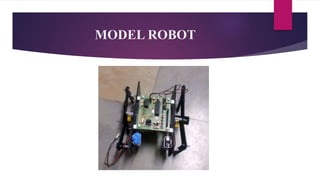
MODEL ROBOT
ABSTRACT
 The aim of the project is to build a six‐legged walking robot that is capable of
basic mobility tasks such as walking forward, backward, rotating in place and
raising or lowering the body height.
 The legs will be of a modular design and will have three degrees of freedom
each.
 This robot will serve as a platform onto which additional sensory components
could be added, or which could be programmed to perform increasingly complex
motions.
 This report discusses the components that make up our final design.
INTRODUCTION
 Walking machines are desirable because they can navigate terrain features that are similar in
size to the size of the robot, whereas wheeled and tracked vehicles are only suitable for
obstacles smaller than half the diameter of the wheel.
 Furthermore, if given an ability to find locally horizontal footholds in regionally steep terrain,
they can climb extreme angles.
 Applications potentially include reaching territories which are unreachable or dangerous for
humans, exploration, mining, military, rescue, and industrial environments, on earth and
beyond.
 For walking machines, mostly two legged (biped), four legged (quadruped), and six legged
(hexapod) constructions are used. The hexapod is the most stable of the named machines. This
is why an autonomous hexapod robot was built with 18 DOFs (degree of freedom).
DESIGN CONSIDERATION
 The mechanical structure of robot body.
 leg architecture.
 actuators and drive mechanisms.
 power supply.
 walking gaits and speed.
 obstacle avoidance capability.
 Payload.
 Autonomy.
 operation features.
 cost.
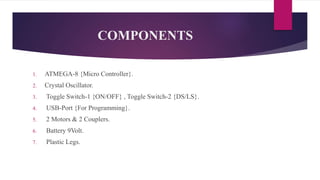
COMPONENTS
1. ATMEGA-8 {Micro Controller}.
2. Crystal Oscillator.
3. Toggle Switch-1 {ON/OFF} , Toggle Switch-2 {DS/LS}.
4. USB-Port {For Programming}.
5. 2 Motors & 2 Couplers.
6. Battery 9Volt.
7. Plastic Legs.
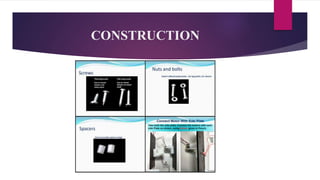
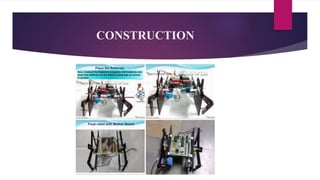
CONSTRUCTION
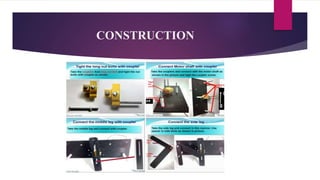
CONSTRUCTION
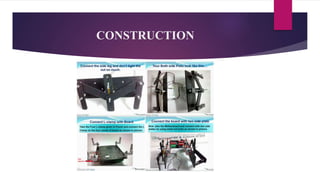
CONSTRUCTION
CONSTRUCTION
SOFTWARE USED
HID BOOTFLASH SOFTWARE
PROGRAMMING
SOURCE CODE
#include<avr/io.h>
#include<util/delay.h>
int main(void) {
DDRD=0xF0; //Setting the data direction of PORTD where motors are connected
while(1)
{
PORTD=0x60; //moving ROBOT forward
_delay_ms(1000);
PORTD=0x90; //moving ROBOT backward
_delay_ms(1000);
} }
CONCLUSION
 An overview of the state of the art on six-leg
walking robots is detailed.
 Careful attention is paid to the main design
issues and constraints that influence the
technical feasibility and performance of these
systems.
 A design procedure is outlined in order to
systematically design a six-leg walking robot.
REFERENCE
 http://poisson.me.dal.ca/~dp_08_02/Site/Documentation_files/Build_Report.pdf
 http://www.uni-obuda.hu/journal/Burkus_Odry_13.pdf
 http://www.technophilia.co.in/Workshop_Details.aspx?WorkshopModuleId=1&Worksh
optypeId=79

Hexapod - Robot

  • 1.
  • 2.
  • 3.
    ABSTRACT  The aimof the project is to build a six‐legged walking robot that is capable of basic mobility tasks such as walking forward, backward, rotating in place and raising or lowering the body height.  The legs will be of a modular design and will have three degrees of freedom each.  This robot will serve as a platform onto which additional sensory components could be added, or which could be programmed to perform increasingly complex motions.  This report discusses the components that make up our final design.
  • 4.
    INTRODUCTION  Walking machinesare desirable because they can navigate terrain features that are similar in size to the size of the robot, whereas wheeled and tracked vehicles are only suitable for obstacles smaller than half the diameter of the wheel.  Furthermore, if given an ability to find locally horizontal footholds in regionally steep terrain, they can climb extreme angles.  Applications potentially include reaching territories which are unreachable or dangerous for humans, exploration, mining, military, rescue, and industrial environments, on earth and beyond.  For walking machines, mostly two legged (biped), four legged (quadruped), and six legged (hexapod) constructions are used. The hexapod is the most stable of the named machines. This is why an autonomous hexapod robot was built with 18 DOFs (degree of freedom).
  • 5.
    DESIGN CONSIDERATION  Themechanical structure of robot body.  leg architecture.  actuators and drive mechanisms.  power supply.  walking gaits and speed.  obstacle avoidance capability.  Payload.  Autonomy.  operation features.  cost.
  • 6.
    COMPONENTS 1. ATMEGA-8 {MicroController}. 2. Crystal Oscillator. 3. Toggle Switch-1 {ON/OFF} , Toggle Switch-2 {DS/LS}. 4. USB-Port {For Programming}. 5. 2 Motors & 2 Couplers. 6. Battery 9Volt. 7. Plastic Legs.
  • 7.
  • 8.
  • 9.
  • 10.
  • 11.
  • 12.
  • 13.
    SOURCE CODE #include<avr/io.h> #include<util/delay.h> int main(void){ DDRD=0xF0; //Setting the data direction of PORTD where motors are connected while(1) { PORTD=0x60; //moving ROBOT forward _delay_ms(1000); PORTD=0x90; //moving ROBOT backward _delay_ms(1000); } }
  • 14.
    CONCLUSION  An overviewof the state of the art on six-leg walking robots is detailed.  Careful attention is paid to the main design issues and constraints that influence the technical feasibility and performance of these systems.  A design procedure is outlined in order to systematically design a six-leg walking robot.
  • 15.