Pick N Place Robot
Presented by:
Ankita Tiwari
M.Tech EST- II semester
A7629416004
Introduction:
 Pick and Place robot is the one which is used to pick up an object and
place it in the desired location. It can be a cylindrical robot providing
movement in horizontal, vertical and rotational axes, a spherical robot
providing two rotational and one linear movement, an articulate robot
or a scara robot (fixed robots with 3 vertical axes rotary arms).
Parts of a Pick N Place Robot
 A Rover: It is the main body of the robot consisting of several rigid
bodies like a cylinder or a sphere, joints and links. It is also known
as a manipulator.
 End Effector: It is the body connected to the last joint of the rover
which is used for the purpose of gripping or handling objects. It
can be an analogy to the arm of a human being.
Parts of a Pick N Place Robot
 Actuators: They are the drivers of the robot. It actually actuates the
robot. It can be any motor like servo motor, stepper motor or
pneumatic or hydraulic cylinders.
 Sensors: They are used to sense the internal as well as the external
state to make sure the robot functions smoothly as a whole. Sensors
involve touch sensors, IR sensor etc.
 Controller: It is used to control the actuators based on the sensor
feedback and thus control the motion of each and every joint and
eventually the movement of the end effector.
Working of a Basic Pick N Place Robot:
 The basic function of a pick and place robot is done by its joints. Joints are
analogous to human joints and are used to join the two consecutive rigid
bodies in the robot. They can be rotary joint or linear joint.
 To add a joint to any link of a robot, we need to know about the degrees of
freedom and degrees of movement for that body part. Degrees of freedom
implement the linear and rotational movement of the body and Degrees of
movement imply the number of axis the body can move.
Working of a Basic Pick N Place Robot:
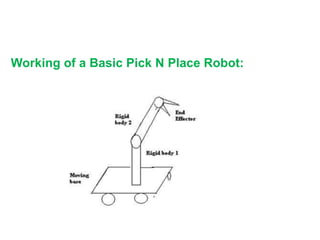
 A simple pick and place robot consists of two rigid bodies on a moving
base, connected together with rotary joint. A rotary joint is a one which
provides rotation in 360 degrees around any one of the axes.
 The bottom or the base is attached with wheels which provide linear
movement.
 The 1st rigid body is fixed and supports the second rigid body to which the
end effector is provided.
 The 2nd rigid body is provided with movement in all 3 axes and has 3
degrees of freedom. It is connected to the 1st body with a rotational joint.
Working of a Basic Pick N Place Robot:
 The end effector should accommodate all 6 degrees of freedom, in order
to reach all sides of the component, to take up position to any height.
On a whole, the basic pick and place robot works as follows:
 The wheels underneath the base help to move the robot to the
desired location.
 The rigid body supporting the end effector bends or straightens up
to reach the position where the object is placed.
 The end effector picks up the object with a strong grip and places it
at the desired position.
How Pick N Place Robot Actually Controlled
 A simple pick and place robot can be controlled by controlling the
movement of its end effector.
 The motion can be using hydraulic motion, i.e. using hydraulic fluid
under pressure to the drive the robot, or using pneumatic motion, i.e.
using pressurized air to cause mechanical motion.
 The most effective way is using motors to provide the required motion.
 The motors have to be controlled in order to provide required motion
to the robot and the end effector.
Working Example of Controlling a Pick N Place Robot
 How about controlling the robot with a just a few buttons on the
keypad.
 Yes, it is possible! Just pressing the required button.
 We can transmit command to the robot to make it move in any
direction to achieve our task.
 This can be achieved using simple wireless communication.
Working Example of Controlling a Pick N Place Robot
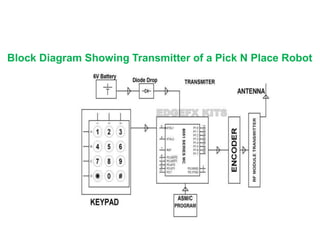
 The transmitter part consists of the keypad interfaced to the
microcontroller.
 Any button number in decimal format is converted to 4 digit binary by
the microcontroller and the parallel output at one of its port is
applied to the encoder.
 The encoder converts this parallel data to serial data and this is fed to
the transmitter, fitted with an antenna to transmit the serial data.
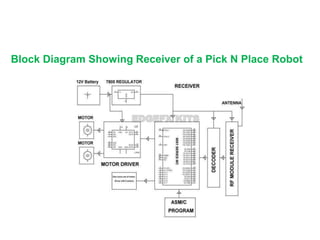
Block Diagram Showing Transmitter of a Pick N Place Robot
Working Example of Controlling a Pick N Place Robot
 The receiver side consists of a decoder interfaced to the
microcontroller.
 The decoder converts the received command in serial format to the
parallel form and gives this data to the microcontroller.
 Based on this command the microcontroller sends the appropriate
input signals to the motor drivers to drive the respective motors.
Block Diagram Showing Receiver of a Pick N Place Robot
Working Example of Controlling a Pick N Place Robot
 The system consists of two motors for providing motion to the whole
robot.
 Two other motors to provide the arm motion.
 The end effector or the gripper needs to be controlled to apply proper
pressure on the object.
 To give it a soft grip by controlling the arm motors through proper
command.
 The output from the arm motors is connected to a 10Ohms/2W resistor.
Working Example of Controlling a Pick N Place Robot
 At the time of motor over load or locked condition, a high voltage is
developed across the resistor.
 It causes a logic high level at the output of the Opto-isolator.
 The interrupt pin of the microcontroller connected to the Opto-
isolator output through a PNP transistor gets logic low signal.
 It halts all other operations of the gripper.
Advantages
 They are faster and can get the work done in seconds compared
to their human counterparts.
 They are flexible and have the appropriate design.
 They are accurate.
 They increase the safety of the working environment and
actually never get tired.
Disadvantages
1. Expense: The initial investment to integrated automated robotics into
your business is significant. Regular maintenance needs can have a financial
toll as well.
2. ROI: Incorporating industrial robots does not guarantee results. Without
planning, companies can have difficulty achieving their goals.
3. Expertise: Employees will require training program and interact with the
new robotic equipment. This normally takes time and financial output.
4. Safety: Robots may protect workers from some hazards, but in the
meantime, their very presence can create other safety problems. These new
dangers must be taken into consideration.
Practical Applications of Pick and Place Robot
 Defense Applications: It can be used for surveillance and also to pick up
harmful objects like bombs and diffuse them safely.
 Industrial Applications: Pick and Place Robots are used in
manufacturing, to pick up the required parts and place it in correct
position to complete the machinery fixture. It can be also used to place
objects on the conveyer belt as well as pick up defective products from
the conveyer belt.
 Medical Applications: These robots can be used in various surgical
operations like in joint replacement operations, orthopaedic and internal
surgery operations. It performs the operations with more precision and
accuracy.
Sem2 robotics ppt

Sem2 robotics ppt

  • 1.
    Pick N PlaceRobot Presented by: Ankita Tiwari M.Tech EST- II semester A7629416004
  • 2.
    Introduction:  Pick andPlace robot is the one which is used to pick up an object and place it in the desired location. It can be a cylindrical robot providing movement in horizontal, vertical and rotational axes, a spherical robot providing two rotational and one linear movement, an articulate robot or a scara robot (fixed robots with 3 vertical axes rotary arms).
  • 3.
    Parts of aPick N Place Robot  A Rover: It is the main body of the robot consisting of several rigid bodies like a cylinder or a sphere, joints and links. It is also known as a manipulator.  End Effector: It is the body connected to the last joint of the rover which is used for the purpose of gripping or handling objects. It can be an analogy to the arm of a human being.
  • 4.
    Parts of aPick N Place Robot  Actuators: They are the drivers of the robot. It actually actuates the robot. It can be any motor like servo motor, stepper motor or pneumatic or hydraulic cylinders.  Sensors: They are used to sense the internal as well as the external state to make sure the robot functions smoothly as a whole. Sensors involve touch sensors, IR sensor etc.  Controller: It is used to control the actuators based on the sensor feedback and thus control the motion of each and every joint and eventually the movement of the end effector.
  • 5.
    Working of aBasic Pick N Place Robot:  The basic function of a pick and place robot is done by its joints. Joints are analogous to human joints and are used to join the two consecutive rigid bodies in the robot. They can be rotary joint or linear joint.  To add a joint to any link of a robot, we need to know about the degrees of freedom and degrees of movement for that body part. Degrees of freedom implement the linear and rotational movement of the body and Degrees of movement imply the number of axis the body can move.
  • 6.
    Working of aBasic Pick N Place Robot:
  • 7.
    Working of aBasic Pick N Place Robot:  A simple pick and place robot consists of two rigid bodies on a moving base, connected together with rotary joint. A rotary joint is a one which provides rotation in 360 degrees around any one of the axes.  The bottom or the base is attached with wheels which provide linear movement.  The 1st rigid body is fixed and supports the second rigid body to which the end effector is provided.  The 2nd rigid body is provided with movement in all 3 axes and has 3 degrees of freedom. It is connected to the 1st body with a rotational joint.
  • 8.
    Working of aBasic Pick N Place Robot:  The end effector should accommodate all 6 degrees of freedom, in order to reach all sides of the component, to take up position to any height. On a whole, the basic pick and place robot works as follows:  The wheels underneath the base help to move the robot to the desired location.  The rigid body supporting the end effector bends or straightens up to reach the position where the object is placed.  The end effector picks up the object with a strong grip and places it at the desired position.
  • 9.
    How Pick NPlace Robot Actually Controlled  A simple pick and place robot can be controlled by controlling the movement of its end effector.  The motion can be using hydraulic motion, i.e. using hydraulic fluid under pressure to the drive the robot, or using pneumatic motion, i.e. using pressurized air to cause mechanical motion.  The most effective way is using motors to provide the required motion.  The motors have to be controlled in order to provide required motion to the robot and the end effector.
  • 10.
    Working Example ofControlling a Pick N Place Robot  How about controlling the robot with a just a few buttons on the keypad.  Yes, it is possible! Just pressing the required button.  We can transmit command to the robot to make it move in any direction to achieve our task.  This can be achieved using simple wireless communication.
  • 11.
    Working Example ofControlling a Pick N Place Robot  The transmitter part consists of the keypad interfaced to the microcontroller.  Any button number in decimal format is converted to 4 digit binary by the microcontroller and the parallel output at one of its port is applied to the encoder.  The encoder converts this parallel data to serial data and this is fed to the transmitter, fitted with an antenna to transmit the serial data.
  • 12.
    Block Diagram ShowingTransmitter of a Pick N Place Robot
  • 13.
    Working Example ofControlling a Pick N Place Robot  The receiver side consists of a decoder interfaced to the microcontroller.  The decoder converts the received command in serial format to the parallel form and gives this data to the microcontroller.  Based on this command the microcontroller sends the appropriate input signals to the motor drivers to drive the respective motors.
  • 14.
    Block Diagram ShowingReceiver of a Pick N Place Robot
  • 15.
    Working Example ofControlling a Pick N Place Robot  The system consists of two motors for providing motion to the whole robot.  Two other motors to provide the arm motion.  The end effector or the gripper needs to be controlled to apply proper pressure on the object.  To give it a soft grip by controlling the arm motors through proper command.  The output from the arm motors is connected to a 10Ohms/2W resistor.
  • 16.
    Working Example ofControlling a Pick N Place Robot  At the time of motor over load or locked condition, a high voltage is developed across the resistor.  It causes a logic high level at the output of the Opto-isolator.  The interrupt pin of the microcontroller connected to the Opto- isolator output through a PNP transistor gets logic low signal.  It halts all other operations of the gripper.
  • 17.
    Advantages  They arefaster and can get the work done in seconds compared to their human counterparts.  They are flexible and have the appropriate design.  They are accurate.  They increase the safety of the working environment and actually never get tired.
  • 18.
    Disadvantages 1. Expense: Theinitial investment to integrated automated robotics into your business is significant. Regular maintenance needs can have a financial toll as well. 2. ROI: Incorporating industrial robots does not guarantee results. Without planning, companies can have difficulty achieving their goals. 3. Expertise: Employees will require training program and interact with the new robotic equipment. This normally takes time and financial output. 4. Safety: Robots may protect workers from some hazards, but in the meantime, their very presence can create other safety problems. These new dangers must be taken into consideration.
  • 19.
    Practical Applications ofPick and Place Robot  Defense Applications: It can be used for surveillance and also to pick up harmful objects like bombs and diffuse them safely.  Industrial Applications: Pick and Place Robots are used in manufacturing, to pick up the required parts and place it in correct position to complete the machinery fixture. It can be also used to place objects on the conveyer belt as well as pick up defective products from the conveyer belt.  Medical Applications: These robots can be used in various surgical operations like in joint replacement operations, orthopaedic and internal surgery operations. It performs the operations with more precision and accuracy.