WHY BLACK SWANS DO NOT EXIST
IN DISASTER RISK REDUCTION
a critique of Nassim Nicholas Taleb's theory
Prof. David Alexander
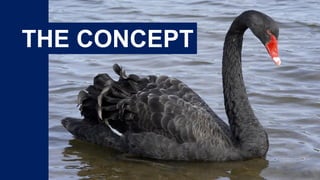
THE CONCEPT
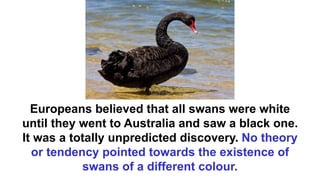
Europeans believed that all swans were white
until they went to Australia and saw a black one.
It was a totally unpredicted discovery. No theory
or tendency pointed towards the existence of
swans of a different colour.
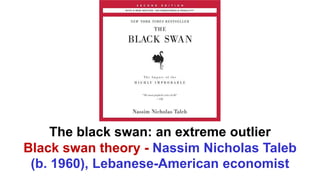
The black swan: an extreme outlier
Black swan theory - Nassim Nicholas Taleb
(b. 1960), Lebanese-American economist
"The central idea in The Black Swan
is that rare events cannot be
estimated from empirical
observation because they are rare."
- Nassim Nicholas Taleb
"We know from chaos theory that even if
you had a perfect model of the world, you
would need infinite precision in order to
predict future events. With sociopolitical or
economic phenomena, we do not have
anything like that."
- Nassim Nicholas Taleb
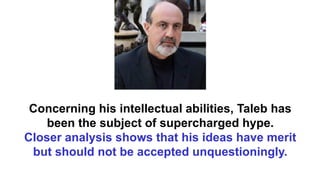
Concerning his intellectual abilities, Taleb has
been the subject of supercharged hype.
Closer analysis shows that his ideas have merit
but should not be accepted unquestioningly.
He is fond of aphorisms which, if they are
apposite, are distilled wisdom, and, if they are
not, are misleading oversimplifications.
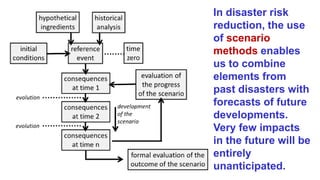
In disaster risk
reduction, the use
of scenario
methods enables
us to combine
elements from
past disasters with
forecasts of future
developments.
Very few impacts
in the future will be
entirely
unanticipated.
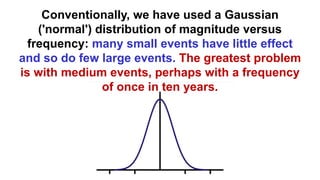
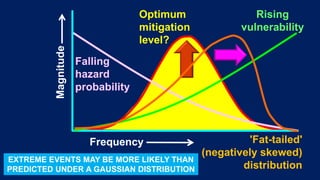
Conventionally, we have used a Gaussian
('normal') distribution of magnitude versus
frequency: many small events have little effect
and so do few large events. The greatest problem
is with medium events, perhaps with a frequency
of once in ten years.
Falling
hazard
probability
Rising
vulnerability
Optimum
mitigation
level?
'Fat-tailed'
(negatively skewed)
distribution
Magnitude
Frequency
EXTREME EVENTS MAY BE MORE LIKELY THAN
PREDICTED UNDER A GAUSSIAN DISTRIBUTION
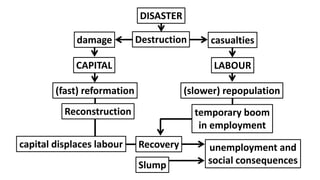
ECONOMICS
DISASTER
Destruction
damage casualties
CAPITAL LABOUR
(fast) reformation (slower) repopulation
temporary boom
in employment
Reconstruction
Recovery
capital displaces labour unemployment and
social consequences
Slump
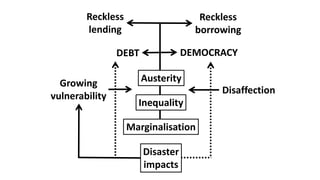
Reckless
lending
Reckless
borrowing
DEBT DEMOCRACY
Austerity
Inequality
Marginalisation
Disaffection
Disaster
impacts
Growing
vulnerability
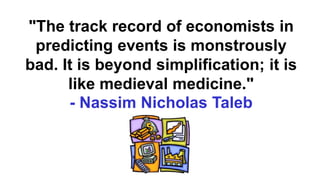
"The track record of economists in
predicting events is monstrously
bad. It is beyond simplification; it is
like medieval medicine."
- Nassim Nicholas Taleb
ANTIFRAGILITY
vere magnum habere in se fragilitatem
hominis ac securitatem Dei
It is a sign of true greatness to have the
fragility of a man together with the self-
confidence of a god.
Lucius Annaeus Seneca, 4BC - AD65
Fragility, from the Latin fragilitas, is the quality of
being easily broken. For the inanimate world, a
fragile material is one that is liable to be
damaged or destroyed. If it lacks an adequately
robust structure, it can be described as weak: if
by its very nature it lacks resistance to applied
forces, it can be termed delicate.
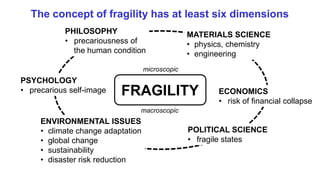
MATERIALS SCIENCE
• physics, chemistry
• engineering
ENVIRONMENTAL ISSUES
• climate change adaptation
• global change
• sustainability
• disaster risk reduction
PHILOSOPHY
• precariousness of
the human condition
ECONOMICS
• risk of financial collapse
POLITICAL SCIENCE
• fragile states
FRAGILITY
PSYCHOLOGY
• precarious self-image
macroscopic
microscopic
The concept of fragility has at least six dimensions
"When you ask people, 'What's the opposite
of fragile?,' they tend to say robust,
resilient, adaptable, solid, strong. That's not
it. The opposite of fragile is something that
gains from disorder."
- Nassim Nicholas Taleb
Antifragility - systems exhibit an ability to
benefit and grow from volatility.
"We humans, facing limits of knowledge,
and things we do not observe, the unseen
and the unknown, resolve the tension by
squeezing life and the world into crisp
commoditized ideas".
- Nassim Nicholas Taleb, The Bed of
Procrustes
CONCLUSION
Economics is an exceptionalist
discipline, one whose ideas cannot be
transferred easily to other disciplines,
even within the social sciences.
Self-condemnation?
"Being an economist is the least ethical profession,
closer to charlatanism than any science."
- Nassim Nicholas Taleb
"A good maxim allows you to have the last word
without even starting a conversation."
- Nassim Nicholas Taleb
"If you give advice, you need to be
exposed to losses from it."
Taleb, Commencement Address,
American University of Beirut, 2016
The problem is not Taleb and his
ideas, but their unquestioning
acceptance by people who would
rather follow them than think.
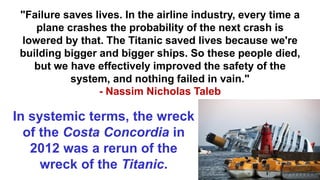
"Failure saves lives. In the airline industry, every time a
plane crashes the probability of the next crash is
lowered by that. The Titanic saved lives because we're
building bigger and bigger ships. So these people died,
but we have effectively improved the safety of the
system, and nothing failed in vain."
- Nassim Nicholas Taleb
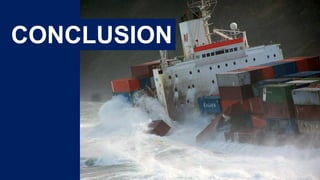
In systemic terms, the wreck
of the Costa Concordia in
2012 was a rerun of the
wreck of the Titanic.
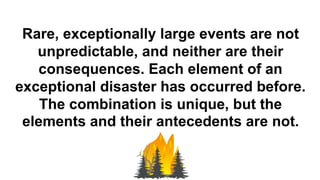
Rare, exceptionally large events are not
unpredictable, and neither are their
consequences. Each element of an
exceptional disaster has occurred before.
The combination is unique, but the
elements and their antecedents are not.
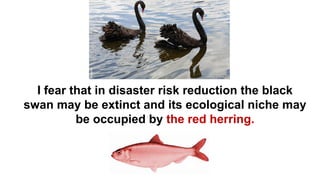
I fear that in disaster risk reduction the black
swan may be extinct and its ecological niche may
be occupied by the red herring.
DISASTER
POLITICS
ECONOMICS
SOCIAL CONDITIONS
PHYSICAL IMPACT
Politics in
the service
of economics
VULNERABILITY
knowledge is ideology
Complexity
Ideology
• extremism
• separatism
• isolationism
• exclusion
• austerity
Conflict
Climate change
Demographic change
• human mobility
Culture
Underlying risk drivers
[x]

Black swans a critique

  • 1.
    WHY BLACK SWANSDO NOT EXIST IN DISASTER RISK REDUCTION a critique of Nassim Nicholas Taleb's theory Prof. David Alexander
  • 2.
  • 3.
    Europeans believed thatall swans were white until they went to Australia and saw a black one. It was a totally unpredicted discovery. No theory or tendency pointed towards the existence of swans of a different colour.
  • 4.
    The black swan:an extreme outlier Black swan theory - Nassim Nicholas Taleb (b. 1960), Lebanese-American economist
  • 5.
    "The central ideain The Black Swan is that rare events cannot be estimated from empirical observation because they are rare." - Nassim Nicholas Taleb
  • 6.
    "We know fromchaos theory that even if you had a perfect model of the world, you would need infinite precision in order to predict future events. With sociopolitical or economic phenomena, we do not have anything like that." - Nassim Nicholas Taleb
  • 7.
    Concerning his intellectualabilities, Taleb has been the subject of supercharged hype. Closer analysis shows that his ideas have merit but should not be accepted unquestioningly.
  • 8.
    He is fondof aphorisms which, if they are apposite, are distilled wisdom, and, if they are not, are misleading oversimplifications.
  • 9.
    In disaster risk reduction,the use of scenario methods enables us to combine elements from past disasters with forecasts of future developments. Very few impacts in the future will be entirely unanticipated.
  • 10.
    Conventionally, we haveused a Gaussian ('normal') distribution of magnitude versus frequency: many small events have little effect and so do few large events. The greatest problem is with medium events, perhaps with a frequency of once in ten years.
  • 11.
  • 12.
  • 13.
    DISASTER Destruction damage casualties CAPITAL LABOUR (fast)reformation (slower) repopulation temporary boom in employment Reconstruction Recovery capital displaces labour unemployment and social consequences Slump
  • 14.
  • 15.
    "The track recordof economists in predicting events is monstrously bad. It is beyond simplification; it is like medieval medicine." - Nassim Nicholas Taleb
  • 16.
  • 17.
    vere magnum haberein se fragilitatem hominis ac securitatem Dei It is a sign of true greatness to have the fragility of a man together with the self- confidence of a god. Lucius Annaeus Seneca, 4BC - AD65
  • 18.
    Fragility, from theLatin fragilitas, is the quality of being easily broken. For the inanimate world, a fragile material is one that is liable to be damaged or destroyed. If it lacks an adequately robust structure, it can be described as weak: if by its very nature it lacks resistance to applied forces, it can be termed delicate.
  • 19.
    MATERIALS SCIENCE • physics,chemistry • engineering ENVIRONMENTAL ISSUES • climate change adaptation • global change • sustainability • disaster risk reduction PHILOSOPHY • precariousness of the human condition ECONOMICS • risk of financial collapse POLITICAL SCIENCE • fragile states FRAGILITY PSYCHOLOGY • precarious self-image macroscopic microscopic The concept of fragility has at least six dimensions
  • 20.
    "When you askpeople, 'What's the opposite of fragile?,' they tend to say robust, resilient, adaptable, solid, strong. That's not it. The opposite of fragile is something that gains from disorder." - Nassim Nicholas Taleb Antifragility - systems exhibit an ability to benefit and grow from volatility.
  • 21.
    "We humans, facinglimits of knowledge, and things we do not observe, the unseen and the unknown, resolve the tension by squeezing life and the world into crisp commoditized ideas". - Nassim Nicholas Taleb, The Bed of Procrustes
  • 22.
  • 23.
    Economics is anexceptionalist discipline, one whose ideas cannot be transferred easily to other disciplines, even within the social sciences.
  • 24.
    Self-condemnation? "Being an economistis the least ethical profession, closer to charlatanism than any science." - Nassim Nicholas Taleb "A good maxim allows you to have the last word without even starting a conversation." - Nassim Nicholas Taleb
  • 25.
    "If you giveadvice, you need to be exposed to losses from it." Taleb, Commencement Address, American University of Beirut, 2016
  • 26.
    The problem isnot Taleb and his ideas, but their unquestioning acceptance by people who would rather follow them than think.
  • 27.
    "Failure saves lives.In the airline industry, every time a plane crashes the probability of the next crash is lowered by that. The Titanic saved lives because we're building bigger and bigger ships. So these people died, but we have effectively improved the safety of the system, and nothing failed in vain." - Nassim Nicholas Taleb In systemic terms, the wreck of the Costa Concordia in 2012 was a rerun of the wreck of the Titanic.
  • 28.
    Rare, exceptionally largeevents are not unpredictable, and neither are their consequences. Each element of an exceptional disaster has occurred before. The combination is unique, but the elements and their antecedents are not.
  • 29.
    I fear thatin disaster risk reduction the black swan may be extinct and its ecological niche may be occupied by the red herring.
  • 30.
    DISASTER POLITICS ECONOMICS SOCIAL CONDITIONS PHYSICAL IMPACT Politicsin the service of economics VULNERABILITY knowledge is ideology Complexity Ideology • extremism • separatism • isolationism • exclusion • austerity Conflict Climate change Demographic change • human mobility Culture Underlying risk drivers [x]