World Health Organization - Indonesia
1 |
Disaster and Crisis ManagementDisaster and Crisis Management
Safety Leadership, Disaster & Crisis ManagementSafety Leadership, Disaster & Crisis Management
International SeminarInternational Seminar
2626thth
March 2013March 2013
Dr Nirmal Kandel , MBBS, MA (Anthropology), MPH
WHO Indonesia
World Health Organization - Indonesia
2 |
Outline
Past Incidents
Terminologies
Disaster Management
Crisis Management
In relation
World Health Organization - Indonesia
3 |
World Health Organization - Indonesia
4 |
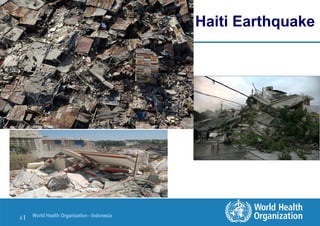
Haiti Earthquake
World Health Organization - Indonesia
5 |
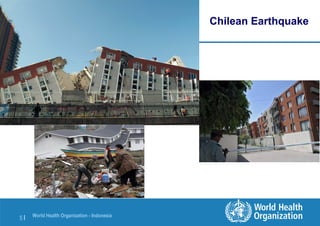
Chilean Earthquake
World Health Organization - Indonesia
6 |
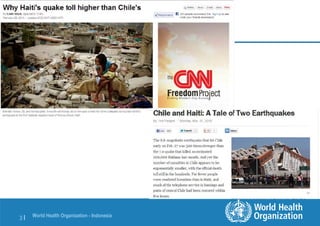
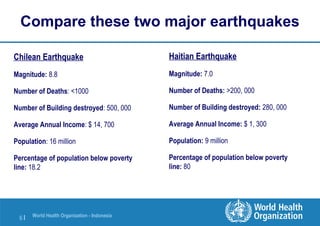
Compare these two major earthquakes
Chilean Earthquake
Magnitude: 8.8
Number of Deaths: <1000
Number of Building destroyed: 500, 000
Average Annual Income: $ 14, 700
Population: 16 million
Percentage of population below poverty
line: 18.2
Haitian Earthquake
Magnitude: 7.0
Number of Deaths: >200, 000
Number of Building destroyed: 280, 000
Average Annual Income: $ 1, 300
Population: 9 million
Percentage of population below poverty
line: 80
World Health Organization - Indonesia
7 |
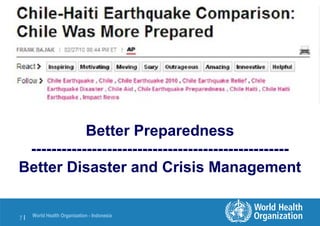
Better Preparedness
---------------------------------------------------
Better Disaster and Crisis Management
World Health Organization - Indonesia
8 |
Terminology
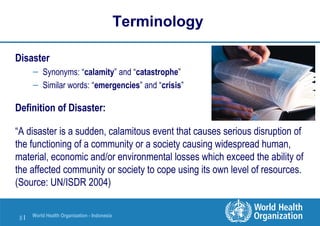
Disaster
– Synonyms: “calamity” and “catastrophe”
– Similar words: “emergencies” and “crisis”
Definition of Disaster:
“A disaster is a sudden, calamitous event that causes serious disruption of
the functioning of a community or a society causing widespread human,
material, economic and/or environmental losses which exceed the ability of
the affected community or society to cope using its own level of resources.
(Source: UN/ISDR 2004)
World Health Organization - Indonesia
9 |
Terminology
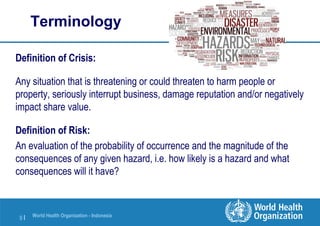
Definition of Crisis:
Any situation that is threatening or could threaten to harm people or
property, seriously interrupt business, damage reputation and/or negatively
impact share value.
Definition of Risk:
An evaluation of the probability of occurrence and the magnitude of the
consequences of any given hazard, i.e. how likely is a hazard and what
consequences will it have?
World Health Organization - Indonesia
10 |
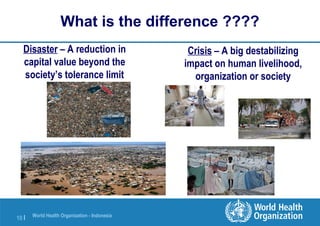
What is the difference ????
Disaster – A reduction in
capital value beyond the
society’s tolerance limit
Crisis – A big destabilizing
impact on human livelihood,
organization or society
World Health Organization - Indonesia
11 |
Disaster Management
““The range of activities designed to maintainThe range of activities designed to maintain
control over disaster and emergencycontrol over disaster and emergency
situations and to provide a framework forsituations and to provide a framework for
helping at risk persons avoid or recover fromhelping at risk persons avoid or recover from
the impact of a disaster”the impact of a disaster” (Cuny)(Cuny)
World Health Organization - Indonesia
12 |
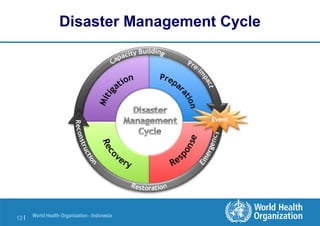
Disaster Management Cycle
World Health Organization - Indonesia
13 |
Disaster Management
– Mitigation - Minimizing the effects of disaster.
Examples: building codes and zoning; vulnerability analyses; public education.
– Preparation/Preparedness - Planning how to respond.
Examples: preparedness plans; emergency exercises/training; warning systems.
– Response - Efforts to minimize the hazards created by a disaster.
Examples: search and rescue; emergency relief .
– Recovery - Returning the community to normal.
Examples: temporary housing; grants; medical care.
World Health Organization - Indonesia
14 |
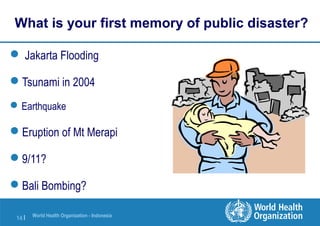
What is your first memory of public disaster?
 Jakarta Flooding
Tsunami in 2004
Earthquake
Eruption of Mt Merapi
9/11?
Bali Bombing?
World Health Organization - Indonesia
15 |
World Health Organization - Indonesia
16 |
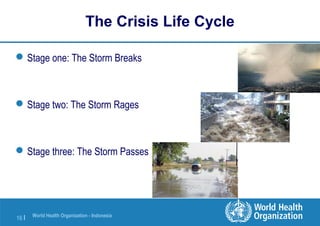
The Crisis Life Cycle
Stage one: The Storm Breaks
Stage two: The Storm Rages
Stage three: The Storm Passes
World Health Organization - Indonesia
17 |
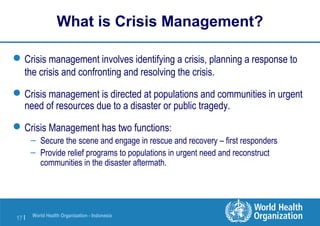
What is Crisis Management?
Crisis management involves identifying a crisis, planning a response to
the crisis and confronting and resolving the crisis.
Crisis management is directed at populations and communities in urgent
need of resources due to a disaster or public tragedy.
Crisis Management has two functions:
– Secure the scene and engage in rescue and recovery – first responders
– Provide relief programs to populations in urgent need and reconstruct
communities in the disaster aftermath.
World Health Organization - Indonesia
18 |
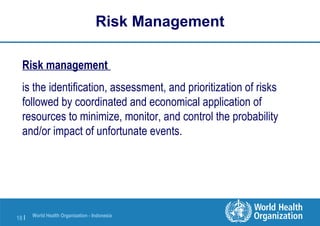
Risk Management
Risk management
is the identification, assessment, and prioritization of risks
followed by coordinated and economical application of
resources to minimize, monitor, and control the probability
and/or impact of unfortunate events.
World Health Organization - Indonesia
19 |
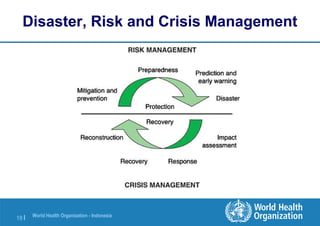
Disaster, Risk and Crisis Management
World Health Organization - Indonesia
20 |
References
Definitions: emergencies – WHO
http://www.who.int/hac/about/definitions/en/index.html and http://www.
http://ec.europa.eu/agriculture/analysis/external/insurance/definitions_en.pdf
Pictures: Google Image (pictures are used for teaching purpose only not
for publishing)
World Health Organization - Indonesia
21 |
Thank You

Disaster and Crisis Management

  • 1.
    World Health Organization- Indonesia 1 | Disaster and Crisis ManagementDisaster and Crisis Management Safety Leadership, Disaster & Crisis ManagementSafety Leadership, Disaster & Crisis Management International SeminarInternational Seminar 2626thth March 2013March 2013 Dr Nirmal Kandel , MBBS, MA (Anthropology), MPH WHO Indonesia
  • 2.
    World Health Organization- Indonesia 2 | Outline Past Incidents Terminologies Disaster Management Crisis Management In relation
  • 3.
  • 4.
    World Health Organization- Indonesia 4 | Haiti Earthquake
  • 5.
    World Health Organization- Indonesia 5 | Chilean Earthquake
  • 6.
    World Health Organization- Indonesia 6 | Compare these two major earthquakes Chilean Earthquake Magnitude: 8.8 Number of Deaths: <1000 Number of Building destroyed: 500, 000 Average Annual Income: $ 14, 700 Population: 16 million Percentage of population below poverty line: 18.2 Haitian Earthquake Magnitude: 7.0 Number of Deaths: >200, 000 Number of Building destroyed: 280, 000 Average Annual Income: $ 1, 300 Population: 9 million Percentage of population below poverty line: 80
  • 7.
    World Health Organization- Indonesia 7 | Better Preparedness --------------------------------------------------- Better Disaster and Crisis Management
  • 8.
    World Health Organization- Indonesia 8 | Terminology Disaster – Synonyms: “calamity” and “catastrophe” – Similar words: “emergencies” and “crisis” Definition of Disaster: “A disaster is a sudden, calamitous event that causes serious disruption of the functioning of a community or a society causing widespread human, material, economic and/or environmental losses which exceed the ability of the affected community or society to cope using its own level of resources. (Source: UN/ISDR 2004)
  • 9.
    World Health Organization- Indonesia 9 | Terminology Definition of Crisis: Any situation that is threatening or could threaten to harm people or property, seriously interrupt business, damage reputation and/or negatively impact share value. Definition of Risk: An evaluation of the probability of occurrence and the magnitude of the consequences of any given hazard, i.e. how likely is a hazard and what consequences will it have?
  • 10.
    World Health Organization- Indonesia 10 | What is the difference ???? Disaster – A reduction in capital value beyond the society’s tolerance limit Crisis – A big destabilizing impact on human livelihood, organization or society
  • 11.
    World Health Organization- Indonesia 11 | Disaster Management ““The range of activities designed to maintainThe range of activities designed to maintain control over disaster and emergencycontrol over disaster and emergency situations and to provide a framework forsituations and to provide a framework for helping at risk persons avoid or recover fromhelping at risk persons avoid or recover from the impact of a disaster”the impact of a disaster” (Cuny)(Cuny)
  • 12.
    World Health Organization- Indonesia 12 | Disaster Management Cycle
  • 13.
    World Health Organization- Indonesia 13 | Disaster Management – Mitigation - Minimizing the effects of disaster. Examples: building codes and zoning; vulnerability analyses; public education. – Preparation/Preparedness - Planning how to respond. Examples: preparedness plans; emergency exercises/training; warning systems. – Response - Efforts to minimize the hazards created by a disaster. Examples: search and rescue; emergency relief . – Recovery - Returning the community to normal. Examples: temporary housing; grants; medical care.
  • 14.
    World Health Organization- Indonesia 14 | What is your first memory of public disaster?  Jakarta Flooding Tsunami in 2004 Earthquake Eruption of Mt Merapi 9/11? Bali Bombing?
  • 15.
    World Health Organization- Indonesia 15 |
  • 16.
    World Health Organization- Indonesia 16 | The Crisis Life Cycle Stage one: The Storm Breaks Stage two: The Storm Rages Stage three: The Storm Passes
  • 17.
    World Health Organization- Indonesia 17 | What is Crisis Management? Crisis management involves identifying a crisis, planning a response to the crisis and confronting and resolving the crisis. Crisis management is directed at populations and communities in urgent need of resources due to a disaster or public tragedy. Crisis Management has two functions: – Secure the scene and engage in rescue and recovery – first responders – Provide relief programs to populations in urgent need and reconstruct communities in the disaster aftermath.
  • 18.
    World Health Organization- Indonesia 18 | Risk Management Risk management is the identification, assessment, and prioritization of risks followed by coordinated and economical application of resources to minimize, monitor, and control the probability and/or impact of unfortunate events.
  • 19.
    World Health Organization- Indonesia 19 | Disaster, Risk and Crisis Management
  • 20.
    World Health Organization- Indonesia 20 | References Definitions: emergencies – WHO http://www.who.int/hac/about/definitions/en/index.html and http://www. http://ec.europa.eu/agriculture/analysis/external/insurance/definitions_en.pdf Pictures: Google Image (pictures are used for teaching purpose only not for publishing)
  • 21.
    World Health Organization- Indonesia 21 | Thank You

Editor's Notes

  • #2 World Health Organization जून 13, 2013