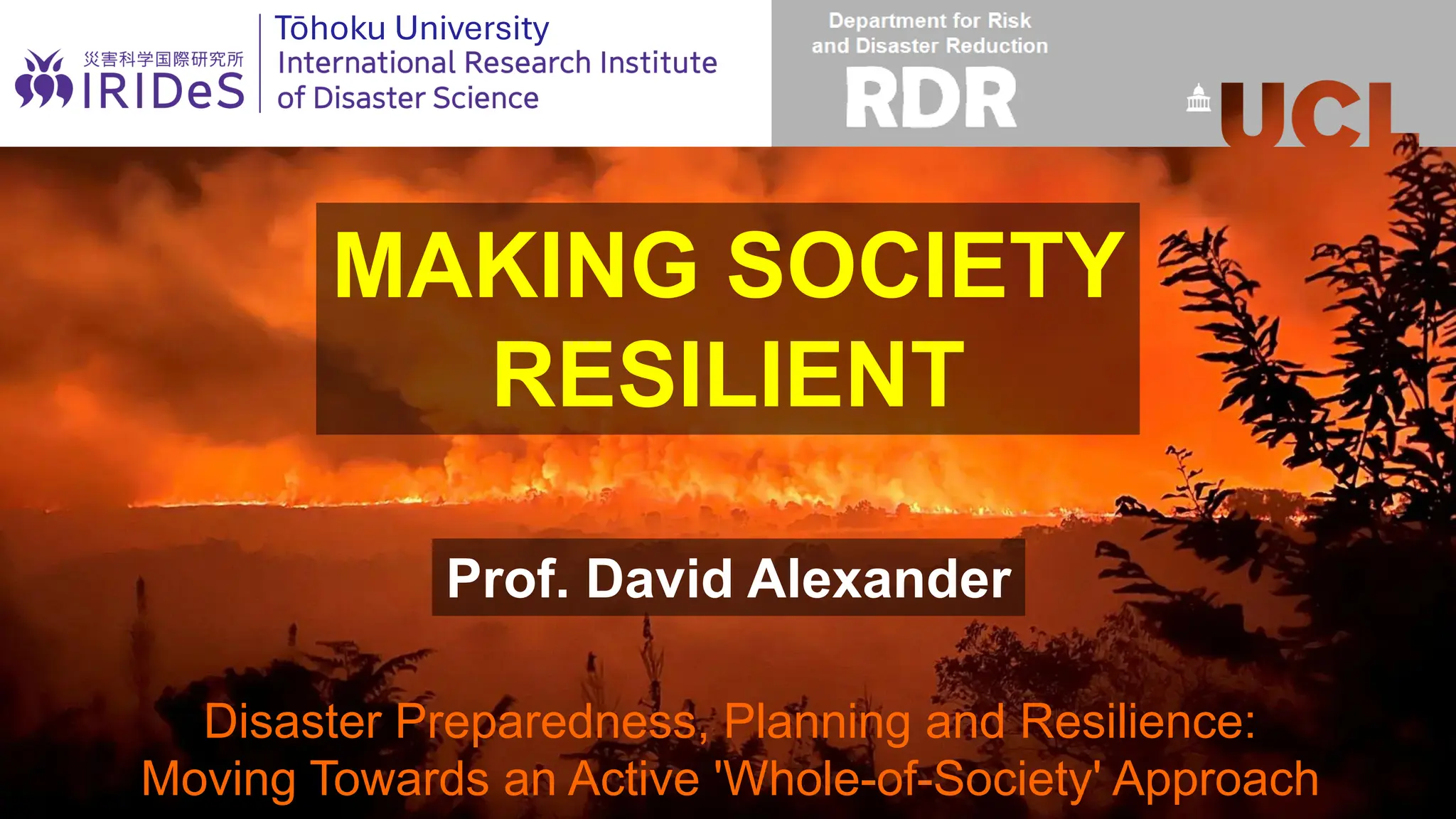
Prof. David Alexander
MAKING SOCIETY
RESILIENT
Tōhoku University
Disaster Preparedness, Planning and Resilience:
Moving Towards an Active 'Whole-of-Society' Approach
Agenda:-
• risk and resilience
• complexity
• context
• foresight
• conclusions
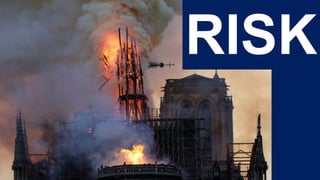
RISK
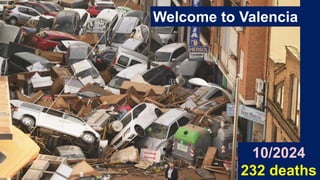
Welcome to Valencia
10/2024
232 deaths
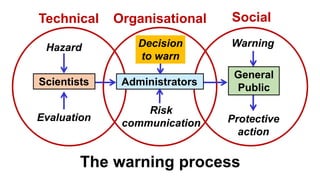
Risk
communication
Warning
Protective
action
The warning process
Organisational Social
Technical
Hazard
Evaluation
Administrators
Scientists
General
Public
Decision
to warn
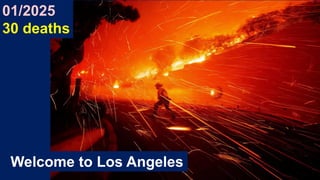
Welcome to Los Angeles
01/2025
30 deaths
The common threads that link the
Valencia, October 2024, floods and
Los Angeles, January 2025, fires are
the neglect or mismanagement of
the environment and failure to
urbanise in an environmentally
compatible manner.
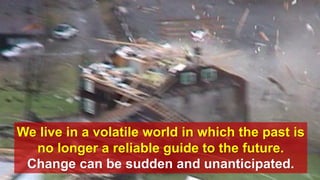
We live in a volatile world in which the past is
no longer a reliable guide to the future.
Change can be sudden and unanticipated.
Mami Mizutori,
Head of the UN Office for Disaster Risk Reduction:
"…at the midpoint of the implementation of the 2015
agreements, progress has stalled and, in some cases,
reversed.
• effect of the Covid pandemic
• short-termism
• weakened multilateralism
• rising inequality
• barriers between science, perception and decision-
making
• war, insurgency and conflict
Systematic risk refers to the possible
breakdown of an entire system rather than
merely the failure of some of its parts.
Existential risk refers to the likelihood of a
disaster that threatens the existence of all or
a significant part of the human race.
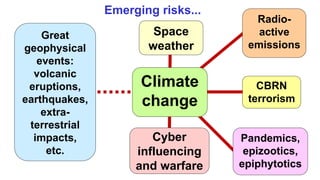
Radio-
active
emissions
CBRN
terrorism
Pandemics,
epizootics,
epiphytotics
Cyber
influencing
and warfare
Climate
change
Emerging risks...
Great
geophysical
events:
volcanic
eruptions,
earthquakes,
extra-
terrestrial
impacts,
etc.
Space
weather
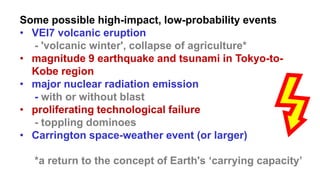
Some possible high-impact, low-probability events
• VEI7 volcanic eruption
- 'volcanic winter', collapse of agriculture*
• magnitude 9 earthquake and tsunami in Tokyo-to-
Kobe region
• major nuclear radiation emission
- with or without blast
• proliferating technological failure
- toppling dominoes
• Carrington space-weather event (or larger)
*a return to the concept of Earth's ‘carrying capacity’
RESILIENCE
RESILIENCE: the ability
to overcome the impacts
of large, negative events
[by a combination of
resistance and adaptation].
Not the only definition, not exclusive, not
comprehensive, and not incontestable.
Resilience:-
• is it an objective, a process or
a strategy?
• does it mean 'bounce-back' or
'bounce-forward’?
• on what scale should it focus –
that of the community?
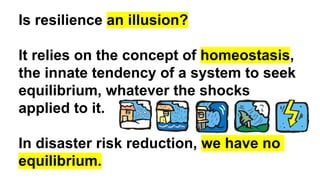
Is resilience an illusion?
It relies on the concept of homeostasis,
the innate tendency of a system to seek
equilibrium, whatever the shocks
applied to it.
In disaster risk reduction, we have no
equilibrium.
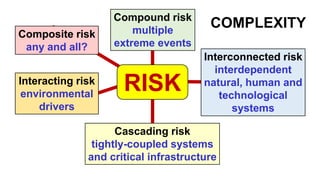
COMPLEXITY
RISK
Cascading risk
tightly-coupled systems
and critical infrastructure
Compound risk
multiple
extreme events
Interacting risk
environmental
drivers
Interconnected risk
interdependent
natural, human and
technological
systems
Composite risk
any and all?
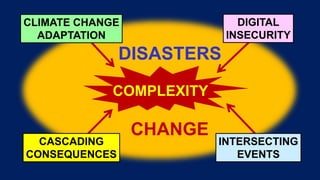
COMPLEXITY
COMPLEXITY
DISASTERS
CLIMATE CHANGE
ADAPTATION
DIGITAL
INSECURITY
CASCADING
CONSEQUENCES
INTERSECTING
EVENTS
CHANGE
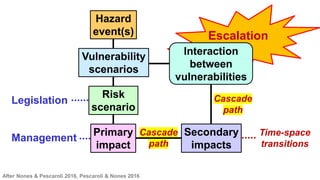
Cascade
path
Escalation
Vulnerability
scenarios
Risk
scenario
Primary
impact
Secondary
impacts
Cascade
path
Hazard
event(s)
After Nones & Pescaroli 2016, Pescaroli & Nones 2016
Interaction
between
vulnerabilities
Legislation
Management
Time-space
transitions
Critical infrastructure is the main
vehicle by which disasters
produce cascading impacts. To a greater
or lesser extent, all modern disasters are
cascading events.
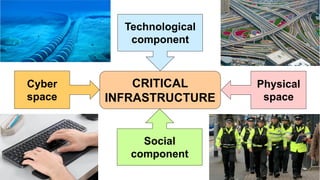
If you want to understand the
risks to critical infrastructure, you
need to understand all four of its
dimensions: physical, technological,
cyber and social.
CRITICAL
INFRASTRUCTURE
Technological
component
Social
component
Cyber
space
Physical
space
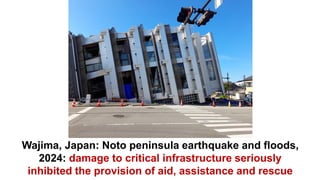
Wajima, Japan: Noto peninsula earthquake and floods,
2024: damage to critical infrastructure seriously
inhibited the provision of aid, assistance and rescue
COMPLEXITY
DISASTERS
CLIMATE CHANGE
ADAPTATION
DIGITAL
INSECURITY
CASCADING
CONSEQUENCES
INTERSECTING
EVENTS
CHANGE
CONTEXT
We can define 'context' as the social,
economic, cultural, psychological and
environmental milieu that surrounds disaster
risk and to some degree interacts with it. If
necessary, we can disaggregate different types
of context. However, overall, context should be
considered as the sum of elements that have
no direct causal relationship with disaster but,
paradoxically, are (or should be) essential to
any attempt to explain it.
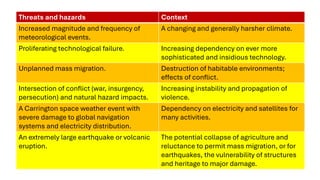
Threats and hazards Context
Increased magnitude and frequency of
meteorological events.
A changing and generally harsher climate.
Proliferating technological failure. Increasing dependency on ever more
sophisticated and insidious technology.
Unplanned mass migration. Destruction of habitable environments;
effects of conflict.
Intersection of conflict (war, insurgency,
persecution) and natural hazard impacts.
Increasing instability and propagation of
violence.
A Carrington space weather event with
severe damage to global navigation
systems and electricity distribution.
Dependency on electricity and satellites for
many activities.
An extremely large earthquake or volcanic
eruption.
The potential collapse of agriculture and
reluctance to permit mass migration, or for
earthquakes, the vulnerability of structures
and heritage to major damage.
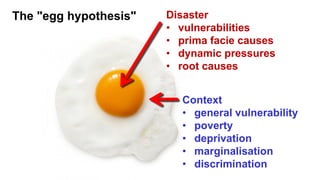
The "egg hypothesis" Disaster
• vulnerabilities
• prima facie causes
• dynamic pressures
• root causes
Context
• general vulnerability
• poverty
• deprivation
• marginalisation
• discrimination
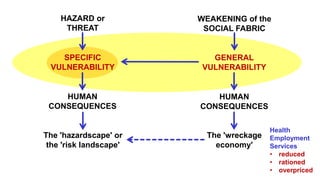
HAZARD or
THREAT
SPECIFIC
VULNERABILITY
HUMAN
CONSEQUENCES
The 'hazardscape' or
the 'risk landscape'
WEAKENING of the
SOCIAL FABRIC
GENERAL
VULNERABILITY
HUMAN
CONSEQUENCES
The 'wreckage
economy'
Health
Employment
Services
• reduced
• rationed
• overpriced
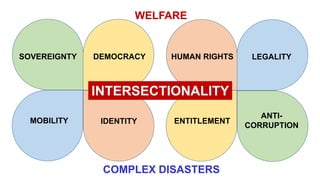
INTERSECTIONALITY
SOVEREIGNTY DEMOCRACY
MOBILITY IDENTITY
HUMAN RIGHTS LEGALITY
ENTITLEMENT
ANTI-
CORRUPTION
WELFARE
COMPLEX DISASTERS
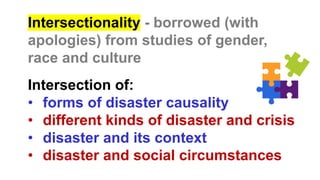
Intersectionality - borrowed (with
apologies) from studies of gender,
race and culture
Intersection of:
• forms of disaster causality
• different kinds of disaster and crisis
• disaster and its context
• disaster and social circumstances
INTERSECTIONALITY:
An exceptionally high sensitivity to political
decisions, especially those with direct
operational consequences.
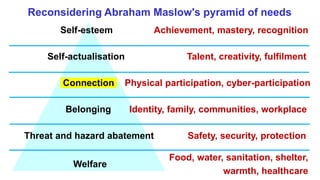
Self-esteem Achievement, mastery, recognition
Self-actualisation Talent, creativity, fulfilment
Connection Physical participation, cyber-participation
Belonging Identity, family, communities, workplace
Threat and hazard abatement Safety, security, protection
Welfare
Reconsidering Abraham Maslow's pyramid of needs
Food, water, sanitation, shelter,
warmth, healthcare
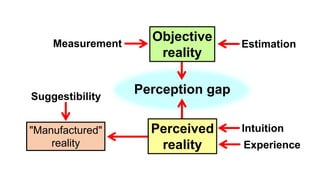
Perceived
reality
Objective
reality
Perception gap
Measurement Estimation
Intuition
Experience
Suggestibility
"Manufactured"
reality
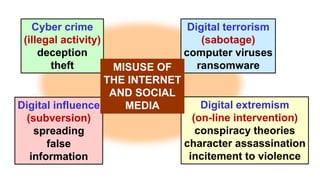
Cyber crime
(illegal activity)
deception
theft
Digital terrorism
(sabotage)
computer viruses
ransomware
Digital influence
(subversion)
spreading
false
information
Digital extremism
(on-line intervention)
conspiracy theories
character assassination
incitement to violence
MISUSE OF
THE INTERNET
AND SOCIAL
MEDIA
CASCADING
DISASTERS
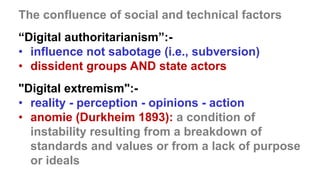
The confluence of social and technical factors
“Digital authoritarianism”:-
• influence not sabotage (i.e., subversion)
• dissident groups AND state actors
"Digital extremism":-
• reality - perception - opinions - action
• anomie (Durkheim 1893): a condition of
instability resulting from a breakdown of
standards and values or from a lack of purpose
or ideals
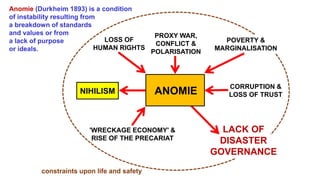
LOSS OF
HUMAN RIGHTS
PROXY WAR,
CONFLICT &
POLARISATION
POVERTY &
MARGINALISATION
'WRECKAGE ECONOMY' &
RISE OF THE PRECARIAT
LACK OF
DISASTER
GOVERNANCE
CORRUPTION &
LOSS OF TRUST
ANOMIE
NIHILISM
constraints upon life and safety
Anomie (Durkheim 1893) is a condition
of instability resulting from
a breakdown of standards
and values or from
a lack of purpose
or ideals.
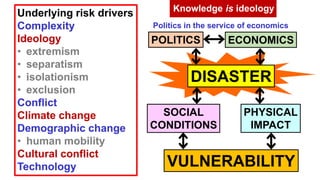
Politics in the service of economics
DISASTER
POLITICS ECONOMICS
SOCIAL
CONDITIONS
PHYSICAL
IMPACT
VULNERABILITY
Knowledge is ideology
Underlying risk drivers
Complexity
Ideology
• extremism
• separatism
• isolationism
• exclusion
Conflict
Climate change
Demographic change
• human mobility
Cultural conflict
Technology
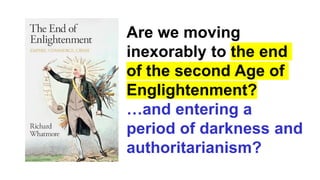
Are we moving
inexorably to the end
of the second Age of
Englightenment?
…and entering a
period of darkness and
authoritarianism?
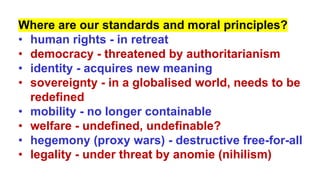
Where are our standards and moral principles?
• human rights - in retreat
• democracy - threatened by authoritarianism
• identity - acquires new meaning
• sovereignty - in a globalised world, needs to be
redefined
• mobility - no longer containable
• welfare - undefined, undefinable?
• hegemony (proxy wars) - destructive free-for-all
• legality - under threat by anomie (nihilism)
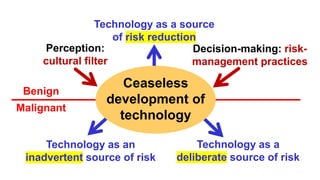
Perception:
cultural filter
Decision-making: risk-
management practices
Benign
Malignant
Technology as a source
of risk reduction
Technology as an
inadvertent source of risk
Technology as a
deliberate source of risk
Ceaseless
development of
technology
FORESIGHT:
present trends, future tendencies
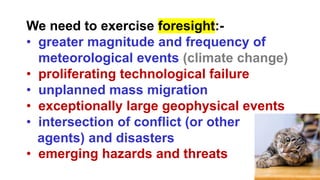
We need to exercise foresight:-
• greater magnitude and frequency of
meteorological events (climate change)
• proliferating technological failure
• unplanned mass migration
• exceptionally large geophysical events
• intersection of conflict (or other
agents) and disasters
• emerging hazards and threats
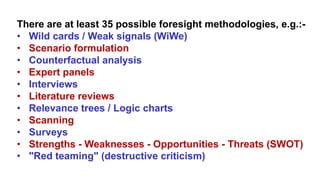
There are at least 35 possible foresight methodologies, e.g.:-
• Wild cards / Weak signals (WiWe)
• Scenario formulation
• Counterfactual analysis
• Expert panels
• Interviews
• Literature reviews
• Relevance trees / Logic charts
• Scanning
• Surveys
• Strengths - Weaknesses - Opportunities - Threats (SWOT)
• "Red teaming" (destructive criticism)
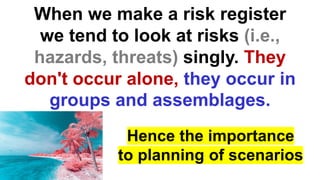
When we make a risk register
we tend to look at risks (i.e.,
hazards, threats) singly. They
don't occur alone, they occur in
groups and assemblages.
Hence the importance
to planning of scenarios
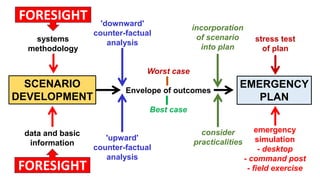
SCENARIO
DEVELOPMENT
Worst case
Envelope of outcomes
Best case
'upward'
counter-factual
analysis
'downward'
counter-factual
analysis
EMERGENCY
PLAN
incorporation
of scenario
into plan
stress test
of plan
systems
methodology
data and basic
information
emergency
simulation
- desktop
- command post
- field exercise
consider
practicalities
FORESIGHT
FORESIGHT
CONCLUSIONS
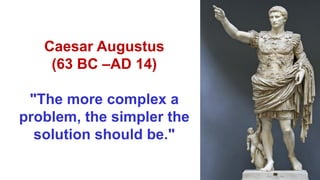
Caesar Augustus
(63 BC –AD 14)
"The more complex a
problem, the simpler the
solution should be."
H.L. Mencken
(1880-1956)
"For every complex
problem, there is an
answer that is clear,
simple, and wrong."
H.L. Mencken
(1880-1956)
"A professor must have
a theory as a dog must
have fleas."
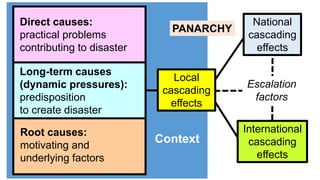
Direct causes:
practical problems
contributing to disaster
Long-term causes
(dynamic pressures):
predisposition
to create disaster
Root causes:
motivating and
underlying factors
Local
cascading
effects
National
cascading
effects
International
cascading
effects
Escalation
factors
Context
PANARCHY
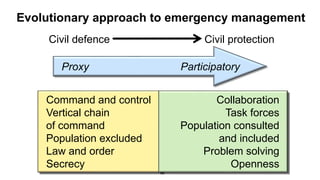
Evolutionary approach to emergency management
Proxy Participatory
Civil defence Civil protection
Command and control
Vertical chain
of command
Population excluded
Law and order
Secrecy
Collaboration
Task forces
Population consulted
and included
Problem solving
Openness
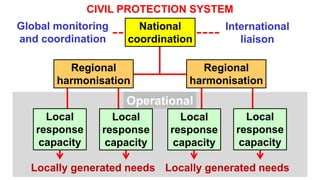
Operational
Locally generated needs
International
liaison
Locally generated needs
Global monitoring
and coordination
Local
response
capacity
Local
response
capacity
Local
response
capacity
Regional
harmonisation
Local
response
capacity
Regional
harmonisation
National
coordination
CIVIL PROTECTION SYSTEM
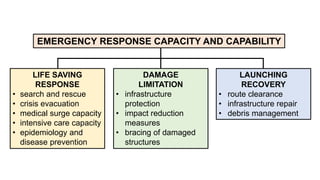
LIFE SAVING
RESPONSE
• search and rescue
• crisis evacuation
• medical surge capacity
• intensive care capacity
• epidemiology and
disease prevention
DAMAGE
LIMITATION
• infrastructure
protection
• impact reduction
measures
• bracing of damaged
structures
LAUNCHING
RECOVERY
• route clearance
• infrastructure repair
• debris management
EMERGENCY RESPONSE CAPACITY AND CAPABILITY
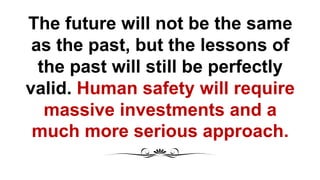
The future will not be the same
as the past, but the lessons of
the past will still be perfectly
valid. Human safety will require
massive investments and a
much more serious approach.
Edward S. Herman and Noam Chomsky 1988.
Manufacturing Consent: The Political Economy
of the Mass Media. Pantheon Books, New York.
Central question:-
What is the value and impact of good,
‘hard’ scientific information in a
[digital] age of relativism, extremism
and a lack of clear morality?
Thank you
for
listening!
david.alexander@ucl.ac.uk
Driving
forward
the agenda
in disaster risk
reduction.

Making Society Resilient: Disaster Preparedness

  • 1.
    Prof. David Alexander MAKINGSOCIETY RESILIENT Tōhoku University Disaster Preparedness, Planning and Resilience: Moving Towards an Active 'Whole-of-Society' Approach
  • 2.
    Agenda:- • risk andresilience • complexity • context • foresight • conclusions
  • 3.
  • 4.
  • 5.
    Risk communication Warning Protective action The warning process OrganisationalSocial Technical Hazard Evaluation Administrators Scientists General Public Decision to warn
  • 6.
    Welcome to LosAngeles 01/2025 30 deaths
  • 7.
    The common threadsthat link the Valencia, October 2024, floods and Los Angeles, January 2025, fires are the neglect or mismanagement of the environment and failure to urbanise in an environmentally compatible manner.
  • 8.
    We live ina volatile world in which the past is no longer a reliable guide to the future. Change can be sudden and unanticipated.
  • 9.
    Mami Mizutori, Head ofthe UN Office for Disaster Risk Reduction: "…at the midpoint of the implementation of the 2015 agreements, progress has stalled and, in some cases, reversed. • effect of the Covid pandemic • short-termism • weakened multilateralism • rising inequality • barriers between science, perception and decision- making • war, insurgency and conflict
  • 10.
    Systematic risk refersto the possible breakdown of an entire system rather than merely the failure of some of its parts. Existential risk refers to the likelihood of a disaster that threatens the existence of all or a significant part of the human race.
  • 11.
  • 12.
    Some possible high-impact,low-probability events • VEI7 volcanic eruption - 'volcanic winter', collapse of agriculture* • magnitude 9 earthquake and tsunami in Tokyo-to- Kobe region • major nuclear radiation emission - with or without blast • proliferating technological failure - toppling dominoes • Carrington space-weather event (or larger) *a return to the concept of Earth's ‘carrying capacity’
  • 13.
  • 14.
    RESILIENCE: the ability toovercome the impacts of large, negative events [by a combination of resistance and adaptation]. Not the only definition, not exclusive, not comprehensive, and not incontestable.
  • 15.
    Resilience:- • is itan objective, a process or a strategy? • does it mean 'bounce-back' or 'bounce-forward’? • on what scale should it focus – that of the community?
  • 16.
    Is resilience anillusion? It relies on the concept of homeostasis, the innate tendency of a system to seek equilibrium, whatever the shocks applied to it. In disaster risk reduction, we have no equilibrium.
  • 17.
  • 18.
    RISK Cascading risk tightly-coupled systems andcritical infrastructure Compound risk multiple extreme events Interacting risk environmental drivers Interconnected risk interdependent natural, human and technological systems Composite risk any and all? COMPLEXITY
  • 19.
  • 20.
    Cascade path Escalation Vulnerability scenarios Risk scenario Primary impact Secondary impacts Cascade path Hazard event(s) After Nones &Pescaroli 2016, Pescaroli & Nones 2016 Interaction between vulnerabilities Legislation Management Time-space transitions
  • 21.
    Critical infrastructure isthe main vehicle by which disasters produce cascading impacts. To a greater or lesser extent, all modern disasters are cascading events. If you want to understand the risks to critical infrastructure, you need to understand all four of its dimensions: physical, technological, cyber and social.
  • 22.
  • 23.
    Wajima, Japan: Notopeninsula earthquake and floods, 2024: damage to critical infrastructure seriously inhibited the provision of aid, assistance and rescue
  • 24.
  • 25.
    We can define'context' as the social, economic, cultural, psychological and environmental milieu that surrounds disaster risk and to some degree interacts with it. If necessary, we can disaggregate different types of context. However, overall, context should be considered as the sum of elements that have no direct causal relationship with disaster but, paradoxically, are (or should be) essential to any attempt to explain it.
  • 26.
    Threats and hazardsContext Increased magnitude and frequency of meteorological events. A changing and generally harsher climate. Proliferating technological failure. Increasing dependency on ever more sophisticated and insidious technology. Unplanned mass migration. Destruction of habitable environments; effects of conflict. Intersection of conflict (war, insurgency, persecution) and natural hazard impacts. Increasing instability and propagation of violence. A Carrington space weather event with severe damage to global navigation systems and electricity distribution. Dependency on electricity and satellites for many activities. An extremely large earthquake or volcanic eruption. The potential collapse of agriculture and reluctance to permit mass migration, or for earthquakes, the vulnerability of structures and heritage to major damage.
  • 27.
    The "egg hypothesis"Disaster • vulnerabilities • prima facie causes • dynamic pressures • root causes Context • general vulnerability • poverty • deprivation • marginalisation • discrimination
  • 28.
    HAZARD or THREAT SPECIFIC VULNERABILITY HUMAN CONSEQUENCES The 'hazardscape'or the 'risk landscape' WEAKENING of the SOCIAL FABRIC GENERAL VULNERABILITY HUMAN CONSEQUENCES The 'wreckage economy' Health Employment Services • reduced • rationed • overpriced
  • 29.
    INTERSECTIONALITY SOVEREIGNTY DEMOCRACY MOBILITY IDENTITY HUMANRIGHTS LEGALITY ENTITLEMENT ANTI- CORRUPTION WELFARE COMPLEX DISASTERS
  • 30.
    Intersectionality - borrowed(with apologies) from studies of gender, race and culture Intersection of: • forms of disaster causality • different kinds of disaster and crisis • disaster and its context • disaster and social circumstances
  • 31.
    INTERSECTIONALITY: An exceptionally highsensitivity to political decisions, especially those with direct operational consequences.
  • 32.
    Self-esteem Achievement, mastery,recognition Self-actualisation Talent, creativity, fulfilment Connection Physical participation, cyber-participation Belonging Identity, family, communities, workplace Threat and hazard abatement Safety, security, protection Welfare Reconsidering Abraham Maslow's pyramid of needs Food, water, sanitation, shelter, warmth, healthcare
  • 33.
  • 34.
    Cyber crime (illegal activity) deception theft Digitalterrorism (sabotage) computer viruses ransomware Digital influence (subversion) spreading false information Digital extremism (on-line intervention) conspiracy theories character assassination incitement to violence MISUSE OF THE INTERNET AND SOCIAL MEDIA
  • 35.
    CASCADING DISASTERS The confluence ofsocial and technical factors “Digital authoritarianism”:- • influence not sabotage (i.e., subversion) • dissident groups AND state actors "Digital extremism":- • reality - perception - opinions - action • anomie (Durkheim 1893): a condition of instability resulting from a breakdown of standards and values or from a lack of purpose or ideals
  • 36.
    LOSS OF HUMAN RIGHTS PROXYWAR, CONFLICT & POLARISATION POVERTY & MARGINALISATION 'WRECKAGE ECONOMY' & RISE OF THE PRECARIAT LACK OF DISASTER GOVERNANCE CORRUPTION & LOSS OF TRUST ANOMIE NIHILISM constraints upon life and safety Anomie (Durkheim 1893) is a condition of instability resulting from a breakdown of standards and values or from a lack of purpose or ideals.
  • 37.
    Politics in theservice of economics DISASTER POLITICS ECONOMICS SOCIAL CONDITIONS PHYSICAL IMPACT VULNERABILITY Knowledge is ideology Underlying risk drivers Complexity Ideology • extremism • separatism • isolationism • exclusion Conflict Climate change Demographic change • human mobility Cultural conflict Technology
  • 38.
    Are we moving inexorablyto the end of the second Age of Englightenment? …and entering a period of darkness and authoritarianism?
  • 39.
    Where are ourstandards and moral principles? • human rights - in retreat • democracy - threatened by authoritarianism • identity - acquires new meaning • sovereignty - in a globalised world, needs to be redefined • mobility - no longer containable • welfare - undefined, undefinable? • hegemony (proxy wars) - destructive free-for-all • legality - under threat by anomie (nihilism)
  • 40.
    Perception: cultural filter Decision-making: risk- managementpractices Benign Malignant Technology as a source of risk reduction Technology as an inadvertent source of risk Technology as a deliberate source of risk Ceaseless development of technology
  • 41.
  • 42.
    We need toexercise foresight:- • greater magnitude and frequency of meteorological events (climate change) • proliferating technological failure • unplanned mass migration • exceptionally large geophysical events • intersection of conflict (or other agents) and disasters • emerging hazards and threats
  • 43.
    There are atleast 35 possible foresight methodologies, e.g.:- • Wild cards / Weak signals (WiWe) • Scenario formulation • Counterfactual analysis • Expert panels • Interviews • Literature reviews • Relevance trees / Logic charts • Scanning • Surveys • Strengths - Weaknesses - Opportunities - Threats (SWOT) • "Red teaming" (destructive criticism)
  • 44.
    When we makea risk register we tend to look at risks (i.e., hazards, threats) singly. They don't occur alone, they occur in groups and assemblages. Hence the importance to planning of scenarios
  • 45.
    SCENARIO DEVELOPMENT Worst case Envelope ofoutcomes Best case 'upward' counter-factual analysis 'downward' counter-factual analysis EMERGENCY PLAN incorporation of scenario into plan stress test of plan systems methodology data and basic information emergency simulation - desktop - command post - field exercise consider practicalities FORESIGHT FORESIGHT
  • 46.
  • 47.
    Caesar Augustus (63 BC–AD 14) "The more complex a problem, the simpler the solution should be."
  • 48.
    H.L. Mencken (1880-1956) "For everycomplex problem, there is an answer that is clear, simple, and wrong."
  • 49.
    H.L. Mencken (1880-1956) "A professormust have a theory as a dog must have fleas."
  • 50.
    Direct causes: practical problems contributingto disaster Long-term causes (dynamic pressures): predisposition to create disaster Root causes: motivating and underlying factors Local cascading effects National cascading effects International cascading effects Escalation factors Context PANARCHY
  • 51.
    Evolutionary approach toemergency management Proxy Participatory Civil defence Civil protection Command and control Vertical chain of command Population excluded Law and order Secrecy Collaboration Task forces Population consulted and included Problem solving Openness
  • 52.
    Operational Locally generated needs International liaison Locallygenerated needs Global monitoring and coordination Local response capacity Local response capacity Local response capacity Regional harmonisation Local response capacity Regional harmonisation National coordination CIVIL PROTECTION SYSTEM
  • 53.
    LIFE SAVING RESPONSE • searchand rescue • crisis evacuation • medical surge capacity • intensive care capacity • epidemiology and disease prevention DAMAGE LIMITATION • infrastructure protection • impact reduction measures • bracing of damaged structures LAUNCHING RECOVERY • route clearance • infrastructure repair • debris management EMERGENCY RESPONSE CAPACITY AND CAPABILITY
  • 54.
    The future willnot be the same as the past, but the lessons of the past will still be perfectly valid. Human safety will require massive investments and a much more serious approach.
  • 55.
    Edward S. Hermanand Noam Chomsky 1988. Manufacturing Consent: The Political Economy of the Mass Media. Pantheon Books, New York. Central question:- What is the value and impact of good, ‘hard’ scientific information in a [digital] age of relativism, extremism and a lack of clear morality?
  • 56.