 DELIVERING QUALITY SINCE 1952.
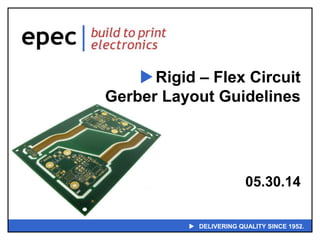
Rigid – Flex Circuit
Gerber Layout Guidelines
05.30.14
2
 Rigid – Flex circuits introduce additional design
requirements which need to be accommodated at the
Geber Layout phase:
– Rigid to Flex Transition Lines
– Layer Stack ups
– Trace Layout in Flex Areas
Introduction
3
Introduction
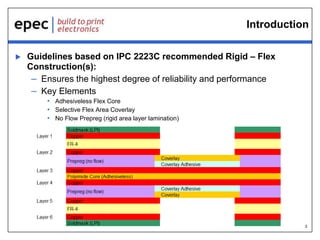
 Guidelines based on IPC 2223C recommended Rigid – Flex
Construction(s):
– Ensures the highest degree of reliability and performance
– Key Elements
• Adhesiveless Flex Core
• Selective Flex Area Coverlay
• No Flow Prepreg (rigid area layer lamination)
4
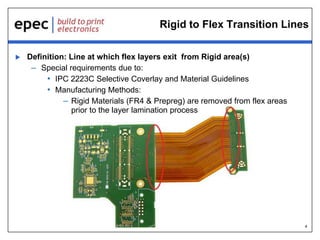
 Definition: Line at which flex layers exit from Rigid area(s)
– Special requirements due to:
• IPC 2223C Selective Coverlay and Material Guidelines
• Manufacturing Methods:
– Rigid Materials (FR4 & Prepreg) are removed from flex areas
prior to the layer lamination process
Rigid to Flex Transition Lines
5
Rigid to Flex Transition Lines:
PTH Hole Spacing
 0.050” Min. Requirement:
– As measured from edge of drilled hole to “Rigid to Flex” transition line(s)
– Prevents PTH holes from being drilled through Selective Coverlay
adhesives
– Accounts for manufacturing and material tolerances
6
Rigid to Flex Transition Lines:
Copper Feature Spacing
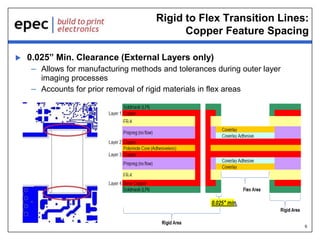
 0.025” Min. Clearance (External Layers only)
– Allows for manufacturing methods and tolerances during outer layer
imaging processes
– Accounts for prior removal of rigid materials in flex areas
7
Rigid – Flex Layer Stack Up Guidelines
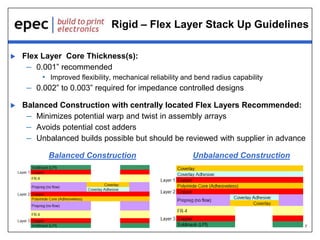
 Flex Layer Core Thickness(s):
– 0.001” recommended
• Improved flexibility, mechanical reliability and bend radius capability
– 0.002” to 0.003” required for impedance controlled designs
 Balanced Construction with centrally located Flex Layers Recommended:
– Minimizes potential warp and twist in assembly arrays
– Avoids potential cost adders
– Unbalanced builds possible but should be reviewed with supplier in advance
Balanced Construction Unbalanced Construction
8
Rigid – Flex Layer Stack Up
Guidelines
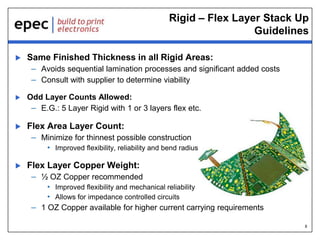
 Same Finished Thickness in all Rigid Areas:
– Avoids sequential lamination processes and significant added costs
– Consult with supplier to determine viability
 Odd Layer Counts Allowed:
– E.G.: 5 Layer Rigid with 1 or 3 layers flex etc.
 Flex Area Layer Count:
– Minimize for thinnest possible construction
• Improved flexibility, reliability and bend radius
 Flex Layer Copper Weight:
– ½ OZ Copper recommended
• Improved flexibility and mechanical reliability
• Allows for impedance controlled circuits
– 1 OZ Copper available for higher current carrying requirements
9
Rigid – Flex Layer Stack Up
Guidelines
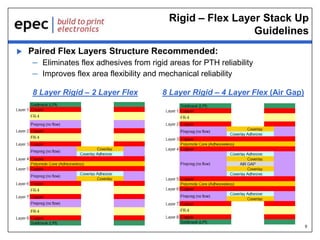
 Paired Flex Layers Structure Recommended:
– Eliminates flex adhesives from rigid areas for PTH reliability
– Improves flex area flexibility and mechanical reliability
8 Layer Rigid – 2 Layer Flex 8 Layer Rigid – 4 Layer Flex (Air Gap)
10
Rigid – Flex Layer Stack Up
Guidelines
 Impedance Controlled / Shielded Designs:
– May require 3 or more flex layers bonded together
– Use of flex adhesives to be minimized to best conform to IPC 2223C
– Potential negative impact on flexibility and bend requirements
– Consult with supplier for best configuration
7 Layer with 3 Flex Layers 8Layer with 4 Flex Layers
11
Flex Area Trace Layout Guidelines
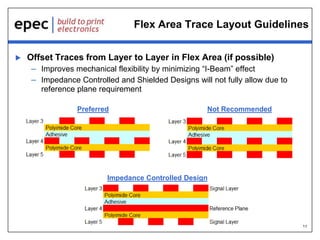
 Offset Traces from Layer to Layer in Flex Area (if possible)
– Improves mechanical flexibility by minimizing “I-Beam” effect
– Impedance Controlled and Shielded Designs will not fully allow due to
reference plane requirement
Preferred Not Recommended
Impedance Controlled Design
12
Flex Area Trace Layout Guidelines
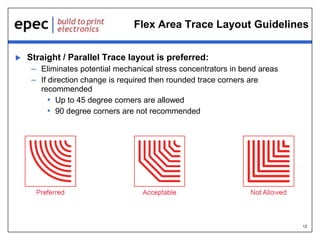
 Straight / Parallel Trace layout is preferred:
– Eliminates potential mechanical stress concentrators in bend areas
– If direction change is required then rounded trace corners are
recommended
• Up to 45 degree corners are allowed
• 90 degree corners are not recommended
13
Our Products
Battery Packs Flex & Rigid-Flex PCB’s User Interfaces
Fans & Motors Cable Assemblies Printed Circuit Boards
14
Design Centers & Technical Support
 Battery Pack & Power Management – Denver, CO
 User Interfaces – Largo, FL
 Fans & Motors – Wales, UK
 PCB’s – New Bedford, MA & Shenzhen, China
 Flex & Rigid Flex – Toronto, Canada
 Cable Assemblies – New Bedford, MA
 Our Engineering and Design teams are ready to help
our customers create world class and cost effective
product solutions.
15
Q&A
 Questions?
– Enter any questions you may have
in the Control Panel.
– If we don’t have time to get to it, we
will reply via email.
16
Thank You
Check out our previous webinars at www.epectec.com.
For more information email sales@epectec.com.
Stay Connected with Epec Engineered Technologies
Follow us on our social media sites for continuous technical updates and information:

Rigid-Flex Circuit Board Gerber Layout Guidelines Webinar

  • 1.
     DELIVERING QUALITYSINCE 1952. Rigid – Flex Circuit Gerber Layout Guidelines 05.30.14
  • 2.
    2  Rigid –Flex circuits introduce additional design requirements which need to be accommodated at the Geber Layout phase: – Rigid to Flex Transition Lines – Layer Stack ups – Trace Layout in Flex Areas Introduction
  • 3.
    3 Introduction  Guidelines basedon IPC 2223C recommended Rigid – Flex Construction(s): – Ensures the highest degree of reliability and performance – Key Elements • Adhesiveless Flex Core • Selective Flex Area Coverlay • No Flow Prepreg (rigid area layer lamination)
  • 4.
    4  Definition: Lineat which flex layers exit from Rigid area(s) – Special requirements due to: • IPC 2223C Selective Coverlay and Material Guidelines • Manufacturing Methods: – Rigid Materials (FR4 & Prepreg) are removed from flex areas prior to the layer lamination process Rigid to Flex Transition Lines
  • 5.
    5 Rigid to FlexTransition Lines: PTH Hole Spacing  0.050” Min. Requirement: – As measured from edge of drilled hole to “Rigid to Flex” transition line(s) – Prevents PTH holes from being drilled through Selective Coverlay adhesives – Accounts for manufacturing and material tolerances
  • 6.
    6 Rigid to FlexTransition Lines: Copper Feature Spacing  0.025” Min. Clearance (External Layers only) – Allows for manufacturing methods and tolerances during outer layer imaging processes – Accounts for prior removal of rigid materials in flex areas
  • 7.
    7 Rigid – FlexLayer Stack Up Guidelines  Flex Layer Core Thickness(s): – 0.001” recommended • Improved flexibility, mechanical reliability and bend radius capability – 0.002” to 0.003” required for impedance controlled designs  Balanced Construction with centrally located Flex Layers Recommended: – Minimizes potential warp and twist in assembly arrays – Avoids potential cost adders – Unbalanced builds possible but should be reviewed with supplier in advance Balanced Construction Unbalanced Construction
  • 8.
    8 Rigid – FlexLayer Stack Up Guidelines  Same Finished Thickness in all Rigid Areas: – Avoids sequential lamination processes and significant added costs – Consult with supplier to determine viability  Odd Layer Counts Allowed: – E.G.: 5 Layer Rigid with 1 or 3 layers flex etc.  Flex Area Layer Count: – Minimize for thinnest possible construction • Improved flexibility, reliability and bend radius  Flex Layer Copper Weight: – ½ OZ Copper recommended • Improved flexibility and mechanical reliability • Allows for impedance controlled circuits – 1 OZ Copper available for higher current carrying requirements
  • 9.
    9 Rigid – FlexLayer Stack Up Guidelines  Paired Flex Layers Structure Recommended: – Eliminates flex adhesives from rigid areas for PTH reliability – Improves flex area flexibility and mechanical reliability 8 Layer Rigid – 2 Layer Flex 8 Layer Rigid – 4 Layer Flex (Air Gap)
  • 10.
    10 Rigid – FlexLayer Stack Up Guidelines  Impedance Controlled / Shielded Designs: – May require 3 or more flex layers bonded together – Use of flex adhesives to be minimized to best conform to IPC 2223C – Potential negative impact on flexibility and bend requirements – Consult with supplier for best configuration 7 Layer with 3 Flex Layers 8Layer with 4 Flex Layers
  • 11.
    11 Flex Area TraceLayout Guidelines  Offset Traces from Layer to Layer in Flex Area (if possible) – Improves mechanical flexibility by minimizing “I-Beam” effect – Impedance Controlled and Shielded Designs will not fully allow due to reference plane requirement Preferred Not Recommended Impedance Controlled Design
  • 12.
    12 Flex Area TraceLayout Guidelines  Straight / Parallel Trace layout is preferred: – Eliminates potential mechanical stress concentrators in bend areas – If direction change is required then rounded trace corners are recommended • Up to 45 degree corners are allowed • 90 degree corners are not recommended
  • 13.
    13 Our Products Battery PacksFlex & Rigid-Flex PCB’s User Interfaces Fans & Motors Cable Assemblies Printed Circuit Boards
  • 14.
    14 Design Centers &Technical Support  Battery Pack & Power Management – Denver, CO  User Interfaces – Largo, FL  Fans & Motors – Wales, UK  PCB’s – New Bedford, MA & Shenzhen, China  Flex & Rigid Flex – Toronto, Canada  Cable Assemblies – New Bedford, MA  Our Engineering and Design teams are ready to help our customers create world class and cost effective product solutions.
  • 15.
    15 Q&A  Questions? – Enterany questions you may have in the Control Panel. – If we don’t have time to get to it, we will reply via email.
  • 16.
    16 Thank You Check outour previous webinars at www.epectec.com. For more information email sales@epectec.com. Stay Connected with Epec Engineered Technologies Follow us on our social media sites for continuous technical updates and information: