 DELIVERING QUALITY SINCE 1952.
Industry Standards &
How They Impact Cable
Assembly Designs
2.12.15
2
Agenda
 Definitions
 Levels of Standards To Be Concerned With
– Materials-centric
• Dimensional Standards
• Construction Standards
– Product-centric
• Performance Standards
– Safety-centric
• Flammability Levels
– Customer-centric
• Exact Color Matches
• Overmold Dimensions
• Logo Matches
 Worldwide Standards
 Standards Examples
3
Guiding Principle Of A Standard
Standards Should:
 Show Relationship To Design
For Manufacturability (DFM) And
Design For The Environment
(DFE)
 Minimize Time To Market
 Contain Simple (Simplified)
Language
 Just Include Spec Information
 Focus On End Product
Performance
 Include a Feedback System On
Use And Problems For Future
Improvement
IPC/WHMA-A-620B Executive Committee 1995
Standards Should Not:
Inhibit Innovation
Increase Time-To-Market
Keep People Out
Increase Cycle Time
Tell You How To Make
Something
Contain Anything That Cannot Be
Defended With Data
4
What Is A “Standard”
 Standard – “Something considered by an authority or by general
consent as a basis of comparison; an approved model; an accepted or
approved example of something against which others are judged or
measured”.
 Use Of A Standard Is Wholly Voluntary.
 A Standard Does Not Mandate That There Is Only One Way That A
Product Or Procedure Can Be Engineered.
 “The nice thing about standards is that there are so many of them to
choose from” 1
– Reference to the fact that competing standards become a source of confusion,
division, obsolescence, and duplication of effort instead of an enhancement to the
usefulness of products.
1
Andrew Tanenbaum
5
What Is “Code”
 Code – “A systematic statement of a body of laws, especially one
given statutory force; a system of principles or rules”.
 Most Recognized Electrical Engineering Code Of The United States Is
The National Fire Protection Association’s NFPA 70 National Electric
Code.
– Generally Accepted As Nationally Accepted Consensus Code In Electrical
Engineering.
– Must Still Be Adopted By Individual Governing Bodies Mandating Its Acceptance
And Use By Law To The Authority Having Jurisdiction.
 Use Of A Code May Be Voluntary Or Mandated By Law.
 Code Is A Living Document With Changes Made To Keep It Up To
Date With Changes In Technology.
6
What Are “Recommended Practices”
 Recommended Practices – “Method or technique that has
consistently shown results superior to those achieved with other
means; can evolve to become better as improvements are discovered”
 Recommended Practices Are Electric Design And Installation
Practices Which Have Been Generally Accepted In The Electrical
Industry As Safe, Reliable, Effective, And Maintainable
 Recommended Practices Are Not Considered
To Be A Fixed Rule, Code, Or Standard
 Anticipated That Sound Engineering Judgment
Will Be Utilized When Implementing A
Recommended Practice
7
Materials-centric Standards Related
To Cable Assemblies
 ASTM – American Society For Testing And Materials
– Six Categories Of Standards
• Standard Specification
• Standard Test Method
• Standard Practice
• Standard Guide
• Standard Classification
• Technology Standard
– B1 Standard For Hard Drawn Copper Wire
– B2 Standard For Medium Hard Drawn Copper Wire
– B3 Standard For Soft Or Annealed Copper Wire
– B8 Standard For Concentric Lay Stranded Copper Conductors
– B172 Standard For Rope Lay Copper Conductors
– B787 Standard For 19 Wire Unilay Stranded Wire
– B193 Test Method For Resistivity Of Electrical Conductor Materials
– B258 Specification For Nominal Diameters Of Solid Round Wires
8
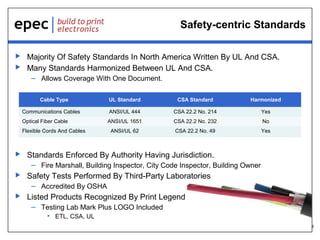
Safety-centric Standards
 Majority Of Safety Standards In North America Written By UL And CSA.
 Many Standards Harmonized Between UL And CSA.
– Allows Coverage With One Document.
 Standards Enforced By Authority Having Jurisdiction.
– Fire Marshall, Building Inspector, City Code Inspector, Building Owner
 Safety Tests Performed By Third-Party Laboratories
– Accredited By OSHA
 Listed Products Recognized By Print Legend
– Testing Lab Mark Plus LOGO Included
• ETL, CSA, UL
Cable Type UL Standard CSA Standard Harmonized
Communications Cables ANSI/UL 444 CSA 22.2 No. 214 Yes
Optical Fiber Cable ANSI/UL 1651 CSA 22.2 No. 232 No
Flexible Cords And Cables ANSI/UL 62 CSA 22.2 No. 49 Yes
9
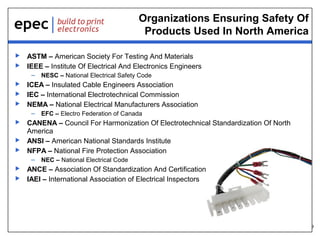
Organizations Ensuring Safety Of
Products Used In North America
 ASTM – American Society For Testing And Materials
 IEEE – Institute Of Electrical And Electronics Engineers
– NESC – National Electrical Safety Code
 ICEA – Insulated Cable Engineers Association
 IEC – International Electrotechnical Commission
 NEMA – National Electrical Manufacturers Association
– EFC – Electro Federation of Canada
 CANENA – Council For Harmonization Of Electrotechnical Standardization Of North
America
 ANSI – American National Standards Institute
 NFPA – National Fire Protection Association
– NEC – National Electrical Code
 ANCE – Association Of Standardization And Certification
 IAEI – International Association of Electrical Inspectors
10
Building Code Establishment
 November 28, 1942 - Fire At Cocoanut Grove Night Club, Boston
– Fire Was Motivating Force Leading To Development And Enforcement Of Building
Codes
 492 People Died Due To Lack Of Working Exits
 There Were No Occupancy Limits Enforced
 Over 1,000 People Were In Building
– 460 Was Supposed To Be Maximum
 Exits Were Bolted Shut Or Bricked Over
 Only One Operable Exit Door
– Revolving Front Door
11
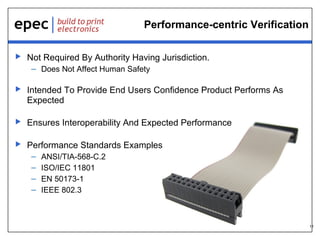
Performance-centric Verification
 Not Required By Authority Having Jurisdiction.
– Does Not Affect Human Safety
 Intended To Provide End Users Confidence Product Performs As
Expected
 Ensures Interoperability And Expected Performance
 Performance Standards Examples
– ANSI/TIA-568-C.2
– ISO/IEC 11801
– EN 50173-1
– IEEE 802.3
12
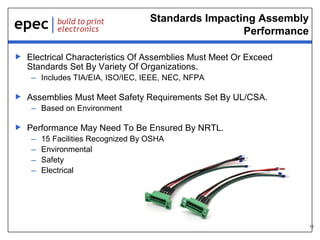
Standards Impacting Assembly
Performance
 Electrical Characteristics Of Assemblies Must Meet Or Exceed
Standards Set By Variety Of Organizations.
– Includes TIA/EIA, ISO/IEC, IEEE, NEC, NFPA
 Assemblies Must Meet Safety Requirements Set By UL/CSA.
– Based on Environment
 Performance May Need To Be Ensured By NRTL.
– 15 Facilities Recognized By OSHA
– Environmental
– Safety
– Electrical
13
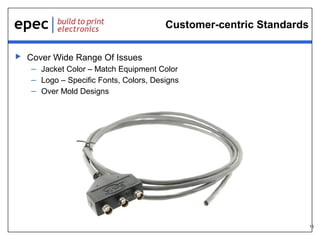
Customer-centric Standards
 Cover Wide Range Of Issues
– Jacket Color – Match Equipment Color
– Logo – Specific Fonts, Colors, Designs
– Over Mold Designs
14
Standards Not Always Adhered To
 Products Manufactured Outside North America Have Been Found To
Be Out Of Compliance With Codes And Standards.
– Do Not Meet Safety Requirements Set By North American Code And
Standards Organizations
– Safety Standards Maintained By UL
– Codes & Standards Provide Framework For Electrical Products To Be
Manufactured And Installed Safely
– Provide Consistency And Protection For Manufacturers And Users
– Standards Help Purchasers Select Most Appropriate Product For Their
Needs
– Electrical Codes And Standards Designed To Ensure The Manufacture
And Installation Of Safe Products
– Most Common Regulatory Approval Is UL Listing Mark
– If Non-Compliant Products Are Used Contractors Expose Themselves To
Liability For Product Failure And Resulting Safety Issues
15
Worldwide Standards
 Trend Towards International Harmonization Of Codes, Standards, And
Recommended Practices
 In Past United States Codes And Standards Readily Accepted
 Emergence Of European Union And Other Regional Trade
Organizations
– Many Emerging Economies Have Adopted ISO And IEC Standards
 Development Of Codes, Standards, Recommended Practices Often
Necessitated Because Of Substantial Loss Of Life And Property
 Development Of Codes, Standards, Recommended Practices Can Be
Done By Industry/Manufacturing Groups, Engineering Or Professional
Societies Or Organizations, Or Government Agencies Worldwide
16
TIA (Telecommunications
Industry Association)
 Develops Standards For Cabling Buildings
 Intent Is To Develop A Uniform Wiring Standard
– Goal Is To Support Multivendor Products And Environments
 TIA Standards Widely Adopted And Considered The Global Standard
For Data System Design
 Standards Developed To Create Guidelines
– 568 Commercial Building Telecommunications Wiring Standards
– 569 Commercial Building Standard For Telecommunication Pathways And
Spaces
 Improved Technology Requires Revisions To Standards
– 10-Gigabit Ethernet Uses Larger Cable Requiring Increased Bend Radius
Needs
17
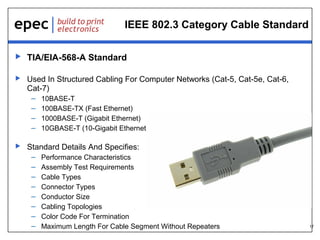
IEEE 802.3 Category Cable Standard
 TIA/EIA-568-A Standard
 Used In Structured Cabling For Computer Networks (Cat-5, Cat-5e, Cat-6,
Cat-7)
– 10BASE-T
– 100BASE-TX (Fast Ethernet)
– 1000BASE-T (Gigabit Ethernet)
– 10GBASE-T (10-Gigabit Ethernet)
 Standard Details And Specifies:
– Performance Characteristics
– Assembly Test Requirements
– Cable Types
– Connector Types
– Conductor Size
– Cabling Topologies
– Color Code For Termination
– Maximum Length For Cable Segment Without Repeaters
18
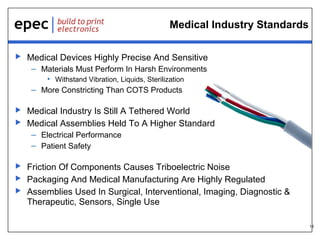
Medical Industry Standards
 Medical Devices Highly Precise And Sensitive
– Materials Must Perform In Harsh Environments
• Withstand Vibration, Liquids, Sterilization
– More Constricting Than COTS Products
 Medical Industry Is Still A Tethered World
 Medical Assemblies Held To A Higher Standard
– Electrical Performance
– Patient Safety
 Friction Of Components Causes Triboelectric Noise
 Packaging And Medical Manufacturing Are Highly Regulated
 Assemblies Used In Surgical, Interventional, Imaging, Diagnostic &
Therapeutic, Sensors, Single Use
19
Medical Industry Standards
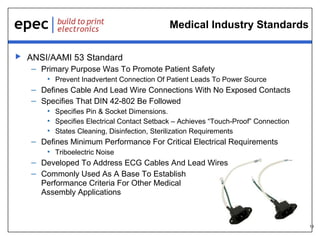
 ANSI/AAMI 53 Standard
– Primary Purpose Was To Promote Patient Safety
• Prevent Inadvertent Connection Of Patient Leads To Power Source
– Defines Cable And Lead Wire Connections With No Exposed Contacts
– Specifies That DIN 42-802 Be Followed
• Specifies Pin & Socket Dimensions.
• Specifies Electrical Contact Setback – Achieves “Touch-Proof” Connection
• States Cleaning, Disinfection, Sterilization Requirements
– Defines Minimum Performance For Critical Electrical Requirements
• Triboelectric Noise
– Developed To Address ECG Cables And Lead Wires
– Commonly Used As A Base To Establish
Performance Criteria For Other Medical
Assembly Applications
20
Medical Industry Standards
 21 CFR 820.30
– Design Control For Product Development Of Medical Devices
 ISO 13485:2003
– ISO Standard Detailing Medical Device Quality Management System
 ISO 14971
– ISO Standard Detailing Requirements For Application Of Risk Management System
For Medical Devices
 MDD 93/42/EEC
– Harmonizes Laws Relating To Medical Devices Within European Union
 ISO 14698
– Standard Describing Principles And Basic Methodology to Control Bio-
Contamination (Cleanroom Practices)
21
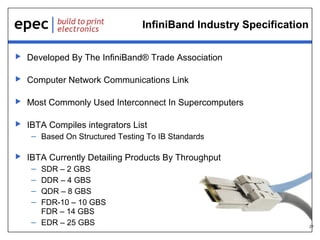
InfiniBand Industry Specification
 Developed By The InfiniBand® Trade Association
 Computer Network Communications Link
 Most Commonly Used Interconnect In Supercomputers
 IBTA Compiles integrators List
– Based On Structured Testing To IB Standards
 IBTA Currently Detailing Products By Throughput
– SDR – 2 GBS
– DDR – 4 GBS
– QDR – 8 GBS
– FDR-10 – 10 GBS
FDR – 14 GBS
– EDR – 25 GBS
22
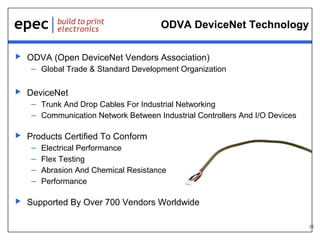
ODVA DeviceNet Technology
 ODVA (Open DeviceNet Vendors Association)
– Global Trade & Standard Development Organization
 DeviceNet
– Trunk And Drop Cables For Industrial Networking
– Communication Network Between Industrial Controllers And I/O Devices
 Products Certified To Conform
– Electrical Performance
– Flex Testing
– Abrasion And Chemical Resistance
– Performance
 Supported By Over 700 Vendors Worldwide
23
Dealing With The Government
 Standards/Regulations Galore
 EAR And ITAR
– Export Administration Regulations
– International Traffic In Arms Regulation
 United States Military Standards
– a.k.a. Defense Standard, Military Standard, MIL-STD, MIL-SPEC
 Achieves Standardization.
 Details Materials And Processes To Use
 Describes The Physical And Operational Characteristics
– Interoperability
– Compliance
– Compatibility
24
Conclusion
 By Referencing Standards Which May Be Either A Test
Method Or A Physical Or Electrical Description, The Task
Of Obtaining A Cable Having The Desired Properties Is
Simplified
 Dealing With A Vendor Familiar With The Various
Standards/Directives Ensures Compliance
 Many Standards That Need To Be Reviewed/Complied
With
 Standards Are Constantly Changing
25
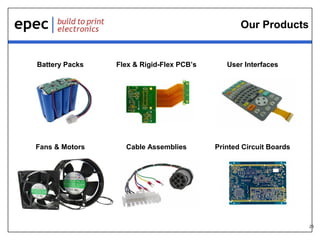
Our Products
Battery Packs Flex & Rigid-Flex PCB’s User Interfaces
Fans & Motors Cable Assemblies Printed Circuit Boards
26
Design Centers & Technical Support
 Battery Pack & Power Management – Denver, CO
 User Interfaces & Cable Assemblies – Largo, FL
 Fans & Motors – Wales, UK & New Bedford, MA
 PCB’s – New Bedford, MA & Shenzhen, China
 Flex & Rigid Flex – Toronto, Canada
 Cable Assemblies – New Bedford, MA & Largo, FL
 Our Engineering and Design teams are ready to help
our customers create world class and cost effective
product solutions.
27
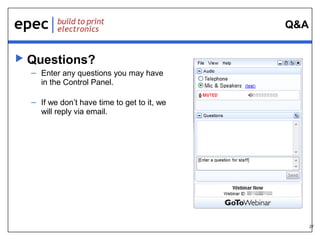
Q&A
 Questions?
– Enter any questions you may have
in the Control Panel.
– If we don’t have time to get to it, we
will reply via email.
28
Thank You
Check out our previous webinars at www.epectec.com.
For more information email sales@epectec.com.
Stay Connected with Epec Engineered Technologies
Follow us on our social media sites for continuous technical updates and information:

Industry Standards and How They Impact Cable Assembly Designs

  • 1.
     DELIVERING QUALITYSINCE 1952. Industry Standards & How They Impact Cable Assembly Designs 2.12.15
  • 2.
    2 Agenda  Definitions  Levelsof Standards To Be Concerned With – Materials-centric • Dimensional Standards • Construction Standards – Product-centric • Performance Standards – Safety-centric • Flammability Levels – Customer-centric • Exact Color Matches • Overmold Dimensions • Logo Matches  Worldwide Standards  Standards Examples
  • 3.
    3 Guiding Principle OfA Standard Standards Should:  Show Relationship To Design For Manufacturability (DFM) And Design For The Environment (DFE)  Minimize Time To Market  Contain Simple (Simplified) Language  Just Include Spec Information  Focus On End Product Performance  Include a Feedback System On Use And Problems For Future Improvement IPC/WHMA-A-620B Executive Committee 1995 Standards Should Not: Inhibit Innovation Increase Time-To-Market Keep People Out Increase Cycle Time Tell You How To Make Something Contain Anything That Cannot Be Defended With Data
  • 4.
    4 What Is A“Standard”  Standard – “Something considered by an authority or by general consent as a basis of comparison; an approved model; an accepted or approved example of something against which others are judged or measured”.  Use Of A Standard Is Wholly Voluntary.  A Standard Does Not Mandate That There Is Only One Way That A Product Or Procedure Can Be Engineered.  “The nice thing about standards is that there are so many of them to choose from” 1 – Reference to the fact that competing standards become a source of confusion, division, obsolescence, and duplication of effort instead of an enhancement to the usefulness of products. 1 Andrew Tanenbaum
  • 5.
    5 What Is “Code” Code – “A systematic statement of a body of laws, especially one given statutory force; a system of principles or rules”.  Most Recognized Electrical Engineering Code Of The United States Is The National Fire Protection Association’s NFPA 70 National Electric Code. – Generally Accepted As Nationally Accepted Consensus Code In Electrical Engineering. – Must Still Be Adopted By Individual Governing Bodies Mandating Its Acceptance And Use By Law To The Authority Having Jurisdiction.  Use Of A Code May Be Voluntary Or Mandated By Law.  Code Is A Living Document With Changes Made To Keep It Up To Date With Changes In Technology.
  • 6.
    6 What Are “RecommendedPractices”  Recommended Practices – “Method or technique that has consistently shown results superior to those achieved with other means; can evolve to become better as improvements are discovered”  Recommended Practices Are Electric Design And Installation Practices Which Have Been Generally Accepted In The Electrical Industry As Safe, Reliable, Effective, And Maintainable  Recommended Practices Are Not Considered To Be A Fixed Rule, Code, Or Standard  Anticipated That Sound Engineering Judgment Will Be Utilized When Implementing A Recommended Practice
  • 7.
    7 Materials-centric Standards Related ToCable Assemblies  ASTM – American Society For Testing And Materials – Six Categories Of Standards • Standard Specification • Standard Test Method • Standard Practice • Standard Guide • Standard Classification • Technology Standard – B1 Standard For Hard Drawn Copper Wire – B2 Standard For Medium Hard Drawn Copper Wire – B3 Standard For Soft Or Annealed Copper Wire – B8 Standard For Concentric Lay Stranded Copper Conductors – B172 Standard For Rope Lay Copper Conductors – B787 Standard For 19 Wire Unilay Stranded Wire – B193 Test Method For Resistivity Of Electrical Conductor Materials – B258 Specification For Nominal Diameters Of Solid Round Wires
  • 8.
    8 Safety-centric Standards  MajorityOf Safety Standards In North America Written By UL And CSA.  Many Standards Harmonized Between UL And CSA. – Allows Coverage With One Document.  Standards Enforced By Authority Having Jurisdiction. – Fire Marshall, Building Inspector, City Code Inspector, Building Owner  Safety Tests Performed By Third-Party Laboratories – Accredited By OSHA  Listed Products Recognized By Print Legend – Testing Lab Mark Plus LOGO Included • ETL, CSA, UL Cable Type UL Standard CSA Standard Harmonized Communications Cables ANSI/UL 444 CSA 22.2 No. 214 Yes Optical Fiber Cable ANSI/UL 1651 CSA 22.2 No. 232 No Flexible Cords And Cables ANSI/UL 62 CSA 22.2 No. 49 Yes
  • 9.
    9 Organizations Ensuring SafetyOf Products Used In North America  ASTM – American Society For Testing And Materials  IEEE – Institute Of Electrical And Electronics Engineers – NESC – National Electrical Safety Code  ICEA – Insulated Cable Engineers Association  IEC – International Electrotechnical Commission  NEMA – National Electrical Manufacturers Association – EFC – Electro Federation of Canada  CANENA – Council For Harmonization Of Electrotechnical Standardization Of North America  ANSI – American National Standards Institute  NFPA – National Fire Protection Association – NEC – National Electrical Code  ANCE – Association Of Standardization And Certification  IAEI – International Association of Electrical Inspectors
  • 10.
    10 Building Code Establishment November 28, 1942 - Fire At Cocoanut Grove Night Club, Boston – Fire Was Motivating Force Leading To Development And Enforcement Of Building Codes  492 People Died Due To Lack Of Working Exits  There Were No Occupancy Limits Enforced  Over 1,000 People Were In Building – 460 Was Supposed To Be Maximum  Exits Were Bolted Shut Or Bricked Over  Only One Operable Exit Door – Revolving Front Door
  • 11.
    11 Performance-centric Verification  NotRequired By Authority Having Jurisdiction. – Does Not Affect Human Safety  Intended To Provide End Users Confidence Product Performs As Expected  Ensures Interoperability And Expected Performance  Performance Standards Examples – ANSI/TIA-568-C.2 – ISO/IEC 11801 – EN 50173-1 – IEEE 802.3
  • 12.
    12 Standards Impacting Assembly Performance Electrical Characteristics Of Assemblies Must Meet Or Exceed Standards Set By Variety Of Organizations. – Includes TIA/EIA, ISO/IEC, IEEE, NEC, NFPA  Assemblies Must Meet Safety Requirements Set By UL/CSA. – Based on Environment  Performance May Need To Be Ensured By NRTL. – 15 Facilities Recognized By OSHA – Environmental – Safety – Electrical
  • 13.
    13 Customer-centric Standards  CoverWide Range Of Issues – Jacket Color – Match Equipment Color – Logo – Specific Fonts, Colors, Designs – Over Mold Designs
  • 14.
    14 Standards Not AlwaysAdhered To  Products Manufactured Outside North America Have Been Found To Be Out Of Compliance With Codes And Standards. – Do Not Meet Safety Requirements Set By North American Code And Standards Organizations – Safety Standards Maintained By UL – Codes & Standards Provide Framework For Electrical Products To Be Manufactured And Installed Safely – Provide Consistency And Protection For Manufacturers And Users – Standards Help Purchasers Select Most Appropriate Product For Their Needs – Electrical Codes And Standards Designed To Ensure The Manufacture And Installation Of Safe Products – Most Common Regulatory Approval Is UL Listing Mark – If Non-Compliant Products Are Used Contractors Expose Themselves To Liability For Product Failure And Resulting Safety Issues
  • 15.
    15 Worldwide Standards  TrendTowards International Harmonization Of Codes, Standards, And Recommended Practices  In Past United States Codes And Standards Readily Accepted  Emergence Of European Union And Other Regional Trade Organizations – Many Emerging Economies Have Adopted ISO And IEC Standards  Development Of Codes, Standards, Recommended Practices Often Necessitated Because Of Substantial Loss Of Life And Property  Development Of Codes, Standards, Recommended Practices Can Be Done By Industry/Manufacturing Groups, Engineering Or Professional Societies Or Organizations, Or Government Agencies Worldwide
  • 16.
    16 TIA (Telecommunications Industry Association) Develops Standards For Cabling Buildings  Intent Is To Develop A Uniform Wiring Standard – Goal Is To Support Multivendor Products And Environments  TIA Standards Widely Adopted And Considered The Global Standard For Data System Design  Standards Developed To Create Guidelines – 568 Commercial Building Telecommunications Wiring Standards – 569 Commercial Building Standard For Telecommunication Pathways And Spaces  Improved Technology Requires Revisions To Standards – 10-Gigabit Ethernet Uses Larger Cable Requiring Increased Bend Radius Needs
  • 17.
    17 IEEE 802.3 CategoryCable Standard  TIA/EIA-568-A Standard  Used In Structured Cabling For Computer Networks (Cat-5, Cat-5e, Cat-6, Cat-7) – 10BASE-T – 100BASE-TX (Fast Ethernet) – 1000BASE-T (Gigabit Ethernet) – 10GBASE-T (10-Gigabit Ethernet)  Standard Details And Specifies: – Performance Characteristics – Assembly Test Requirements – Cable Types – Connector Types – Conductor Size – Cabling Topologies – Color Code For Termination – Maximum Length For Cable Segment Without Repeaters
  • 18.
    18 Medical Industry Standards Medical Devices Highly Precise And Sensitive – Materials Must Perform In Harsh Environments • Withstand Vibration, Liquids, Sterilization – More Constricting Than COTS Products  Medical Industry Is Still A Tethered World  Medical Assemblies Held To A Higher Standard – Electrical Performance – Patient Safety  Friction Of Components Causes Triboelectric Noise  Packaging And Medical Manufacturing Are Highly Regulated  Assemblies Used In Surgical, Interventional, Imaging, Diagnostic & Therapeutic, Sensors, Single Use
  • 19.
    19 Medical Industry Standards ANSI/AAMI 53 Standard – Primary Purpose Was To Promote Patient Safety • Prevent Inadvertent Connection Of Patient Leads To Power Source – Defines Cable And Lead Wire Connections With No Exposed Contacts – Specifies That DIN 42-802 Be Followed • Specifies Pin & Socket Dimensions. • Specifies Electrical Contact Setback – Achieves “Touch-Proof” Connection • States Cleaning, Disinfection, Sterilization Requirements – Defines Minimum Performance For Critical Electrical Requirements • Triboelectric Noise – Developed To Address ECG Cables And Lead Wires – Commonly Used As A Base To Establish Performance Criteria For Other Medical Assembly Applications
  • 20.
    20 Medical Industry Standards 21 CFR 820.30 – Design Control For Product Development Of Medical Devices  ISO 13485:2003 – ISO Standard Detailing Medical Device Quality Management System  ISO 14971 – ISO Standard Detailing Requirements For Application Of Risk Management System For Medical Devices  MDD 93/42/EEC – Harmonizes Laws Relating To Medical Devices Within European Union  ISO 14698 – Standard Describing Principles And Basic Methodology to Control Bio- Contamination (Cleanroom Practices)
  • 21.
    21 InfiniBand Industry Specification Developed By The InfiniBand® Trade Association  Computer Network Communications Link  Most Commonly Used Interconnect In Supercomputers  IBTA Compiles integrators List – Based On Structured Testing To IB Standards  IBTA Currently Detailing Products By Throughput – SDR – 2 GBS – DDR – 4 GBS – QDR – 8 GBS – FDR-10 – 10 GBS FDR – 14 GBS – EDR – 25 GBS
  • 22.
    22 ODVA DeviceNet Technology ODVA (Open DeviceNet Vendors Association) – Global Trade & Standard Development Organization  DeviceNet – Trunk And Drop Cables For Industrial Networking – Communication Network Between Industrial Controllers And I/O Devices  Products Certified To Conform – Electrical Performance – Flex Testing – Abrasion And Chemical Resistance – Performance  Supported By Over 700 Vendors Worldwide
  • 23.
    23 Dealing With TheGovernment  Standards/Regulations Galore  EAR And ITAR – Export Administration Regulations – International Traffic In Arms Regulation  United States Military Standards – a.k.a. Defense Standard, Military Standard, MIL-STD, MIL-SPEC  Achieves Standardization.  Details Materials And Processes To Use  Describes The Physical And Operational Characteristics – Interoperability – Compliance – Compatibility
  • 24.
    24 Conclusion  By ReferencingStandards Which May Be Either A Test Method Or A Physical Or Electrical Description, The Task Of Obtaining A Cable Having The Desired Properties Is Simplified  Dealing With A Vendor Familiar With The Various Standards/Directives Ensures Compliance  Many Standards That Need To Be Reviewed/Complied With  Standards Are Constantly Changing
  • 25.
    25 Our Products Battery PacksFlex & Rigid-Flex PCB’s User Interfaces Fans & Motors Cable Assemblies Printed Circuit Boards
  • 26.
    26 Design Centers &Technical Support  Battery Pack & Power Management – Denver, CO  User Interfaces & Cable Assemblies – Largo, FL  Fans & Motors – Wales, UK & New Bedford, MA  PCB’s – New Bedford, MA & Shenzhen, China  Flex & Rigid Flex – Toronto, Canada  Cable Assemblies – New Bedford, MA & Largo, FL  Our Engineering and Design teams are ready to help our customers create world class and cost effective product solutions.
  • 27.
    27 Q&A  Questions? – Enterany questions you may have in the Control Panel. – If we don’t have time to get to it, we will reply via email.
  • 28.
    28 Thank You Check outour previous webinars at www.epectec.com. For more information email sales@epectec.com. Stay Connected with Epec Engineered Technologies Follow us on our social media sites for continuous technical updates and information: