





1
2
ANGINA PECTORIS
PREPARED BY :
OM VERMA
ASSISTANT PROFESSOR
RELIANCE INSTITUTE OF NURSING
3
• Definition:
• Angina: Choking or suffocation.
• Pectoris: Chest.Angina pectoris, is
the medical term used to describe
acute chest pain or discomfort.
Angina occurs when the heart’s need
for oxygen increases beyond the
Level of oxygen available from the
blood nourishing the heart.
4
• DEFINITION :-
• ACCORDING TO BRUNNER AND
SUDDHARTH –,Angina Pectoris is
severe chest pain due to ischemia
(a lack of blood, thus a lack of
oxygen supply) of the heart muscle,
generally due to obstruction or
spasm of the coronary arteries (the
heart's blood vessels).
5
• ACCORDING TO LIPPINCOTT :-
Chest pain that is typically
severe and crushing with a
feeling just behind the
breastbone (the sternum) of
pressure and suffocation, due to
an inadequate supply of oxygen
to the heart muscle.
6
7
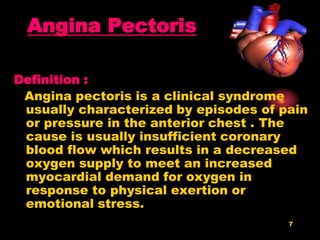
Angina Pectoris
Definition :
Angina pectoris is a clinical syndrome
usually characterized by episodes of pain
or pressure in the anterior chest . The
cause is usually insufficient coronary
blood flow which results in a decreased
oxygen supply to meet an increased
myocardial demand for oxygen in
response to physical exertion or
emotional stress.
8
• a condition marked by severe pain
in the chest, often also spreading
(radiate ) to the shoulders, arms,
and neck, cause to an inadequate
blood supply to the heart.
ETIOLOGY
9
• ETIOLOGY
• Supply-demand mismatch
• Factors that decrease supply
• Coronary vessel
• disorders
• Atherosclerosis
• Arterial spasm
• Coronary arteritis
10
•Polycythemia ( abnormal
increased concentration of
haemoglobin in the blood
and reduction plasma
volume or increased red
cell number.
11
• Angina Causes
• Angina usually happens because of heart disease. A fatty
substance called plaque builds up in your arteries, blocking
blood flow to your heart muscle. This forces your heart to
work with less oxygen. That causes pain. You may also
have blood clots in the arteries of your heart, which can
cause heart attacks.
• Less common causes of chest pain include:
• A blockage in a major artery of your lungs (pulmonary
embolism)
• An enlarged or thickened heart (hypertrophic
cardiomyopathy)
• Narrowing of a valve in the main part of your heart (aortic
stenosis)
• Swelling of the sac around your heart (pericarditis)
• Tearing in the wall of your aorta, the largest artery in your
body (aortic dissection)
•
12
Tobacco use. Chewing tobacco, smoking and long-term
exposure to secondhand smoke damage the interior walls of
arteries — including arteries to your heart — allowing deposits
of cholesterol to collect and block blood flow.
Diabetes. Diabetes increases the risk of coronary artery
disease, which leads to angina and heart attacks by speeding
up atherosclerosis and increasing your cholesterol levels.
High blood pressure. Over time, high blood pressure damages
arteries by accelerating hardening of the arteries.
High blood cholesterol or triglyceride levels. Cholesterol is a
major part of the deposits that can narrow arteries throughout
your body, including those that supply your heart. A high level of
low-density lipoprotein (LDL) cholesterol, also known as "bad"
cholesterol, increases your risk of angina and heart attacks. A
high level of triglycerides, a type of blood fat related to your
diet, also is unhealthy. 13
Family history of heart disease. If a family member has coronary
artery disease or has had a heart attack, you're at a greater risk
of developing angina.
Older age. Men older than 45 and women older than 55 have a
greater risk than do younger adults.
Lack of exercise. An inactive lifestyle contributes to high
cholesterol, high blood pressure, type 2 diabetes and obesity.
However, it is important to talk with your doctor before starting
an exercise program.
Obesity. Obesity
is linked with high blood cholesterol levels, high blood pressure
and diabetes, all which increase your risk of angina and heart
disease. If you're overweight, your heart has to work harder to
supply blood to the body.
Stress. Stress can increase your risk of angina and heart
attacks. Too much stress, as well as anger, also can raise your
blood pressure. Surges of hormones produced during stress can
narrow your arteries and worsen angina. 14
C.M
15
General Symptoms
• Severe chest discomfort (heaviness,
pressure, tightness, choking,
squeezing) (suffocation )
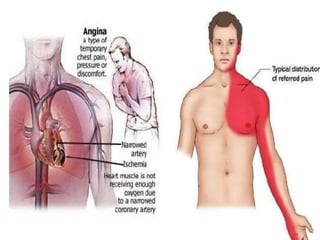
• The pain may radiate to the
shoulders, arms, back,
neck, or jaw.
• Palpitations
• Sweating
• Dizziness
• Dyspnea
17
• CLINICAL FEATURES
• Chest pain
• Manifest as
• heaviness, tightness,
• aching, fullness, or
• burning of the chest,
• epigastrium, and/or
• arm or forearm
• (usually the left
18
• Onset :- Develop quickly or slowly.
• Location :- Slightly to the left of
• sternum.
• Radiation :- Left shoulder and
upper and may then travel down the
inner aspect of the left arm to the
elbow, wrist, fourth and fifth fingers,
radiate to right shoulder, neck, jaw,
epigastric region. Duration :- Less
than 5 minutes. Sensation :- Like
squeezing, burning, pressing ,
chocking, aching , pain feels like gas,
heartburn
19
• Associated: Dyspnea, Sweating,
faintness ( behoshi ) , palpitation,
dizziness ect.
• Relieving: GTN and rest.
• Aggravating: exertion, exercise,
heavy meal, emotional upset, and
anger
20
Pathophysiology
• Due to etiological factors
• A reduction of coronary blood flow
caused by fixed &or dynamic
epicardial artery stenosis.
• Abnormal constriction or deficient
relaxation of coronary artery.
• Reduce O2-carrying capacity of the
blood .
• Atherosclerosis Arterial spasm
Atherosclerosis+Plaque
split+Thrombus
Obstruction sudden reversible
occlusion obstruction
• ISCHAEMIA (Hypoxia)
Reduced oxygen demand Angina
Thrombolysis -
Unstable angina 21
• imbalance between the heart's
oxygen demand
• This imbalance can result from
an increase in demand (e.g.,
during exercise)
Lead to angina pectoris
22
• TYPES OF ANGINA PECTORIS
23
24
1. STABLE ANGINA:
• predictable (STABLE) & consistent pain
• Predictable
• Occurs on exercise, emotion or eating.
• Caused by increase demand of the
heart and by a fixed
• narrowing of coronary vessels, almost
always by atheroma.
• Coronary obstruction is ‘fixed’
• relieved by rest.
• 2. Intractable or refractory angina:
sever incapacitating chest pain.
refractory angina pectoris (chest
pain) is a sensation of pressure
or pain in the chest that is the
result of insufficient blood flow to
the heart muscle and in which
treatment with medication
and heart surgery is either
insufficient or no longer effective.
25
3.Unstable angina or preinfarction or
cresendo angina:
• symptoms occur more frequently and
longer ( PROLONGATE )than stable
angina. Dangerous and requires
emergency treatment.
• It is the rupture of the fibrous cap,
leading to the blockage of
• the artery by clotted blood.
• • Occurs with increasing frequency
(progression) • Affects the patient's
life by not being able to work. 26
27
4. Variant angina or prinzmetals angina :
secondary epicardial coronary artery
spasm. pain at rest with reversable ST-
segment elevation, caused by coronary
artery vasospasm.
5. Silent ischemia: objective evidence of
ischemia in absence of chest
discomfort (as ECG changes with a
test), but pt report no symptom.
28
• ANGINA: SILENT ISCHEMIA
• Very Common
• More episodes of Silent than
Painful angina in the
• same patient.
• Difficult to diagnose
• Gnerally Exercise testing.
29
Diagnostic findings
Often made by evaluating the
clinical manifestations of ischemia
and the pts history
30
DIAGNOSTIC FINDINGS
• DIAGNOSTIC TESTS :-
• Electrocardiogram (EKG) - records electrical
activity of the heart and can detect when the
heart is starved for oxygen
•
• Stress test - blood pressure readings and an
EKG while the patient is increasing physical
activity
• Chest X-ray - to see structures inside the chest
• Coronary angiography - dye and special X-rays
to show the inside of coronary arteries (dye is
inserted using cardiac catheterization)
•
• Blood tests - to check levels of fats,
cholesterol, sugar, and proteins 31
32
Medical management for
the pt with angina pectoris
• MANAGEMENT :- Treatment will depend on the
severity of the symptoms, severity of the
underlying disease, and extent of damage to the
heart muscle, if any Simple rest and observation,
an aspirin, breathing oxygen, and sublingual
nitroglycerin may be all that the patient needs, if it
is only angina.
• Medication may be administered to reduce anxiety.
• Medication may be administered to lower blood
pressure or heart rate.
• Medication may be administered to reduce the risk
of having a blood clot or to prevent further clotting.
• If the healthcare provider believes the chest pain
actually represents a heart attack, the patient may
be given a fibrinolytic (apowerful clot-buster
medication).
• Lifestyle changes recommended to treat angina33
• Regularly checking cholesterol
levels
• Resting and slowing down
• Avoiding large meals
• Learning how to handle or avoid
stress
• Eating fruits, vegetables, whole
grains, low-fat or no-fat diary
products, and lean meat and
fish
34
35
• The objective is to decrease
oxygen demand of myocardium
and to increase oxygen supply
• 1.Nitroglycerin : administered to
reduce myocardial oxygen
consumption
36
2.Beta-adrenergic blocking agents :
( propranolol ,metoprolol , atenolol)
appear to reduce myocardial oxygen
consumption, result in a reduction in
heart rate, decreased BP , and
reduced myocardial contractility .
37
3-Calcium channel blocking
agents : some decrease
sinoatrial node automaticity and
node conduction ,resulting in
slower heart rate
38
4- Antiplatelet and
anticoagulent
medications
Aspirin: prevents platelet
activation and reduces the
incidence of MI and death with
CAD
Heparin : prevents the
formation of new blood clots
39
• Oxygen administration :
usually initiated at the onset of
chest pain to increase the amount
of oxygen delivered to the
myocardium and to decrease the
pain.
Angioplasty
• is a treatment used for people whose angina does not get
better with medication and/or who are at high risk of having a
heart attack.
• Before angioplasty can be done, the area(s) of coronary
artery narrowing is located with coronary arteriography.
• A thin plastic tube called a catheter is inserted into
an artery in the arm or groin with local sedation.
The catheter has a tiny balloon attached to the
end.
• The catheter is threaded through the arteries and
into the artery where the narrowing is.
• The balloon on the catheter is inflated, opening up
the narrowing.
• Following ballon treatment, many patients require
placement of a "stent," a small metal sleeve that is
placed in the narrowed artery. The stent holds the40
41
Prevention
Self care action plan changing habits.
 Stop smoking
 Increase level of exercise
 Cut down on fatty foods
 Eat more oats, which decrease
cholesterol
42
 Lose wt if u DR. thinks you are
overweight.
 Make sure your BP is not high by
regular check
 Consider another method of
contraceptive if you take pill
43
Nsg process for pt with
Angina pectoris
Assessment
The nurse gather information about
the pts symptoms and activities .
The nurse may ask about the period
that angina last , and if any
medication relieve the angina.
44
Diagnosis
1. Ineffective myocardial tissue
perfusion secondary to CAD as
evidence by chest pain or equivalent
symptoms
2. Anxiety related to fear of death
45
Diagnosis
3. Noncompliance , ineffective
management of therapeutic
regimen related to failure to
accept necessary lifestyle changes
46
Planning and goals
The major goal include
immediate treatment when
angina occur , preventing of
angina , reduction of anxiety
and absence of complications
47
NSG interventions
1. Treating angina : when pt
experiences angina the nurse should
direct pt to stop activities and sit or
rest in bed in semi-fowler position
2. Reducing anxiety : The nurse should
explore and implicate that the
diagnosis has for the pt providing
information about the illness ,
treatment and methods of preventing
its progression
48
3. Preventing pain : when the pt has
pain with minimal activity , the
nurse alternates the pts activities
with rest periods
49
Evaluation
expected pts outcomes may include
1. Reports that pain is relieved
promptly
2. Reports decreased
3. anxietyUnderstands ways to avoid
complications and demonstrates
freedom from complications
• Complications:
• Myocardial infarction
• Cardiac Arrhythmias
50
51

Angina pectoris

  • 1.
  • 2.
    2 ANGINA PECTORIS PREPARED BY: OM VERMA ASSISTANT PROFESSOR RELIANCE INSTITUTE OF NURSING
  • 3.
  • 4.
    • Definition: • Angina:Choking or suffocation. • Pectoris: Chest.Angina pectoris, is the medical term used to describe acute chest pain or discomfort. Angina occurs when the heart’s need for oxygen increases beyond the Level of oxygen available from the blood nourishing the heart. 4
  • 5.
    • DEFINITION :- •ACCORDING TO BRUNNER AND SUDDHARTH –,Angina Pectoris is severe chest pain due to ischemia (a lack of blood, thus a lack of oxygen supply) of the heart muscle, generally due to obstruction or spasm of the coronary arteries (the heart's blood vessels). 5
  • 6.
    • ACCORDING TOLIPPINCOTT :- Chest pain that is typically severe and crushing with a feeling just behind the breastbone (the sternum) of pressure and suffocation, due to an inadequate supply of oxygen to the heart muscle. 6
  • 7.
    7 Angina Pectoris Definition : Anginapectoris is a clinical syndrome usually characterized by episodes of pain or pressure in the anterior chest . The cause is usually insufficient coronary blood flow which results in a decreased oxygen supply to meet an increased myocardial demand for oxygen in response to physical exertion or emotional stress.
  • 8.
    8 • a conditionmarked by severe pain in the chest, often also spreading (radiate ) to the shoulders, arms, and neck, cause to an inadequate blood supply to the heart.
  • 9.
  • 10.
    • ETIOLOGY • Supply-demandmismatch • Factors that decrease supply • Coronary vessel • disorders • Atherosclerosis • Arterial spasm • Coronary arteritis 10
  • 11.
    •Polycythemia ( abnormal increasedconcentration of haemoglobin in the blood and reduction plasma volume or increased red cell number. 11
  • 12.
    • Angina Causes •Angina usually happens because of heart disease. A fatty substance called plaque builds up in your arteries, blocking blood flow to your heart muscle. This forces your heart to work with less oxygen. That causes pain. You may also have blood clots in the arteries of your heart, which can cause heart attacks. • Less common causes of chest pain include: • A blockage in a major artery of your lungs (pulmonary embolism) • An enlarged or thickened heart (hypertrophic cardiomyopathy) • Narrowing of a valve in the main part of your heart (aortic stenosis) • Swelling of the sac around your heart (pericarditis) • Tearing in the wall of your aorta, the largest artery in your body (aortic dissection) • 12
  • 13.
    Tobacco use. Chewingtobacco, smoking and long-term exposure to secondhand smoke damage the interior walls of arteries — including arteries to your heart — allowing deposits of cholesterol to collect and block blood flow. Diabetes. Diabetes increases the risk of coronary artery disease, which leads to angina and heart attacks by speeding up atherosclerosis and increasing your cholesterol levels. High blood pressure. Over time, high blood pressure damages arteries by accelerating hardening of the arteries. High blood cholesterol or triglyceride levels. Cholesterol is a major part of the deposits that can narrow arteries throughout your body, including those that supply your heart. A high level of low-density lipoprotein (LDL) cholesterol, also known as "bad" cholesterol, increases your risk of angina and heart attacks. A high level of triglycerides, a type of blood fat related to your diet, also is unhealthy. 13
  • 14.
    Family history ofheart disease. If a family member has coronary artery disease or has had a heart attack, you're at a greater risk of developing angina. Older age. Men older than 45 and women older than 55 have a greater risk than do younger adults. Lack of exercise. An inactive lifestyle contributes to high cholesterol, high blood pressure, type 2 diabetes and obesity. However, it is important to talk with your doctor before starting an exercise program. Obesity. Obesity is linked with high blood cholesterol levels, high blood pressure and diabetes, all which increase your risk of angina and heart disease. If you're overweight, your heart has to work harder to supply blood to the body. Stress. Stress can increase your risk of angina and heart attacks. Too much stress, as well as anger, also can raise your blood pressure. Surges of hormones produced during stress can narrow your arteries and worsen angina. 14
  • 15.
  • 16.
    General Symptoms • Severechest discomfort (heaviness, pressure, tightness, choking, squeezing) (suffocation ) • The pain may radiate to the shoulders, arms, back, neck, or jaw. • Palpitations • Sweating • Dizziness • Dyspnea
  • 17.
    17 • CLINICAL FEATURES •Chest pain • Manifest as • heaviness, tightness, • aching, fullness, or • burning of the chest, • epigastrium, and/or • arm or forearm • (usually the left
  • 18.
    18 • Onset :-Develop quickly or slowly. • Location :- Slightly to the left of • sternum. • Radiation :- Left shoulder and upper and may then travel down the inner aspect of the left arm to the elbow, wrist, fourth and fifth fingers, radiate to right shoulder, neck, jaw, epigastric region. Duration :- Less than 5 minutes. Sensation :- Like squeezing, burning, pressing , chocking, aching , pain feels like gas, heartburn
  • 19.
    19 • Associated: Dyspnea,Sweating, faintness ( behoshi ) , palpitation, dizziness ect. • Relieving: GTN and rest. • Aggravating: exertion, exercise, heavy meal, emotional upset, and anger
  • 20.
    20 Pathophysiology • Due toetiological factors • A reduction of coronary blood flow caused by fixed &or dynamic epicardial artery stenosis. • Abnormal constriction or deficient relaxation of coronary artery. • Reduce O2-carrying capacity of the blood .
  • 21.
    • Atherosclerosis Arterialspasm Atherosclerosis+Plaque split+Thrombus Obstruction sudden reversible occlusion obstruction • ISCHAEMIA (Hypoxia) Reduced oxygen demand Angina Thrombolysis - Unstable angina 21
  • 22.
    • imbalance betweenthe heart's oxygen demand • This imbalance can result from an increase in demand (e.g., during exercise) Lead to angina pectoris 22
  • 23.
    • TYPES OFANGINA PECTORIS 23
  • 24.
    24 1. STABLE ANGINA: •predictable (STABLE) & consistent pain • Predictable • Occurs on exercise, emotion or eating. • Caused by increase demand of the heart and by a fixed • narrowing of coronary vessels, almost always by atheroma. • Coronary obstruction is ‘fixed’ • relieved by rest.
  • 25.
    • 2. Intractableor refractory angina: sever incapacitating chest pain. refractory angina pectoris (chest pain) is a sensation of pressure or pain in the chest that is the result of insufficient blood flow to the heart muscle and in which treatment with medication and heart surgery is either insufficient or no longer effective. 25
  • 26.
    3.Unstable angina orpreinfarction or cresendo angina: • symptoms occur more frequently and longer ( PROLONGATE )than stable angina. Dangerous and requires emergency treatment. • It is the rupture of the fibrous cap, leading to the blockage of • the artery by clotted blood. • • Occurs with increasing frequency (progression) • Affects the patient's life by not being able to work. 26
  • 27.
    27 4. Variant anginaor prinzmetals angina : secondary epicardial coronary artery spasm. pain at rest with reversable ST- segment elevation, caused by coronary artery vasospasm. 5. Silent ischemia: objective evidence of ischemia in absence of chest discomfort (as ECG changes with a test), but pt report no symptom.
  • 28.
    28 • ANGINA: SILENTISCHEMIA • Very Common • More episodes of Silent than Painful angina in the • same patient. • Difficult to diagnose • Gnerally Exercise testing.
  • 29.
    29 Diagnostic findings Often madeby evaluating the clinical manifestations of ischemia and the pts history
  • 30.
  • 31.
    • DIAGNOSTIC TESTS:- • Electrocardiogram (EKG) - records electrical activity of the heart and can detect when the heart is starved for oxygen • • Stress test - blood pressure readings and an EKG while the patient is increasing physical activity • Chest X-ray - to see structures inside the chest • Coronary angiography - dye and special X-rays to show the inside of coronary arteries (dye is inserted using cardiac catheterization) • • Blood tests - to check levels of fats, cholesterol, sugar, and proteins 31
  • 32.
    32 Medical management for thept with angina pectoris
  • 33.
    • MANAGEMENT :-Treatment will depend on the severity of the symptoms, severity of the underlying disease, and extent of damage to the heart muscle, if any Simple rest and observation, an aspirin, breathing oxygen, and sublingual nitroglycerin may be all that the patient needs, if it is only angina. • Medication may be administered to reduce anxiety. • Medication may be administered to lower blood pressure or heart rate. • Medication may be administered to reduce the risk of having a blood clot or to prevent further clotting. • If the healthcare provider believes the chest pain actually represents a heart attack, the patient may be given a fibrinolytic (apowerful clot-buster medication). • Lifestyle changes recommended to treat angina33
  • 34.
    • Regularly checkingcholesterol levels • Resting and slowing down • Avoiding large meals • Learning how to handle or avoid stress • Eating fruits, vegetables, whole grains, low-fat or no-fat diary products, and lean meat and fish 34
  • 35.
    35 • The objectiveis to decrease oxygen demand of myocardium and to increase oxygen supply • 1.Nitroglycerin : administered to reduce myocardial oxygen consumption
  • 36.
    36 2.Beta-adrenergic blocking agents: ( propranolol ,metoprolol , atenolol) appear to reduce myocardial oxygen consumption, result in a reduction in heart rate, decreased BP , and reduced myocardial contractility .
  • 37.
    37 3-Calcium channel blocking agents: some decrease sinoatrial node automaticity and node conduction ,resulting in slower heart rate
  • 38.
    38 4- Antiplatelet and anticoagulent medications Aspirin:prevents platelet activation and reduces the incidence of MI and death with CAD Heparin : prevents the formation of new blood clots
  • 39.
    39 • Oxygen administration: usually initiated at the onset of chest pain to increase the amount of oxygen delivered to the myocardium and to decrease the pain.
  • 40.
    Angioplasty • is atreatment used for people whose angina does not get better with medication and/or who are at high risk of having a heart attack. • Before angioplasty can be done, the area(s) of coronary artery narrowing is located with coronary arteriography. • A thin plastic tube called a catheter is inserted into an artery in the arm or groin with local sedation. The catheter has a tiny balloon attached to the end. • The catheter is threaded through the arteries and into the artery where the narrowing is. • The balloon on the catheter is inflated, opening up the narrowing. • Following ballon treatment, many patients require placement of a "stent," a small metal sleeve that is placed in the narrowed artery. The stent holds the40
  • 41.
    41 Prevention Self care actionplan changing habits.  Stop smoking  Increase level of exercise  Cut down on fatty foods  Eat more oats, which decrease cholesterol
  • 42.
    42  Lose wtif u DR. thinks you are overweight.  Make sure your BP is not high by regular check  Consider another method of contraceptive if you take pill
  • 43.
    43 Nsg process forpt with Angina pectoris Assessment The nurse gather information about the pts symptoms and activities . The nurse may ask about the period that angina last , and if any medication relieve the angina.
  • 44.
    44 Diagnosis 1. Ineffective myocardialtissue perfusion secondary to CAD as evidence by chest pain or equivalent symptoms 2. Anxiety related to fear of death
  • 45.
    45 Diagnosis 3. Noncompliance ,ineffective management of therapeutic regimen related to failure to accept necessary lifestyle changes
  • 46.
    46 Planning and goals Themajor goal include immediate treatment when angina occur , preventing of angina , reduction of anxiety and absence of complications
  • 47.
    47 NSG interventions 1. Treatingangina : when pt experiences angina the nurse should direct pt to stop activities and sit or rest in bed in semi-fowler position 2. Reducing anxiety : The nurse should explore and implicate that the diagnosis has for the pt providing information about the illness , treatment and methods of preventing its progression
  • 48.
    48 3. Preventing pain: when the pt has pain with minimal activity , the nurse alternates the pts activities with rest periods
  • 49.
    49 Evaluation expected pts outcomesmay include 1. Reports that pain is relieved promptly 2. Reports decreased 3. anxietyUnderstands ways to avoid complications and demonstrates freedom from complications
  • 50.
    • Complications: • Myocardialinfarction • Cardiac Arrhythmias 50
  • 51.