RHEUMATIC HEART DISEASE
ULFAT AMIN
Msc Nursing (Pediatric nursing)
INTRODUCTION
 Rheumatic fever is a diffuse inflammatory disease characterized
by a delayed response to an infection by group A beta-hemolytic
streptococci (GAS) in the tonsilo-pharyngeal area, affecting the
heart, joints, central nervous system, skin and subcutaneous
tissues.
 It is thought that 40-60% of patients with ARF will go on to
developing RHD.
DEFINITION
 Rheumatic heart disease is a chronic condition resulting
from rheumatic fever which involves all the layers of
the heart (i.e. pancarditis) and is characterized by
scarring and deformity of the heart valves.
 The commonest valves affecting are the mitral and
aortic, in that order. However all four valves can be
affected.
INCIDENCE
 Rheumatic fever is principally a disease of childhood, with a
median age of 10 years, although it also occurs in adults (20% of
cases).
 Rheumatic fever occurs in equal numbers in males and females,
but the prognosis is worse for females than for males.
 The disease is seen more commonly in poor socio-economic strata
of the society living in damp and overcrowded place.
 Common in the developing countries like India, Pakistan.
 The incidence of RF in Developing countries is 27-100/1 lac /yr
(G.S.Sainani 2006)
ETIOLOGY
 Group A beta-hemolytic streptococcus.
 Rheumatic fever
 Poor socio-economic status: People who are poor and belongs to
low socio-economic conditions are prone to get Rheumatic heart
disease.
 Over-crowding: People who are living in a slum or damp area are
more prone to get Rheumatic heart disease.
 Age: It appears most commonly in children between the age of 5
to 15 years.
RISK FACTORS
 Climate and season: It occurs more in the rainy season
and in the cold climate.
 Upper respiratory tract infection: Rheumatic fever is an
outcome of upper respiratory tract infection with group
A beta hemolytic streptococcus.
 Previous history of Rheumatic fever: The client with
previous history of Rheumatic fever are at high risk to
develop Rheumatic heart disease.
 Genetic predisposition: Rheumatic heart disease shows
familier tendancy.
PATHOPHYSIOLOGY
CAUSATIVE AGENT ( GROUP A BETA HEMOLYTIC
STREPTOCOCCI
UNTREATED SORE THROAT
RHEUMATIC FEVER
ALL LAYERS OF HEART AND MITRIAL VALUE BECOME
INFLAMED
VEGETATION FORMS
VALVULAR REGURGITATIONS AND STENOSIS
HEART FAILURE
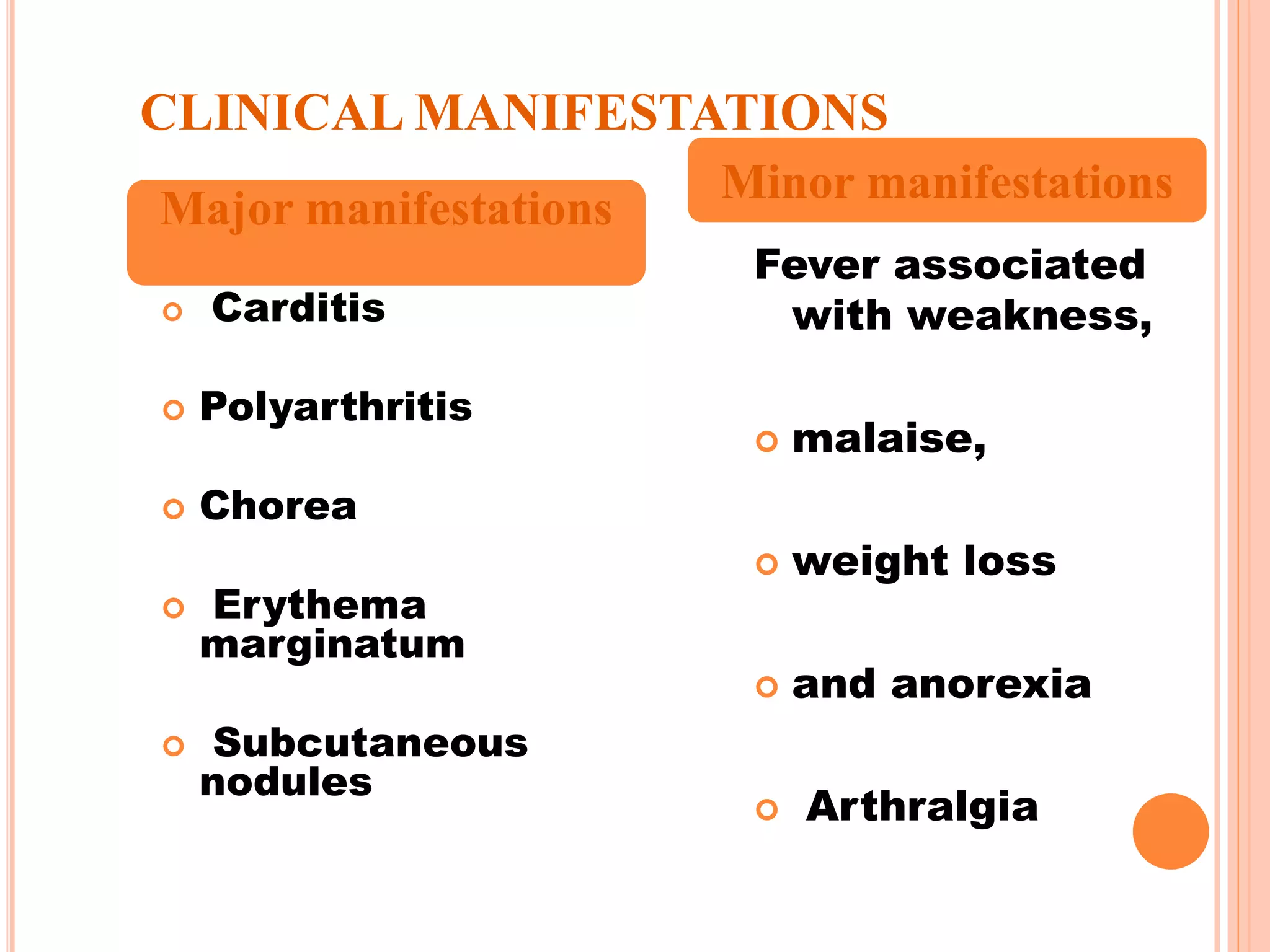
CLINICAL MANIFESTATIONS
 Carditis
 Polyarthritis
 Chorea
 Erythema
marginatum
 Subcutaneous
nodules
Fever associated
with weakness,
 malaise,
 weight loss
 and anorexia
 Arthralgia
Major manifestations
Minor manifestations
LABORATORY FINDINGS
 Positive throat culture for group A beta- hemolytic streptococci.
 Elevated acute phase reactants: a) Erythrocyte sedimentation rate
b) C-reactive protein c) Leukocytosis
 Prolonged P-R interval
DIAGNOSTIC EVALUATIONS
A diagnosis of rheumatic heart disease is made after confirming antecedent
rheumatic fever.
The modified Jones criteria (revised in 1992) provide guidelines for the
diagnosis of rheumatic fever.
JONES CRITERIA
 2 major or
 1 major and 2 minor
Jones’ criteria for the diagnosis of Rheumatic fever
Major manifestations : Carditis, Polyarthritis, Chorea, Erythema
marginatum, Subcutaneous nodules
Minor manifestations
a) Clinical findings, Previous rheumatic fever or rheumatic heart disease,
Arthralgia , Fever associated with weakness, malaise, weight loss and
anorexia
b) Laboratory findings
 Elevated ESR, C-reactive protein and Leukocytosis
 ECG and echocardiogram to confirm rhythm problems
and structural changes (prolonged P-R interval).
 Chest X-ray shows enlarged heart.
c) Evidence of Group A streptococcal infection
Positive throat culture for strep A
Elevated or rising anti-streptococcal antibody titer
Recent scarlet fever
IMAGING STUDIES
 Chest roentgenography : Cardiomegaly, pulmonary
congestion, and other findings consistent with heart
failure may be seen on chest radiography.
 Doppler-echocardiogram: In acute rheumatic heart
disease, Doppler- echocardiography identifies and
quantitates valve insufficiency and ventricular
dysfunction.
 In chronic rheumatic heart disease, echocardiography
may be used to track the progression of valve stenosis and
may help determine the time for surgical intervention.
 Heart catheterization:- In acute rheumatic heart
disease, this procedure is not indicated.
 With chronic disease, heart catheterization has been
performed to evaluate mitral and aortic valve disease and
to balloon stenotic mitral valves.
 ON ECG :- Sinus tachycardia most frequently
accompanies acute rheumatic heart disease. Alternatively,
some children develop sinus bradycardia from increased
vagal tone. Patients with rheumatic heart disease also
may develop atrial flutter, multifocal atrial tachycardia,
or atrial fibrillation from chronic mitral valve disease and
atrial dilation.
MEDICAL MANAGEMENT
1. Eradicate infection
 Preventive and prophylactic therapy is indicated after
rheumatic fever and acute rheumatic heart disease to
prevent further damage to valves.
 Primary prophylaxis (initial course of antibiotics
administered to eradicate the streptococcal infection) also
serves as the first course of secondary prophylaxis
(prevention of recurrent rheumatic fever and rheumatic
heart disease).
 An injection of 0.6-1.2 million units of benzathine
penicillin G intramuscularly every 4 weeks is the
recommended regimen for secondary prophylaxis for most
US patients.
 Alternate drugs recommended by the American Heart
Association for these patients include PO clindamycin (20
mg/kg in children, 600 mg in adults) and PO azithromycin or
clarithromycin (15 mg/kg in children, 500 mg in adults).
 Administer the same dosage every 3 weeks in areas where
rheumatic fever is
 endemic, in patients with residual carditis, and in high-risk
patients.
 Continue antibiotic prophylaxis indefinitely for patients at
high risk (eg, health care workers, teachers, daycare workers)
for recurrent GABHS infection.
 Patients with rheumatic fever with carditis and valve
disease should receive antibiotics for at least 10 years or
until age 40 years.
 Patients with rheumatic heart disease and valve damage
require a single dose of antibiotics 1 hour before surgical
and dental procedures to help prevent bacterial
endocarditis.
 Patients who had rheumatic fever without valve damage
do not need endocarditis prophylaxis.
2. Maximize cardiac output:- Corticosteroids are used to
treat carditis, especially if heart failure is evident.
 If heart failure develops, treatment, including ACE
inhibitors, beta blockers and diuretics, is effective.
3. Promote comfort :- Client with arthritic manifestations
obtain relief with salicylates.
 Bed rest is usually prescribed to reduce cardiac effort
until evidence of inflammation has subsided.
SURGICAL MANAGEMENT
 When heart failure persists or worsens after aggressive medical therapy
for acute rheumatic heart disease, surgery to decrease valve insufficiency
may be life-saving.
 Forty percent of patients with acute rheumatic heart disease
subsequently develop mitral stenosis as adults.
 Cummisurotomy can be done to widen the valve.
 In patients with critical stenosis, mitral valvulotomy, percutaneous
balloon valvuloplasty, or mitral valve replacement may be indicated.
 Due to high rates of recurrent symptoms after annuloplasty or other
repair procedures, valve replacement appears to be the preferred surgical
option
NURSING MANAGEMENT
Nursing diagnosis:- Pain related to inflammatory response in the
joints.
Objectives: The client verbalizes increased comfort as evidenced by
reports of reduced discomfort, expression of joint pain reduction,
relaxed body posture and a calm facial expression.
Interventions
 Assess the level of pain, duration, intensity and frequency of pain.
 Complete bed rest and provide comfortable position.
 Provide diversional therapy and psychological support.
 Administer analgesics as needed.
Nursing diagnosis:- Decreased cardiac output related to valve
dysfunction or HF.
Objectives: client increases cardiac output as evidenced by regular
cardiac rhythm, heart rate, blood pressure, respiration and urine
output within normal limit.
Interventions
 Assess the symptoms of heart failure and decreased cardiac output
including diminished quality of peripheral pulses, cool skin and
extremities, increased respiration, increased heart rate, neck vein
distention and presence of edema.
 Assess for heart sounds.
 Monitor intake and output.
 Provide bed rest.
 Administration of cardiac glycosides as prescribed.
Nursing diagnosis:- Knowledge deficit related to
disease condition and long term treatment.
Objectives: Patient gains adequate knowledge as
evidenced by explaining disease condition, recognizing
need for medication, understanding treatment.
Intervention
 Assess the clients level of knowledge.
Assess the client’s ability to learn.
 Explain about disease condition and about
prophylactic treatment of antibiotics.
Clarify the clients doubt clearly.
Nursing diagnosis:- Anxiety related to disease condition and
heart failure
Objectives: clients shows maximum reduction of anxiety.
Interventions
 Assess the clients level of anxiety.
 Clarify the doubts of the clients by using non medical terms
and calm, slow speech.
 Explain all activities, procedures and issues that involves
the client.
 Explain about the disease conditions and prophylactic
treatment.
 Provide anxiolytics as prescribed.
BIBLIOGRAPHY
 Dutta parul ,pediatric nursing , 2nd edition ,2009
 Dorthy r. Morlow, text book of pediatric nsg 6thedition, 2010.
 Piyush gupta. “Text book of pediatric nursing”, ist edition 2012
 Black JM, hawks JH. Medical surgical nursing. 8th ed.Vol-2.
Elsevier; p.1396-1401
 lewis, heitkemper, dirksen o’brien, bucher. Medical surgical
nursing.7th ed.New delhi.Elsevier;p. 875-82
 url:https://en.Wikipedia.Org/wiki/rheumatic_fever
 url:http://www.Slideshare.Net/miel9156/rheumatic- heart-disease-
3264045
Rheumatic heart disease

Rheumatic heart disease

  • 1.
    RHEUMATIC HEART DISEASE ULFATAMIN Msc Nursing (Pediatric nursing)
  • 2.
    INTRODUCTION  Rheumatic feveris a diffuse inflammatory disease characterized by a delayed response to an infection by group A beta-hemolytic streptococci (GAS) in the tonsilo-pharyngeal area, affecting the heart, joints, central nervous system, skin and subcutaneous tissues.  It is thought that 40-60% of patients with ARF will go on to developing RHD.
  • 3.
    DEFINITION  Rheumatic heartdisease is a chronic condition resulting from rheumatic fever which involves all the layers of the heart (i.e. pancarditis) and is characterized by scarring and deformity of the heart valves.  The commonest valves affecting are the mitral and aortic, in that order. However all four valves can be affected.
  • 4.
    INCIDENCE  Rheumatic feveris principally a disease of childhood, with a median age of 10 years, although it also occurs in adults (20% of cases).  Rheumatic fever occurs in equal numbers in males and females, but the prognosis is worse for females than for males.  The disease is seen more commonly in poor socio-economic strata of the society living in damp and overcrowded place.  Common in the developing countries like India, Pakistan.  The incidence of RF in Developing countries is 27-100/1 lac /yr (G.S.Sainani 2006)
  • 5.
    ETIOLOGY  Group Abeta-hemolytic streptococcus.  Rheumatic fever  Poor socio-economic status: People who are poor and belongs to low socio-economic conditions are prone to get Rheumatic heart disease.  Over-crowding: People who are living in a slum or damp area are more prone to get Rheumatic heart disease.  Age: It appears most commonly in children between the age of 5 to 15 years. RISK FACTORS
  • 6.
     Climate andseason: It occurs more in the rainy season and in the cold climate.  Upper respiratory tract infection: Rheumatic fever is an outcome of upper respiratory tract infection with group A beta hemolytic streptococcus.  Previous history of Rheumatic fever: The client with previous history of Rheumatic fever are at high risk to develop Rheumatic heart disease.  Genetic predisposition: Rheumatic heart disease shows familier tendancy.
  • 7.
    PATHOPHYSIOLOGY CAUSATIVE AGENT (GROUP A BETA HEMOLYTIC STREPTOCOCCI UNTREATED SORE THROAT RHEUMATIC FEVER ALL LAYERS OF HEART AND MITRIAL VALUE BECOME INFLAMED VEGETATION FORMS VALVULAR REGURGITATIONS AND STENOSIS HEART FAILURE
  • 8.
    CLINICAL MANIFESTATIONS  Carditis Polyarthritis  Chorea  Erythema marginatum  Subcutaneous nodules Fever associated with weakness,  malaise,  weight loss  and anorexia  Arthralgia Major manifestations Minor manifestations
  • 13.
    LABORATORY FINDINGS  Positivethroat culture for group A beta- hemolytic streptococci.  Elevated acute phase reactants: a) Erythrocyte sedimentation rate b) C-reactive protein c) Leukocytosis  Prolonged P-R interval
  • 15.
    DIAGNOSTIC EVALUATIONS A diagnosisof rheumatic heart disease is made after confirming antecedent rheumatic fever. The modified Jones criteria (revised in 1992) provide guidelines for the diagnosis of rheumatic fever. JONES CRITERIA  2 major or  1 major and 2 minor Jones’ criteria for the diagnosis of Rheumatic fever Major manifestations : Carditis, Polyarthritis, Chorea, Erythema marginatum, Subcutaneous nodules Minor manifestations a) Clinical findings, Previous rheumatic fever or rheumatic heart disease, Arthralgia , Fever associated with weakness, malaise, weight loss and anorexia
  • 16.
    b) Laboratory findings Elevated ESR, C-reactive protein and Leukocytosis  ECG and echocardiogram to confirm rhythm problems and structural changes (prolonged P-R interval).  Chest X-ray shows enlarged heart. c) Evidence of Group A streptococcal infection Positive throat culture for strep A Elevated or rising anti-streptococcal antibody titer Recent scarlet fever
  • 17.
    IMAGING STUDIES  Chestroentgenography : Cardiomegaly, pulmonary congestion, and other findings consistent with heart failure may be seen on chest radiography.  Doppler-echocardiogram: In acute rheumatic heart disease, Doppler- echocardiography identifies and quantitates valve insufficiency and ventricular dysfunction.  In chronic rheumatic heart disease, echocardiography may be used to track the progression of valve stenosis and may help determine the time for surgical intervention.
  • 18.
     Heart catheterization:-In acute rheumatic heart disease, this procedure is not indicated.  With chronic disease, heart catheterization has been performed to evaluate mitral and aortic valve disease and to balloon stenotic mitral valves.  ON ECG :- Sinus tachycardia most frequently accompanies acute rheumatic heart disease. Alternatively, some children develop sinus bradycardia from increased vagal tone. Patients with rheumatic heart disease also may develop atrial flutter, multifocal atrial tachycardia, or atrial fibrillation from chronic mitral valve disease and atrial dilation.
  • 19.
    MEDICAL MANAGEMENT 1. Eradicateinfection  Preventive and prophylactic therapy is indicated after rheumatic fever and acute rheumatic heart disease to prevent further damage to valves.  Primary prophylaxis (initial course of antibiotics administered to eradicate the streptococcal infection) also serves as the first course of secondary prophylaxis (prevention of recurrent rheumatic fever and rheumatic heart disease).  An injection of 0.6-1.2 million units of benzathine penicillin G intramuscularly every 4 weeks is the recommended regimen for secondary prophylaxis for most US patients.
  • 20.
     Alternate drugsrecommended by the American Heart Association for these patients include PO clindamycin (20 mg/kg in children, 600 mg in adults) and PO azithromycin or clarithromycin (15 mg/kg in children, 500 mg in adults).  Administer the same dosage every 3 weeks in areas where rheumatic fever is  endemic, in patients with residual carditis, and in high-risk patients.  Continue antibiotic prophylaxis indefinitely for patients at high risk (eg, health care workers, teachers, daycare workers) for recurrent GABHS infection.
  • 21.
     Patients withrheumatic fever with carditis and valve disease should receive antibiotics for at least 10 years or until age 40 years.  Patients with rheumatic heart disease and valve damage require a single dose of antibiotics 1 hour before surgical and dental procedures to help prevent bacterial endocarditis.  Patients who had rheumatic fever without valve damage do not need endocarditis prophylaxis.
  • 22.
    2. Maximize cardiacoutput:- Corticosteroids are used to treat carditis, especially if heart failure is evident.  If heart failure develops, treatment, including ACE inhibitors, beta blockers and diuretics, is effective. 3. Promote comfort :- Client with arthritic manifestations obtain relief with salicylates.  Bed rest is usually prescribed to reduce cardiac effort until evidence of inflammation has subsided.
  • 23.
    SURGICAL MANAGEMENT  Whenheart failure persists or worsens after aggressive medical therapy for acute rheumatic heart disease, surgery to decrease valve insufficiency may be life-saving.  Forty percent of patients with acute rheumatic heart disease subsequently develop mitral stenosis as adults.  Cummisurotomy can be done to widen the valve.  In patients with critical stenosis, mitral valvulotomy, percutaneous balloon valvuloplasty, or mitral valve replacement may be indicated.  Due to high rates of recurrent symptoms after annuloplasty or other repair procedures, valve replacement appears to be the preferred surgical option
  • 24.
    NURSING MANAGEMENT Nursing diagnosis:-Pain related to inflammatory response in the joints. Objectives: The client verbalizes increased comfort as evidenced by reports of reduced discomfort, expression of joint pain reduction, relaxed body posture and a calm facial expression. Interventions  Assess the level of pain, duration, intensity and frequency of pain.  Complete bed rest and provide comfortable position.  Provide diversional therapy and psychological support.  Administer analgesics as needed.
  • 25.
    Nursing diagnosis:- Decreasedcardiac output related to valve dysfunction or HF. Objectives: client increases cardiac output as evidenced by regular cardiac rhythm, heart rate, blood pressure, respiration and urine output within normal limit. Interventions  Assess the symptoms of heart failure and decreased cardiac output including diminished quality of peripheral pulses, cool skin and extremities, increased respiration, increased heart rate, neck vein distention and presence of edema.  Assess for heart sounds.  Monitor intake and output.  Provide bed rest.  Administration of cardiac glycosides as prescribed.
  • 26.
    Nursing diagnosis:- Knowledgedeficit related to disease condition and long term treatment. Objectives: Patient gains adequate knowledge as evidenced by explaining disease condition, recognizing need for medication, understanding treatment. Intervention  Assess the clients level of knowledge. Assess the client’s ability to learn.  Explain about disease condition and about prophylactic treatment of antibiotics. Clarify the clients doubt clearly.
  • 27.
    Nursing diagnosis:- Anxietyrelated to disease condition and heart failure Objectives: clients shows maximum reduction of anxiety. Interventions  Assess the clients level of anxiety.  Clarify the doubts of the clients by using non medical terms and calm, slow speech.  Explain all activities, procedures and issues that involves the client.  Explain about the disease conditions and prophylactic treatment.  Provide anxiolytics as prescribed.
  • 28.
    BIBLIOGRAPHY  Dutta parul,pediatric nursing , 2nd edition ,2009  Dorthy r. Morlow, text book of pediatric nsg 6thedition, 2010.  Piyush gupta. “Text book of pediatric nursing”, ist edition 2012  Black JM, hawks JH. Medical surgical nursing. 8th ed.Vol-2. Elsevier; p.1396-1401  lewis, heitkemper, dirksen o’brien, bucher. Medical surgical nursing.7th ed.New delhi.Elsevier;p. 875-82  url:https://en.Wikipedia.Org/wiki/rheumatic_fever  url:http://www.Slideshare.Net/miel9156/rheumatic- heart-disease- 3264045