 The Polymerase Chain Reaction
(PCR) was not a discovery, but
rather an invention
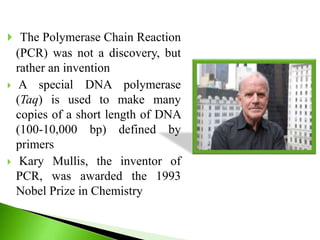
 A special DNA polymerase
(Taq) is used to make many
copies of a short length of DNA
(100-10,000 bp) defined by
primers
 Kary Mullis, the inventor of
PCR, was awarded the 1993
Nobel Prize in Chemistry
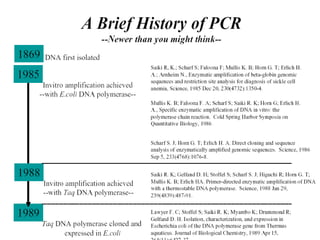
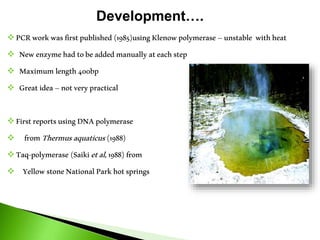
 PCRworkwasfirstpublished(1985)usingKlenowpolymerase–unstable withheat
 Newenzymehadtobeaddedmanually ateachstep
 Maximumlength400bp
 Greatidea–notverypractical
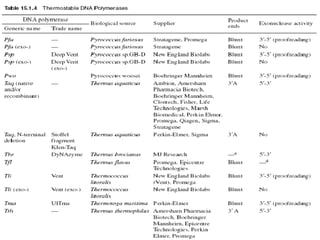
 FirstreportsusingDNApolymerase
 fromThermusaquaticus(1988)
 Taq-polymerase (Saikietal,1988)from
 YellowstoneNationalParkhotsprings
Development….
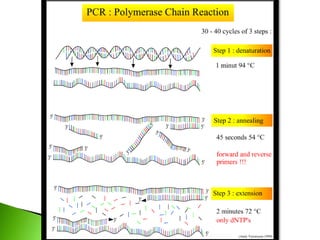
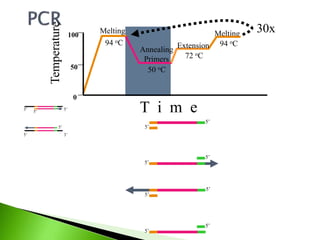
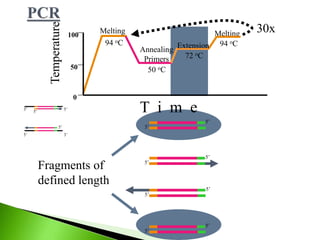
 PCR is a technique which is used to amplify the
number of copies of a specific region of DNA, in
order to produce enough DNA to be adequately
tested.
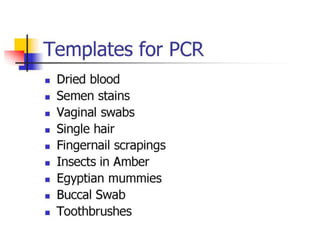
 The purpose of a PCR is to make a huge number of
copies of a gene. As a result, it now becomes
possible to analyze and characterize DNA fragments
found in minute quantities in places like a drop of
blood at a crime scene or a cell from an extinct
dinosaur.
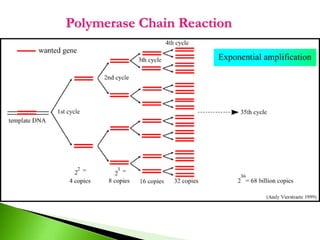
 Starting with one original copy an almost infinite
number of copies can be made using PCR
 “Amplified” fragments of DNA can be sequenced,
cloned, probed or sized using electrophoresis
 Defective genes can be amplified to diagnose any
number of illnesses
 Genes from pathogens can be amplified to
identify them (i.e., HIV, Vibrio sp., Salmonella sp.
etc.)
 Amplified fragments can act as genetic
fingerprints
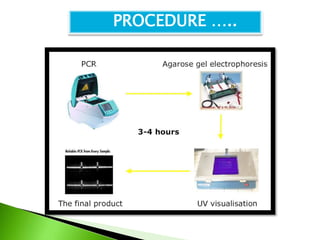
PROCEDURE …..
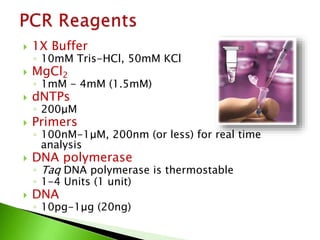
 1X Buffer
◦ 10mM Tris-HCl, 50mM KCl
 MgCl2
◦ 1mM - 4mM (1.5mM)
 dNTPs
◦ 200μM
 Primers
◦ 100nM-1μM, 200nm (or less) for real time
analysis
 DNA polymerase
◦ Taq DNA polymerase is thermostable
◦ 1-4 Units (1 unit)
 DNA
◦ 10pg-1μg (20ng)
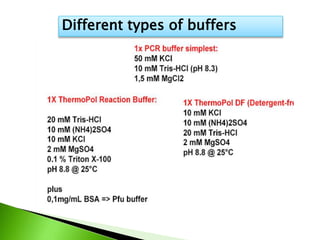
Different types of buffers
Polymerase Chain Reaction
3’ 5’
3’5’
5’
5’
3’
3’
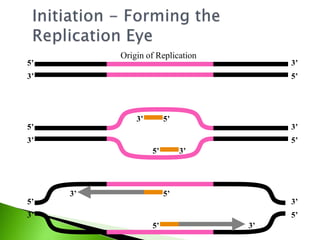
Origin of Replication
5’
3’
3’
5’
5’
3’
5’
5’
5’
3’
3’
3’
Leading Strand
Laging Strand
3’
5’
3’
5’
5’
5’
5’
3’
3’
5’3’
3’
5’
Single strand
binding
proteins
DNA
Polymerase
Okazaki
fragment
RNA
Primers
Primase
5’
3’
5’
Helicase
. N/A as fragments
are short
 Joining nicks
. Taq Polymerase Polymerizing DNA
. Primers added to
the reaction mix
 Providing
primer
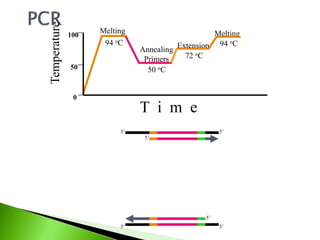
PCRFunction
. Heat Melting DNA
ENZYMES
• Helicase
•SSB proteins
•Topoisomerase
•DNA pol
•Primase
•Ligase
Melting
94 oC
Temperature
100
0
50
T i m e
5’3’
3’5’
Melting
94 oC
Temperature
100
0
50
T i m e
3’5’
5’3’
Heat
Melting
94 oC
Annealing
Primers
50 oC
Extension
72 oCTemperature
100
0
50
T i m e
3’5’
5’3’
5’
5’
Melting
94 oC
Melting
94 oC
Melting
94 oC
Annealing
Primers
50 oC
Extension
72 oCTemperature
100
0
50
T i m e
30x
3’5’
5’3’
Heat
Heat
5’
5’
5’
Melting
94 oC
Melting
94 oC
Annealing
Primers
50 oC
Extension
72 oCTemperature
100
0
50
T i m e
30x
3’5’
5’3’
5’
5’
5’
5’
5’
5’
Melting
94 oC
Melting
94 oC
Annealing
Primers
50 oC
Extension
72 oCTemperature
100
0
50
T i m e
30x
3’5’
5’3’
5’
5’
5’
5’
5’
5’
Heat
Heat
Melting
94 oC
Melting
94 oC
Annealing
Primers
50 oC
Extension
72 oCTemperature
100
0
50
T i m e
30x
3’5’
5’3’
5’
5’
5’
5’
5’
5’
5’
5’
5’
5’
Fragments of
defined length
Melting
94 oC
Melting
94 oC
Annealing
Primers
50 oC
Extension
72 oCTemperature
100
0
50
T i m e
30x
3’5’
5’3’
5’
5’
5’
5’
5’
5’
5’
5’
5’
5’
POLYMERIZED CHAIN REACTION : ANIMATION
Number of cycles
0 10 15 20 25 30
Size
Marker
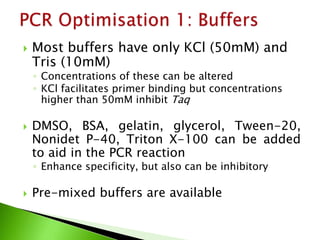
 Most buffers have only KCl (50mM) and
Tris (10mM)
◦ Concentrations of these can be altered
◦ KCl facilitates primer binding but concentrations
higher than 50mM inhibit Taq
 DMSO, BSA, gelatin, glycerol, Tween-20,
Nonidet P-40, Triton X-100 can be added
to aid in the PCR reaction
◦ Enhance specificity, but also can be inhibitory
 Pre-mixed buffers are available
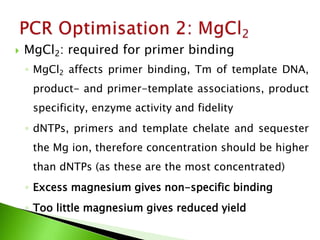
 MgCl2: required for primer binding
◦ MgCl2 affects primer binding, Tm of template DNA,
product- and primer-template associations, product
specificity, enzyme activity and fidelity
◦ dNTPs, primers and template chelate and sequester
the Mg ion, therefore concentration should be higher
than dNTPs (as these are the most concentrated)
◦ Excess magnesium gives non-specific binding
◦ Too little magnesium gives reduced yield
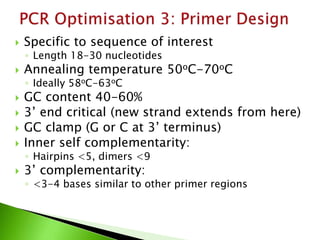
 Specific to sequence of interest
◦ Length 18-30 nucleotides
 Annealing temperature 50oC-70oC
◦ Ideally 58oC-63oC
 GC content 40-60%
 3’ end critical (new strand extends from here)
 GC clamp (G or C at 3’ terminus)
 Inner self complementarity:
◦ Hairpins <5, dimers <9
 3’ complementarity:
◦ <3-4 bases similar to other primer regions
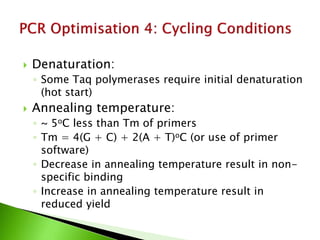
 Denaturation:
◦ Some Taq polymerases require initial denaturation
(hot start)
 Annealing temperature:
◦ ~ 5oC less than Tm of primers
◦ Tm = 4(G + C) + 2(A + T)oC (or use of primer
software)
◦ Decrease in annealing temperature result in non-
specific binding
◦ Increase in annealing temperature result in
reduced yield
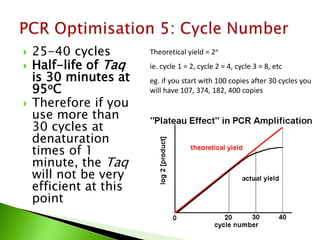
 25-40 cycles
 Half-life of Taq
is 30 minutes at
95oC
 Therefore if you
use more than
30 cycles at
denaturation
times of 1
minute, the Taq
will not be very
efficient at this
point
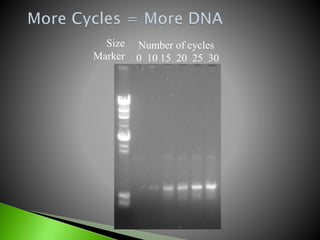
Theoretical yield = 2n
ie. cycle 1 = 2, cycle 2 = 4, cycle 3 = 8, etc
eg. if you start with 100 copies after 30 cycles you
will have 107, 374, 182, 400 copies
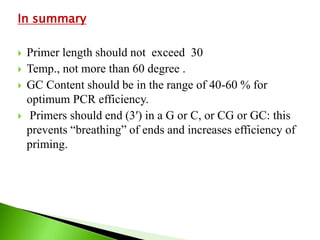
In summary
 Primer length should not exceed 30
 Temp., not more than 60 degree .
 GC Content should be in the range of 40-60 % for
optimum PCR efficiency.
 Primers should end (3′) in a G or C, or CG or GC: this
prevents “breathing” of ends and increases efficiency of
priming.
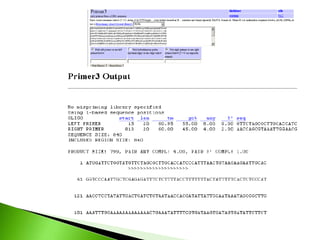
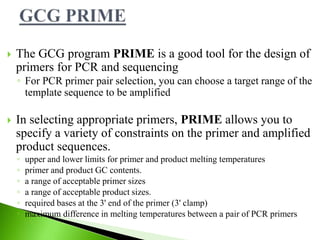
 The GCG program PRIME is a good tool for the design of
primers for PCR and sequencing
◦ For PCR primer pair selection, you can choose a target range of the
template sequence to be amplified
 In selecting appropriate primers, PRIME allows you to
specify a variety of constraints on the primer and amplified
product sequences.
◦ upper and lower limits for primer and product melting temperatures
◦ primer and product GC contents.
◦ a range of acceptable primer sizes
◦ a range of acceptable product sizes.
◦ required bases at the 3' end of the primer (3' clamp)
◦ maximum difference in melting temperatures between a pair of PCR primers
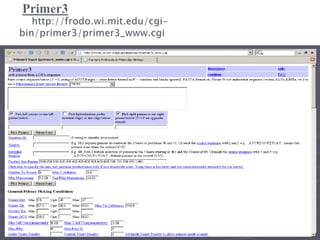
 There are a number of (expensive) dedicated PCR primers
design programs for personal computers that have “special
features” such as nested and multiplex PCR :
◦ Oligo (Molecular Biology Insights, Inc.)
◦ Primer Premier (Premier Biosoft)
 Many of the comprehensive MolBio. programs also have PCR
features
 Mac Vector
 OMIGA
 Vector NTI
 Gene Tool
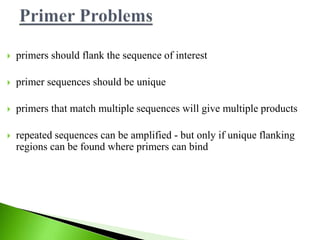
 primers should flank the sequence of interest
 primer sequences should be unique
 primers that match multiple sequences will give multiple products
 repeated sequences can be amplified - but only if unique flanking
regions can be found where primers can bind
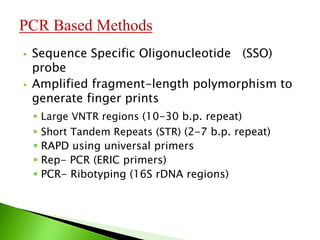
 Sequence Specific Oligonucleotide (SSO)
probe
 Amplified fragment-length polymorphism to
generate finger prints
 Large VNTR regions (10-30 b.p. repeat)
 Short Tandem Repeats (STR) (2-7 b.p. repeat)
 RAPD using universal primers
 Rep- PCR (ERIC primers)
 PCR- Ribotyping (16S rDNA regions)
PCR Based Methods
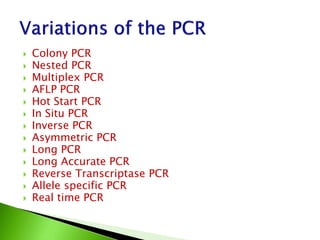
 Colony PCR
 Nested PCR
 Multiplex PCR
 AFLP PCR
 Hot Start PCR
 In Situ PCR
 Inverse PCR
 Asymmetric PCR
 Long PCR
 Long Accurate PCR
 Reverse Transcriptase PCR
 Allele specific PCR
 Real time PCR
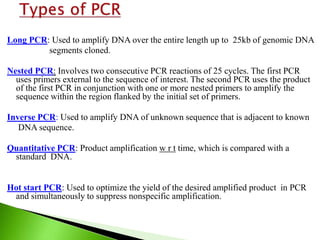
Long PCR: Used to amplify DNA over the entire length up to 25kb of genomic DNA
segments cloned.
Nested PCR: Involves two consecutive PCR reactions of 25 cycles. The first PCR
uses primers external to the sequence of interest. The second PCR uses the product
of the first PCR in conjunction with one or more nested primers to amplify the
sequence within the region flanked by the initial set of primers.
Inverse PCR: Used to amplify DNA of unknown sequence that is adjacent to known
DNA sequence.
Quantitative PCR: Product amplification w r t time, which is compared with a
standard DNA.
Hot start PCR: Used to optimize the yield of the desired amplified product in PCR
and simultaneously to suppress nonspecific amplification.
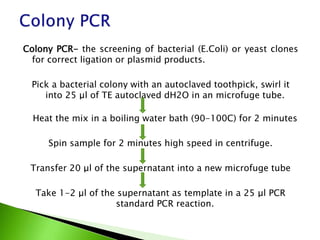
Colony PCR- the screening of bacterial (E.Coli) or yeast clones
for correct ligation or plasmid products.
Pick a bacterial colony with an autoclaved toothpick, swirl it
into 25 μl of TE autoclaved dH2O in an microfuge tube.
Heat the mix in a boiling water bath (90-100C) for 2 minutes
Spin sample for 2 minutes high speed in centrifuge.
Transfer 20 μl of the supernatant into a new microfuge tube
Take 1-2 μl of the supernatant as template in a 25 μl PCR
standard PCR reaction.
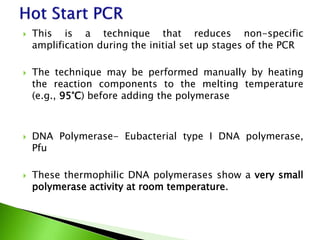
 This is a technique that reduces non-specific
amplification during the initial set up stages of the PCR
 The technique may be performed manually by heating
the reaction components to the melting temperature
(e.g., 95°C) before adding the polymerase
 DNA Polymerase- Eubacterial type I DNA polymerase,
Pfu
 These thermophilic DNA polymerases show a very small
polymerase activity at room temperature.
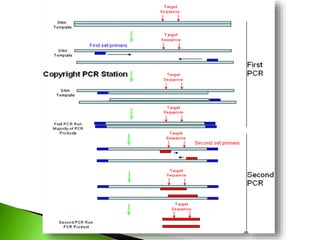
 Two pairs (instead of one pair) of PCR primers are used
to amplify a fragment.
 First pair -amplify a fragment similar to a standard
PCR. Second pair of primers-nested primers (as they lie
/ are nested within the first fragment) bind inside the
first PCR product fragment to allow amplification of a
second PCR product which is shorter than the first one.
 Advantage- Very low probability of nonspecific
amplification
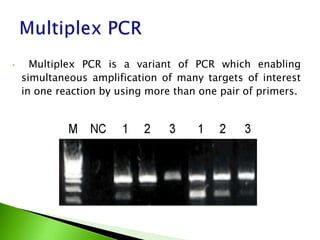
• Multiplex PCR is a variant of PCR which enabling
simultaneous amplification of many targets of interest
in one reaction by using more than one pair of primers.
 Inverse PCR (Ochman et al., 1988) uses standard PCR
(polymerase chain reaction)- primers oriented in the
reverse direction of the usual orientation.
 The template for the reverse primers is a restriction
fragment that has been selfligated
 Inverse PCR functions to clone sequences flanking a
known sequence. Flanking DNA sequences are
digested and then ligated to generate circular DNA.
Application
 Amplification and identification of flanking sequences
such as transposable elements, and the identification
of genomic inserts.
 Extended or longer than standard PCR, meaning
over 5 kilobases (frequently over 10 kb).
 Long PCR is useful only if it is accurate. Thus,
special mixtures of proficient polymerases along
with accurate polymerases such as Pfu are often
mixed together.
 Application- to clone large genes
 Based on the process of reverse transcription, which
reverse transcribes RNA into DNA and was initially
isolated from retroviruses.
 First step of RT-PCR - "first strand reaction“-
Synthesis of cDNA using oligo dT primers (37°C) 1 hr.
 “Second strand reaction“-Digestion of cDNA:RNA
hybrid (RNaseH)-Standard PCR with DNA oligo
primers.
 Allows the detection of even rare or low copy mRNA
sequences by amplifying its complementary DNA.
Why real time PCR ?
• QUANTITATION OF mRNA
– northern blotting
– ribonuclease protection assay
– in situ hybridization
– RT-PCR
• most sensitive
• can discriminate closely related mRNAs
• technically simple
• but difficult to get truly quantitative results using
conventional PCR
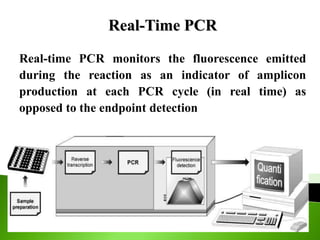
Real-Time PCR
Real-time PCR monitors the fluorescence emitted
during the reaction as an indicator of amplicon
production at each PCR cycle (in real time) as
opposed to the endpoint detection
 Traditional PCR has advanced from detection
at the end-point of the reaction to detection
while the reaction is occurring (Real-Time).
 Real-time PCR uses a fluorescent reporter
signal to measure the amount of amplicon as
it is generated. This kinetic PCR allows for
data collection after each cycle of PCR instead
of only at the end of the 20 to 40 cycles.
Real-time PCR advantages
* amplification can be monitored real-time
* no post-PCR processing of products
(high throughput, low contamination risk)
* ultra-rapid cycling (30 minutes to 2 hours)
* wider dynamic range of up to 1010-fold
* requirement of 1000-fold less RNA than conventional
assays
(6 picogram = one diploid genome equivalent)
* detection is capable down to a two-fold change
* confirmation of specific amplification by melting curve
analysis
* most specific, sensitive and reproducible
* not much more expensive than conventional PCR
(except equipment cost)
Real-time PCR disadvantages
* Not ideal for multiplexing
* setting up requires high technical skill and support
* high equipment cost
* intra- and inter-assay variation
* RNA liability
* DNA contamination (in mRNA analysis)
 Classification
of organisms
 Genotyping
 Molecular
archaeology
 Mutagenesis
 Mutation
detection
 Sequencing
 Cancer research
 Detection of
pathogens
 DNA
fingerprinting
 Drug discovery
 Genetic
matching
 Genetic
engineering
 Pre-natal
diagnosis
 High sensitivity
 Can detect and quantify specific events
 Higher stability of DNA permits analysis of
food samples.
 Quantitative and qualitative
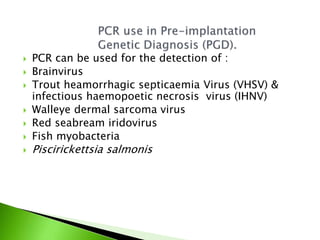
 PCR can be used for the detection of :
 Brainvirus
 Trout heamorrhagic septicaemia Virus (VHSV) &
infectious haemopoetic necrosis virus (IHNV)
 Walleye dermal sarcoma virus
 Red seabream iridovirus
 Fish myobacteria
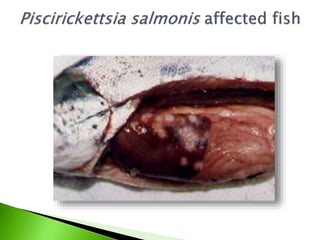
 Piscirickettsia salmonis
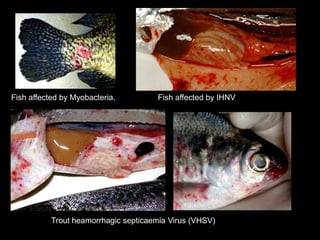
Fish affected by Myobacteria.
Trout heamorrhagic septicaemia Virus (VHSV)
Fish affected by IHNV
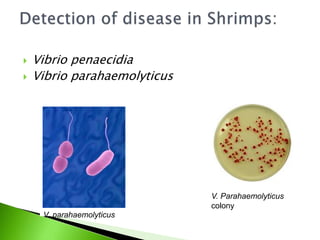
 Vibrio penaecidia
 Vibrio parahaemolyticus
V. parahaemolyticus
V. Parahaemolyticus
colony
Thank you
THANK YOU

Polymerase chain reaction

  • 3.
     The PolymeraseChain Reaction (PCR) was not a discovery, but rather an invention  A special DNA polymerase (Taq) is used to make many copies of a short length of DNA (100-10,000 bp) defined by primers  Kary Mullis, the inventor of PCR, was awarded the 1993 Nobel Prize in Chemistry
  • 5.
     PCRworkwasfirstpublished(1985)usingKlenowpolymerase–unstable withheat Newenzymehadtobeaddedmanually ateachstep  Maximumlength400bp  Greatidea–notverypractical  FirstreportsusingDNApolymerase  fromThermusaquaticus(1988)  Taq-polymerase (Saikietal,1988)from  YellowstoneNationalParkhotsprings Development….
  • 7.
     PCR isa technique which is used to amplify the number of copies of a specific region of DNA, in order to produce enough DNA to be adequately tested.  The purpose of a PCR is to make a huge number of copies of a gene. As a result, it now becomes possible to analyze and characterize DNA fragments found in minute quantities in places like a drop of blood at a crime scene or a cell from an extinct dinosaur.
  • 9.
     Starting withone original copy an almost infinite number of copies can be made using PCR  “Amplified” fragments of DNA can be sequenced, cloned, probed or sized using electrophoresis  Defective genes can be amplified to diagnose any number of illnesses  Genes from pathogens can be amplified to identify them (i.e., HIV, Vibrio sp., Salmonella sp. etc.)  Amplified fragments can act as genetic fingerprints
  • 10.
  • 11.
     1X Buffer ◦10mM Tris-HCl, 50mM KCl  MgCl2 ◦ 1mM - 4mM (1.5mM)  dNTPs ◦ 200μM  Primers ◦ 100nM-1μM, 200nm (or less) for real time analysis  DNA polymerase ◦ Taq DNA polymerase is thermostable ◦ 1-4 Units (1 unit)  DNA ◦ 10pg-1μg (20ng)
  • 12.
  • 14.
  • 16.
    3’ 5’ 3’5’ 5’ 5’ 3’ 3’ Origin ofReplication 5’ 3’ 3’ 5’ 5’ 3’ 5’ 5’ 5’ 3’ 3’ 3’
  • 17.
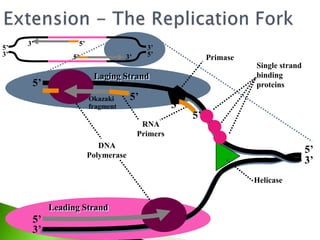
    Leading Strand Laging Strand 3’ 5’ 3’ 5’ 5’ 5’ 5’ 3’ 3’ 5’3’ 3’ 5’ Singlestrand binding proteins DNA Polymerase Okazaki fragment RNA Primers Primase 5’ 3’ 5’ Helicase
  • 18.
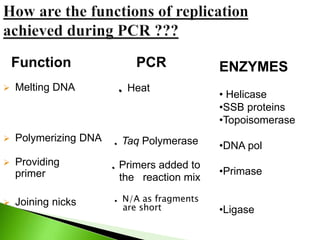
    . N/A asfragments are short  Joining nicks . Taq Polymerase Polymerizing DNA . Primers added to the reaction mix  Providing primer PCRFunction . Heat Melting DNA ENZYMES • Helicase •SSB proteins •Topoisomerase •DNA pol •Primase •Ligase
  • 19.
  • 20.
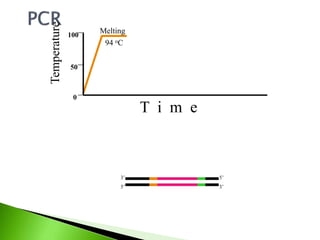
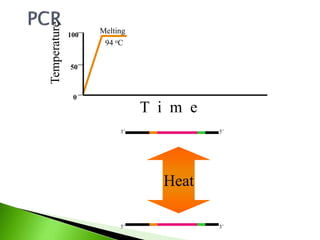
    Melting 94 oC Temperature 100 0 50 T im e 3’5’ 5’3’ Heat
  • 21.
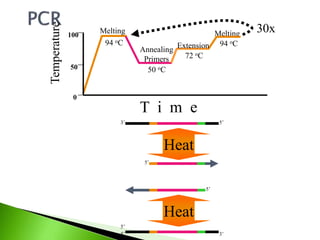
    Melting 94 oC Annealing Primers 50 oC Extension 72oCTemperature 100 0 50 T i m e 3’5’ 5’3’ 5’ 5’ Melting 94 oC
  • 22.
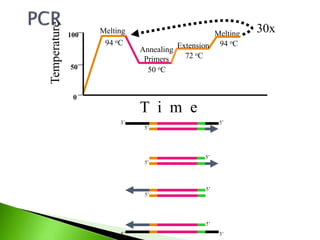
    Melting 94 oC Melting 94 oC Annealing Primers 50oC Extension 72 oCTemperature 100 0 50 T i m e 30x 3’5’ 5’3’ Heat Heat 5’ 5’ 5’
  • 23.
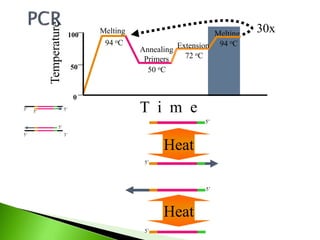
    Melting 94 oC Melting 94 oC Annealing Primers 50oC Extension 72 oCTemperature 100 0 50 T i m e 30x 3’5’ 5’3’ 5’ 5’ 5’ 5’ 5’ 5’
  • 24.
    Melting 94 oC Melting 94 oC Annealing Primers 50oC Extension 72 oCTemperature 100 0 50 T i m e 30x 3’5’ 5’3’ 5’ 5’ 5’ 5’ 5’ 5’ Heat Heat
  • 25.
    Melting 94 oC Melting 94 oC Annealing Primers 50oC Extension 72 oCTemperature 100 0 50 T i m e 30x 3’5’ 5’3’ 5’ 5’ 5’ 5’ 5’ 5’ 5’ 5’ 5’ 5’
  • 26.
    Fragments of defined length Melting 94oC Melting 94 oC Annealing Primers 50 oC Extension 72 oCTemperature 100 0 50 T i m e 30x 3’5’ 5’3’ 5’ 5’ 5’ 5’ 5’ 5’ 5’ 5’ 5’ 5’
  • 27.
  • 28.
    Number of cycles 010 15 20 25 30 Size Marker
  • 29.
     Most buffershave only KCl (50mM) and Tris (10mM) ◦ Concentrations of these can be altered ◦ KCl facilitates primer binding but concentrations higher than 50mM inhibit Taq  DMSO, BSA, gelatin, glycerol, Tween-20, Nonidet P-40, Triton X-100 can be added to aid in the PCR reaction ◦ Enhance specificity, but also can be inhibitory  Pre-mixed buffers are available
  • 30.
     MgCl2: requiredfor primer binding ◦ MgCl2 affects primer binding, Tm of template DNA, product- and primer-template associations, product specificity, enzyme activity and fidelity ◦ dNTPs, primers and template chelate and sequester the Mg ion, therefore concentration should be higher than dNTPs (as these are the most concentrated) ◦ Excess magnesium gives non-specific binding ◦ Too little magnesium gives reduced yield
  • 31.
     Specific tosequence of interest ◦ Length 18-30 nucleotides  Annealing temperature 50oC-70oC ◦ Ideally 58oC-63oC  GC content 40-60%  3’ end critical (new strand extends from here)  GC clamp (G or C at 3’ terminus)  Inner self complementarity: ◦ Hairpins <5, dimers <9  3’ complementarity: ◦ <3-4 bases similar to other primer regions
  • 32.
     Denaturation: ◦ SomeTaq polymerases require initial denaturation (hot start)  Annealing temperature: ◦ ~ 5oC less than Tm of primers ◦ Tm = 4(G + C) + 2(A + T)oC (or use of primer software) ◦ Decrease in annealing temperature result in non- specific binding ◦ Increase in annealing temperature result in reduced yield
  • 33.
     25-40 cycles Half-life of Taq is 30 minutes at 95oC  Therefore if you use more than 30 cycles at denaturation times of 1 minute, the Taq will not be very efficient at this point Theoretical yield = 2n ie. cycle 1 = 2, cycle 2 = 4, cycle 3 = 8, etc eg. if you start with 100 copies after 30 cycles you will have 107, 374, 182, 400 copies
  • 34.
    In summary  Primerlength should not exceed 30  Temp., not more than 60 degree .  GC Content should be in the range of 40-60 % for optimum PCR efficiency.  Primers should end (3′) in a G or C, or CG or GC: this prevents “breathing” of ends and increases efficiency of priming.
  • 35.
     The GCGprogram PRIME is a good tool for the design of primers for PCR and sequencing ◦ For PCR primer pair selection, you can choose a target range of the template sequence to be amplified  In selecting appropriate primers, PRIME allows you to specify a variety of constraints on the primer and amplified product sequences. ◦ upper and lower limits for primer and product melting temperatures ◦ primer and product GC contents. ◦ a range of acceptable primer sizes ◦ a range of acceptable product sizes. ◦ required bases at the 3' end of the primer (3' clamp) ◦ maximum difference in melting temperatures between a pair of PCR primers
  • 36.
     There area number of (expensive) dedicated PCR primers design programs for personal computers that have “special features” such as nested and multiplex PCR : ◦ Oligo (Molecular Biology Insights, Inc.) ◦ Primer Premier (Premier Biosoft)  Many of the comprehensive MolBio. programs also have PCR features  Mac Vector  OMIGA  Vector NTI  Gene Tool
  • 39.
     primers shouldflank the sequence of interest  primer sequences should be unique  primers that match multiple sequences will give multiple products  repeated sequences can be amplified - but only if unique flanking regions can be found where primers can bind
  • 40.
     Sequence SpecificOligonucleotide (SSO) probe  Amplified fragment-length polymorphism to generate finger prints  Large VNTR regions (10-30 b.p. repeat)  Short Tandem Repeats (STR) (2-7 b.p. repeat)  RAPD using universal primers  Rep- PCR (ERIC primers)  PCR- Ribotyping (16S rDNA regions) PCR Based Methods
  • 41.
     Colony PCR Nested PCR  Multiplex PCR  AFLP PCR  Hot Start PCR  In Situ PCR  Inverse PCR  Asymmetric PCR  Long PCR  Long Accurate PCR  Reverse Transcriptase PCR  Allele specific PCR  Real time PCR
  • 42.
    Long PCR: Usedto amplify DNA over the entire length up to 25kb of genomic DNA segments cloned. Nested PCR: Involves two consecutive PCR reactions of 25 cycles. The first PCR uses primers external to the sequence of interest. The second PCR uses the product of the first PCR in conjunction with one or more nested primers to amplify the sequence within the region flanked by the initial set of primers. Inverse PCR: Used to amplify DNA of unknown sequence that is adjacent to known DNA sequence. Quantitative PCR: Product amplification w r t time, which is compared with a standard DNA. Hot start PCR: Used to optimize the yield of the desired amplified product in PCR and simultaneously to suppress nonspecific amplification.
  • 43.
    Colony PCR- thescreening of bacterial (E.Coli) or yeast clones for correct ligation or plasmid products. Pick a bacterial colony with an autoclaved toothpick, swirl it into 25 μl of TE autoclaved dH2O in an microfuge tube. Heat the mix in a boiling water bath (90-100C) for 2 minutes Spin sample for 2 minutes high speed in centrifuge. Transfer 20 μl of the supernatant into a new microfuge tube Take 1-2 μl of the supernatant as template in a 25 μl PCR standard PCR reaction.
  • 44.
     This isa technique that reduces non-specific amplification during the initial set up stages of the PCR  The technique may be performed manually by heating the reaction components to the melting temperature (e.g., 95°C) before adding the polymerase  DNA Polymerase- Eubacterial type I DNA polymerase, Pfu  These thermophilic DNA polymerases show a very small polymerase activity at room temperature.
  • 45.
     Two pairs(instead of one pair) of PCR primers are used to amplify a fragment.  First pair -amplify a fragment similar to a standard PCR. Second pair of primers-nested primers (as they lie / are nested within the first fragment) bind inside the first PCR product fragment to allow amplification of a second PCR product which is shorter than the first one.  Advantage- Very low probability of nonspecific amplification
  • 47.
    • Multiplex PCRis a variant of PCR which enabling simultaneous amplification of many targets of interest in one reaction by using more than one pair of primers.
  • 48.
     Inverse PCR(Ochman et al., 1988) uses standard PCR (polymerase chain reaction)- primers oriented in the reverse direction of the usual orientation.  The template for the reverse primers is a restriction fragment that has been selfligated  Inverse PCR functions to clone sequences flanking a known sequence. Flanking DNA sequences are digested and then ligated to generate circular DNA. Application  Amplification and identification of flanking sequences such as transposable elements, and the identification of genomic inserts.
  • 49.
     Extended orlonger than standard PCR, meaning over 5 kilobases (frequently over 10 kb).  Long PCR is useful only if it is accurate. Thus, special mixtures of proficient polymerases along with accurate polymerases such as Pfu are often mixed together.  Application- to clone large genes
  • 50.
     Based onthe process of reverse transcription, which reverse transcribes RNA into DNA and was initially isolated from retroviruses.  First step of RT-PCR - "first strand reaction“- Synthesis of cDNA using oligo dT primers (37°C) 1 hr.  “Second strand reaction“-Digestion of cDNA:RNA hybrid (RNaseH)-Standard PCR with DNA oligo primers.  Allows the detection of even rare or low copy mRNA sequences by amplifying its complementary DNA.
  • 51.
    Why real timePCR ? • QUANTITATION OF mRNA – northern blotting – ribonuclease protection assay – in situ hybridization – RT-PCR • most sensitive • can discriminate closely related mRNAs • technically simple • but difficult to get truly quantitative results using conventional PCR
  • 52.
    Real-Time PCR Real-time PCRmonitors the fluorescence emitted during the reaction as an indicator of amplicon production at each PCR cycle (in real time) as opposed to the endpoint detection
  • 53.
     Traditional PCRhas advanced from detection at the end-point of the reaction to detection while the reaction is occurring (Real-Time).  Real-time PCR uses a fluorescent reporter signal to measure the amount of amplicon as it is generated. This kinetic PCR allows for data collection after each cycle of PCR instead of only at the end of the 20 to 40 cycles.
  • 54.
    Real-time PCR advantages *amplification can be monitored real-time * no post-PCR processing of products (high throughput, low contamination risk) * ultra-rapid cycling (30 minutes to 2 hours) * wider dynamic range of up to 1010-fold * requirement of 1000-fold less RNA than conventional assays (6 picogram = one diploid genome equivalent) * detection is capable down to a two-fold change * confirmation of specific amplification by melting curve analysis * most specific, sensitive and reproducible * not much more expensive than conventional PCR (except equipment cost)
  • 55.
    Real-time PCR disadvantages *Not ideal for multiplexing * setting up requires high technical skill and support * high equipment cost * intra- and inter-assay variation * RNA liability * DNA contamination (in mRNA analysis)
  • 56.
     Classification of organisms Genotyping  Molecular archaeology  Mutagenesis  Mutation detection  Sequencing  Cancer research  Detection of pathogens  DNA fingerprinting  Drug discovery  Genetic matching  Genetic engineering  Pre-natal diagnosis
  • 57.
     High sensitivity Can detect and quantify specific events  Higher stability of DNA permits analysis of food samples.  Quantitative and qualitative
  • 58.
     PCR canbe used for the detection of :  Brainvirus  Trout heamorrhagic septicaemia Virus (VHSV) & infectious haemopoetic necrosis virus (IHNV)  Walleye dermal sarcoma virus  Red seabream iridovirus  Fish myobacteria  Piscirickettsia salmonis
  • 59.
    Fish affected byMyobacteria. Trout heamorrhagic septicaemia Virus (VHSV) Fish affected by IHNV
  • 62.
     Vibrio penaecidia Vibrio parahaemolyticus V. parahaemolyticus V. Parahaemolyticus colony
  • 63.