RI PLASMID
Enal Jain
12014
Msc Biotechnology
WHAT IS PLASMID
 Plasmids are used in genetic engineering to
amplify, or produce many copies of, certain genes.
 In molecular cloning, a plasmid is a type of vector.
A vector is a DNA sequence that can transport
foreign genetic material from one cell to
another cell, where the genes can be further
expressed and replicated
 Plasmids are circular, made of DNA, and much
smaller than chromosomes
RI PLASMID : INTRODUCTION
 The root-inducing, or Ri, plasmid is the cause of
hairy root formation on dicotyledenous plants that
are infected by Agrobacterium rhizogenes.
 The virulence plasmid of A. rhizogenes is known
as the Ri-plasmid to distinguish it from the
tumor-inducing (Ti) plasmid
 Agrobacterium rhizogenes is a gram negative soil
bacterium. It incites hairy root disease of many
dicotyledonous plants
 The Ri-plasmid shares extensive functional
homology with the Ti–plasmid
 Large plasmids were shown to be present in strains
of A. rhizogenes
 These strains are known to produce at least two
classes of opines.
 All strains of A. rhizogenes are known to produce
agrocinopine and all or a few opines of the
agropine group.
 Two T-DNA regions have been identified in
agropine Ri-plasmids.
 Mutagenesis of this region in the Ri–plasmid is
shown to result in the loss or attenuation of
virulence
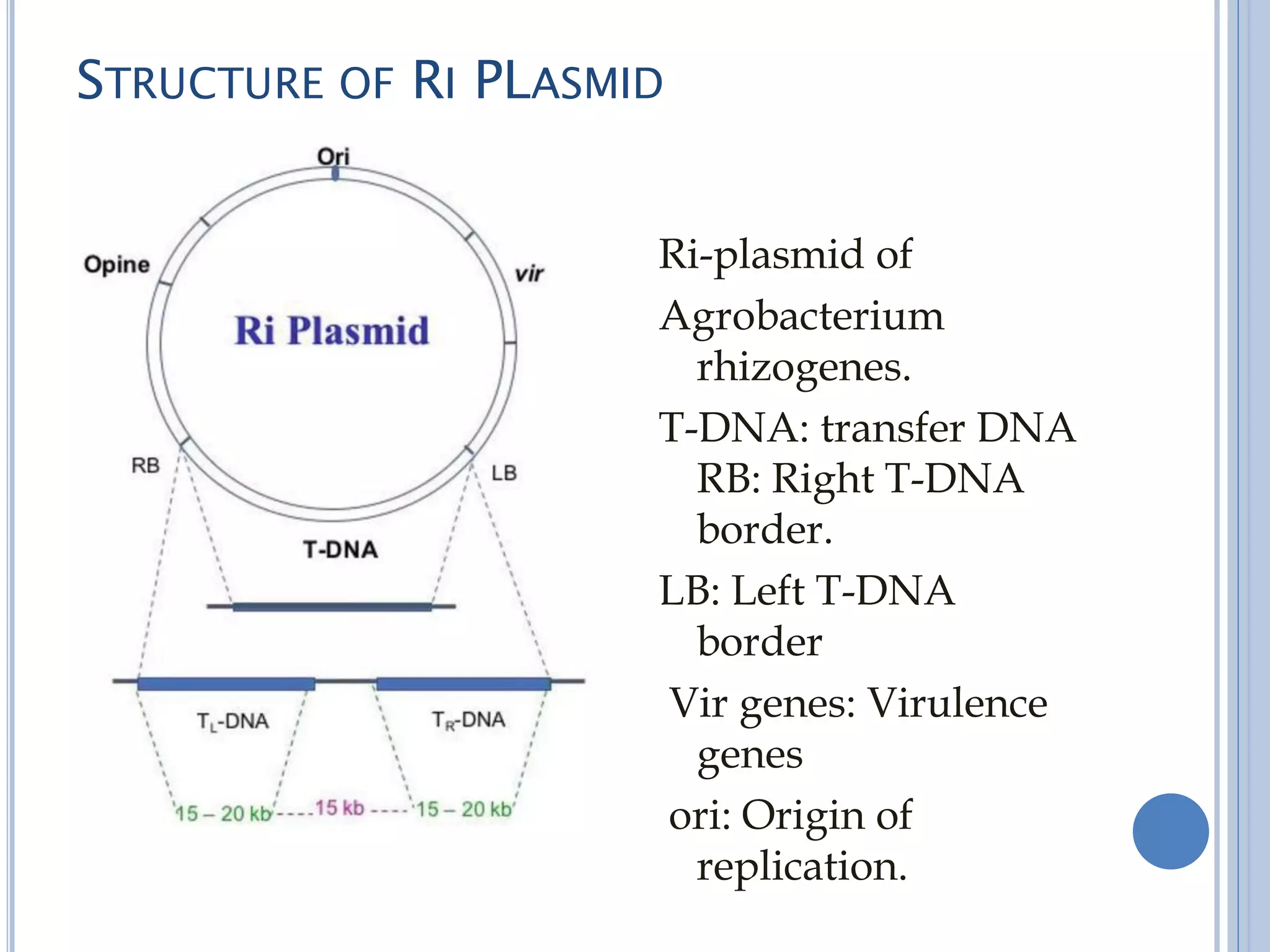
STRUCTURE OF RI PLASMID
Ri-plasmid of
Agrobacterium
rhizogenes.
T-DNA: transfer DNA
RB: Right T-DNA
border.
LB: Left T-DNA
border
Vir genes: Virulence
genes
ori: Origin of
replication.
DISEASE CAUSED BY RI PLASMID
 Pathogenic strains of R. rhizogenes are capable of
inducing hairy root growth on their hosts.
 When a plant is wounded it releases compounds which
are sensed by the bacterium in the soil. R. rhizogenes is
attracted towards the plant wound and it can transfer its
DNA into the host cell via transfer of a portion of the
root-inducing (Ri) plasmid.
 The transferred DNA (T-DNA) is integrated into the
plant cell genome. After integration the plant produces
an abundance of growth hormones and opines which
are beneficial for growth of R. rhizogenes. It is thought
that the virulence genes of R. rhizogenes are activated by
the lignin forming compounds in some plant cell walls
INDUCTION OF HAIRY ROOTS IN PLANTS
Wounded plant cells
Signal molecules
Attachment of agrobacterium
with plant cells
Transfer of Ri plasmid to
wounded plant cells
Integration of Ri plasmid into
plant genome
ECOLOGY
 R. rhizogenes are soil dwelling bacteria which live in
the rhizosphere of many plant roots.
 Optimum growth occurs at pH above 4 and 20-
28°C
 The strains which contain Ri-plasmids with
virulence genes are considered plant pathogens.
However, due to the ease of horizontal transfer of
plasmids via conjugation, it is difficult to
distinguish pathogenic strains from non-pathogenic
strains.
FUNCTIONS OF RI PLASMID
 Virulence (vir) genes of Ri as well as of Ti plasmid
are essential for the T-DNA transfer into plant
chromosomes.
 The T‐region is flanked by 25 bp direct repeats,
which are essential for transfer. The T‐regions
contain oncogenes that are expressed in the plants.
 The T‐DNA of Ri plasmids codes for at least three
genes that each can induce root formation, and that
together cause hairy root formation from plant
tissue.
REGULATING GENES IN RI PLASMID
 Three types of Ri plasmids have been
identified so far, corresponding to the
synthesis of the opines agropine,
mannopine and cucumopine
 . The TL-region of the agropine Ri plasmids
is strongly homologous to the single T-
region of the mannopine and cucumopine
Ri plasmids .
 Both the TL- and TR-regions can induce
roots
 Only roots induced by the agropine plasmid
TLDNA exhibit the typical phenotype of hairy
roots ,which is high growth rate, reduced apical
dominance, and plagiotropism.
 Roots caused by the presence of the agropine
piasmid TR-DNA alone exhibit a pheeotype similar
to that of normal roots
 Hairy roots can be induced by mannopine or
cucumopine Ri piasmid T-DNA or agropine Ri
piasmid TLDNA, which all lack auxin genes
THANK YOU

Ri Plasmid

  • 1.
  • 2.
    WHAT IS PLASMID Plasmids are used in genetic engineering to amplify, or produce many copies of, certain genes.  In molecular cloning, a plasmid is a type of vector. A vector is a DNA sequence that can transport foreign genetic material from one cell to another cell, where the genes can be further expressed and replicated  Plasmids are circular, made of DNA, and much smaller than chromosomes
  • 3.
    RI PLASMID :INTRODUCTION  The root-inducing, or Ri, plasmid is the cause of hairy root formation on dicotyledenous plants that are infected by Agrobacterium rhizogenes.  The virulence plasmid of A. rhizogenes is known as the Ri-plasmid to distinguish it from the tumor-inducing (Ti) plasmid  Agrobacterium rhizogenes is a gram negative soil bacterium. It incites hairy root disease of many dicotyledonous plants  The Ri-plasmid shares extensive functional homology with the Ti–plasmid
  • 4.
     Large plasmidswere shown to be present in strains of A. rhizogenes  These strains are known to produce at least two classes of opines.  All strains of A. rhizogenes are known to produce agrocinopine and all or a few opines of the agropine group.  Two T-DNA regions have been identified in agropine Ri-plasmids.  Mutagenesis of this region in the Ri–plasmid is shown to result in the loss or attenuation of virulence
  • 5.
    STRUCTURE OF RIPLASMID Ri-plasmid of Agrobacterium rhizogenes. T-DNA: transfer DNA RB: Right T-DNA border. LB: Left T-DNA border Vir genes: Virulence genes ori: Origin of replication.
  • 6.
    DISEASE CAUSED BYRI PLASMID  Pathogenic strains of R. rhizogenes are capable of inducing hairy root growth on their hosts.  When a plant is wounded it releases compounds which are sensed by the bacterium in the soil. R. rhizogenes is attracted towards the plant wound and it can transfer its DNA into the host cell via transfer of a portion of the root-inducing (Ri) plasmid.  The transferred DNA (T-DNA) is integrated into the plant cell genome. After integration the plant produces an abundance of growth hormones and opines which are beneficial for growth of R. rhizogenes. It is thought that the virulence genes of R. rhizogenes are activated by the lignin forming compounds in some plant cell walls
  • 7.
    INDUCTION OF HAIRYROOTS IN PLANTS Wounded plant cells Signal molecules Attachment of agrobacterium with plant cells Transfer of Ri plasmid to wounded plant cells Integration of Ri plasmid into plant genome
  • 8.
    ECOLOGY  R. rhizogenesare soil dwelling bacteria which live in the rhizosphere of many plant roots.  Optimum growth occurs at pH above 4 and 20- 28°C  The strains which contain Ri-plasmids with virulence genes are considered plant pathogens. However, due to the ease of horizontal transfer of plasmids via conjugation, it is difficult to distinguish pathogenic strains from non-pathogenic strains.
  • 9.
    FUNCTIONS OF RIPLASMID  Virulence (vir) genes of Ri as well as of Ti plasmid are essential for the T-DNA transfer into plant chromosomes.  The T‐region is flanked by 25 bp direct repeats, which are essential for transfer. The T‐regions contain oncogenes that are expressed in the plants.  The T‐DNA of Ri plasmids codes for at least three genes that each can induce root formation, and that together cause hairy root formation from plant tissue.
  • 10.
    REGULATING GENES INRI PLASMID  Three types of Ri plasmids have been identified so far, corresponding to the synthesis of the opines agropine, mannopine and cucumopine  . The TL-region of the agropine Ri plasmids is strongly homologous to the single T- region of the mannopine and cucumopine Ri plasmids .  Both the TL- and TR-regions can induce roots
  • 11.
     Only rootsinduced by the agropine plasmid TLDNA exhibit the typical phenotype of hairy roots ,which is high growth rate, reduced apical dominance, and plagiotropism.  Roots caused by the presence of the agropine piasmid TR-DNA alone exhibit a pheeotype similar to that of normal roots  Hairy roots can be induced by mannopine or cucumopine Ri piasmid T-DNA or agropine Ri piasmid TLDNA, which all lack auxin genes
  • 12.