Construction of DNA Library
Gurvinder kaur
P hD
What is DNA library?
• Collection of DNA fragments that have been cloned into vectors
so that researchers can identify and isolate the DNA fragments that
interest them for further study.
• In molecular biology, a library is a collection of DNA fragments
that is stored and propagated in a population of micro-organisms
through the process of molecular cloning.
What are libraries for?
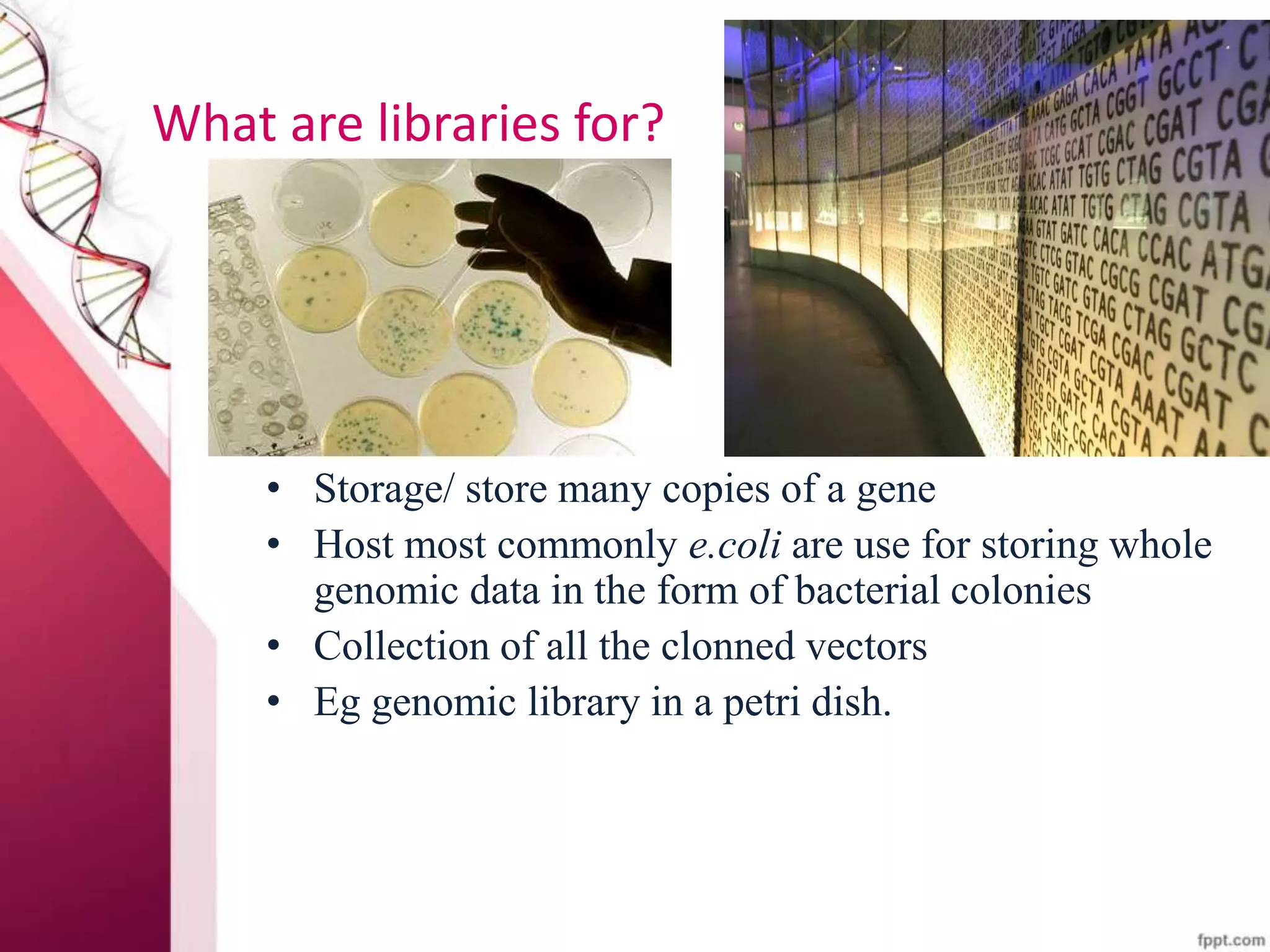
• Storage/ store many copies of a gene
• Host most commonly e.coli are use for storing whole
genomic data in the form of bacterial colonies
• Collection of all the clonned vectors
• Eg genomic library in a petri dish.
Why we require libraries?
• In order to study a gene, a researcher needs to isolate
it from all the other genes in an organism's DNA
• To make the research easier
• Once, we have a library, we can locate it by various
screening methods and can use it for various
research purposes
• Genomic libraries are commonly used for
sequencing applications.
• Ease of purification, storage and analysis.
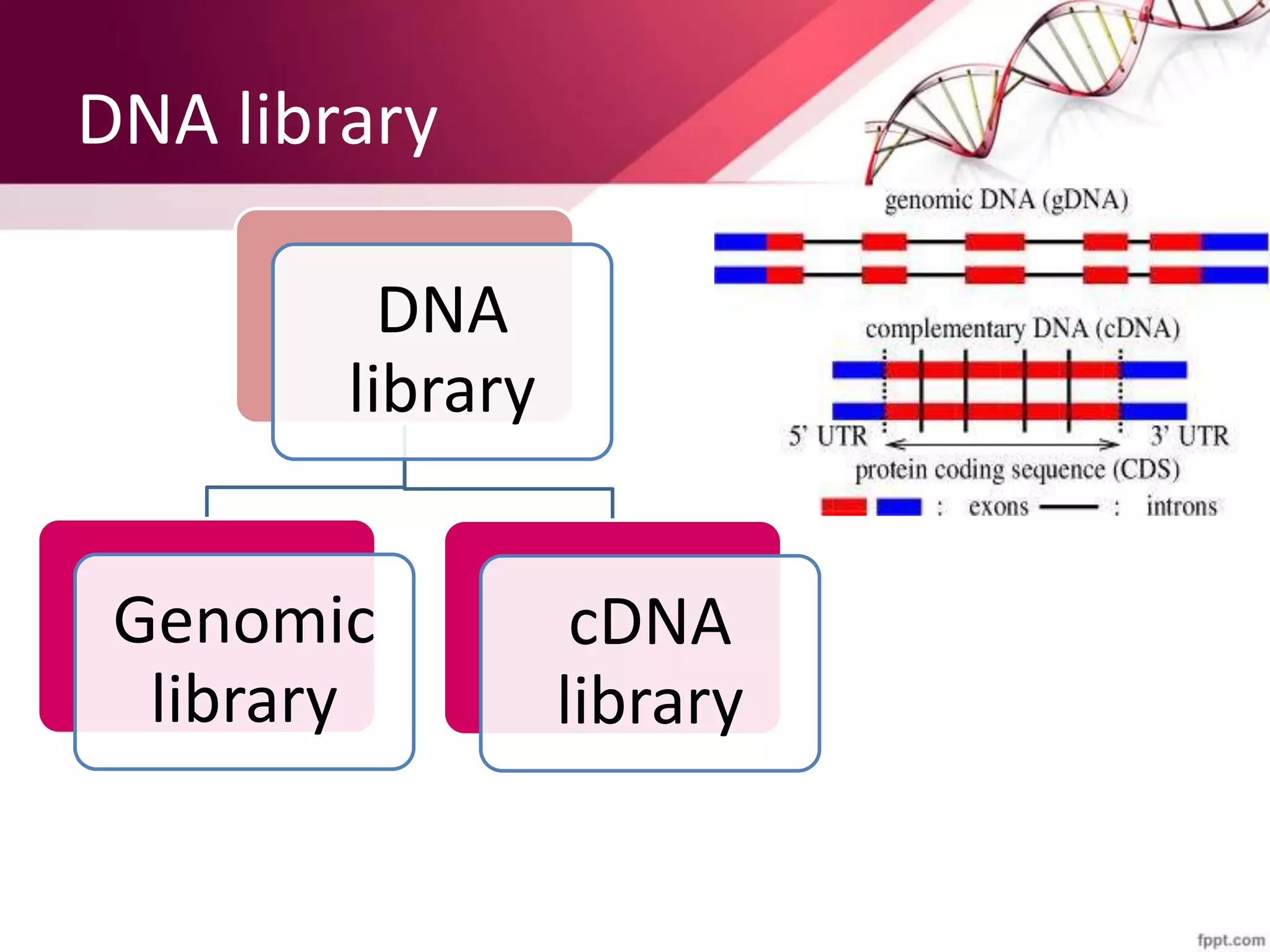
DNA library
DNA
library
Genomic
library
cDNA
library
Genomic Library
 Contains DNA fragments representing entire genome of an organism
Created using molecular cloning
vectors are engineered to carry the DNA fragments.
vector genome containing the foreign insert is replicated, producing
clones of the original genome
This collection of clones, in theory contains all sequences found in the
original source, including the sequence of interest
Genomic libraries can be constructed using various hosts like plasmids,
bacteriophage lambda and many more.
Steps of genomic library construction
1. Isolation of DNA from cells
2. Digestion into small fragments
3. Introduction into suitable vectors
4. Insertion into bacteria
5. Production/identification of clones
6. Collection of Genomic DNA library
1. Isolation of DNA
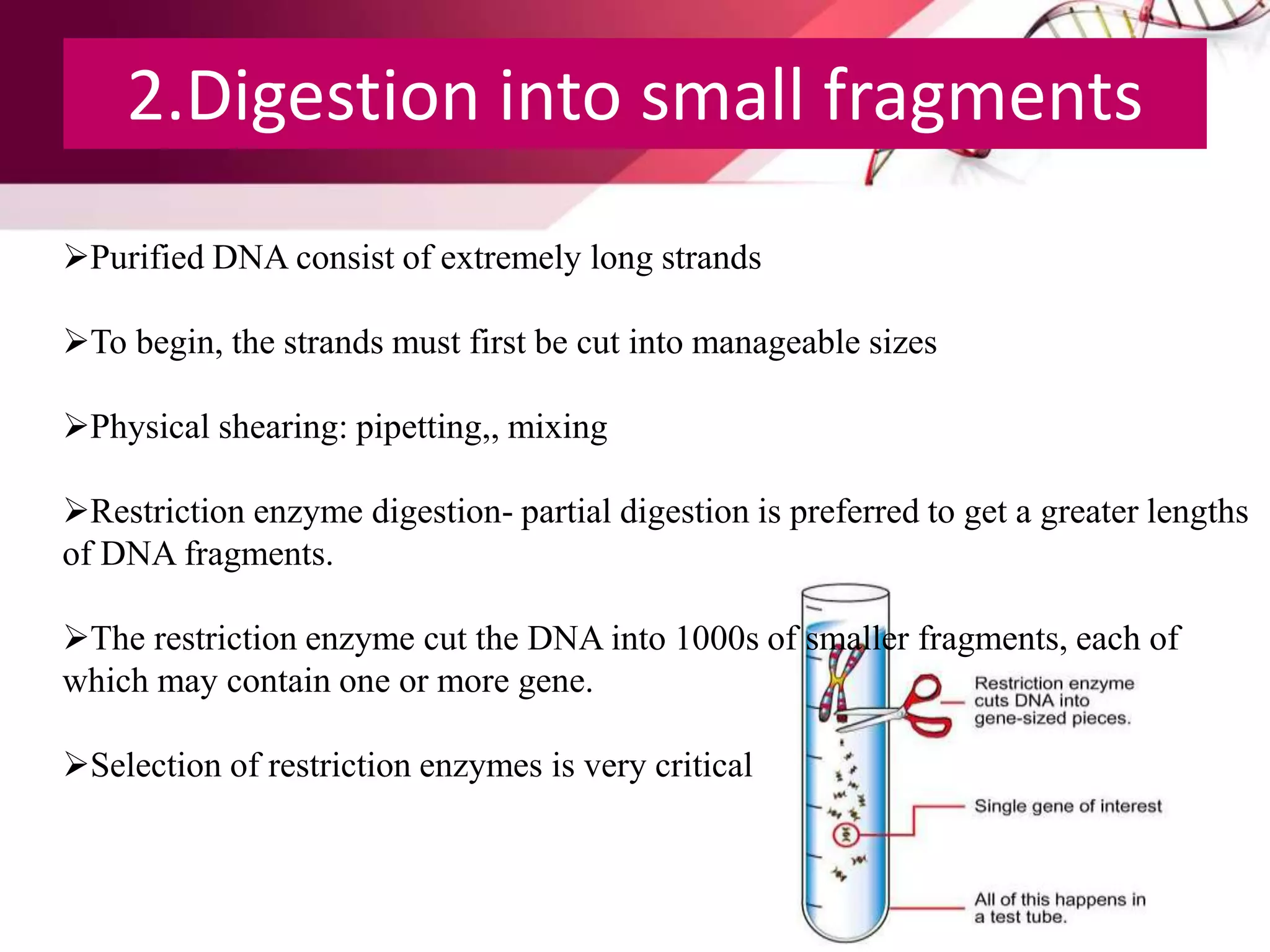
2.Digestion into small fragments
Purified DNA consist of extremely long strands
To begin, the strands must first be cut into manageable sizes
Physical shearing: pipetting,, mixing
Restriction enzyme digestion- partial digestion is preferred to get a greater lengths
of DNA fragments.
The restriction enzyme cut the DNA into 1000s of smaller fragments, each of
which may contain one or more gene.
Selection of restriction enzymes is very critical
3.Introduction into suitable vectors
Each fragment is different and
have a unique DNA sequence
inserted into suitable vectors
including plasmids and
bacteriophage vectors
Vectors are digested with the same
Restriction enzymes and sealed to
human DNA using DNA ligase
enzyme.
The resulting molecules are
recombinant.
4.Insertion into host
Inserted into host bacteria (E.coli)
Bacterial cells are made competent to take up the
DNA.
They replicate their genome along with the vector
genome contained with them.
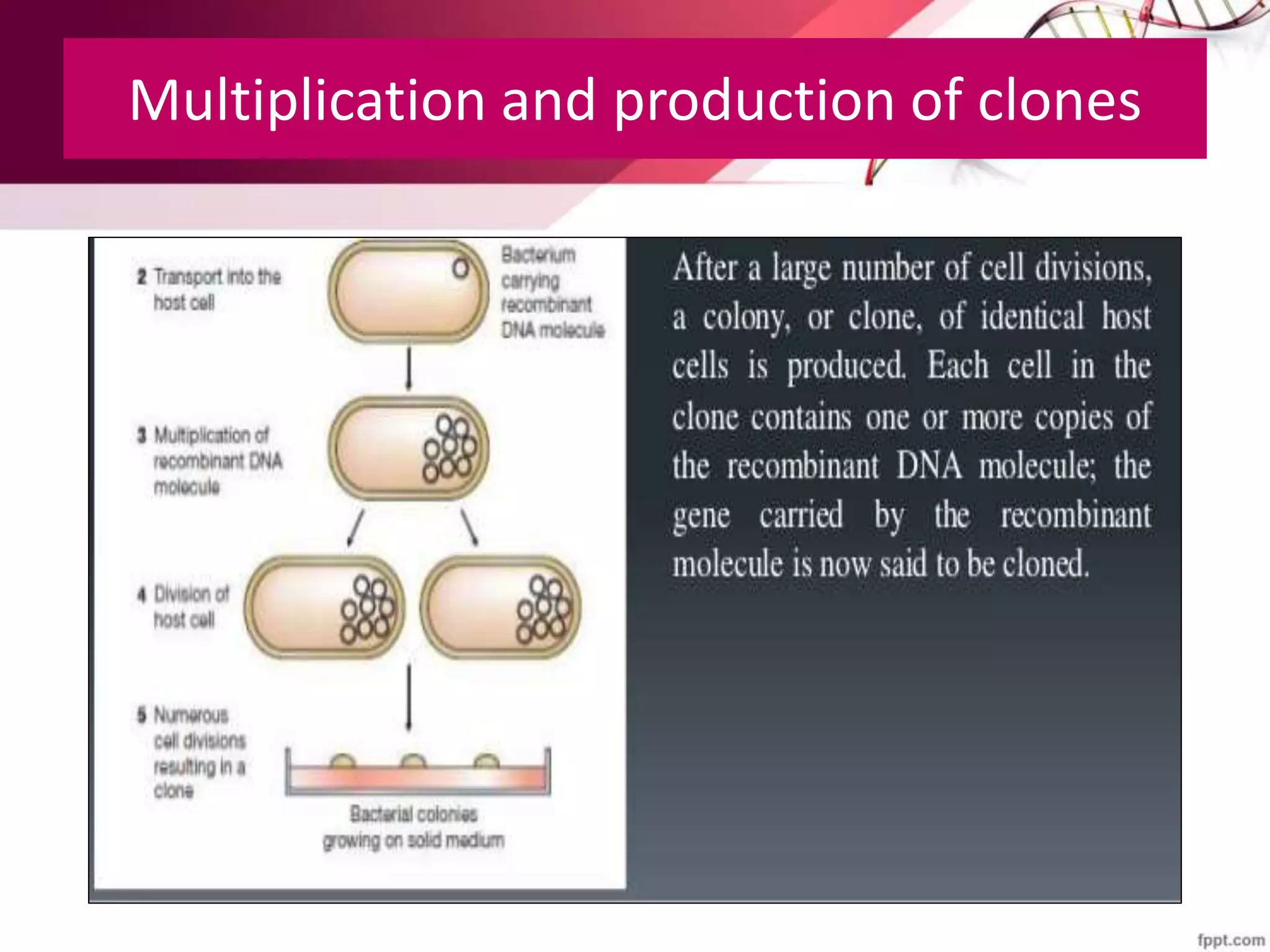
Produce clones of the original genome
This collection of clones which contains all the
sequences, including the sequence of interest forms
the genomic library.
Multiplication and production of clones
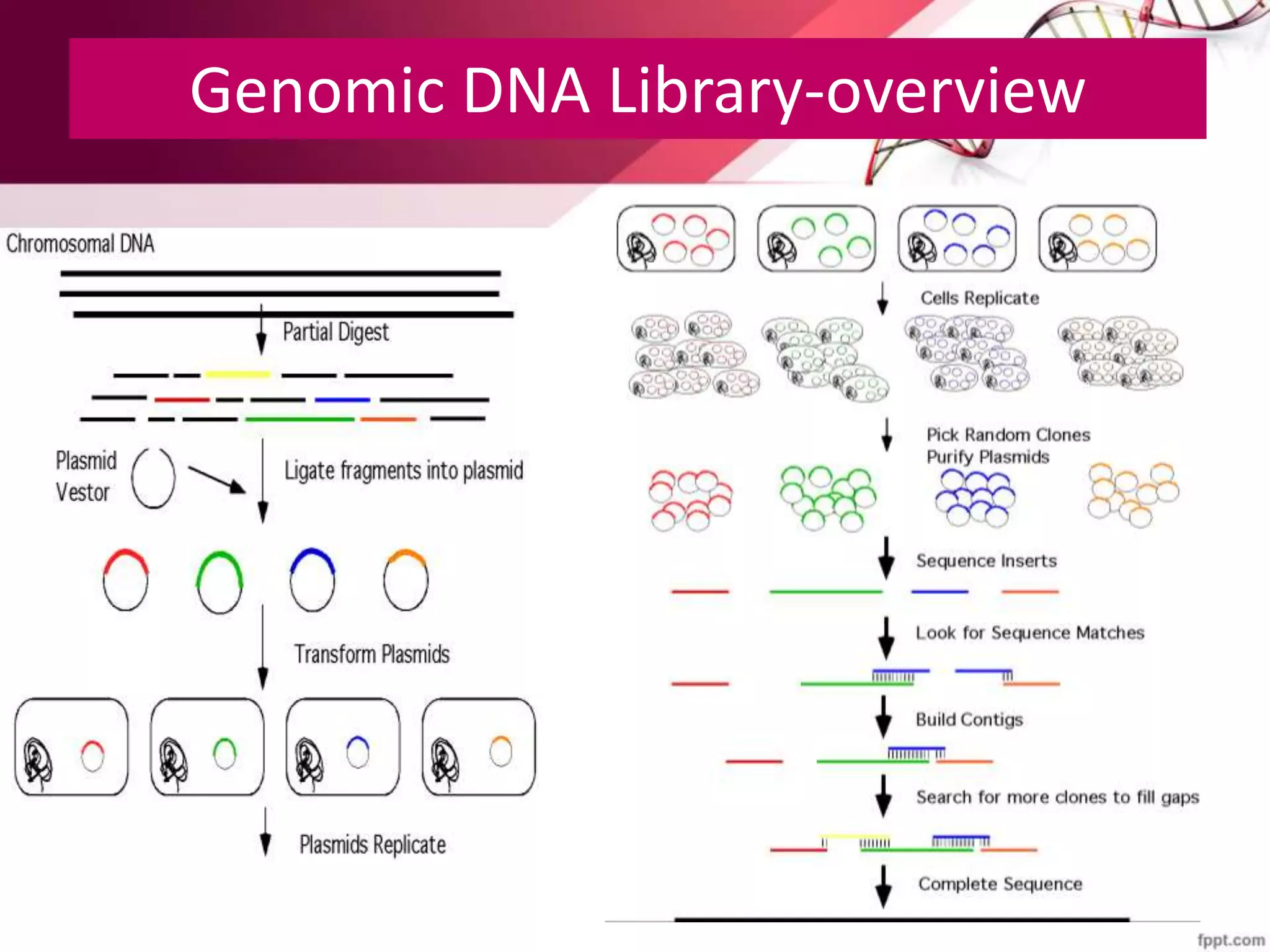
Genomic DNA Library-overview
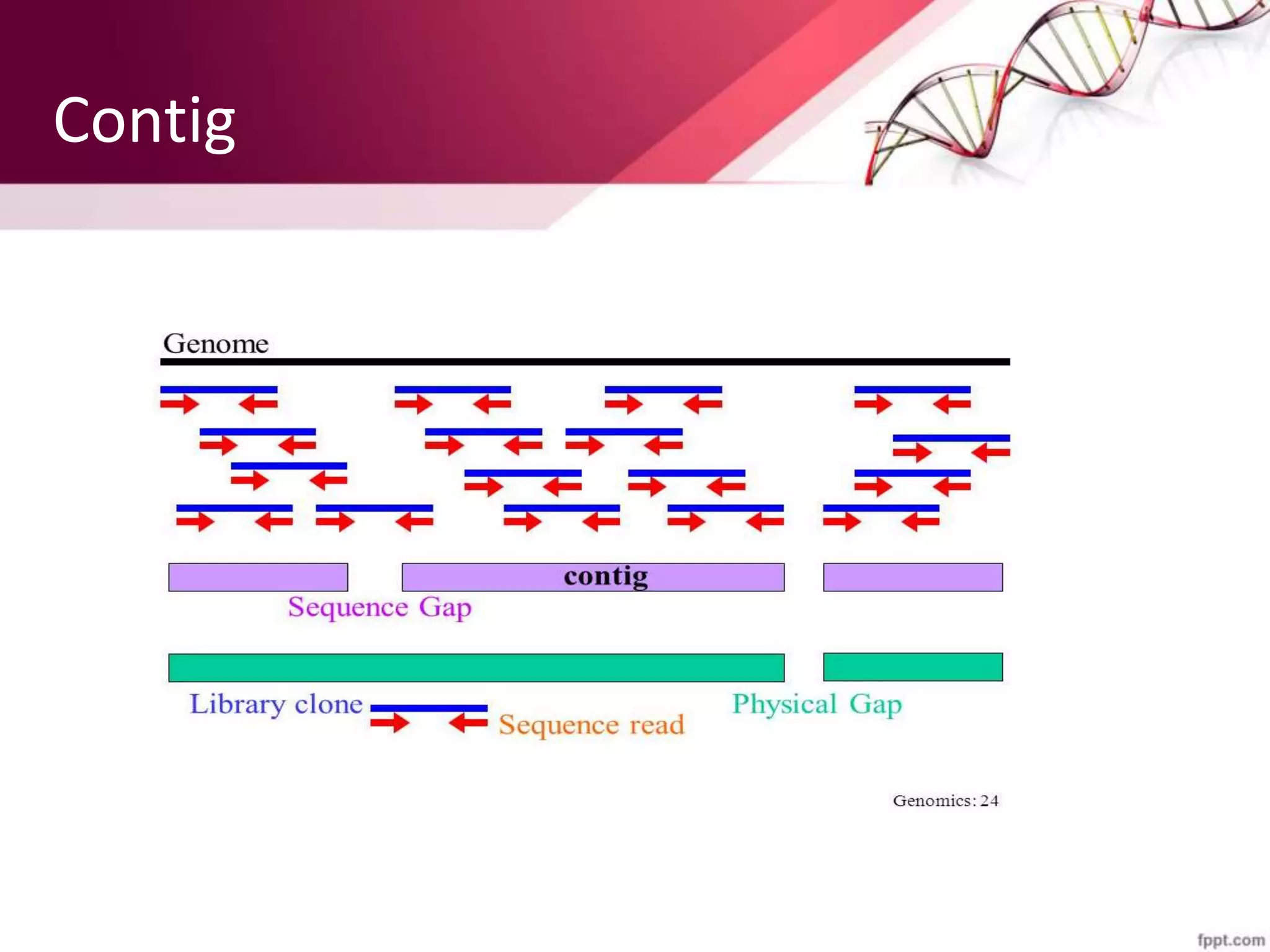
Contig
cDNA Library
 Libraries that represent the mrna in a particular cell or tissue are termed
cdna libraries.
DNA copies derived from the mrna molecules
This process is accomplished using enzyme reverse transcriptase, which is
isolated from RNA- containg retroviruses.
Cdna is synthesized in two steps from mrna molecule.
The resulting cdna molecules are then engineered so that they have RE sites
at each end of every molecule, which allows them to be digested and inserted
into a vector.
Steps to prepare cdna
Synthesis of cDNA from mRNA
Construction of cdna library
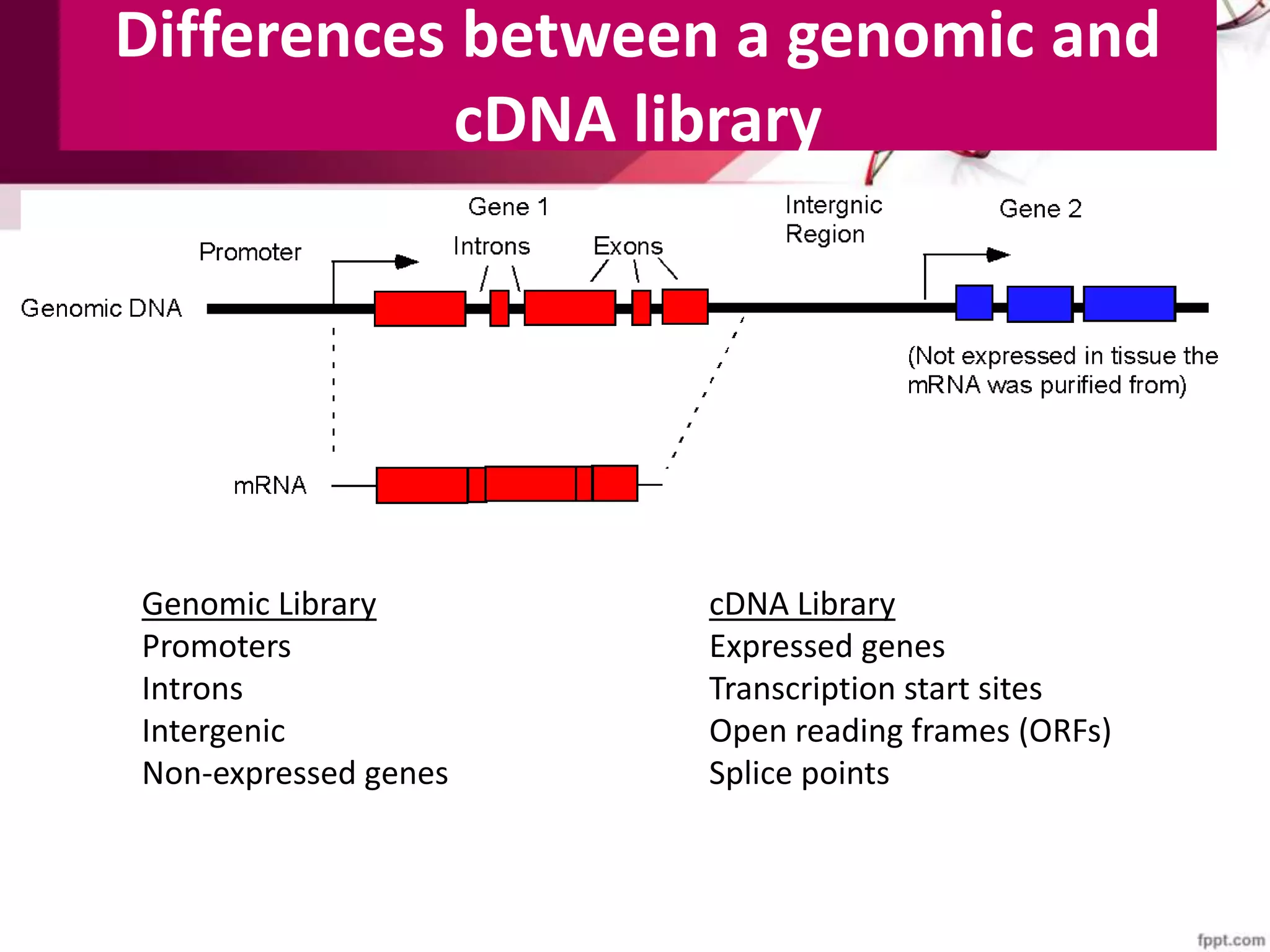
Differences between a genomic and
cDNA library
cDNA Library
Expressed genes
Transcription start sites
Open reading frames (ORFs)
Splice points
Genomic Library
Promoters
Introns
Intergenic
Non-expressed genes
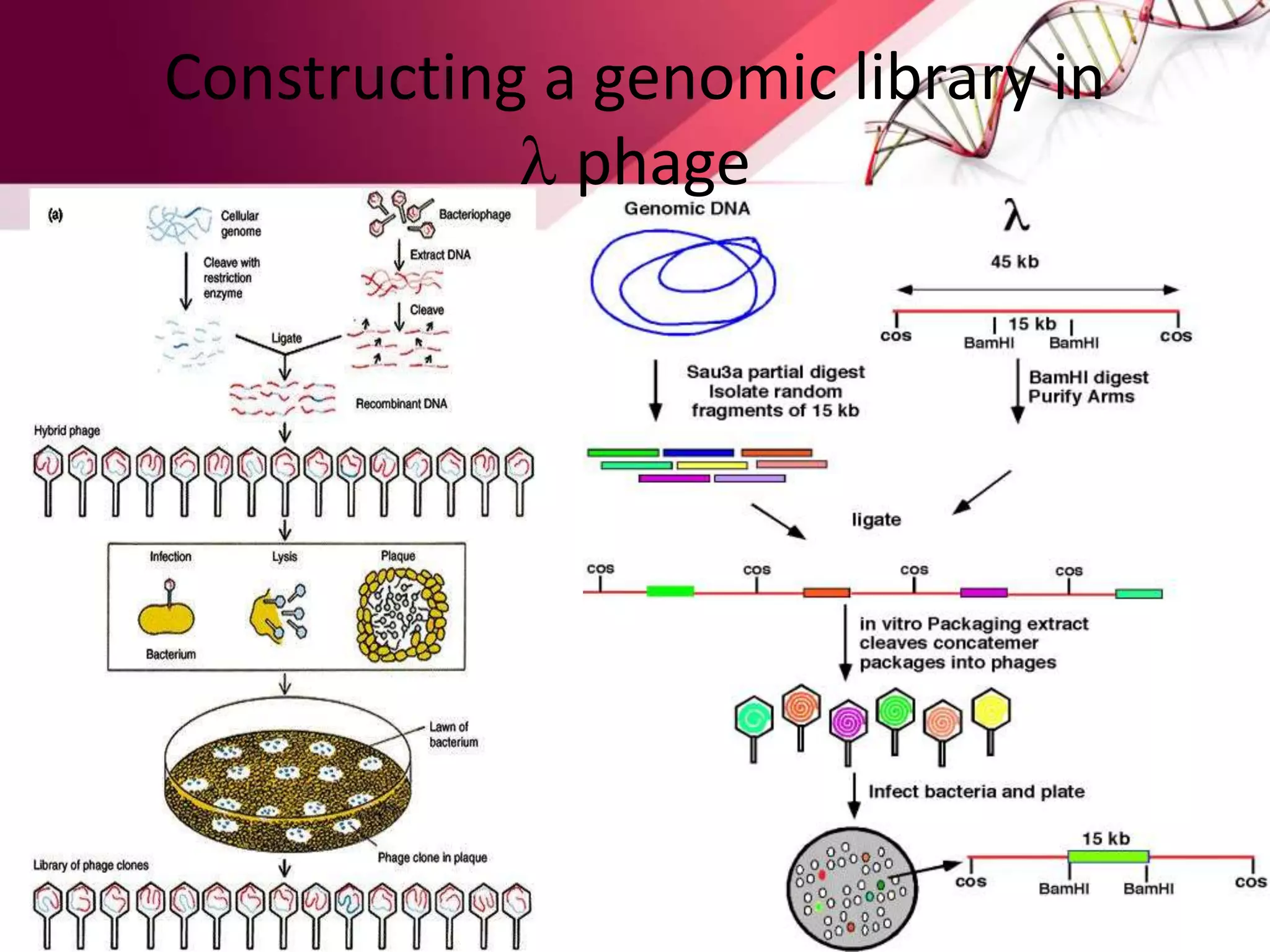
Constructing a genomic library in
phage
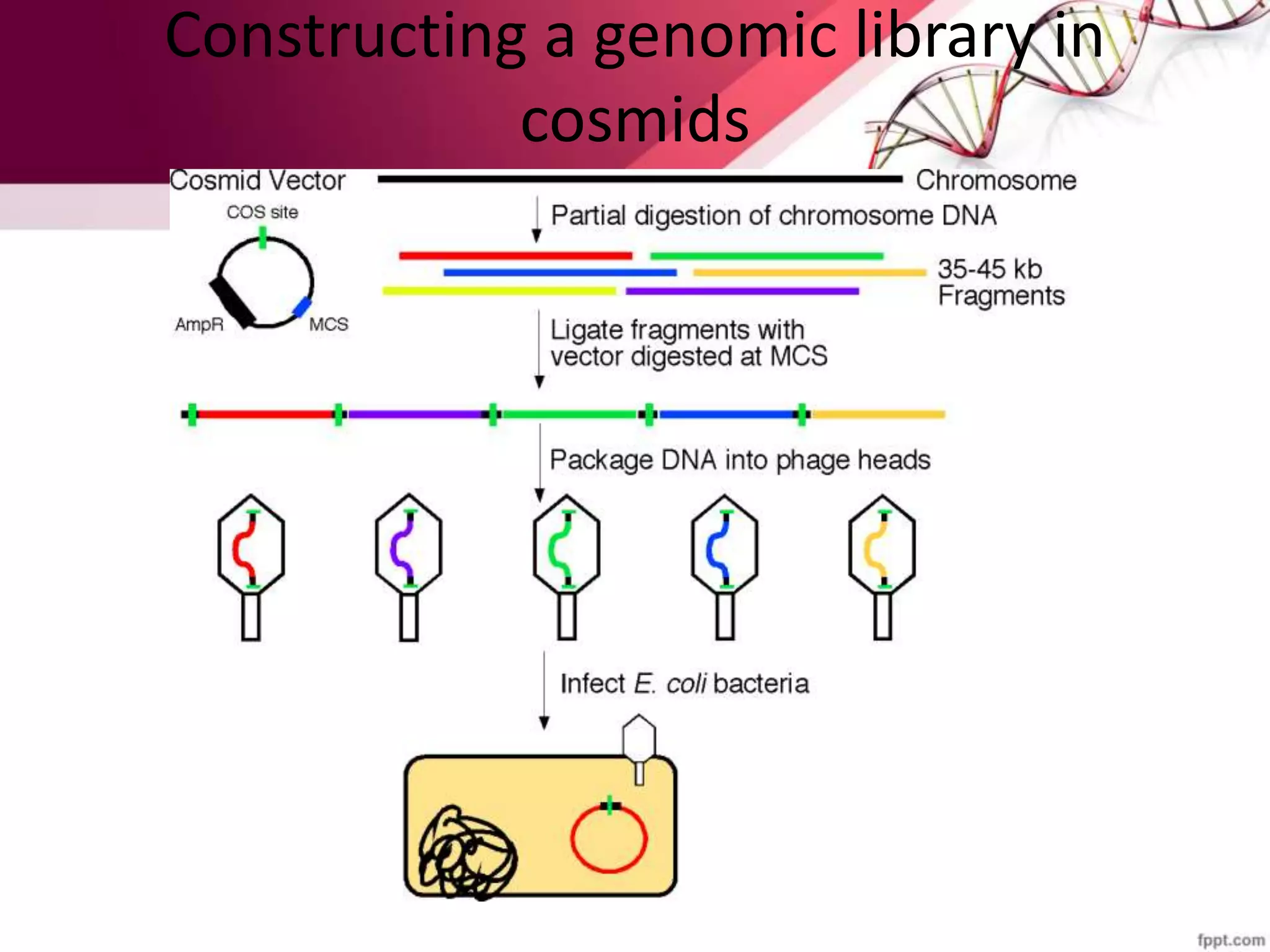
Constructing a genomic library in
cosmids
Constructing a genomic library in YACs
Screening a clones
Expression screening or Direct selection of recombinants
Insertional selection inactivation method
Blue white screening
Colony hybridization
PCR screening of gene libraries
Hybrid select/arrest translation
Screening expression cDNA libraries.
Expression screening
Colony hybridization
Hybrid arrest/release
Individual Cdna clones or pools of clones can be used to
hybridize to mrna preparation
Hybrid arrest: translate the Mrna population directly, and the
inhibition of translation of some products detected.
Hybrid release translation: purify the hybrids and the
hybridized mrnaa released from them and translated, it identifies
the protein encoded by the cdna clone.
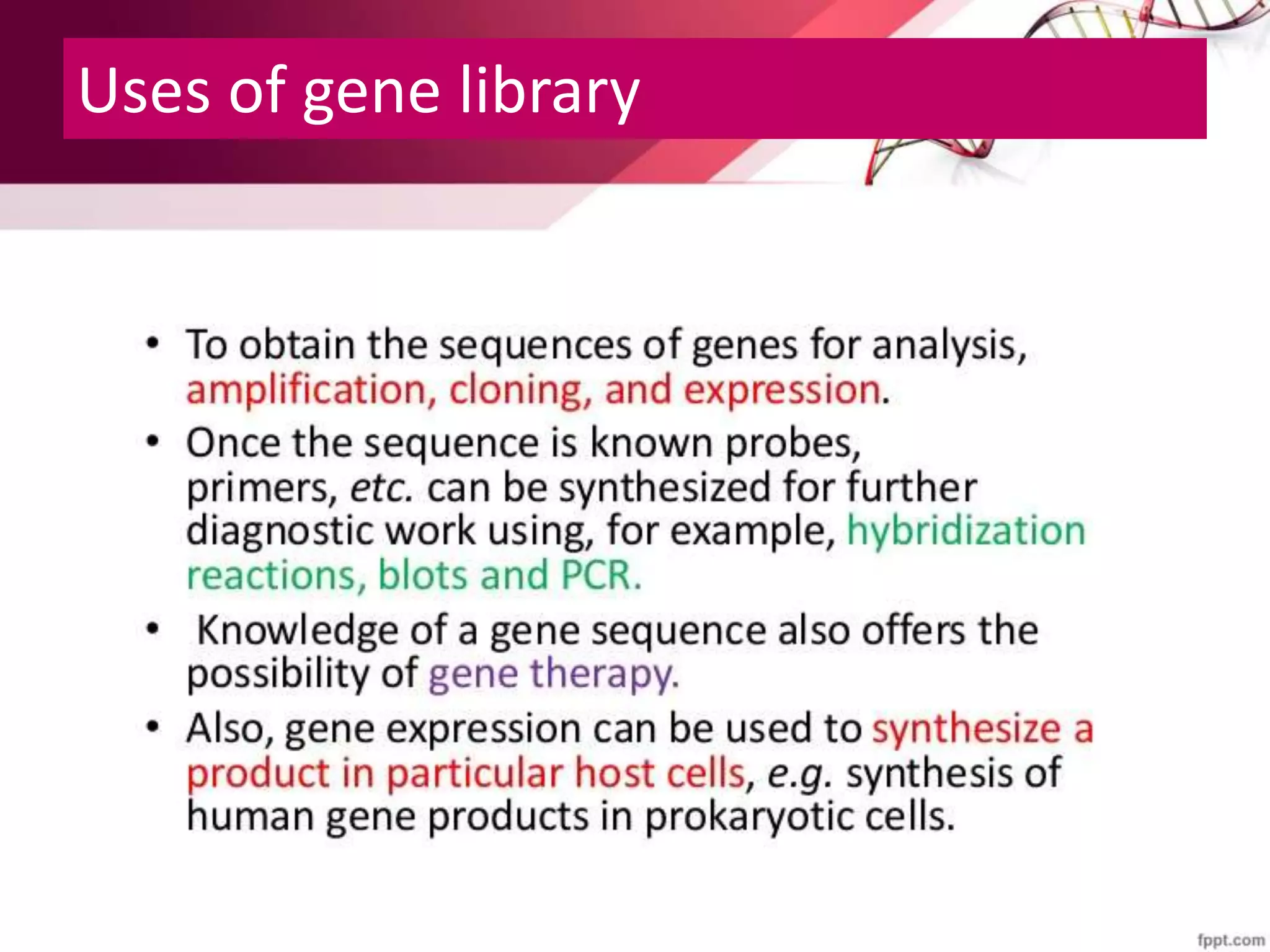
Uses of gene library
Genomic library construction

Genomic library construction

  • 1.
    Construction of DNALibrary Gurvinder kaur P hD
  • 2.
    What is DNAlibrary? • Collection of DNA fragments that have been cloned into vectors so that researchers can identify and isolate the DNA fragments that interest them for further study. • In molecular biology, a library is a collection of DNA fragments that is stored and propagated in a population of micro-organisms through the process of molecular cloning.
  • 3.
    What are librariesfor? • Storage/ store many copies of a gene • Host most commonly e.coli are use for storing whole genomic data in the form of bacterial colonies • Collection of all the clonned vectors • Eg genomic library in a petri dish.
  • 4.
    Why we requirelibraries? • In order to study a gene, a researcher needs to isolate it from all the other genes in an organism's DNA • To make the research easier • Once, we have a library, we can locate it by various screening methods and can use it for various research purposes • Genomic libraries are commonly used for sequencing applications. • Ease of purification, storage and analysis.
  • 5.
  • 6.
    Genomic Library  ContainsDNA fragments representing entire genome of an organism Created using molecular cloning vectors are engineered to carry the DNA fragments. vector genome containing the foreign insert is replicated, producing clones of the original genome This collection of clones, in theory contains all sequences found in the original source, including the sequence of interest Genomic libraries can be constructed using various hosts like plasmids, bacteriophage lambda and many more.
  • 7.
    Steps of genomiclibrary construction 1. Isolation of DNA from cells 2. Digestion into small fragments 3. Introduction into suitable vectors 4. Insertion into bacteria 5. Production/identification of clones 6. Collection of Genomic DNA library
  • 8.
  • 9.
    2.Digestion into smallfragments Purified DNA consist of extremely long strands To begin, the strands must first be cut into manageable sizes Physical shearing: pipetting,, mixing Restriction enzyme digestion- partial digestion is preferred to get a greater lengths of DNA fragments. The restriction enzyme cut the DNA into 1000s of smaller fragments, each of which may contain one or more gene. Selection of restriction enzymes is very critical
  • 10.
    3.Introduction into suitablevectors Each fragment is different and have a unique DNA sequence inserted into suitable vectors including plasmids and bacteriophage vectors Vectors are digested with the same Restriction enzymes and sealed to human DNA using DNA ligase enzyme. The resulting molecules are recombinant.
  • 11.
    4.Insertion into host Insertedinto host bacteria (E.coli) Bacterial cells are made competent to take up the DNA. They replicate their genome along with the vector genome contained with them. Produce clones of the original genome This collection of clones which contains all the sequences, including the sequence of interest forms the genomic library.
  • 12.
  • 13.
  • 14.
  • 15.
    cDNA Library  Librariesthat represent the mrna in a particular cell or tissue are termed cdna libraries. DNA copies derived from the mrna molecules This process is accomplished using enzyme reverse transcriptase, which is isolated from RNA- containg retroviruses. Cdna is synthesized in two steps from mrna molecule. The resulting cdna molecules are then engineered so that they have RE sites at each end of every molecule, which allows them to be digested and inserted into a vector.
  • 16.
  • 17.
  • 18.
  • 19.
    Differences between agenomic and cDNA library cDNA Library Expressed genes Transcription start sites Open reading frames (ORFs) Splice points Genomic Library Promoters Introns Intergenic Non-expressed genes
  • 21.
    Constructing a genomiclibrary in phage
  • 22.
    Constructing a genomiclibrary in cosmids
  • 23.
    Constructing a genomiclibrary in YACs
  • 24.
    Screening a clones Expressionscreening or Direct selection of recombinants Insertional selection inactivation method Blue white screening Colony hybridization PCR screening of gene libraries Hybrid select/arrest translation Screening expression cDNA libraries.
  • 25.
  • 26.
  • 27.
    Hybrid arrest/release Individual Cdnaclones or pools of clones can be used to hybridize to mrna preparation Hybrid arrest: translate the Mrna population directly, and the inhibition of translation of some products detected. Hybrid release translation: purify the hybrids and the hybridized mrnaa released from them and translated, it identifies the protein encoded by the cdna clone.
  • 28.
    Uses of genelibrary