PULMONARY FUNCTION TEST 
Prepared By: 
Sharmin Susiwala
DEFINITION: 
• Pulmonary Function Testing (PFT) is a complete 
evaluation of the respiratory system including patient 
history, physical examinations, chest x-ray 
examinations, arterial blood gas analysis, and tests of 
pulmonary function. 
• The primary purpose of pulmonary function testing is 
to identify the severity of pulmonary impairment. 
• Pulmonary function testing has diagnostic and 
therapeutic roles and helps clinicians answer some 
general questions about patients with lung disease.
INDICATIONS: 
• Pulmonary function testing is a diagnostic and management tool used for 
a variety of reasons. 
• Pediatric neuromuscular disorders 
• Neuromuscular disorders such as Duchenne muscular Dystrophy. 
• Musculoskeletal deformities such as kyphoscoliosis contribute to 
restrictive lung disease. 
• Pulmonary function testing in patients with neuromuscular disorders 
helps to evaluate the respiratory status of patients at the time of 
diagnosis, monitor their progress and course, evaluate them for possible 
surgery, and gives an overall idea of the prognosis. 
• Other indications 
• Chronic dyspnea 
• Asthma 
• Chronic obstructive pulmonary disease 
• Restrictive lung disease 
• Preoperative testing 
• Impairment or disability
MEASUREMENTS: 
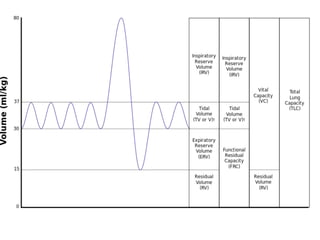
• There are four lung volumes and four lung capacities. 
• A lung capacity consists of two or more lung volumes. 
• The lung volumes are: 
1. Tidal volume (VT) 
2. Inspiratory reserve volume (IRV) 
3. Expiratory reserve volume (ERV) 
4. Residual volume (RV). 
• The four lung capacities are: 
1. Total lung capacity (TLC) 
2. Inspiratory capacity (IC) 
3. Functional residual capacity (FRC) 
4. Vital capacity (VC).
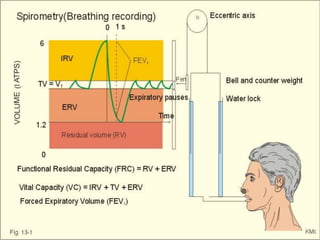
1. Tidal volume: It is the volume of air moved into or 
out of the lungs during quiet breathing. Value: 500 
ml 
2. Inspiratory reserve volume: It is the maximal 
volume that can be inhaled from the end-inspiratory 
level(after the inspiration of a normal 
tidal volume). Value: 3100 ml 
3. Expiratory reserve volume: It is the maximal 
volume of air that can be exhaled from the end-expiratory 
position(after the expiration of a normal 
tidal volume). Value: 1200 ml 
4. Residual volume: It is the volume of air remaining 
in the lungs after a maximal exhalation. Value: 
1200 ml
1. Total lung capacity: It is the volume in the lungs at 
maximal inflation or maximum amount of air that 
can fill the lungs. Value: 6000 ml (TLC = TV + IRV + 
ERV + RV). 
2. Vital capacity: It is the total amount of air that can 
be expired after fully inhaling. Value: 4800 ml (VC 
= TV + IRV + ERV = approximately 80 percent TLC). 
The value varies according to age and body size. 
3. Inspiratory capacity: It is the maximum amount of 
air that can be inspired. Value: 3600 ml (IC = TV + 
IRV). 
4. Functional residual capacity: It is the amount of 
air remaining in the lungs after a normal 
expiration. Value: 2400 ml (FRC = RV + ERV)
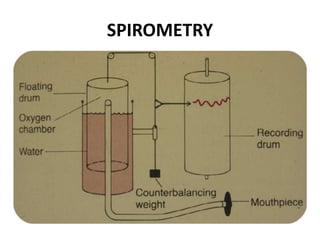
SPIROMETRY
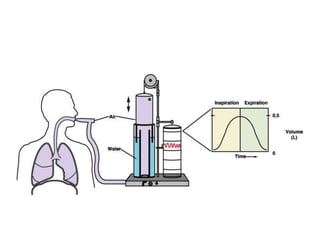
• Spirometry (meaning the measuring of breath) is the most 
common of the pulmonary function tests (PFTs), 
measuring lung function, specifically the amount (volume) 
and/or speed (flow) of air that can be inhaled and exhaled. 
• Indications: 
• Spirometry is indicated for the following reasons: 
 to diagnose or manage asthma 
 to detect respiratory disease in patients presenting with symptoms of 
breathlessness, and to distinguish respiratory from cardiac disease as the 
cause 
 to measure bronchial responsiveness in patients suspected of having 
asthma 
 to diagnose and differentiate between obstructive lung 
disease and restrictive lung disease 
 to follow the natural history of disease in respiratory conditions 
 to assess of impairment from occupational asthma 
 to identify those at risk from pulmonary barotrauma while scuba diving 
 to conduct pre-operative risk assessment before anaesthesia 
or cardiothoracic surgery 
 to measure response to treatment of conditions which spirometry detects
• Spirometer 
• The spirometry test is performed 
using a device called a spirometer, 
which comes in several different 
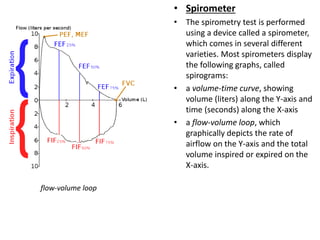
varieties. Most spirometers display 
the following graphs, called 
spirograms: 
• a volume-time curve, showing 
volume (liters) along the Y-axis and 
time (seconds) along the X-axis 
• a flow-volume loop, which 
graphically depicts the rate of 
airflow on the Y-axis and the total 
volume inspired or expired on the 
X-axis. 
flow-volume loop
• Parameters 
• The most common parameters measured in spirometry 
are 
1. Vital capacity (VC), 
2. Forced vital capacity (FVC), 
3. Forced expiratory volume (FEV) at timed intervals of 
0.5, 1.0 (FEV1), 2.0, and 3.0 seconds, 
4. Forced expiratory flow 25–75% (FEF 25–75) and 
5. Maximal voluntary ventilation (MVV),[5] also known as 
Maximum breathing capacity. 
* Functional residual capacity (FRC) cannot be measured 
via spirometry, but it can be measured with 
a plethysmograph or dilution tests (for example, helium 
dilution test)
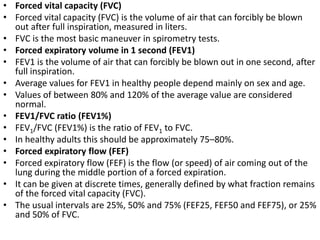
• Forced vital capacity (FVC) 
• Forced vital capacity (FVC) is the volume of air that can forcibly be blown 
out after full inspiration, measured in liters. 
• FVC is the most basic maneuver in spirometry tests. 
• Forced expiratory volume in 1 second (FEV1) 
• FEV1 is the volume of air that can forcibly be blown out in one second, after 
full inspiration. 
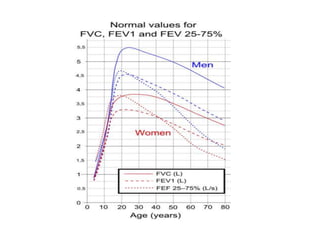
• Average values for FEV1 in healthy people depend mainly on sex and age. 
• Values of between 80% and 120% of the average value are considered 
normal. 
• FEV1/FVC ratio (FEV1%) 
• FEV1/FVC (FEV1%) is the ratio of FEV1 to FVC. 
• In healthy adults this should be approximately 75–80%. 
• Forced expiratory flow (FEF) 
• Forced expiratory flow (FEF) is the flow (or speed) of air coming out of the 
lung during the middle portion of a forced expiration. 
• It can be given at discrete times, generally defined by what fraction remains 
of the forced vital capacity (FVC). 
• The usual intervals are 25%, 50% and 75% (FEF25, FEF50 and FEF75), or 25% 
and 50% of FVC.
• Forced inspiratory flow 25–75% or 25–50% 
• Forced inspiratory flow 25–75% or 25–50% (FIF 25–75% or 25–50%) is similar to FEF 
25–75% or 25–50% except the measurement is taken during inspiration. 
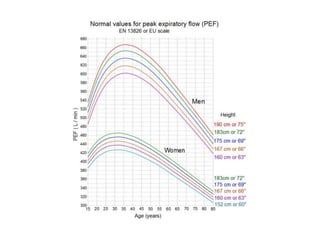
• Peak expiratory flow (PEF) 
• Peak expiratory flow (PEF) is the maximal flow (or speed) achieved during the 
maximally forced expiration initiated at full inspiration, measured in liters per 
minute. 
• Maximum voluntary ventilation (MVV) 
• Maximum voluntary ventilation (MVV) is a measure of the maximum amount of air 
that can be inhaled and exhaled within one minute. 
• For the comfort of the patient this is done over a 15 second time period before 
being extrapolated to a value for one minute expressed as liters/minute. 
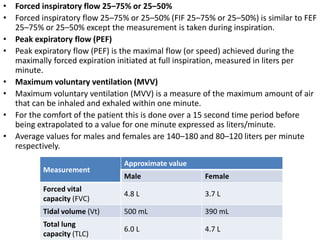
• Average values for males and females are 140–180 and 80–120 liters per minute 
respectively. 
Measurement 
Approximate value 
Male Female 
Forced vital 
capacity (FVC) 
4.8 L 3.7 L 
Tidal volume (Vt) 500 mL 390 mL 
Total lung 
6.0 L 4.7 L 
capacity (TLC)
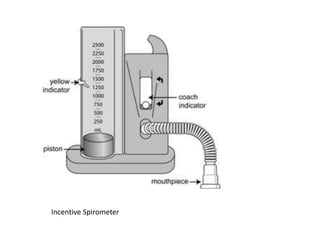
Incentive Spirometer
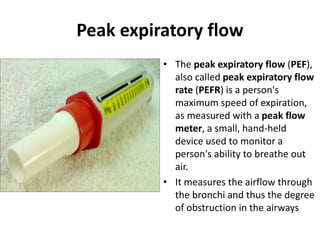
Peak expiratory flow 
• The peak expiratory flow (PEF), 
also called peak expiratory flow 
rate (PEFR) is a person's 
maximum speed of expiration, 
as measured with a peak flow 
meter, a small, hand-held 
device used to monitor a 
person's ability to breathe out 
air. 
• It measures the airflow through 
the bronchi and thus the degree 
of obstruction in the airways
• Measurement 
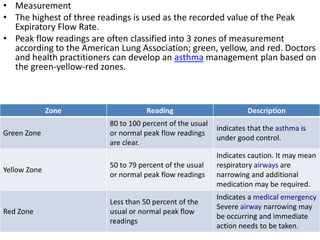
• The highest of three readings is used as the recorded value of the Peak 
Expiratory Flow Rate. 
• Peak flow readings are often classified into 3 zones of measurement 
according to the American Lung Association; green, yellow, and red. Doctors 
and health practitioners can develop an asthma management plan based on 
the green-yellow-red zones. 
Zone Reading Description 
Green Zone 
80 to 100 percent of the usual 
or normal peak flow readings 
are clear. 
indicates that the asthma is 
under good control. 
Yellow Zone 
50 to 79 percent of the usual 
or normal peak flow readings 
Indicates caution. It may mean 
respiratory airways are 
narrowing and additional 
medication may be required. 
Red Zone 
Less than 50 percent of the 
usual or normal peak flow 
readings 
Indicates a medical emergency 
Severe airway narrowing may 
be occurring and immediate 
action needs to be taken.
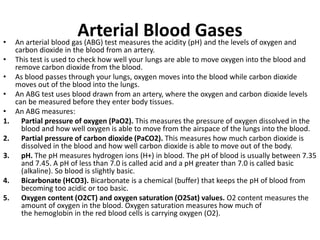
Arterial Blood Gases 
• An arterial blood gas (ABG) test measures the acidity (pH) and the levels of oxygen and 
carbon dioxide in the blood from an artery. 
• This test is used to check how well your lungs are able to move oxygen into the blood and 
remove carbon dioxide from the blood. 
• As blood passes through your lungs, oxygen moves into the blood while carbon dioxide 
moves out of the blood into the lungs. 
• An ABG test uses blood drawn from an artery, where the oxygen and carbon dioxide levels 
can be measured before they enter body tissues. 
• An ABG measures: 
1. Partial pressure of oxygen (PaO2). This measures the pressure of oxygen dissolved in the 
blood and how well oxygen is able to move from the airspace of the lungs into the blood. 
2. Partial pressure of carbon dioxide (PaCO2). This measures how much carbon dioxide is 
dissolved in the blood and how well carbon dioxide is able to move out of the body. 
3. pH. The pH measures hydrogen ions (H+) in blood. The pH of blood is usually between 7.35 
and 7.45. A pH of less than 7.0 is called acid and a pH greater than 7.0 is called basic 
(alkaline). So blood is slightly basic. 
4. Bicarbonate (HCO3). Bicarbonate is a chemical (buffer) that keeps the pH of blood from 
becoming too acidic or too basic. 
5. Oxygen content (O2CT) and oxygen saturation (O2Sat) values. O2 content measures the 
amount of oxygen in the blood. Oxygen saturation measures how much of 
the hemoglobin in the red blood cells is carrying oxygen (O2).
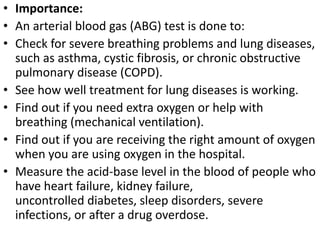
• Importance: 
• An arterial blood gas (ABG) test is done to: 
• Check for severe breathing problems and lung diseases, 
such as asthma, cystic fibrosis, or chronic obstructive 
pulmonary disease (COPD). 
• See how well treatment for lung diseases is working. 
• Find out if you need extra oxygen or help with 
breathing (mechanical ventilation). 
• Find out if you are receiving the right amount of oxygen 
when you are using oxygen in the hospital. 
• Measure the acid-base level in the blood of people who 
have heart failure, kidney failure, 
uncontrolled diabetes, sleep disorders, severe 
infections, or after a drug overdose.
• Measurements 
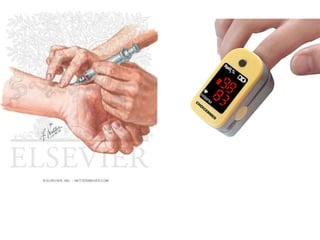
• A sample of blood from an artery is usually taken from the inside of the 
wrist (radial artery), but it can also be taken from an artery in the groin 
(femoral artery) or on the inside of the arm above the elbow crease 
(brachial artery). 
• Pulse oximetry plus transcutaneous carbon dioxide measurement is an 
alternative method of obtaining measurement. 
• Results 
• An arterial blood gas (ABG) test measures the acidity (pH) and levels of 
oxygen and carbon dioxide in the blood. 
• Normal 
Partial pressure of oxygen 
(PaO2): 
Greater than 80 mm 
Hg (greater than 10.6 kPa) 
Partial pressure of carbon 
dioxide (PaCO2): 
35-45 mm Hg (4.6-5.9 kPa) 
pH: 7.35-7.45 
Bicarbonate (HCO3): 23-30 mEq/L (23-30 mmol/L) 
Oxygen content (O2CT): 
15-22 mL per 100 mL of 
blood (6.6-9.7 mmol/L) 
Oxygen saturation (O2Sat): 95%-100% (0.95-1.00)
Pulmonary Function Testing-Simplified description...!

Pulmonary Function Testing-Simplified description...!

  • 1.
    PULMONARY FUNCTION TEST Prepared By: Sharmin Susiwala
  • 2.
    DEFINITION: • PulmonaryFunction Testing (PFT) is a complete evaluation of the respiratory system including patient history, physical examinations, chest x-ray examinations, arterial blood gas analysis, and tests of pulmonary function. • The primary purpose of pulmonary function testing is to identify the severity of pulmonary impairment. • Pulmonary function testing has diagnostic and therapeutic roles and helps clinicians answer some general questions about patients with lung disease.
  • 3.
    INDICATIONS: • Pulmonaryfunction testing is a diagnostic and management tool used for a variety of reasons. • Pediatric neuromuscular disorders • Neuromuscular disorders such as Duchenne muscular Dystrophy. • Musculoskeletal deformities such as kyphoscoliosis contribute to restrictive lung disease. • Pulmonary function testing in patients with neuromuscular disorders helps to evaluate the respiratory status of patients at the time of diagnosis, monitor their progress and course, evaluate them for possible surgery, and gives an overall idea of the prognosis. • Other indications • Chronic dyspnea • Asthma • Chronic obstructive pulmonary disease • Restrictive lung disease • Preoperative testing • Impairment or disability
  • 4.
    MEASUREMENTS: • Thereare four lung volumes and four lung capacities. • A lung capacity consists of two or more lung volumes. • The lung volumes are: 1. Tidal volume (VT) 2. Inspiratory reserve volume (IRV) 3. Expiratory reserve volume (ERV) 4. Residual volume (RV). • The four lung capacities are: 1. Total lung capacity (TLC) 2. Inspiratory capacity (IC) 3. Functional residual capacity (FRC) 4. Vital capacity (VC).
  • 6.
    1. Tidal volume:It is the volume of air moved into or out of the lungs during quiet breathing. Value: 500 ml 2. Inspiratory reserve volume: It is the maximal volume that can be inhaled from the end-inspiratory level(after the inspiration of a normal tidal volume). Value: 3100 ml 3. Expiratory reserve volume: It is the maximal volume of air that can be exhaled from the end-expiratory position(after the expiration of a normal tidal volume). Value: 1200 ml 4. Residual volume: It is the volume of air remaining in the lungs after a maximal exhalation. Value: 1200 ml
  • 7.
    1. Total lungcapacity: It is the volume in the lungs at maximal inflation or maximum amount of air that can fill the lungs. Value: 6000 ml (TLC = TV + IRV + ERV + RV). 2. Vital capacity: It is the total amount of air that can be expired after fully inhaling. Value: 4800 ml (VC = TV + IRV + ERV = approximately 80 percent TLC). The value varies according to age and body size. 3. Inspiratory capacity: It is the maximum amount of air that can be inspired. Value: 3600 ml (IC = TV + IRV). 4. Functional residual capacity: It is the amount of air remaining in the lungs after a normal expiration. Value: 2400 ml (FRC = RV + ERV)
  • 8.
  • 11.
    • Spirometry (meaningthe measuring of breath) is the most common of the pulmonary function tests (PFTs), measuring lung function, specifically the amount (volume) and/or speed (flow) of air that can be inhaled and exhaled. • Indications: • Spirometry is indicated for the following reasons:  to diagnose or manage asthma  to detect respiratory disease in patients presenting with symptoms of breathlessness, and to distinguish respiratory from cardiac disease as the cause  to measure bronchial responsiveness in patients suspected of having asthma  to diagnose and differentiate between obstructive lung disease and restrictive lung disease  to follow the natural history of disease in respiratory conditions  to assess of impairment from occupational asthma  to identify those at risk from pulmonary barotrauma while scuba diving  to conduct pre-operative risk assessment before anaesthesia or cardiothoracic surgery  to measure response to treatment of conditions which spirometry detects
  • 12.
    • Spirometer •The spirometry test is performed using a device called a spirometer, which comes in several different varieties. Most spirometers display the following graphs, called spirograms: • a volume-time curve, showing volume (liters) along the Y-axis and time (seconds) along the X-axis • a flow-volume loop, which graphically depicts the rate of airflow on the Y-axis and the total volume inspired or expired on the X-axis. flow-volume loop
  • 13.
    • Parameters •The most common parameters measured in spirometry are 1. Vital capacity (VC), 2. Forced vital capacity (FVC), 3. Forced expiratory volume (FEV) at timed intervals of 0.5, 1.0 (FEV1), 2.0, and 3.0 seconds, 4. Forced expiratory flow 25–75% (FEF 25–75) and 5. Maximal voluntary ventilation (MVV),[5] also known as Maximum breathing capacity. * Functional residual capacity (FRC) cannot be measured via spirometry, but it can be measured with a plethysmograph or dilution tests (for example, helium dilution test)
  • 14.
    • Forced vitalcapacity (FVC) • Forced vital capacity (FVC) is the volume of air that can forcibly be blown out after full inspiration, measured in liters. • FVC is the most basic maneuver in spirometry tests. • Forced expiratory volume in 1 second (FEV1) • FEV1 is the volume of air that can forcibly be blown out in one second, after full inspiration. • Average values for FEV1 in healthy people depend mainly on sex and age. • Values of between 80% and 120% of the average value are considered normal. • FEV1/FVC ratio (FEV1%) • FEV1/FVC (FEV1%) is the ratio of FEV1 to FVC. • In healthy adults this should be approximately 75–80%. • Forced expiratory flow (FEF) • Forced expiratory flow (FEF) is the flow (or speed) of air coming out of the lung during the middle portion of a forced expiration. • It can be given at discrete times, generally defined by what fraction remains of the forced vital capacity (FVC). • The usual intervals are 25%, 50% and 75% (FEF25, FEF50 and FEF75), or 25% and 50% of FVC.
  • 16.
    • Forced inspiratoryflow 25–75% or 25–50% • Forced inspiratory flow 25–75% or 25–50% (FIF 25–75% or 25–50%) is similar to FEF 25–75% or 25–50% except the measurement is taken during inspiration. • Peak expiratory flow (PEF) • Peak expiratory flow (PEF) is the maximal flow (or speed) achieved during the maximally forced expiration initiated at full inspiration, measured in liters per minute. • Maximum voluntary ventilation (MVV) • Maximum voluntary ventilation (MVV) is a measure of the maximum amount of air that can be inhaled and exhaled within one minute. • For the comfort of the patient this is done over a 15 second time period before being extrapolated to a value for one minute expressed as liters/minute. • Average values for males and females are 140–180 and 80–120 liters per minute respectively. Measurement Approximate value Male Female Forced vital capacity (FVC) 4.8 L 3.7 L Tidal volume (Vt) 500 mL 390 mL Total lung 6.0 L 4.7 L capacity (TLC)
  • 17.
  • 18.
    Peak expiratory flow • The peak expiratory flow (PEF), also called peak expiratory flow rate (PEFR) is a person's maximum speed of expiration, as measured with a peak flow meter, a small, hand-held device used to monitor a person's ability to breathe out air. • It measures the airflow through the bronchi and thus the degree of obstruction in the airways
  • 19.
    • Measurement •The highest of three readings is used as the recorded value of the Peak Expiratory Flow Rate. • Peak flow readings are often classified into 3 zones of measurement according to the American Lung Association; green, yellow, and red. Doctors and health practitioners can develop an asthma management plan based on the green-yellow-red zones. Zone Reading Description Green Zone 80 to 100 percent of the usual or normal peak flow readings are clear. indicates that the asthma is under good control. Yellow Zone 50 to 79 percent of the usual or normal peak flow readings Indicates caution. It may mean respiratory airways are narrowing and additional medication may be required. Red Zone Less than 50 percent of the usual or normal peak flow readings Indicates a medical emergency Severe airway narrowing may be occurring and immediate action needs to be taken.
  • 21.
    Arterial Blood Gases • An arterial blood gas (ABG) test measures the acidity (pH) and the levels of oxygen and carbon dioxide in the blood from an artery. • This test is used to check how well your lungs are able to move oxygen into the blood and remove carbon dioxide from the blood. • As blood passes through your lungs, oxygen moves into the blood while carbon dioxide moves out of the blood into the lungs. • An ABG test uses blood drawn from an artery, where the oxygen and carbon dioxide levels can be measured before they enter body tissues. • An ABG measures: 1. Partial pressure of oxygen (PaO2). This measures the pressure of oxygen dissolved in the blood and how well oxygen is able to move from the airspace of the lungs into the blood. 2. Partial pressure of carbon dioxide (PaCO2). This measures how much carbon dioxide is dissolved in the blood and how well carbon dioxide is able to move out of the body. 3. pH. The pH measures hydrogen ions (H+) in blood. The pH of blood is usually between 7.35 and 7.45. A pH of less than 7.0 is called acid and a pH greater than 7.0 is called basic (alkaline). So blood is slightly basic. 4. Bicarbonate (HCO3). Bicarbonate is a chemical (buffer) that keeps the pH of blood from becoming too acidic or too basic. 5. Oxygen content (O2CT) and oxygen saturation (O2Sat) values. O2 content measures the amount of oxygen in the blood. Oxygen saturation measures how much of the hemoglobin in the red blood cells is carrying oxygen (O2).
  • 22.
    • Importance: •An arterial blood gas (ABG) test is done to: • Check for severe breathing problems and lung diseases, such as asthma, cystic fibrosis, or chronic obstructive pulmonary disease (COPD). • See how well treatment for lung diseases is working. • Find out if you need extra oxygen or help with breathing (mechanical ventilation). • Find out if you are receiving the right amount of oxygen when you are using oxygen in the hospital. • Measure the acid-base level in the blood of people who have heart failure, kidney failure, uncontrolled diabetes, sleep disorders, severe infections, or after a drug overdose.
  • 23.
    • Measurements •A sample of blood from an artery is usually taken from the inside of the wrist (radial artery), but it can also be taken from an artery in the groin (femoral artery) or on the inside of the arm above the elbow crease (brachial artery). • Pulse oximetry plus transcutaneous carbon dioxide measurement is an alternative method of obtaining measurement. • Results • An arterial blood gas (ABG) test measures the acidity (pH) and levels of oxygen and carbon dioxide in the blood. • Normal Partial pressure of oxygen (PaO2): Greater than 80 mm Hg (greater than 10.6 kPa) Partial pressure of carbon dioxide (PaCO2): 35-45 mm Hg (4.6-5.9 kPa) pH: 7.35-7.45 Bicarbonate (HCO3): 23-30 mEq/L (23-30 mmol/L) Oxygen content (O2CT): 15-22 mL per 100 mL of blood (6.6-9.7 mmol/L) Oxygen saturation (O2Sat): 95%-100% (0.95-1.00)